Region:Global
Author(s):Rebecca
Product Code:KRAA2153
Pages:96
Published On:August 2025
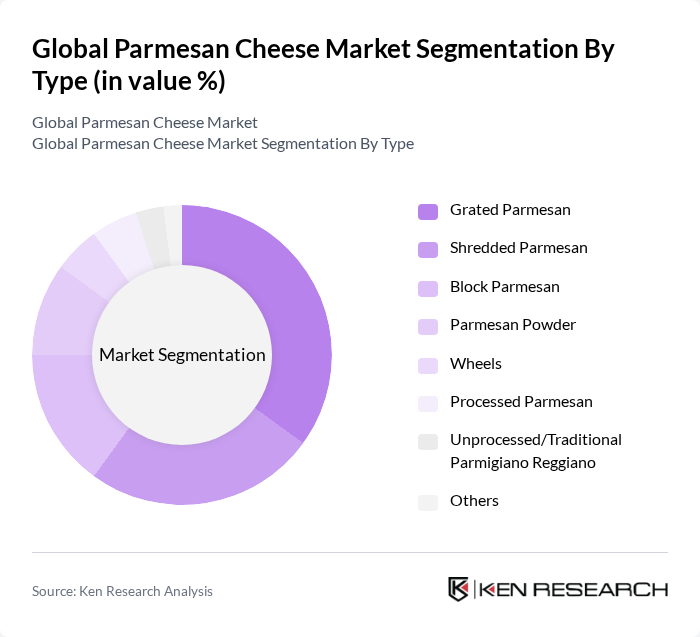
By Type:The Parmesan cheese market is segmented into various types, including Grated Parmesan, Shredded Parmesan, Block Parmesan, Parmesan Powder, Wheels, Processed Parmesan, Unprocessed/Traditional Parmigiano Reggiano, and Others. Among these, Grated Parmesan is the most popular due to its convenience and versatility in cooking. Consumers increasingly prefer ready-to-use products, which has led to a significant rise in the demand for grated forms. Shredded and Block Parmesan also hold substantial market shares, catering to both home cooks and professional chefs. The emergence of vegan and plant-based Parmesan alternatives is an additional trend, particularly in North America and Europe .
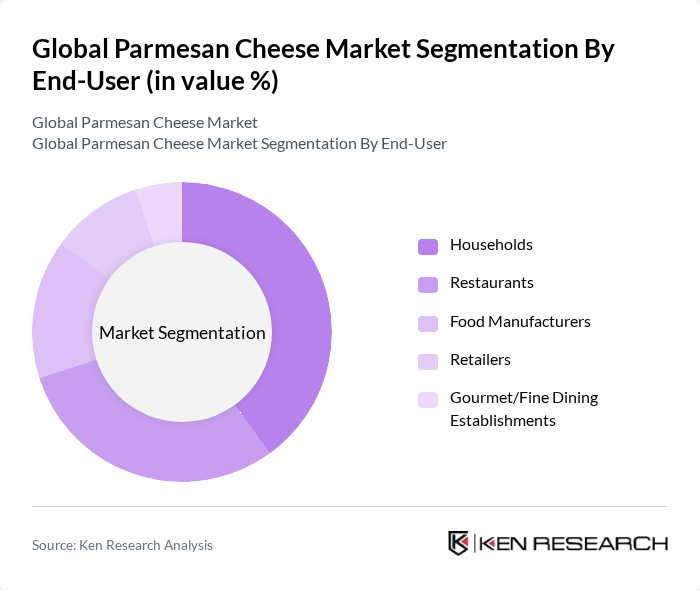
By End-User:The end-user segmentation includes Households, Restaurants, Food Manufacturers, Retailers, and Gourmet/Fine Dining Establishments. Households represent the largest segment, driven by the increasing trend of home cooking and the growing popularity of Italian cuisine. Restaurants and gourmet establishments also contribute significantly to the market, as they often use high-quality Parmesan cheese in their dishes. Food manufacturers utilize Parmesan cheese as an ingredient in various processed foods, further driving demand. The foodservice sector, including cafes and quick-service restaurants, is also a key growth driver .
The Global Parmesan Cheese Market is characterized by a dynamic mix of regional and international players. Leading participants such as Parmalat S.p.A., Kraft Heinz Company, Bel Group, Lactalis Group, Grana Padano Consortium, Galbani Cheese, Sargento Foods Inc., Murray Goulburn Co-operative Co. Limited, Arla Foods amba, Emmi Group, Fonterra Co-operative Group Limited, Saputo Inc., FrieslandCampina, Parmareggio S.p.A., Agriform S.c.a., Zanetti S.p.A., BelGioioso Cheese Inc., AOP Cheese, TINE SA contribute to innovation, geographic expansion, and service delivery in this space.
The future of the Parmesan cheese market appears promising, driven by evolving consumer preferences and innovative product offerings. As the trend towards organic and sustainably sourced foods continues, producers are likely to adapt their practices to meet these demands. Additionally, the rise of e-commerce platforms for gourmet foods will facilitate broader access to Parmesan cheese, enhancing market penetration. Collaborations with gourmet restaurants and chefs will further elevate the profile of Parmesan cheese, solidifying its place in culinary trends.
| Segment | Sub-Segments |
|---|---|
| By Type | Grated Parmesan Shredded Parmesan Block Parmesan Parmesan Powder Wheels Processed Parmesan Unprocessed/Traditional Parmigiano Reggiano Others |
| By End-User | Households Restaurants Food Manufacturers Retailers Gourmet/Fine Dining Establishments |
| By Packaging Type | Vacuum-Sealed Packs Plastic Containers Glass Jars Paperboard Packaging Others |
| By Distribution Channel | Supermarkets/Hypermarkets Online Retail Specialty Stores Direct Sales Foodservice Distributors |
| By Region | North America Europe Asia-Pacific Latin America Middle East & Africa |
| By Price Range | Premium Mid-Range Economy |
| By Product Origin | Domestic Imported PDO (Protected Designation of Origin) Others |
| Scope Item/Segment | Sample Size | Target Respondent Profiles |
|---|---|---|
| Retail Cheese Sales | 100 | Store Managers, Category Buyers |
| Food Service Industry | 80 | Restaurant Owners, Executive Chefs |
| Wholesale Distributors | 60 | Distribution Managers, Sales Representatives |
| Export Market Analysis | 50 | Export Managers, Trade Analysts |
| Consumer Preferences | 120 | Household Consumers, Food Enthusiasts |
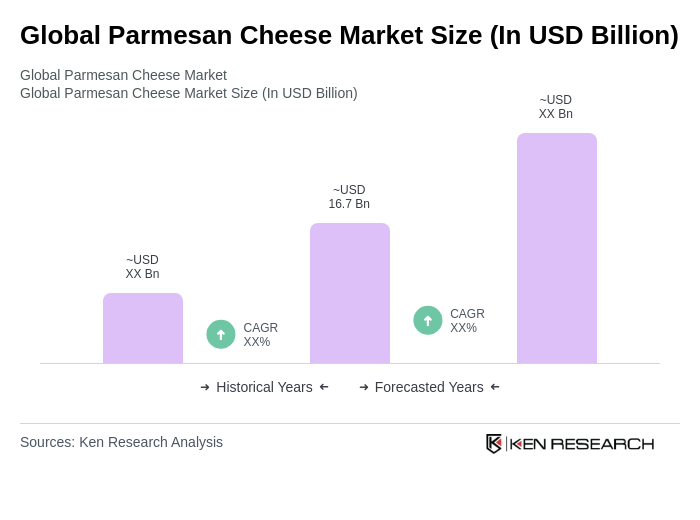
The Global Parmesan Cheese Market is valued at approximately USD 16.7 billion, reflecting a significant growth trend driven by increasing demand for gourmet cheeses and the popularity of Italian cuisine worldwide.

What makes us stand out is that our consultants follow Robust, Refine and Result (RRR) methodology. Robust for clear definitions, approaches and sanity checking, Refine for differentiating respondents' facts and opinions, and Result for presenting data with story.

We have set a benchmark in the industry by offering our clients with syndicated and customized market research reports featuring coverage of entire market as well as meticulous research and analyst insights.

While we don't replace traditional research, we flip the method upside down. Our dual approach of Top Bottom & Bottom Top ensures quality deliverable by not just verifying company fundamentals but also looking at the sector and macroeconomic factors.

With one step in the future, our research team constantly tries to show you the bigger picture. We help with some of the tough questions you may encounter along the way: How is the industry positioned? Best marketing channel? KPI's of competitors? By aligning every element, we help maximize success.

Our report gives you instant access to the answers and sources that other companies might choose to hide. We elaborate each steps of research methodology we have used and showcase you the sample size to earn your trust.

If you need any support, we are here! We pride ourselves on universe strength, data quality, and quick, friendly, and professional service.













