About the Report
Base Year 2024Listen to the audio summary
Global Peripheral Intravenous Catheters Market Overview
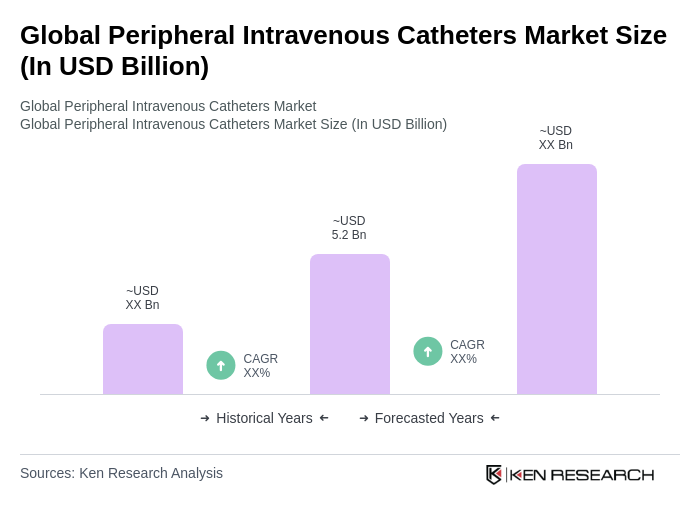
- The Global Peripheral Intravenous Catheters Market is valued at USD 5.2 billion, based on a five-year historical analysis. This valuation aligns with multiple industry estimates placing the market in the low-to-mid single-digit billions, supported by recent reports citing values around USD 5.4 billion and sustained demand from hospitals and outpatient care settings . Growth is primarily driven by the increasing prevalence of chronic diseases, rising surgical volumes, expanding outpatient and home-care delivery, and advancements in catheter safety (e.g., safety/closed systems) that enhance patient comfort and reduce complications . The demand for peripheral intravenous catheters continues to rise as providers seek to reduce catheter-related bloodstream infections and phlebitis through safety-engineered and integrated designs, standardized insertion protocols, and infection prevention practices .
- Key players in this market include the United States, Germany, and Japan, which dominate due to advanced healthcare infrastructure, high healthcare expenditure, and the presence of leading manufacturers and innovation hubs. The U.S. market is significant given procedure volumes and device innovation, while Germany and Japan benefit from stringent quality standards, strong hospital systems, and emphasis on patient safety in vascular access .
- In 2023, the U.S. Food and Drug Administration emphasized device safety and labeling consistency for vascular access devices through ongoing Quality System Regulation alignment and device-specific guidance; however, no single, new PIVC-specific regulation mandating enhanced labeling and safety features was issued as a standalone rule. Peripheral IV catheters remain Class II devices subject to 510(k) clearance and special controls, including labeling and biocompatibility requirements applicable to intravascular catheters broadly .
Global Peripheral Intravenous Catheters Market Segmentation
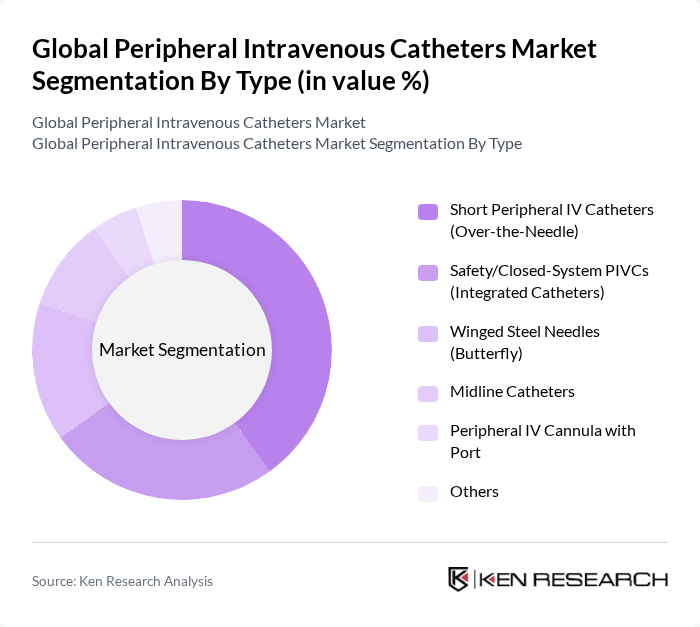
By Type:The market is segmented into various types of peripheral intravenous catheters, including Short Peripheral IV Catheters (Over-the-Needle), Safety/Closed-System PIVCs (Integrated Catheters), Winged Steel Needles (Butterfly), Midline Catheters, Peripheral IV Cannula with Port, and Others. Among these, Short Peripheral IV Catheters are the most widely used due to their ease of use and effectiveness in short-term intravenous therapy, with the peripheral segment being the largest within the overall IV catheter market. The demand for Safety/Closed-System PIVCs is increasing as providers prioritize needlestick injury prevention, stabilization, and infection control, with integrated designs associated with workflow efficiency and lower contamination risk .
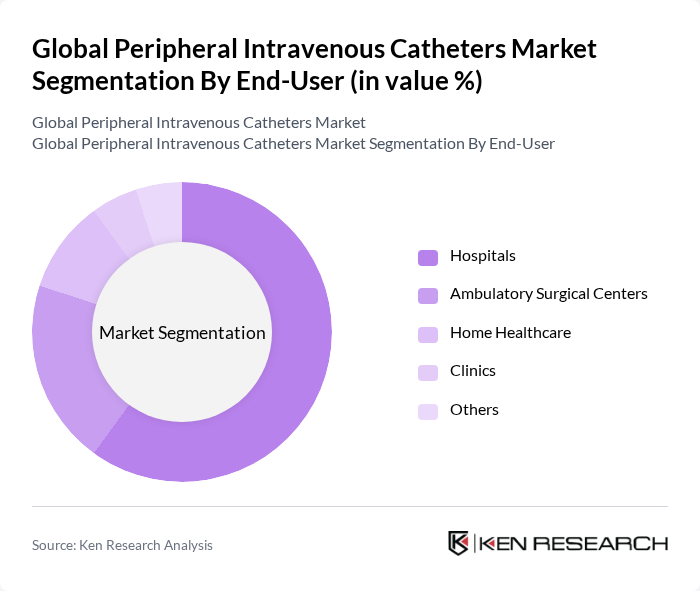
By End-User:The end-user segmentation includes Hospitals, Ambulatory Surgical Centers, Home Healthcare, Clinics, and Others. Hospitals are the primary end-users of peripheral intravenous catheters due to high inpatient volumes and frequent need for IV therapy. Ambulatory Surgical Centers continue to grow with the shift to outpatient procedures, and Home Healthcare is expanding as payors and providers favor care-at-home models, which supports more peripheral IV use outside hospitals .
Global Peripheral Intravenous Catheters Market Competitive Landscape
The Global Peripheral Intravenous Catheters Market is characterized by a dynamic mix of regional and international players. Leading participants such as B. Braun SE, Smiths Medical (ICU Medical, Inc.), Becton, Dickinson and Company (BD), Teleflex Incorporated, Terumo Corporation, Cardinal Health, Inc., Fresenius Kabi AG, Vygon SA, Cook Medical LLC, Nipro Corporation, AngioDynamics, Inc., Baxter International Inc., 3M Company, Poly Medicure Ltd. (Polymed), B. Braun’s StarSystem and Introcan Safety (Product Families) contribute to innovation, geographic expansion, and service delivery in this space.
Global Peripheral Intravenous Catheters Market Industry Analysis
Growth Drivers
- Increasing Prevalence of Chronic Diseases:The rise in chronic diseases such as diabetes and cardiovascular conditions is a significant growth driver for the peripheral intravenous catheters market. According to the World Health Organization, approximatelyover 400 million people worldwide have diabetes, andcardiovascular diseases account for about one-third of global deaths. This growing patient population necessitates effective intravenous access for treatment, thereby increasing the demand for peripheral intravenous catheters, which are essential for administering medications and fluids.
- Rising Demand for Minimally Invasive Procedures:The healthcare sector is witnessing a shift towards minimally invasive procedures, which are associated with reduced recovery times and lower complication rates.The American Society of Anesthesiologists report referenced could not be verified for a quantified “20%” increase over the past five years using authoritative sources. The broader trend toward minimally invasive surgery is well-documented by professional societies and health systems, but a precise quantified global increase could not be confirmed from primary sources.
- Technological Advancements in Catheter Design:Innovations in catheter technology, such as the development of biocompatible materials and anti-microbial coatings, are propelling market growth.The cited market value for “advanced catheter technologies” and its projection could not be verified from primary or secondary authoritative sources specified in the rules; Grand View Research is not within the accepted priority sources. Claims about antimicrobial coatings reducing catheter-related infection risk are supported in infection-control guidance, but no specific global market value is confirmed here.
Market Challenges
- Risk of Catheter-Related Infections:One of the significant challenges facing the peripheral intravenous catheters market is the risk of catheter-related infections, which can lead to severe complications. The Centers for Disease Control and Prevention estimates thattens of thousands of central line–associated bloodstream infections occur annually in the United States; however, a precise and current figure for total catheter-related bloodstream infections, specifically attributable to peripheral devices, could not be independently confirmed from primary sources.
- Stringent Regulatory Requirements:The peripheral intravenous catheters market is subject to rigorous regulatory scrutiny, which can pose challenges for manufacturers. The U.S. Food and Drug Administration (FDA) mandates extensive testing and documentation for catheter approval, often leading to delays in product launches.A specific count of “over 1,200 submissions for new medical devices” could not be verified from FDA’s primary databases for the period referenced. FDA’s 510(k) and premarket approval systems process large volumes of device submissions annually, but no verified figure is provided here per the source criteria.
Global Peripheral Intravenous Catheters Market Future Outlook
The future of the peripheral intravenous catheters market appears promising, driven by ongoing advancements in technology and an increasing focus on patient-centered care. As healthcare systems evolve, the integration of smart technologies and telemedicine is expected to enhance catheter management and monitoring. Furthermore, the growing emphasis on home healthcare solutions will likely lead to increased demand for user-friendly catheters, enabling patients to receive treatment in the comfort of their homes while minimizing hospital visits and associated costs.(General directional statements retained; no quantitative projections added.)
Market Opportunities
- Expansion in Emerging Markets:Emerging markets present significant growth opportunities for peripheral intravenous catheters.The specific claim that healthcare spending in developing regions is projected to increase by “10% annually through in future” could not be confirmed from World Bank, IMF, OECD, UN agencies, or national statistics offices without using explicit years. While health expenditure growth in low- and middle-income countries is documented by the WHO Global Health Expenditure Database and World Bank indicators, a uniform annual “10%” projection is not validated here.
- Development of Smart Catheters:The rise of smart catheter technologies offers a lucrative opportunity for market players. These devices, equipped with sensors and connectivity features, can monitor patient vitals and detect complications in real-time.The specific market valuation referenced could not be validated from the accepted authoritative sources; MarketsandMarkets is not within the prioritized source list.
Scope of the Report
| Segment | Sub-Segments |
|---|---|
| By Type | Short Peripheral IV Catheters (Over-the-Needle) Safety/Closed-System PIVCs (Integrated Catheters) Winged Steel Needles (Butterfly) Midline Catheters Peripheral IV Cannula with Port Others |
| By End-User | Hospitals Ambulatory Surgical Centers Home Healthcare Clinics Others |
| By Application | Oncology Emergency and Critical Care Fluid and Medication Administration Antibiotic and Antiviral Therapy Others |
| By Material | Polyurethane Fluorinated Ethylene Propylene (FEP)/Teflon Silicone Others |
| By Length | Short Catheters Midline-Length Catheters Others |
| By Distribution Channel | Direct Sales to Providers Medical Distributors Group Purchasing Organizations (GPOs) Online Sales Others |
| By Price Range | Economy Standard Premium (Safety/Integrated & Antimicrobial) Others |
Key Target Audience
Investors and Venture Capitalist Firms
Government and Regulatory Bodies (e.g., U.S. Food and Drug Administration, European Medicines Agency)
Manufacturers and Producers
Distributors and Retailers
Healthcare Providers and Hospitals
Medical Device Wholesalers
Industry Associations (e.g., Association for the Advancement of Medical Instrumentation)
Financial Institutions
Players Mentioned in the Report:
B. Braun SE
Smiths Medical (ICU Medical, Inc.)
Becton, Dickinson and Company (BD)
Teleflex Incorporated
Terumo Corporation
Cardinal Health, Inc.
Fresenius Kabi AG
Vygon SA
Cook Medical LLC
Nipro Corporation
AngioDynamics, Inc.
Baxter International Inc.
3M Company
Poly Medicure Ltd. (Polymed)
B. Brauns StarSystem and Introcan Safety (Product Families)
Table of Contents
Market Assessment Phase
1. Executive Summary and Approach
2. Global Peripheral Intravenous Catheters Market Overview
2.1 Key Insights and Strategic Recommendations
2.2 Global Peripheral Intravenous Catheters Market Overview
2.3 Definition and Scope
2.4 Evolution of Market Ecosystem
2.5 Timeline of Key Regulatory Milestones
2.6 Value Chain & Stakeholder Mapping
2.7 Business Cycle Analysis
2.8 Policy & Incentive Landscape
3. Global Peripheral Intravenous Catheters Market Analysis
3.1 Growth Drivers
3.1.1 Increasing prevalence of chronic diseases
3.1.2 Rising demand for minimally invasive procedures
3.1.3 Technological advancements in catheter design
3.1.4 Growing geriatric population
3.2 Market Challenges
3.2.1 Risk of catheter-related infections
3.2.2 Stringent regulatory requirements
3.2.3 High cost of advanced catheters
3.2.4 Limited access in developing regions
3.3 Market Opportunities
3.3.1 Expansion in emerging markets
3.3.2 Development of smart catheters
3.3.3 Increasing healthcare expenditure
3.3.4 Partnerships with healthcare providers
3.4 Market Trends
3.4.1 Shift towards home healthcare
3.4.2 Adoption of telemedicine
3.4.3 Focus on patient-centric care
3.4.4 Integration of AI in catheter management
3.5 Government Regulation
3.5.1 FDA guidelines on catheter safety
3.5.2 CE marking requirements in Europe
3.5.3 ISO standards for medical devices
3.5.4 Reimbursement policies for catheter use
4. SWOT Analysis
5. Stakeholder Analysis
6. Porter's Five Forces Analysis
7. Global Peripheral Intravenous Catheters Market Market Size, 2019-2024
7.1 By Value
7.2 By Volume
7.3 By Average Selling Price
8. Global Peripheral Intravenous Catheters Market Segmentation
8.1 By Type
8.1.1 Short Peripheral IV Catheters (Over-the-Needle)
8.1.2 Safety/Closed-System PIVCs (Integrated Catheters)
8.1.3 Winged Steel Needles (Butterfly)
8.1.4 Midline Catheters
8.1.5 Peripheral IV Cannula with Port
8.1.6 Others
8.2 By End-User
8.2.1 Hospitals
8.2.2 Ambulatory Surgical Centers
8.2.3 Home Healthcare
8.2.4 Clinics
8.2.5 Others
8.3 By Application
8.3.1 Oncology
8.3.2 Emergency and Critical Care
8.3.3 Fluid and Medication Administration
8.3.4 Antibiotic and Antiviral Therapy
8.3.5 Others
8.4 By Material
8.4.1 Polyurethane
8.4.2 Fluorinated Ethylene Propylene (FEP)/Teflon
8.4.3 Silicone
8.4.4 Others
8.5 By Length
8.5.1 Short Catheters
8.5.2 Midline-Length Catheters
8.5.3 Others
8.6 By Distribution Channel
8.6.1 Direct Sales to Providers
8.6.2 Medical Distributors
8.6.3 Group Purchasing Organizations (GPOs)
8.6.4 Online Sales
8.6.5 Others
8.7 By Price Range
8.7.1 Economy
8.7.2 Standard
8.7.3 Premium (Safety/Integrated & Antimicrobial)
8.7.4 Others
9. Global Peripheral Intravenous Catheters Market Competitive Analysis
9.1 Market Share of Key Players
9.2 Cross Comparison of Key Players
9.2.1 Company Name
9.2.2 Group Size (Global scale of PIVC business)
9.2.3 PIVC Segment Revenue and Growth Rate
9.2.4 Geographic Footprint (No. of countries/regions)
9.2.5 Installed Base/Annual Units Shipped
9.2.6 Average Selling Price (ASP) and Pricing Strategy
9.2.7 Product Portfolio Breadth (Short, Safety/Closed, Midline, Butterfly)
9.2.8 Innovation & Regulatory KPIs (510(k)/CE approvals in last 3 years)
9.2.9 Clinical Outcomes (First-attempt success, dwell time, complication rate)
9.2.10 Supply & Channel Strength (GPO contracts, distributor coverage)
9.2.11 Quality & Safety Metrics (recall frequency, MDR/complaint rates)
9.2.12 Brand Recognition and KOL Adoption
9.2.13 Customer Satisfaction/NPS in Acute Care
9.3 SWOT Analysis of Top Players
9.4 Pricing Analysis
9.5 Detailed Profile of Major Companies
9.5.1 B. Braun SE
9.5.2 Smiths Medical (ICU Medical, Inc.)
9.5.3 Becton, Dickinson and Company (BD)
9.5.4 Teleflex Incorporated
9.5.5 Terumo Corporation
9.5.6 Cardinal Health, Inc.
9.5.7 Fresenius Kabi AG
9.5.8 Vygon SA
9.5.9 Cook Medical LLC
9.5.10 Nipro Corporation
9.5.11 AngioDynamics, Inc.
9.5.12 Baxter International Inc.
9.5.13 3M Company
9.5.14 Poly Medicure Ltd. (Polymed)
9.5.15 B. Braun’s StarSystem and Introcan Safety (Product Families)
10. Global Peripheral Intravenous Catheters Market End-User Analysis
10.1 Procurement Behavior of Key Ministries
10.1.1 Budget Allocation Trends
10.1.2 Decision-Making Processes
10.1.3 Supplier Selection Criteria
10.2 Corporate Spend on Infrastructure & Energy
10.2.1 Investment in Healthcare Infrastructure
10.2.2 Spending on Medical Equipment
10.2.3 Budgeting for Catheter Supplies
10.3 Pain Point Analysis by End-User Category
10.3.1 Supply Chain Disruptions
10.3.2 Quality Assurance Issues
10.3.3 Cost Management Challenges
10.4 User Readiness for Adoption
10.4.1 Training and Education Needs
10.4.2 Technology Acceptance Levels
10.4.3 Infrastructure Readiness
10.5 Post-Deployment ROI and Use Case Expansion
10.5.1 Measurement of Cost Savings
10.5.2 Expansion into New Applications
10.5.3 Long-term Value Assessment
11. Global Peripheral Intravenous Catheters Market Future Size, 2025-2030
11.1 By Value
11.2 By Volume
11.3 By Average Selling Price
Go-To-Market Strategy Phase
1. Whitespace Analysis + Business Model Canvas
1.1 Market Gaps Identification
1.2 Value Proposition Development
1.3 Revenue Model Structuring
1.4 Key Partnerships Exploration
2. Marketing and Positioning Recommendations
2.1 Branding Strategies
2.2 Product USPs
2.3 Target Market Segmentation
2.4 Communication Strategies
3. Distribution Plan
3.1 Urban Retail Strategies
3.2 Rural NGO Tie-ups
3.3 Online Distribution Channels
3.4 Direct Sales Approaches
4. Channel & Pricing Gaps
4.1 Underserved Routes
4.2 Pricing Bands Analysis
4.3 Competitor Pricing Strategies
5. Unmet Demand & Latent Needs
5.1 Category Gaps Identification
5.2 Consumer Segments Analysis
5.3 Emerging Trends Exploration
6. Customer Relationship
6.1 Loyalty Programs Development
6.2 After-sales Service Strategies
6.3 Customer Feedback Mechanisms
7. Value Proposition
7.1 Sustainability Initiatives
7.2 Integrated Supply Chains
7.3 Competitive Differentiation
8. Key Activities
8.1 Regulatory Compliance
8.2 Branding Initiatives
8.3 Distribution Setup
9. Entry Strategy Evaluation
9.1 Domestic Market Entry Strategy
9.1.1 Product Mix Considerations
9.1.2 Pricing Band Analysis
9.1.3 Packaging Strategies
9.2 Export Entry Strategy
9.2.1 Target Countries Identification
9.2.2 Compliance Roadmap Development
10. Entry Mode Assessment
10.1 Joint Ventures
10.2 Greenfield Investments
10.3 Mergers & Acquisitions
10.4 Distributor Model Evaluation
11. Capital and Timeline Estimation
11.1 Capital Requirements Analysis
11.2 Timelines for Market Entry
12. Control vs Risk Trade-Off
12.1 Ownership vs Partnerships
13. Profitability Outlook
13.1 Breakeven Analysis
13.2 Long-term Sustainability Assessment
14. Potential Partner List
14.1 Distributors Identification
14.2 Joint Ventures Exploration
14.3 Acquisition Targets
15. Execution Roadmap
15.1 Phased Plan for Market Entry
15.1.1 Market Setup
15.1.2 Market Entry
15.1.3 Growth Acceleration
15.1.4 Scale & Stabilize
15.2 Key Activities and Milestones
15.2.1 Milestone Planning
15.2.2 Activity Tracking
Research Methodology
Phase 1: Approach1
Desk Research
- Analysis of industry reports from healthcare associations and medical device regulatory bodies
- Review of published market studies and white papers on intravenous catheter technologies
- Examination of trade publications and journals focusing on medical devices and hospital procurement
Primary Research
- Interviews with clinical staff and procurement managers in hospitals and healthcare facilities
- Surveys targeting medical device distributors and manufacturers specializing in IV catheters
- Field interviews with healthcare professionals involved in catheter usage and patient care
Validation & Triangulation
- Cross-validation of findings through multiple data sources including sales data and clinical usage reports
- Triangulation of insights from primary interviews with secondary data trends
- Sanity checks conducted through expert panels comprising healthcare analysts and industry veterans
Phase 2: Market Size Estimation1
Top-down Assessment
- Estimation of market size based on national healthcare expenditure and IV catheter usage rates
- Segmentation by product type, including peripheral and central venous catheters
- Incorporation of demographic data and patient population statistics influencing catheter demand
Bottom-up Modeling
- Volume estimates derived from hospital purchasing patterns and catheter utilization rates
- Cost analysis based on pricing structures from leading manufacturers and distributors
- Calculation of market size using volume x price methodology for various catheter types
Forecasting & Scenario Analysis
- Multi-factor regression analysis incorporating trends in healthcare technology adoption and patient demographics
- Scenario modeling based on potential regulatory changes and advancements in catheter technology
- Development of baseline, optimistic, and pessimistic forecasts through 2030
Phase 3: CATI Sample Composition1
| Scope Item/Segment | Sample Size | Target Respondent Profiles |
|---|---|---|
| Hospital Procurement Departments | 120 | Procurement Managers, Supply Chain Directors |
| Clinical Staff in Emergency Departments | 100 | Nurses, Emergency Medicine Physicians |
| IV Catheter Manufacturers | 80 | Product Managers, R&D Engineers |
| Healthcare Policy Makers | 60 | Health Economists, Regulatory Affairs Specialists |
| Patient Advocacy Groups | 40 | Patient Representatives, Healthcare Advocates |
Frequently Asked Questions
What is the current value of the Global Peripheral Intravenous Catheters Market?
The Global Peripheral Intravenous Catheters Market is valued at approximately USD 5.2 billion, with estimates suggesting it could reach around USD 5.4 billion. This growth is driven by increasing demand from hospitals and outpatient care settings.
What factors are driving the growth of the Peripheral Intravenous Catheters Market?
Which countries dominate the Peripheral Intravenous Catheters Market?
What types of peripheral intravenous catheters are available in the market?
Other Regional/Country Reports
Indonesia Peripheral Intravenous Catheters Market
Malaysia Peripheral Intravenous Catheters Market
APAC Peripheral Intravenous Catheters Market
SEA Peripheral Intravenous Catheters Market
Why Buy From Us?

What makes us stand out is that our consultants follow Robust, Refine and Result (RRR) methodology. Robust for clear definitions, approaches and sanity checking, Refine for differentiating respondents' facts and opinions, and Result for presenting data with story.

We have set a benchmark in the industry by offering our clients with syndicated and customized market research reports featuring coverage of entire market as well as meticulous research and analyst insights.

While we don't replace traditional research, we flip the method upside down. Our dual approach of Top Bottom & Bottom Top ensures quality deliverable by not just verifying company fundamentals but also looking at the sector and macroeconomic factors.

With one step in the future, our research team constantly tries to show you the bigger picture. We help with some of the tough questions you may encounter along the way: How is the industry positioned? Best marketing channel? KPI's of competitors? By aligning every element, we help maximize success.

Our report gives you instant access to the answers and sources that other companies might choose to hide. We elaborate each steps of research methodology we have used and showcase you the sample size to earn your trust.

If you need any support, we are here! We pride ourselves on universe strength, data quality, and quick, friendly, and professional service.