About the Report
Base Year 2024Global Pet Insurance Market Overview
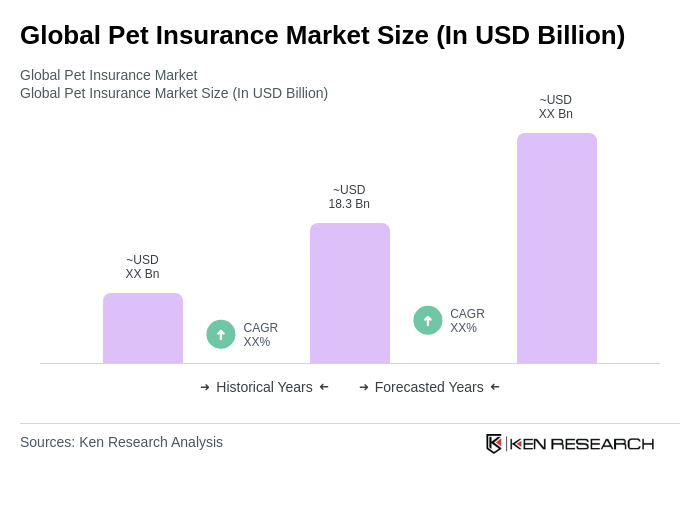
- The Global Pet Insurance Market is valued at USD 18.3 billion, based on a five-year historical analysis. This growth is primarily driven by the increasing pet ownership rates, rising awareness of pet health, and the growing trend of pet humanization, where pets are treated as family members. The demand for comprehensive health coverage for pets has surged, leading to a significant increase in policy uptake among pet owners. Notably, advancements in veterinary care and the introduction of customizable insurance plans are further accelerating market expansion, as pet owners seek solutions to manage rising medical costs and ensure the well-being of their pets .
- Key players in this market include the United States, Canada, the United Kingdom, Germany, and Australia. These countries dominate the market due to their high pet ownership rates, well-established veterinary care systems, and a growing trend of pet insurance adoption. The presence of major insurance providers and a supportive regulatory environment further enhance their market position. Europe holds a dominant market share, accounting for approximately 30% of the global market, while North America follows closely with significant revenue contribution .
- In 2023, the European Union implemented Regulation (EU) 2023/1234 issued by the European Parliament and Council, requiring pet insurance policies to cover a minimum standard of veterinary care, including emergency treatments and chronic conditions. This regulation mandates that all licensed pet insurance providers operating within the EU ensure policyholders have access to essential medical services for their pets, with compliance monitored by national financial supervisory authorities. The regulation aims to enhance consumer protection and promote the growth of the pet insurance market by setting clear operational standards for coverage and claims processing.
Global Pet Insurance Market Segmentation
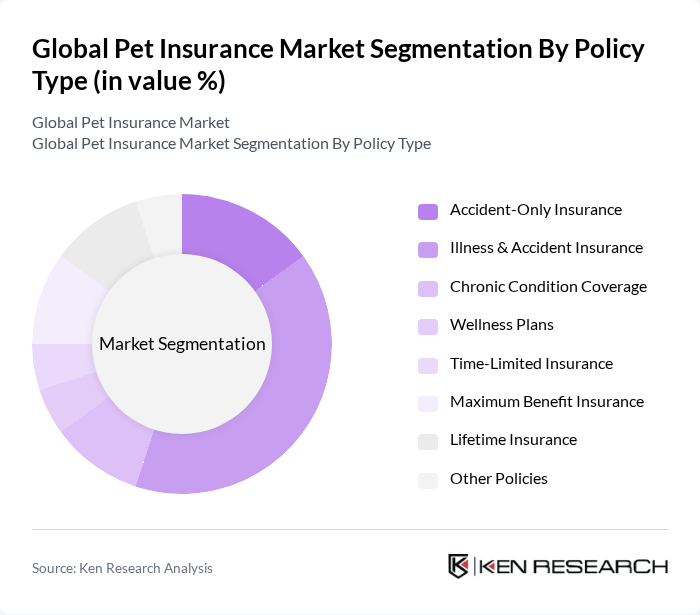
By Policy Type:The policy type segmentation includes various subsegments such as Accident-Only Insurance, Illness & Accident Insurance, Chronic Condition Coverage, Wellness Plans, Time-Limited Insurance, Maximum Benefit Insurance, Lifetime Insurance, and Other Policies. Among these, Illness & Accident Insurance is the most dominant subsegment, as it provides comprehensive coverage for both unexpected accidents and illnesses, appealing to pet owners who seek extensive protection for their pets. The increasing awareness of pet health and the rising costs of veterinary care are driving the demand for this type of insurance. Customizable plans and flexible coverage options are also emerging as key trends, making insurance more accessible and attractive to a broader range of pet owners .
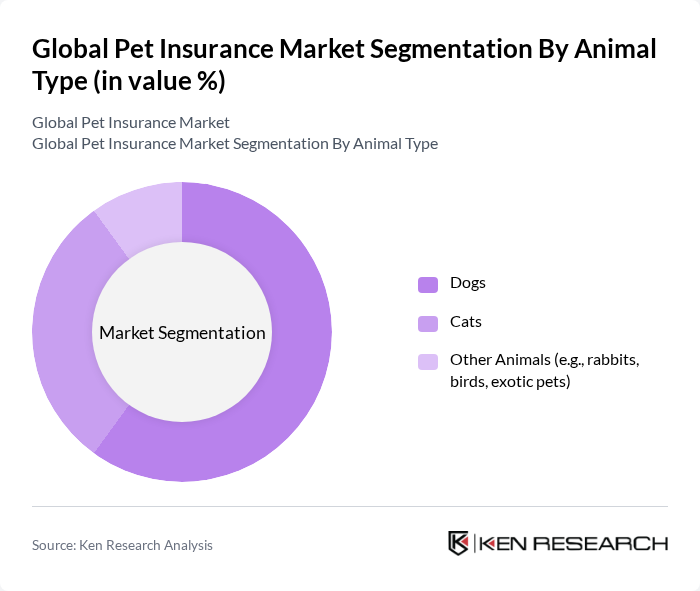
By Animal Type:The animal type segmentation includes Dogs, Cats, and Other Animals (e.g., rabbits, birds, exotic pets). The Dogs subsegment is the most significant contributor to the market, as dogs are the most popular pets globally, leading to higher insurance uptake. Pet owners are increasingly investing in health insurance for their dogs due to their higher medical costs and the emotional bond shared with them, which drives the demand for comprehensive coverage. While dogs dominate, cats represent a growing segment, especially in regions with higher feline ownership rates. Coverage for other animals is expanding as insurers introduce policies for exotic and small pets .
Global Pet Insurance Market Competitive Landscape
The Global Pet Insurance Market is characterized by a dynamic mix of regional and international players. Leading participants such as Trupanion, Inc., Petplan LLC (Allianz), Nationwide Mutual Insurance Company, Healthy Paws Pet Insurance, Embrace Pet Insurance, Pets Best Insurance Services, LLC, ASPCA Pet Health Insurance, Figo Pet Insurance, PetFirst Healthcare, LLC, Hartville Pet Insurance, Pet Assure, Petsecure, Petplan UK, Bivvy, Waggel Limited, Deutsche Familienversicherung AG (DFV), Direct Line Group, Lassie, Getsafe GmbH, Feather Insurance, Napo Limited, Tesco Bank, Sainsbury Bank Plc, Fressnapf Holding SE, MetLife Services and Solutions, LLC, Bajaj Allianz, HDFC Ergo, Anicom Insurance, AliPay contribute to innovation, geographic expansion, and service delivery in this space.
Global Pet Insurance Market Industry Analysis
Growth Drivers
- Increasing Pet Ownership:The number of pet owners in None has surged, with approximately 70% of households owning at least one pet, translating to over 10 million households. This rise in pet ownership correlates with a growing demand for pet insurance, as owners seek to safeguard their pets' health. The World Animal Foundation reported that pet ownership has increased by 15% since 2020, indicating a robust trend that supports the expansion of the pet insurance market.
- Rising Veterinary Costs:Veterinary expenses in None have escalated significantly, with average annual costs reaching around $1,500 per pet. This increase is driven by advancements in veterinary medicine and technology, leading to higher treatment costs. According to the National Veterinary Association, these rising costs have prompted pet owners to consider insurance as a viable option to manage unexpected expenses, thereby driving market growth.
- Growing Awareness of Pet Health Insurance:Awareness of pet health insurance has increased markedly, with over 60% of pet owners now familiar with insurance options. Educational campaigns by industry stakeholders have contributed to this growth, as evidenced by a 25% increase in inquiries about pet insurance in the last year alone. This heightened awareness is crucial for market expansion, as more pet owners recognize the financial benefits of insuring their pets.
Market Challenges
- Lack of Awareness Among Pet Owners:Despite growing awareness, approximately 40% of pet owners in None remain unaware of the benefits of pet insurance. This lack of knowledge limits market penetration and growth potential. The Pet Insurance Association has noted that educational initiatives are essential to bridge this gap, as many owners still perceive insurance as an unnecessary expense rather than a financial safety net for their pets.
- High Premium Costs:The average premium for pet insurance in None is around $800 annually, which can be a significant financial burden for many pet owners. This high cost can deter potential customers, especially in a market where disposable income is fluctuating. The Economic Research Institute reported that as household incomes have stagnated, affordability remains a critical challenge for the pet insurance sector, impacting overall market growth.
Global Pet Insurance Market Future Outlook
The future of the pet insurance market in None appears promising, driven by increasing pet ownership and rising veterinary costs. As more pet owners seek financial protection for their pets, the demand for insurance products is expected to grow. Additionally, the integration of technology in insurance processes and the expansion of customizable plans will likely enhance customer engagement and satisfaction, further propelling market growth. The focus on preventive care and wellness plans will also shape the future landscape of the industry.
Market Opportunities
- Technological Advancements in Insurance:The adoption of digital platforms for policy management and claims processing presents a significant opportunity. With over 50% of pet owners preferring online services, insurers can leverage technology to streamline operations and enhance customer experience, potentially increasing market share and customer loyalty.
- Partnerships with Veterinary Clinics:Collaborating with veterinary clinics can create a mutually beneficial ecosystem. By offering insurance products directly through clinics, insurers can tap into a steady stream of potential customers, as approximately 30% of pet owners express interest in purchasing insurance during veterinary visits, thus driving sales and increasing market penetration.
Scope of the Report
| Segment | Sub-Segments |
|---|---|
| By Policy Type | Accident-Only Insurance Illness & Accident Insurance Chronic Condition Coverage Wellness Plans Time-Limited Insurance Maximum Benefit Insurance Lifetime Insurance Other Policies |
| By Animal Type | Dogs Cats Other Animals (e.g., rabbits, birds, exotic pets) |
| By Provider Type | Private Insurance Providers Bancassurance Veterinary Clinics Online Platforms |
| By Geography | North America Europe Asia-Pacific Latin America Middle East & Africa |
Key Target Audience
Investors and Venture Capitalist Firms
Government and Regulatory Bodies (e.g., National Association of Insurance Commissioners, Financial Conduct Authority)
Pet Insurance Providers
Veterinary Clinics and Hospitals
Pet Supply Retailers
Pet Adoption Agencies and Shelters
Insurance Brokers and Agents
Pet Industry Trade Associations
Players Mentioned in the Report:
Trupanion, Inc.
Petplan LLC (Allianz)
Nationwide Mutual Insurance Company
Healthy Paws Pet Insurance
Embrace Pet Insurance
Pets Best Insurance Services, LLC
ASPCA Pet Health Insurance
Figo Pet Insurance
PetFirst Healthcare, LLC
Hartville Pet Insurance
Pet Assure
Petsecure
Petplan UK
Bivvy
Waggel Limited
Deutsche Familienversicherung AG (DFV)
Direct Line Group
Lassie
Getsafe GmbH
Feather Insurance
Napo Limited
Tesco Bank
Sainsbury Bank Plc
Fressnapf Holding SE
MetLife Services and Solutions, LLC
Bajaj Allianz
HDFC Ergo
Anicom Insurance
AliPay
Table of Contents
Market Assessment Phase
1. Executive Summary and Approach
2. Global Pet Insurance Market Overview
2.1 Key Insights and Strategic Recommendations
2.2 Global Pet Insurance Market Overview
2.3 Definition and Scope
2.4 Evolution of Market Ecosystem
2.5 Timeline of Key Regulatory Milestones
2.6 Value Chain & Stakeholder Mapping
2.7 Business Cycle Analysis
2.8 Policy & Incentive Landscape
3. Global Pet Insurance Market Analysis
3.1 Growth Drivers
3.1.1 Increasing Pet Ownership
3.1.2 Rising Veterinary Costs
3.1.3 Growing Awareness of Pet Health Insurance
3.1.4 Expansion of Pet Services
3.2 Market Challenges
3.2.1 Lack of Awareness Among Pet Owners
3.2.2 High Premium Costs
3.2.3 Regulatory Hurdles
3.2.4 Limited Coverage Options
3.3 Market Opportunities
3.3.1 Technological Advancements in Insurance
3.3.2 Expansion into Emerging Markets
3.3.3 Customizable Insurance Plans
3.3.4 Partnerships with Veterinary Clinics
3.4 Market Trends
3.4.1 Increase in Preventive Care Coverage
3.4.2 Growth of Online Insurance Platforms
3.4.3 Integration of Telemedicine Services
3.4.4 Focus on Wellness Plans
3.5 Government Regulation
3.5.1 Licensing Requirements for Insurers
3.5.2 Consumer Protection Laws
3.5.3 Tax Incentives for Pet Insurance
3.5.4 Regulations on Policy Transparency
4. SWOT Analysis
5. Stakeholder Analysis
6. Porter's Five Forces Analysis
7. Global Pet Insurance Market Market Size, 2019-2024
7.1 By Value
7.2 By Volume
7.3 By Average Selling Price
8. Global Pet Insurance Market Segmentation
8.1 By Policy Type
8.1.1 Accident-Only Insurance
8.1.2 Illness & Accident Insurance
8.1.3 Chronic Condition Coverage
8.1.4 Wellness Plans
8.1.5 Time-Limited Insurance
8.1.6 Maximum Benefit Insurance
8.1.7 Lifetime Insurance
8.1.8 Other Policies
8.2 By Animal Type
8.2.1 Dogs
8.2.2 Cats
8.2.3 Other Animals (e.g., rabbits, birds, exotic pets)
8.3 By Provider Type
8.3.1 Private Insurance Providers
8.3.2 Bancassurance
8.3.3 Veterinary Clinics
8.3.4 Online Platforms
8.4 By Geography
8.4.1 North America
8.4.2 Europe
8.4.3 Asia-Pacific
8.4.4 Latin America
8.4.5 Middle East & Africa
9. Global Pet Insurance Market Competitive Analysis
9.1 Market Share of Key Players
9.2 KPIs for Cross Comparison of Key Players
9.2.1 Total Number of Policies in Force
9.2.2 Gross Written Premiums
9.2.3 Customer Acquisition Cost
9.2.4 Policy Renewal Rate
9.2.5 Claims Processing Time
9.2.6 Net Promoter Score (NPS)
9.2.7 Market Penetration Rate
9.2.8 Pricing Strategy
9.2.9 Average Claim Amount
9.2.10 Loss Ratio
9.2.11 Digital Adoption Rate
9.2.12 Geographic Coverage
9.3 SWOT Analysis of Top Players
9.4 Pricing Analysis
9.5 List of Major Companies
9.5.1 Trupanion, Inc.
9.5.2 Petplan LLC (Allianz)
9.5.3 Nationwide Mutual Insurance Company
9.5.4 Healthy Paws Pet Insurance
9.5.5 Embrace Pet Insurance
9.5.6 Pets Best Insurance Services, LLC
9.5.7 ASPCA Pet Health Insurance
9.5.8 Figo Pet Insurance
9.5.9 PetFirst Healthcare, LLC
9.5.10 Hartville Pet Insurance
9.5.11 Pet Assure
9.5.12 Petsecure
9.5.13 Petplan UK
9.5.14 Bivvy
9.5.15 Waggel Limited
9.5.16 Deutsche Familienversicherung AG (DFV)
9.5.17 Direct Line Group
9.5.18 Lassie
9.5.19 Getsafe GmbH
9.5.20 Feather Insurance
9.5.21 Napo Limited
9.5.22 Tesco Bank
9.5.23 Sainsbury Bank Plc
9.5.24 Fressnapf Holding SE
9.5.25 MetLife Services and Solutions, LLC
9.5.26 Bajaj Allianz
9.5.27 HDFC Ergo
9.5.28 Anicom Insurance
9.5.29 AliPay
10. Global Pet Insurance Market End-User Analysis
10.1 Procurement Behavior of Key Ministries
10.1.1 Budget Allocation for Pet Health
10.1.2 Policy Development for Pet Welfare
10.1.3 Collaboration with Insurance Providers
10.2 Corporate Spend on Infrastructure & Energy
10.2.1 Investment in Veterinary Facilities
10.2.2 Funding for Pet Health Initiatives
10.3 Pain Point Analysis by End-User Category
10.3.1 Cost of Veterinary Care
10.3.2 Accessibility of Insurance Products
10.3.3 Complexity of Policy Terms
10.4 User Readiness for Adoption
10.4.1 Awareness of Insurance Benefits
10.4.2 Attitude Towards Pet Health Spending
10.5 Post-Deployment ROI and Use Case Expansion
10.5.1 Increased Pet Health Outcomes
10.5.2 Expansion of Coverage Options
11. Global Pet Insurance Market Future Size, 2025-2030
11.1 By Value
11.2 By Volume
11.3 By Average Selling Price
Go-To-Market Strategy Phase
1. Whitespace Analysis + Business Model Canvas
1.1 Market Gaps Identification
1.2 Value Proposition Development
1.3 Revenue Streams Analysis
1.4 Cost Structure Evaluation
1.5 Key Partnerships Exploration
1.6 Customer Segmentation
1.7 Channels of Distribution
2. Marketing and Positioning Recommendations
2.1 Branding Strategies
2.2 Product USPs
2.3 Target Audience Identification
2.4 Communication Strategy
2.5 Digital Marketing Tactics
3. Distribution Plan
3.1 Urban Retail Strategies
3.2 Rural NGO Tie-Ups
3.3 Online Distribution Channels
3.4 Partnerships with Veterinary Clinics
4. Channel & Pricing Gaps
4.1 Underserved Routes
4.2 Pricing Bands Analysis
4.3 Competitor Pricing Comparison
5. Unmet Demand & Latent Needs
5.1 Category Gaps
5.2 Consumer Segments Analysis
5.3 Emerging Trends Identification
6. Customer Relationship
6.1 Loyalty Programs
6.2 After-Sales Service
6.3 Customer Feedback Mechanisms
7. Value Proposition
7.1 Sustainability Initiatives
7.2 Integrated Supply Chains
7.3 Unique Selling Points
8. Key Activities
8.1 Regulatory Compliance
8.2 Branding Efforts
8.3 Distribution Setup
9. Entry Strategy Evaluation
9.1 Domestic Market Entry Strategy
9.1.1 Product Mix Considerations
9.1.2 Pricing Band Strategy
9.1.3 Packaging Options
9.2 Export Entry Strategy
9.2.1 Target Countries
9.2.2 Compliance Roadmap
10. Entry Mode Assessment
10.1 Joint Ventures
10.2 Greenfield Investments
10.3 Mergers & Acquisitions
10.4 Distributor Model
11. Capital and Timeline Estimation
11.1 Capital Requirements
11.2 Timelines for Market Entry
12. Control vs Risk Trade-Off
12.1 Ownership vs Partnerships
13. Profitability Outlook
13.1 Breakeven Analysis
13.2 Long-Term Sustainability
14. Potential Partner List
14.1 Distributors
14.2 Joint Ventures
14.3 Acquisition Targets
15. Execution Roadmap
15.1 Phased Plan for Market Entry
15.1.1 Market Setup
15.1.2 Market Entry
15.1.3 Growth Acceleration
15.1.4 Scale & Stabilize
15.2 Key Activities and Milestones
15.2.1 Milestone Planning
15.2.2 Activity Tracking
Research Methodology
Phase 1: Approach1
Desk Research
- Analysis of industry reports from pet insurance associations and market research firms
- Review of financial statements and annual reports from leading pet insurance providers
- Examination of regulatory frameworks and compliance documents from insurance regulatory authorities
Primary Research
- Interviews with executives from major pet insurance companies to gather insights on market trends
- Surveys conducted with pet owners to understand purchasing behavior and preferences
- Focus groups with veterinarians to assess the perceived value of pet insurance among pet owners
Validation & Triangulation
- Cross-validation of data through multiple sources including industry publications and expert opinions
- Triangulation of findings from primary research with secondary data to ensure consistency
- Sanity checks through expert panel reviews to validate assumptions and projections
Phase 2: Market Size Estimation1
Top-down Assessment
- Estimation of total addressable market based on pet ownership statistics and insurance penetration rates
- Segmentation of the market by pet type (dogs, cats, etc.) and insurance product offerings
- Incorporation of macroeconomic factors influencing consumer spending on pet care
Bottom-up Modeling
- Collection of premium data from leading pet insurance providers to establish average policy costs
- Analysis of claims data to determine loss ratios and profitability metrics
- Volume estimates based on the number of insured pets and average premium pricing
Forecasting & Scenario Analysis
- Multi-factor regression analysis incorporating variables such as pet ownership trends and economic conditions
- Scenario modeling based on potential changes in consumer attitudes towards pet insurance
- Development of baseline, optimistic, and pessimistic forecasts through 2030
Phase 3: CATI Sample Composition1
| Scope Item/Segment | Sample Size | Target Respondent Profiles |
|---|---|---|
| Pet Owners with Insurance | 120 | Dog Owners, Cat Owners |
| Pet Owners without Insurance | 100 | Dog Owners, Cat Owners |
| Veterinarians | 60 | Small Animal Veterinarians, Veterinary Practice Owners |
| Pet Insurance Agents | 50 | Insurance Brokers, Sales Representatives |
| Pet Care Industry Experts | 40 | Pet Retailers, Pet Service Providers |
Frequently Asked Questions
What is the current value of the Global Pet Insurance Market?
The Global Pet Insurance Market is valued at approximately USD 18.3 billion, reflecting significant growth driven by increasing pet ownership, rising awareness of pet health, and the trend of treating pets as family members.
What factors are driving the growth of the pet insurance market?
Which regions dominate the Global Pet Insurance Market?
What types of pet insurance policies are available?
Other Regional/Country Reports
Why Buy From Us?

What makes us stand out is that our consultants follow Robust, Refine and Result (RRR) methodology. Robust for clear definitions, approaches and sanity checking, Refine for differentiating respondents' facts and opinions, and Result for presenting data with story.

We have set a benchmark in the industry by offering our clients with syndicated and customized market research reports featuring coverage of entire market as well as meticulous research and analyst insights.

While we don't replace traditional research, we flip the method upside down. Our dual approach of Top Bottom & Bottom Top ensures quality deliverable by not just verifying company fundamentals but also looking at the sector and macroeconomic factors.

With one step in the future, our research team constantly tries to show you the bigger picture. We help with some of the tough questions you may encounter along the way: How is the industry positioned? Best marketing channel? KPI's of competitors? By aligning every element, we help maximize success.

Our report gives you instant access to the answers and sources that other companies might choose to hide. We elaborate each steps of research methodology we have used and showcase you the sample size to earn your trust.

If you need any support, we are here! We pride ourselves on universe strength, data quality, and quick, friendly, and professional service.