About the Report
Base Year 2024Listen to the audio summary
Global Pharmaceutical Excipients Market Overview
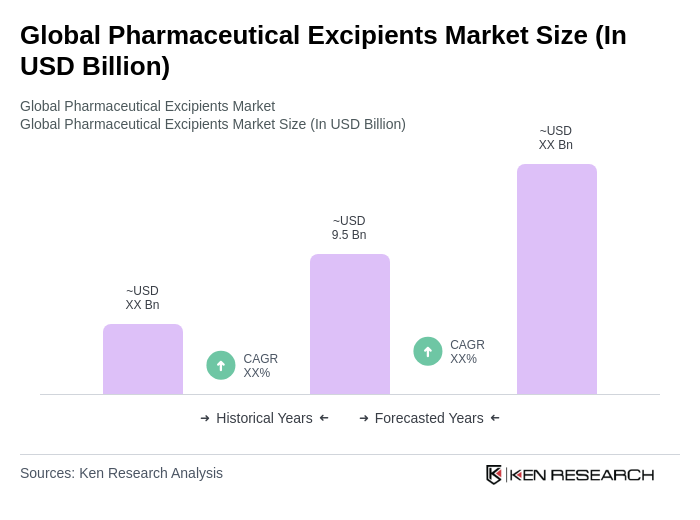
- The Global Pharmaceutical Excipients Market is valued at USD 9.5 billion, based on a five-year historical analysis. Market growth is driven by rising demand for advanced drug formulations, the increasing prevalence of chronic diseases, and expansion of the pharmaceutical industry. Additional drivers include the need for excipients that improve drug stability, bioavailability, and patient compliance, as well as the surge in generic drug manufacturing and the adoption of multifunctional excipients .
- Key players in this market include the United States, Germany, and China, which dominate due to robust pharmaceutical manufacturing capabilities, significant investments in research and development, and comprehensive regulatory frameworks. The presence of major pharmaceutical companies, advanced excipient technologies, and a well-established supply chain further support market leadership in these regions .
- The U.S. Food and Drug Administration (FDA) regulates excipients under the Federal Food, Drug, and Cosmetic Act and has issued the “Guidance for Industry: Nonclinical Studies for the Safety Evaluation of Pharmaceutical Excipients” (U.S. FDA, Center for Drug Evaluation and Research, 2005). This guidance mandates comprehensive safety assessments and robust quality control measures for excipients used in drug formulations, ensuring that excipients meet stringent safety standards and supporting the overall quality of pharmaceutical products .
Global Pharmaceutical Excipients Market Segmentation
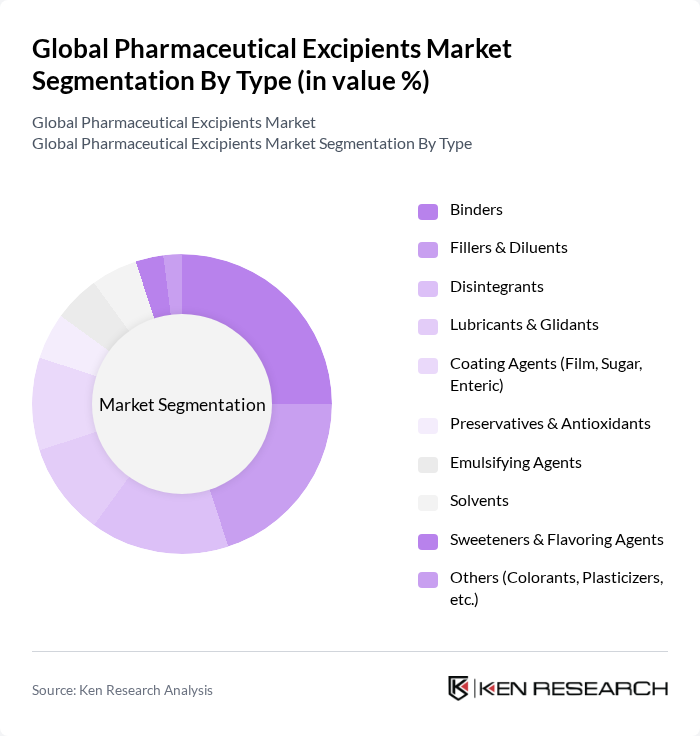
By Type:The market is segmented into various types of excipients, each serving a unique function in drug formulation. The major types include Binders, Fillers & Diluents, Disintegrants, Lubricants & Glidants, Coating Agents (Film, Sugar, Enteric), Preservatives & Antioxidants, Emulsifying Agents, Solvents, Sweeteners & Flavoring Agents, and Others (Colorants, Plasticizers, etc.). Among these,BindersandFillers & Diluentsremain dominant due to their critical roles in tablet formulation and overall drug stability .
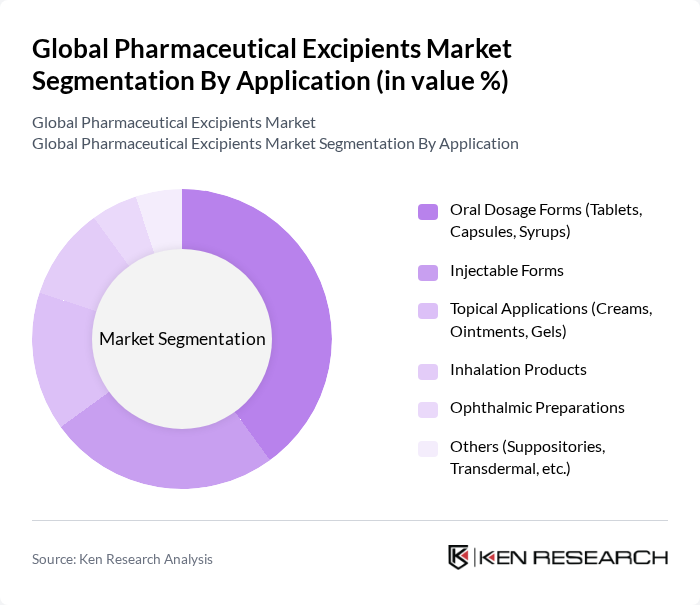
By Application:The applications of pharmaceutical excipients are diverse, including Oral Dosage Forms (Tablets, Capsules, Syrups), Injectable Forms, Topical Applications (Creams, Ointments, Gels), Inhalation Products, Ophthalmic Preparations, and Others (Suppositories, Transdermal, etc.).Oral Dosage Formsdominate the market due to their widespread use and the increasing demand for solid dosage forms, supported by the continued growth in generic and over-the-counter medications .
Global Pharmaceutical Excipients Market Competitive Landscape
The Global Pharmaceutical Excipients Market is characterized by a dynamic mix of regional and international players. Leading participants such as BASF SE, Dow Chemical Company, Ashland Global Holdings Inc., Evonik Industries AG, Croda International Plc, FMC Corporation, JRS Pharma, Merck KGaA, Roquette Frères, Signet Chemical Corporation Pvt. Ltd., Sensient Technologies Corporation, Ingredion Incorporated, Colorcon, Inc., Kerry Group plc, DFE Pharma, Wacker Chemie AG, Gattefossé, Shin-Etsu Chemical Co., Ltd., Associated British Foods plc, ADM (Archer Daniels Midland Company), Air Liquide, Actylis, Berkshire Hathaway Inc., Chemie Trade contribute to innovation, geographic expansion, and service delivery in this space .
Global Pharmaceutical Excipients Market Industry Analysis
Growth Drivers
- Increasing Demand for Generic Drugs:The global generic drug market is projected to reach $500 billion in future, driven by the expiration of patents for several blockbuster drugs. This surge in generic drug production necessitates a corresponding increase in excipients, which are essential for drug formulation. The World Health Organization reported that generic drugs account for over 80% of all prescriptions in developed countries, highlighting the critical role of excipients in ensuring drug efficacy and safety.
- Advancements in Drug Formulation Technologies:The pharmaceutical industry is witnessing rapid advancements in formulation technologies, with investments exceeding $100 billion in future. Innovations such as nanotechnology and 3D printing are enhancing drug delivery systems, requiring specialized excipients. According to the International Pharmaceutical Excipients Council, these technologies are expected to improve bioavailability and patient compliance, further driving the demand for high-quality excipients in drug formulations.
- Rising Investment in Pharmaceutical R&D:Global pharmaceutical R&D spending is anticipated to surpass $100 billion in future, reflecting a robust commitment to developing new therapies. This investment is crucial for discovering novel excipients that can enhance drug stability and performance. The Pharmaceutical Research and Manufacturers of America (PhRMA) indicates that increased R&D funding correlates with a higher demand for excipients, as innovative formulations often require specialized ingredients to meet regulatory standards and efficacy requirements.
Market Challenges
- Stringent Regulatory Requirements:The pharmaceutical excipients market faces significant challenges due to stringent regulatory frameworks imposed by agencies like the FDA and EMA. Compliance with these regulations often requires extensive testing and documentation, which can delay product launches. In future, the cost of compliance is estimated to reach $10 billion globally, impacting smaller manufacturers disproportionately and limiting their ability to compete in the market.
- High Cost of Raw Materials:The rising cost of raw materials, driven by supply chain disruptions and inflation, poses a significant challenge for excipient manufacturers. In future, the price of key excipients is projected to increase by 15%, affecting overall production costs. This escalation can lead to higher prices for end products, potentially reducing market competitiveness and limiting access to essential medications, particularly in emerging markets.
Global Pharmaceutical Excipients Market Future Outlook
The future of the pharmaceutical excipients market is poised for significant transformation, driven by technological advancements and evolving healthcare needs. The integration of artificial intelligence in drug formulation processes is expected to streamline production and enhance efficiency. Additionally, the growing emphasis on personalized medicine will necessitate the development of tailored excipients, fostering innovation. As regulatory landscapes evolve, companies that adapt to these changes will likely gain a competitive edge, positioning themselves favorably in the market.
Market Opportunities
- Expansion in Emerging Markets:Emerging markets, particularly in Asia-Pacific and Latin America, present significant growth opportunities for excipient manufacturers. With a projected increase in pharmaceutical spending to $300 billion in future in these regions, the demand for excipients is expected to rise correspondingly. This growth is driven by increasing healthcare access and a growing middle class, creating a favorable environment for excipient innovation and distribution.
- Development of Novel Excipients:The ongoing research into novel excipients, particularly those derived from natural sources, offers substantial market opportunities. With the global market for natural excipients projected to reach $50 billion in future, manufacturers focusing on sustainable and innovative excipient solutions can capitalize on this trend. The demand for clean-label products is driving the need for excipients that align with consumer preferences for safety and environmental responsibility.
Scope of the Report
| Segment | Sub-Segments |
|---|---|
| By Type | Binders Fillers & Diluents Disintegrants Lubricants & Glidants Coating Agents (Film, Sugar, Enteric) Preservatives & Antioxidants Emulsifying Agents Solvents Sweeteners & Flavoring Agents Others (Colorants, Plasticizers, etc.) |
| By Application | Oral Dosage Forms (Tablets, Capsules, Syrups) Injectable Forms Topical Applications (Creams, Ointments, Gels) Inhalation Products Ophthalmic Preparations Others (Suppositories, Transdermal, etc.) |
| By End-User | Pharmaceutical Manufacturers Contract Manufacturing Organizations (CMOs) Research & Academic Institutions Others (Biotech Companies, etc.) |
| By Distribution Channel | Direct Sales Distributors & Wholesalers Online Sales Others |
| By Region | North America (U.S., Canada) Europe (Germany, UK, France, Italy, Spain, Rest of Europe) Asia-Pacific (China, India, Japan, South Korea, Rest of APAC) Latin America (Brazil, Mexico, Rest of LATAM) Middle East & Africa (GCC, South Africa, Rest of MEA) |
| By Price Range | Low Price Medium Price High Price |
| By Quality Standard | USP Grade EP Grade BP Grade JP Grade Others (Ph. Eur., IP, etc.) |
Key Target Audience
Investors and Venture Capitalist Firms
Government and Regulatory Bodies (e.g., U.S. Food and Drug Administration, European Medicines Agency)
Pharmaceutical Manufacturers
Biopharmaceutical Companies
Contract Manufacturing Organizations
Raw Material Suppliers
Pharmaceutical Industry Associations
Financial Institutions
Players Mentioned in the Report:
BASF SE
Dow Chemical Company
Ashland Global Holdings Inc.
Evonik Industries AG
Croda International Plc
FMC Corporation
JRS Pharma
Merck KGaA
Roquette Freres
Signet Chemical Corporation Pvt. Ltd.
Sensient Technologies Corporation
Ingredion Incorporated
Colorcon, Inc.
Kerry Group plc
DFE Pharma
Wacker Chemie AG
Gattefosse
Shin-Etsu Chemical Co., Ltd.
Associated British Foods plc
ADM (Archer Daniels Midland Company)
Air Liquide
Actylis
Berkshire Hathaway Inc.
Chemie Trade
Table of Contents
Market Assessment Phase
1. Executive Summary and Approach
2. Global Pharmaceutical Excipients Market Overview
2.1 Key Insights and Strategic Recommendations
2.2 Global Pharmaceutical Excipients Market Overview
2.3 Definition and Scope
2.4 Evolution of Market Ecosystem
2.5 Timeline of Key Regulatory Milestones
2.6 Value Chain & Stakeholder Mapping
2.7 Business Cycle Analysis
2.8 Policy & Incentive Landscape
3. Global Pharmaceutical Excipients Market Analysis
3.1 Growth Drivers
3.1.1 Increasing Demand for Generic Drugs
3.1.2 Advancements in Drug Formulation Technologies
3.1.3 Rising Investment in Pharmaceutical R&D
3.1.4 Growing Biopharmaceutical Sector
3.2 Market Challenges
3.2.1 Stringent Regulatory Requirements
3.2.2 High Cost of Raw Materials
3.2.3 Limited Availability of Quality Excipients
3.2.4 Competition from Alternative Ingredients
3.3 Market Opportunities
3.3.1 Expansion in Emerging Markets
3.3.2 Development of Novel Excipients
3.3.3 Increasing Demand for Personalized Medicine
3.3.4 Collaborations and Partnerships in R&D
3.4 Market Trends
3.4.1 Shift Towards Natural and Organic Excipients
3.4.2 Integration of Digital Technologies in Manufacturing
3.4.3 Focus on Sustainable Practices
3.4.4 Customization of Excipients for Specific Applications
3.5 Government Regulation
3.5.1 FDA Guidelines on Excipients
3.5.2 EU Regulations on Pharmaceutical Ingredients
3.5.3 WHO Standards for Quality Control
3.5.4 Environmental Regulations Impacting Production
4. SWOT Analysis
5. Stakeholder Analysis
6. Porter's Five Forces Analysis
7. Global Pharmaceutical Excipients Market Market Size, 2019-2024
7.1 By Value
7.2 By Volume
7.3 By Average Selling Price
8. Global Pharmaceutical Excipients Market Segmentation
8.1 By Type
8.1.1 Binders
8.1.2 Fillers & Diluents
8.1.3 Disintegrants
8.1.4 Lubricants & Glidants
8.1.5 Coating Agents (Film, Sugar, Enteric)
8.1.6 Preservatives & Antioxidants
8.1.7 Emulsifying Agents
8.1.8 Solvents
8.1.9 Sweeteners & Flavoring Agents
8.1.10 Others (Colorants, Plasticizers, etc.)
8.2 By Application
8.2.1 Oral Dosage Forms (Tablets, Capsules, Syrups)
8.2.2 Injectable Forms
8.2.3 Topical Applications (Creams, Ointments, Gels)
8.2.4 Inhalation Products
8.2.5 Ophthalmic Preparations
8.2.6 Others (Suppositories, Transdermal, etc.)
8.3 By End-User
8.3.1 Pharmaceutical Manufacturers
8.3.2 Contract Manufacturing Organizations (CMOs)
8.3.3 Research & Academic Institutions
8.3.4 Others (Biotech Companies, etc.)
8.4 By Distribution Channel
8.4.1 Direct Sales
8.4.2 Distributors & Wholesalers
8.4.3 Online Sales
8.4.4 Others
8.5 By Region
8.5.1 North America (U.S., Canada)
8.5.2 Europe (Germany, UK, France, Italy, Spain, Rest of Europe)
8.5.3 Asia-Pacific (China, India, Japan, South Korea, Rest of APAC)
8.5.4 Latin America (Brazil, Mexico, Rest of LATAM)
8.5.5 Middle East & Africa (GCC, South Africa, Rest of MEA)
8.6 By Price Range
8.6.1 Low Price
8.6.2 Medium Price
8.6.3 High Price
8.7 By Quality Standard
8.7.1 USP Grade
8.7.2 EP Grade
8.7.3 BP Grade
8.7.4 JP Grade
8.7.5 Others (Ph. Eur., IP, etc.)
9. Global Pharmaceutical Excipients Market Competitive Analysis
9.1 Market Share of Key Players
9.2 Cross Comparison of Key Players
9.2.1 Company Name
9.2.2 Group Size (Large, Medium, or Small as per industry convention)
9.2.3 Global Pharmaceutical Excipients Revenue (USD, latest year)
9.2.4 Revenue Growth Rate (CAGR, 3-5 years)
9.2.5 Market Share Percentage (Global/Regional)
9.2.6 Product Portfolio Breadth (Number of Excipient Types)
9.2.7 Geographic Presence (Number of Countries/Regions)
9.2.8 R&D Investment Ratio (% of Revenue)
9.2.9 Regulatory Compliance Certifications (e.g., GMP, FDA, EMA)
9.2.10 Supply Chain Efficiency (Lead Time, On-Time Delivery %)
9.2.11 Strategic Partnerships/Collaborations (Number, Type)
9.2.12 Sustainability Initiatives (e.g., Green Chemistry, Carbon Footprint)
9.3 SWOT Analysis of Top Players
9.4 Pricing Analysis
9.5 Detailed Profile of Major Companies
9.5.1 BASF SE
9.5.2 Dow Chemical Company
9.5.3 Ashland Global Holdings Inc.
9.5.4 Evonik Industries AG
9.5.5 Croda International Plc
9.5.6 FMC Corporation
9.5.7 JRS Pharma
9.5.8 Merck KGaA
9.5.9 Roquette Frères
9.5.10 Signet Chemical Corporation Pvt. Ltd.
9.5.11 Sensient Technologies Corporation
9.5.12 Ingredion Incorporated
9.5.13 Colorcon, Inc.
9.5.14 Kerry Group plc
9.5.15 DFE Pharma
9.5.16 Wacker Chemie AG
9.5.17 Gattefossé
9.5.18 Shin-Etsu Chemical Co., Ltd.
9.5.19 Associated British Foods plc
9.5.20 ADM (Archer Daniels Midland Company)
9.5.21 Air Liquide
9.5.22 Actylis
9.5.23 Berkshire Hathaway Inc.
9.5.24 Chemie Trade
10. Global Pharmaceutical Excipients Market End-User Analysis
10.1 Procurement Behavior of Key Ministries
10.1.1 Government Procurement Policies
10.1.2 Budget Allocation Trends
10.1.3 Supplier Selection Criteria
10.1.4 Contract Management Practices
10.2 Corporate Spend on Infrastructure & Energy
10.2.1 Investment in Manufacturing Facilities
10.2.2 Energy Efficiency Initiatives
10.2.3 Infrastructure Development Projects
10.3 Pain Point Analysis by End-User Category
10.3.1 Quality Assurance Challenges
10.3.2 Supply Chain Disruptions
10.3.3 Cost Management Issues
10.4 User Readiness for Adoption
10.4.1 Training and Support Needs
10.4.2 Technology Adoption Barriers
10.5 Post-Deployment ROI and Use Case Expansion
10.5.1 Performance Metrics Evaluation
10.5.2 Scalability of Solutions
10.5.3 Long-term Value Assessment
11. Global Pharmaceutical Excipients Market Future Size, 2025-2030
11.1 By Value
11.2 By Volume
11.3 By Average Selling Price
Go-To-Market Strategy Phase
1. Whitespace Analysis + Business Model Canvas
1.1 Market Gaps Identification
1.2 Value Proposition Development
1.3 Revenue Model Structuring
1.4 Key Partnerships Identification
1.5 Customer Segmentation Analysis
1.6 Competitive Landscape Overview
1.7 Risk Assessment
2. Marketing and Positioning Recommendations
2.1 Branding Strategies
2.2 Product USPs
2.3 Target Market Identification
2.4 Communication Strategy
2.5 Digital Marketing Approach
3. Distribution Plan
3.1 Urban Retail Strategies
3.2 Rural NGO Tie-ups
3.3 E-commerce Integration
3.4 Direct Sales Force Deployment
4. Channel & Pricing Gaps
4.1 Underserved Routes
4.2 Pricing Bands Analysis
4.3 Competitor Pricing Comparison
5. Unmet Demand & Latent Needs
5.1 Category Gaps Identification
5.2 Consumer Segments Analysis
5.3 Product Development Opportunities
6. Customer Relationship
6.1 Loyalty Programs
6.2 After-sales Service
6.3 Customer Feedback Mechanisms
7. Value Proposition
7.1 Sustainability Initiatives
7.2 Integrated Supply Chains
7.3 Cost-Effectiveness
8. Key Activities
8.1 Regulatory Compliance
8.2 Branding Efforts
8.3 Distribution Setup
9. Entry Strategy Evaluation
9.1 Domestic Market Entry Strategy
9.1.1 Product Mix Considerations
9.1.2 Pricing Band Strategy
9.1.3 Packaging Innovations
9.2 Export Entry Strategy
9.2.1 Target Countries Analysis
9.2.2 Compliance Roadmap Development
10. Entry Mode Assessment
10.1 Joint Ventures
10.2 Greenfield Investments
10.3 Mergers & Acquisitions
10.4 Distributor Model Evaluation
11. Capital and Timeline Estimation
11.1 Capital Requirements
11.2 Timelines for Implementation
12. Control vs Risk Trade-Off
12.1 Ownership vs Partnerships
13. Profitability Outlook
13.1 Breakeven Analysis
13.2 Long-term Sustainability Strategies
14. Potential Partner List
14.1 Distributors
14.2 Joint Ventures
14.3 Acquisition Targets
15. Execution Roadmap
15.1 Phased Plan for Market Entry
15.1.1 Market Setup
15.1.2 Market Entry
15.1.3 Growth Acceleration
15.1.4 Scale & Stabilize
15.2 Key Activities and Milestones
15.2.1 Milestone Planning
15.2.2 Activity Tracking
Research Methodology
Phase 1: Approach1
Desk Research
- Analysis of industry reports from pharmaceutical associations and market research firms
- Review of published articles in scientific journals focusing on excipients and their applications
- Examination of regulatory guidelines from agencies such as the FDA and EMA regarding excipient usage
Primary Research
- Interviews with formulation scientists and R&D heads in pharmaceutical companies
- Surveys targeting procurement managers to understand sourcing trends and preferences
- Field visits to manufacturing plants to observe excipient production processes
Validation & Triangulation
- Cross-validation of data through multiple sources including trade publications and expert opinions
- Triangulation of market size estimates using sales data and industry growth rates
- Sanity checks conducted through expert panel discussions to ensure data reliability
Phase 2: Market Size Estimation1
Top-down Assessment
- Estimation of the global pharmaceutical market size and its growth trajectory
- Segmentation of the excipients market by type, application, and region
- Incorporation of macroeconomic factors influencing pharmaceutical spending
Bottom-up Modeling
- Collection of sales data from leading excipient manufacturers to establish baseline figures
- Estimation of market share based on product categories and regional distribution
- Volume and pricing analysis to derive revenue projections for each segment
Forecasting & Scenario Analysis
- Utilization of time-series analysis to project future market trends based on historical data
- Scenario modeling based on potential regulatory changes and technological advancements
- Development of best-case, worst-case, and most-likely forecasts through 2030
Phase 3: CATI Sample Composition1
| Scope Item/Segment | Sample Size | Target Respondent Profiles |
|---|---|---|
| Pharmaceutical Formulation Development | 100 | Formulation Scientists, R&D Managers |
| Excipients Procurement Strategies | 60 | Procurement Managers, Supply Chain Managers |
| Regulatory Compliance in Excipients | 50 | Regulatory Affairs Specialists, Quality Assurance Managers |
| Market Trends in Excipients | 70 | Market Analysts, Business Development Managers |
| Technological Innovations in Excipients | 40 | Product Development Scientists, Technology Managers |
Frequently Asked Questions
What is the current value of the Global Pharmaceutical Excipients Market?
The Global Pharmaceutical Excipients Market is valued at approximately USD 9.5 billion, based on a five-year historical analysis. This valuation reflects the increasing demand for advanced drug formulations and the growth of the pharmaceutical industry.
What factors are driving the growth of the Pharmaceutical Excipients Market?
Which regions dominate the Pharmaceutical Excipients Market?
What are the main types of pharmaceutical excipients?
Other Regional/Country Reports
Indonesia Pharmaceutical Excipients Market
Malaysia Pharmaceutical Excipients Market
APAC Pharmaceutical Excipients Market
SEA Pharmaceutical Excipients Market
Other Adjacent Reports
Germany Active Pharmaceutical Ingredients Market
Philippines Drug Delivery Systems Market
Belgium Generic Drugs Market
UAE Biopharmaceuticals Market
Brazil Pharmaceutical Packaging Market
Philippines Nutraceuticals Market
South Korea Contract Pharmaceutical Manufacturing Market
Thailand Pharmaceutical Biotechnology Market
Germany Over-the-Counter Drugs Market
South Korea Veterinary Pharmaceuticals Market
Why Buy From Us?

What makes us stand out is that our consultants follow Robust, Refine and Result (RRR) methodology. Robust for clear definitions, approaches and sanity checking, Refine for differentiating respondents' facts and opinions, and Result for presenting data with story.

We have set a benchmark in the industry by offering our clients with syndicated and customized market research reports featuring coverage of entire market as well as meticulous research and analyst insights.

While we don't replace traditional research, we flip the method upside down. Our dual approach of Top Bottom & Bottom Top ensures quality deliverable by not just verifying company fundamentals but also looking at the sector and macroeconomic factors.

With one step in the future, our research team constantly tries to show you the bigger picture. We help with some of the tough questions you may encounter along the way: How is the industry positioned? Best marketing channel? KPI's of competitors? By aligning every element, we help maximize success.

Our report gives you instant access to the answers and sources that other companies might choose to hide. We elaborate each steps of research methodology we have used and showcase you the sample size to earn your trust.

If you need any support, we are here! We pride ourselves on universe strength, data quality, and quick, friendly, and professional service.