About the Report
Base Year 2024Listen to the audio summary
Global Pharmaceutical Warehousing Market Overview
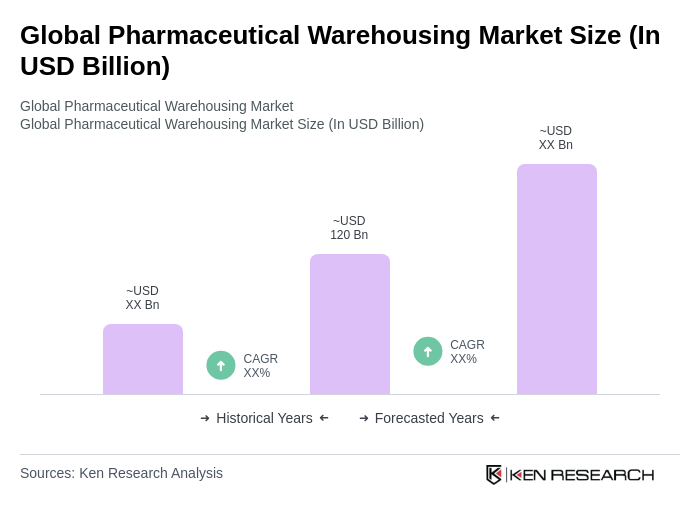
- The Global Pharmaceutical Warehousing Market is valued at USD 120 billion, based on a five-year historical analysis. This growth is primarily driven by the increasing demand for temperature-sensitive pharmaceuticals, the rise in e-commerce for healthcare products, and the expansion of biopharmaceuticals requiring specialized storage solutions .
- Key players in this market include the United States, Germany, and China, which dominate due to their advanced healthcare infrastructure, significant investments in pharmaceutical research and development, and robust logistics networks that facilitate efficient distribution of medical products .
- In 2023, the U.S. government advanced implementation of the Drug Supply Chain Security Act (DSCSA) with enhanced requirements for product tracing and interoperable systems across the supply chain, mandating stakeholders to maintain detailed records to ensure traceability and compliance, thereby strengthening integrity in pharmaceutical warehousing .
Global Pharmaceutical Warehousing Market Segmentation
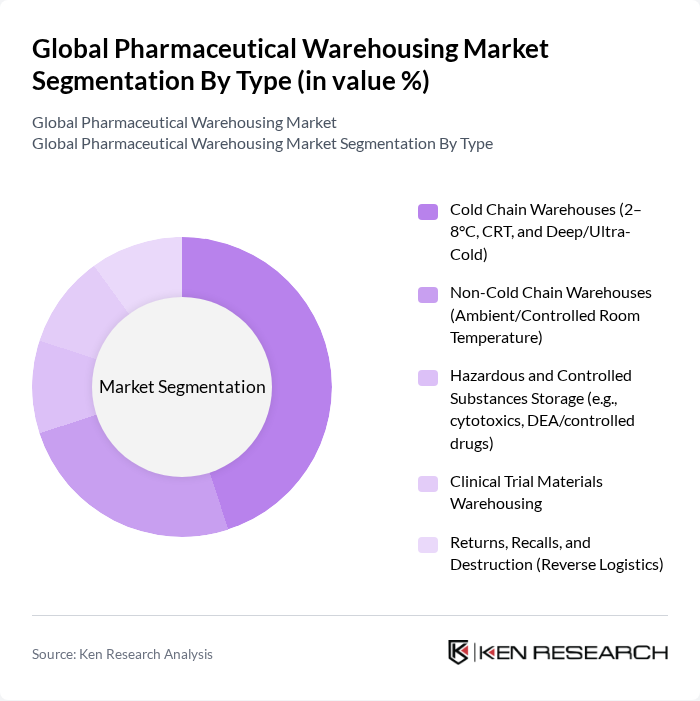
By Type:The market is segmented into various types of warehousing solutions that cater to the specific needs of pharmaceutical products. The subsegments include Cold Chain Warehouses, Non-Cold Chain Warehouses, Hazardous and Controlled Substances Storage, Clinical Trial Materials Warehousing, and Returns, Recalls, and Destruction services. Among these, Cold Chain Warehouses are particularly dominant due to the increasing need for temperature-controlled environments for sensitive medications and vaccines. The rise in biopharmaceuticals and the global pandemic have further accelerated the demand for these specialized storage facilities .
By End-User:The end-user segmentation includes Pharmaceutical and Biopharmaceutical Manufacturers, Wholesalers and Distributors, Retail and Online Pharmacies, Hospitals and Clinics, and Research Institutes and Government Agencies. The Pharmaceutical and Biopharmaceutical Manufacturers segment leads the market, driven by the increasing production of complex drugs and biologics that require specialized storage and handling. The growing trend of personalized medicine and the need for compliance with stringent regulatory standards further bolster this segment's dominance .

Global Pharmaceutical Warehousing Market Competitive Landscape
The Global Pharmaceutical Warehousing Market is characterized by a dynamic mix of regional and international players. Leading participants such as DHL Supply Chain (DHL Group), Kuehne+Nagel, Cencora (formerly AmerisourceBergen), UPS Healthcare, McKesson Corporation, Cardinal Health, DB Schenker, GXO Logistics, GEODIS, CEVA Logistics, FedEx Logistics and FedEx Supply Chain, C.H. Robinson, DSV, Agility Logistics (Agility Logistics Parks; Menzies Aviation Pharma), Sinopharm Logistics contribute to innovation, geographic expansion, and service delivery in this space .
Global Pharmaceutical Warehousing Market Industry Analysis
Growth Drivers
- Increasing Demand for Temperature-Controlled Storage:The global pharmaceutical market is projected to reach $1.5 trillion in size in future, driving the need for temperature-controlled storage solutions. In future, the cold chain logistics market was valued at approximately $200 billion, with a significant portion dedicated to pharmaceuticals. This demand is fueled by the rise in biologics and vaccines, which require strict temperature management, leading to an estimated 15% increase in temperature-controlled warehousing facilities in the next year.
- Rise in E-commerce for Pharmaceuticals:The e-commerce pharmaceutical sector is expected to grow to $130 billion in future, reflecting a 20% increase from the previous year. This surge is driven by consumer preferences for online purchasing and the convenience of home delivery. As a result, pharmaceutical companies are investing in warehousing solutions that can efficiently handle e-commerce logistics, including rapid order fulfillment and distribution, thereby enhancing their operational capabilities and market reach.
- Expansion of Biopharmaceuticals:The biopharmaceutical sector is anticipated to grow to $600 billion in future, representing a 10% annual growth rate. This expansion necessitates specialized warehousing solutions due to the unique storage requirements of biologics. The increasing number of biopharmaceutical products entering the market, including monoclonal antibodies and gene therapies, is driving investments in advanced warehousing technologies, ensuring compliance with stringent storage regulations and maintaining product integrity.
Market Challenges
- Stringent Regulatory Compliance:The pharmaceutical warehousing sector faces rigorous regulatory requirements, including FDA and EU guidelines, which can complicate operations. In future, over 60% of pharmaceutical companies reported challenges in meeting compliance standards, leading to potential fines and operational delays. The cost of non-compliance can reach millions, making it essential for companies to invest in training and technology to ensure adherence to these regulations, impacting overall profitability.
- High Operational Costs:The operational costs for pharmaceutical warehousing are projected to rise by 8% in future, primarily due to increased energy prices and labor costs. In future, the average cost of maintaining a temperature-controlled warehouse was approximately $1.2 million annually. These rising costs can strain profit margins, particularly for smaller firms, necessitating strategic investments in automation and efficiency improvements to remain competitive in the market.
Global Pharmaceutical Warehousing Market Future Outlook
The future of pharmaceutical warehousing is poised for significant transformation, driven by technological advancements and evolving market demands. The integration of IoT and AI technologies is expected to enhance inventory management and operational efficiency, while the shift towards sustainable practices will reshape logistics strategies. Additionally, as personalized medicine continues to gain traction, warehousing solutions will need to adapt to accommodate smaller, more diverse product lines, ensuring that companies remain agile and responsive to market changes.
Market Opportunities
- Adoption of Automation and Robotics:The increasing adoption of automation in warehousing is projected to reduce operational costs by up to 30% in future. Companies are investing in robotic systems for picking and packing, which enhances efficiency and accuracy. This trend presents a significant opportunity for firms to streamline operations and improve service delivery, ultimately leading to higher customer satisfaction and retention rates.
- Investment in Cold Chain Logistics:With the biopharmaceutical market expanding, investment in cold chain logistics is expected to exceed $250 billion in future. This investment will enhance the capacity and reliability of temperature-sensitive product storage and distribution. Companies that capitalize on this opportunity can improve their competitive edge by ensuring product integrity and compliance with regulatory standards, thereby attracting more clients in the pharmaceutical sector.
Scope of the Report
| Segment | Sub-Segments |
|---|---|
| By Type | Cold Chain Warehouses (2–8°C, CRT, and Deep/Ultra-Cold) Non-Cold Chain Warehouses (Ambient/Controlled Room Temperature) Hazardous and Controlled Substances Storage (e.g., cytotoxics, DEA/controlled drugs) Clinical Trial Materials Warehousing Returns, Recalls, and Destruction (Reverse Logistics) |
| By End-User | Pharmaceutical and Biopharmaceutical Manufacturers Wholesalers and Distributors Retail and Online Pharmacies Hospitals and Clinics Research Institutes and Government Agencies |
| By Distribution Mode | Direct-to-Pharmacy/Hospital Distribution Third-Party Logistics (3PL) and Fourth-Party Logistics (4PL) Direct-to-Patient and E-commerce Fulfillment Cross-Border and Bonded Warehousing |
| By Storage Capacity | Small Scale (Less than 10,000 sq. ft.) Medium Scale (10,000 - 50,000 sq. ft.) Large Scale (More than 50,000 sq. ft.) Mega Sites and Campus Networks (multi-facility hubs) |
| By Service Type | Storage and Handling Distribution and Transportation Inventory Management and Order Fulfillment Packaging, Kitting, and Labelling (including GDP-compliant repack) Value-Added Services (serialization, QP release, quality assurance) |
| By Geographic Coverage | National Coverage Regional Coverage Global Coverage Last-Mile and Urban Micro-Fulfillment |
| By Pricing Model | Space and Throughput-Based Pricing (per pallet/CBM, inbound/outbound) Activity-Based and Variable Pricing (value-added service menus) Contract Logistics/Long-Term SLA Pricing Subscription and Outcome-Based Models (e.g., SLA uptime, temperature excursion) |
Key Target Audience
Investors and Venture Capitalist Firms
Government and Regulatory Bodies (e.g., Food and Drug Administration, European Medicines Agency)
Pharmaceutical Manufacturers
Logistics and Supply Chain Companies
Pharmaceutical Wholesalers
Cold Chain Solution Providers
Healthcare Providers and Hospitals
Insurance Companies
Players Mentioned in the Report:
DHL Supply Chain (DHL Group)
Kuehne+Nagel
Cencora (formerly AmerisourceBergen)
UPS Healthcare
McKesson Corporation
Cardinal Health
DB Schenker
GXO Logistics
GEODIS
CEVA Logistics
FedEx Logistics and FedEx Supply Chain
C.H. Robinson
DSV
Agility Logistics (Agility Logistics Parks; Menzies Aviation Pharma)
Sinopharm Logistics
Table of Contents
Market Assessment Phase
1. Executive Summary and Approach
2. Global Pharmaceutical Warehousing Market Overview
2.1 Key Insights and Strategic Recommendations
2.2 Global Pharmaceutical Warehousing Market Overview
2.3 Definition and Scope
2.4 Evolution of Market Ecosystem
2.5 Timeline of Key Regulatory Milestones
2.6 Value Chain & Stakeholder Mapping
2.7 Business Cycle Analysis
2.8 Policy & Incentive Landscape
3. Global Pharmaceutical Warehousing Market Analysis
3.1 Growth Drivers
3.1.1 Increasing Demand for Temperature-Controlled Storage
3.1.2 Rise in E-commerce for Pharmaceuticals
3.1.3 Expansion of Biopharmaceuticals
3.1.4 Globalization of Supply Chains
3.2 Market Challenges
3.2.1 Stringent Regulatory Compliance
3.2.2 High Operational Costs
3.2.3 Limited Infrastructure in Emerging Markets
3.2.4 Risk of Supply Chain Disruptions
3.3 Market Opportunities
3.3.1 Adoption of Automation and Robotics
3.3.2 Growth in Personalized Medicine
3.3.3 Investment in Cold Chain Logistics
3.3.4 Expansion into Emerging Markets
3.4 Market Trends
3.4.1 Increasing Use of IoT in Warehousing
3.4.2 Shift Towards Sustainable Practices
3.4.3 Integration of AI for Inventory Management
3.4.4 Growth of Third-Party Logistics Providers
3.5 Government Regulation
3.5.1 FDA Guidelines for Drug Storage
3.5.2 EU Good Distribution Practice (GDP)
3.5.3 WHO Guidelines on Pharmaceutical Storage
3.5.4 National Regulations on Cold Chain Management
4. SWOT Analysis
5. Stakeholder Analysis
6. Porter's Five Forces Analysis
7. Global Pharmaceutical Warehousing Market Market Size, 2019-2024
7.1 By Value
7.2 By Volume
7.3 By Average Selling Price
8. Global Pharmaceutical Warehousing Market Segmentation
8.1 By Type
8.1.1 Cold Chain Warehouses (2–8°C, CRT, and Deep/Ultra-Cold)
8.1.2 Non-Cold Chain Warehouses (Ambient/Controlled Room Temperature)
8.1.3 Hazardous and Controlled Substances Storage (e.g., cytotoxics, DEA/controlled drugs)
8.1.4 Clinical Trial Materials Warehousing
8.1.5 Returns, Recalls, and Destruction (Reverse Logistics)
8.2 By End-User
8.2.1 Pharmaceutical and Biopharmaceutical Manufacturers
8.2.2 Wholesalers and Distributors
8.2.3 Retail and Online Pharmacies
8.2.4 Hospitals and Clinics
8.2.5 Research Institutes and Government Agencies
8.3 By Distribution Mode
8.3.1 Direct-to-Pharmacy/Hospital Distribution
8.3.2 Third-Party Logistics (3PL) and Fourth-Party Logistics (4PL)
8.3.3 Direct-to-Patient and E-commerce Fulfillment
8.3.4 Cross-Border and Bonded Warehousing
8.4 By Storage Capacity
8.4.1 Small Scale (Less than 10,000 sq. ft.)
8.4.2 Medium Scale (10,000 - 50,000 sq. ft.)
8.4.3 Large Scale (More than 50,000 sq. ft.)
8.4.4 Mega Sites and Campus Networks (multi-facility hubs)
8.5 By Service Type
8.5.1 Storage and Handling
8.5.2 Distribution and Transportation
8.5.3 Inventory Management and Order Fulfillment
8.5.4 Packaging, Kitting, and Labelling (including GDP-compliant repack)
8.5.5 Value-Added Services (serialization, QP release, quality assurance)
8.6 By Geographic Coverage
8.6.1 National Coverage
8.6.2 Regional Coverage
8.6.3 Global Coverage
8.6.4 Last-Mile and Urban Micro-Fulfillment
8.7 By Pricing Model
8.7.1 Space and Throughput-Based Pricing (per pallet/CBM, inbound/outbound)
8.7.2 Activity-Based and Variable Pricing (value-added service menus)
8.7.3 Contract Logistics/Long-Term SLA Pricing
8.7.4 Subscription and Outcome-Based Models (e.g., SLA uptime, temperature excursion)
9. Global Pharmaceutical Warehousing Market Competitive Analysis
9.1 Market Share of Key Players
9.2 Cross Comparison of Key Players
9.2.1 Company Name
9.2.2 Group Size (Large, Medium, or Small as per industry convention)
9.2.3 Life Sciences/Healthcare Logistics Revenue (latest fiscal, USD)
9.2.4 YoY Revenue Growth in Pharma/Life Sciences (%)
9.2.5 Temperature-Controlled Capacity (pallet positions; ULT/LTN/CRT)
9.2.6 GDP/GxP Compliance Coverage (sites with certifications; regions)
9.2.7 On-Time In-Full (OTIF) and SLA Compliance (%)
9.2.8 Inventory Accuracy and Cycle Count Accuracy (%)
9.2.9 Average Order-to-Ship Lead Time (hours)
9.2.10 Technology Adoption (WMS/TMS, serialization, IoT monitoring, automation level)
9.2.11 Carbon Intensity per Throughput (kg CO2e per pallet or order)
9.2.12 Quality Metrics (temperature excursion rate; CAPA closure time)
9.3 SWOT Analysis of Top Players
9.4 Pricing Analysis
9.5 Detailed Profile of Major Companies
9.5.1 DHL Supply Chain (DHL Group)
9.5.2 Kuehne+Nagel
9.5.3 Cencora (formerly AmerisourceBergen)
9.5.4 UPS Healthcare
9.5.5 McKesson Corporation
9.5.6 Cardinal Health
9.5.7 DB Schenker
9.5.8 GXO Logistics
9.5.9 GEODIS
9.5.10 CEVA Logistics
9.5.11 FedEx Logistics and FedEx Supply Chain
9.5.12 C.H. Robinson
9.5.13 DSV
9.5.14 Agility Logistics (Agility Logistics Parks; Menzies Aviation Pharma)
9.5.15 Sinopharm Logistics
10. Global Pharmaceutical Warehousing Market End-User Analysis
10.1 Procurement Behavior of Key Ministries
10.1.1 Government Procurement Policies
10.1.2 Budget Allocation Trends
10.1.3 Supplier Selection Criteria
10.2 Corporate Spend on Infrastructure & Energy
10.2.1 Investment in Cold Chain Infrastructure
10.2.2 Energy Efficiency Initiatives
10.2.3 Budgeting for Compliance and Safety
10.3 Pain Point Analysis by End-User Category
10.3.1 Supply Chain Disruptions
10.3.2 Regulatory Compliance Challenges
10.3.3 Cost Management Issues
10.4 User Readiness for Adoption
10.4.1 Technology Adoption Levels
10.4.2 Training and Skill Gaps
10.4.3 Infrastructure Readiness
10.5 Post-Deployment ROI and Use Case Expansion
10.5.1 Measurement of ROI Metrics
10.5.2 Case Studies of Successful Implementations
10.5.3 Future Use Case Opportunities
11. Global Pharmaceutical Warehousing Market Future Size, 2025-2030
11.1 By Value
11.2 By Volume
11.3 By Average Selling Price
Go-To-Market Strategy Phase
1. Whitespace Analysis + Business Model Canvas
1.1 Market Gaps Identification
1.2 Value Proposition Development
1.3 Revenue Streams Analysis
1.4 Key Partnerships Exploration
1.5 Cost Structure Assessment
2. Marketing and Positioning Recommendations
2.1 Branding Strategies
2.2 Product USPs
2.3 Target Market Segmentation
2.4 Communication Strategies
3. Distribution Plan
3.1 Urban Retail Strategies
3.2 Rural NGO Tie-ups
3.3 Direct-to-Consumer Approaches
4. Channel & Pricing Gaps
4.1 Underserved Routes
4.2 Pricing Bands Analysis
4.3 Competitive Pricing Strategies
5. Unmet Demand & Latent Needs
5.1 Category Gaps Identification
5.2 Consumer Segments Analysis
5.3 Future Demand Projections
6. Customer Relationship
6.1 Loyalty Programs Development
6.2 After-sales Service Strategies
6.3 Customer Feedback Mechanisms
7. Value Proposition
7.1 Sustainability Initiatives
7.2 Integrated Supply Chains
7.3 Competitive Advantages
8. Key Activities
8.1 Regulatory Compliance
8.2 Branding Initiatives
8.3 Distribution Setup
9. Entry Strategy Evaluation
9.1 Domestic Market Entry Strategy
9.1.1 Product Mix Considerations
9.1.2 Pricing Band Strategies
9.1.3 Packaging Innovations
9.2 Export Entry Strategy
9.2.1 Target Countries Identification
9.2.2 Compliance Roadmap Development
10. Entry Mode Assessment
10.1 Joint Ventures
10.2 Greenfield Investments
10.3 Mergers & Acquisitions
10.4 Distributor Model Evaluation
11. Capital and Timeline Estimation
11.1 Capital Requirements Analysis
11.2 Timelines for Implementation
12. Control vs Risk Trade-Off
12.1 Ownership vs Partnerships
12.2 Risk Management Strategies
13. Profitability Outlook
13.1 Breakeven Analysis
13.2 Long-term Sustainability Strategies
14. Potential Partner List
14.1 Distributors Identification
14.2 Joint Ventures Opportunities
14.3 Acquisition Targets
15. Execution Roadmap
15.1 Phased Plan for Market Entry
15.1.1 Market Setup
15.1.2 Market Entry
15.1.3 Growth Acceleration
15.1.4 Scale & Stabilize
15.2 Key Activities and Milestones
15.2.1 Milestone Planning
15.2.2 Activity Tracking
Research Methodology
Phase 1: Approach1
Desk Research
- Industry reports from global pharmaceutical associations and market research firms
- Analysis of regulatory frameworks and compliance guidelines from health authorities
- Published financial reports and press releases from leading pharmaceutical warehousing companies
Primary Research
- Interviews with logistics managers at major pharmaceutical manufacturers
- Surveys with warehouse operators specializing in pharmaceutical storage
- Field interviews with regulatory compliance officers in the pharmaceutical sector
Validation & Triangulation
- Cross-validation of data through multiple industry sources and expert opinions
- Triangulation of market trends using sales data, regulatory changes, and logistics costs
- Sanity checks through expert panel discussions and feedback sessions
Phase 2: Market Size Estimation1
Top-down Assessment
- Analysis of global pharmaceutical sales data to estimate warehousing needs
- Segmentation of the market by therapeutic areas and geographical regions
- Incorporation of trends in e-commerce and direct-to-consumer pharmaceutical distribution
Bottom-up Modeling
- Volume estimates based on the number of pharmaceutical products and their storage requirements
- Cost analysis derived from operational expenses of leading warehousing facilities
- Calculation of market size based on average storage fees and turnover rates
Forecasting & Scenario Analysis
- Multi-variable forecasting using growth rates in the pharmaceutical sector and logistics innovations
- Scenario planning based on potential regulatory changes and market disruptions
- Development of baseline, optimistic, and pessimistic forecasts through 2030
Phase 3: CATI Sample Composition1
| Scope Item/Segment | Sample Size | Target Respondent Profiles |
|---|---|---|
| Pharmaceutical Distribution Warehousing | 140 | Warehouse Managers, Supply Chain Analysts |
| Cold Chain Logistics for Biopharmaceuticals | 100 | Logistics Coordinators, Quality Assurance Managers |
| Regulatory Compliance in Pharmaceutical Storage | 80 | Compliance Officers, Regulatory Affairs Specialists |
| Pharmaceutical Returns Management | 70 | Returns Managers, Inventory Control Specialists |
| Technology Integration in Warehousing | 90 | IT Managers, Operations Directors |
Frequently Asked Questions
What is the current value of the Global Pharmaceutical Warehousing Market?
The Global Pharmaceutical Warehousing Market is valued at approximately USD 120 billion, driven by the increasing demand for temperature-sensitive pharmaceuticals, the rise in e-commerce for healthcare products, and the expansion of biopharmaceuticals requiring specialized storage solutions.
Which countries dominate the Global Pharmaceutical Warehousing Market?
What are the main types of warehousing solutions in the pharmaceutical sector?
What are the key growth drivers for the pharmaceutical warehousing market?
Other Regional/Country Reports
Indonesia Pharmaceutical Warehousing Market
Malaysia Pharmaceutical Warehousing Market
APAC Pharmaceutical Warehousing Market
SEA Pharmaceutical Warehousing Market
Why Buy From Us?

What makes us stand out is that our consultants follow Robust, Refine and Result (RRR) methodology. Robust for clear definitions, approaches and sanity checking, Refine for differentiating respondents' facts and opinions, and Result for presenting data with story.

We have set a benchmark in the industry by offering our clients with syndicated and customized market research reports featuring coverage of entire market as well as meticulous research and analyst insights.

While we don't replace traditional research, we flip the method upside down. Our dual approach of Top Bottom & Bottom Top ensures quality deliverable by not just verifying company fundamentals but also looking at the sector and macroeconomic factors.

With one step in the future, our research team constantly tries to show you the bigger picture. We help with some of the tough questions you may encounter along the way: How is the industry positioned? Best marketing channel? KPI's of competitors? By aligning every element, we help maximize success.

Our report gives you instant access to the answers and sources that other companies might choose to hide. We elaborate each steps of research methodology we have used and showcase you the sample size to earn your trust.

If you need any support, we are here! We pride ourselves on universe strength, data quality, and quick, friendly, and professional service.