About the Report
Base Year 2024Listen to the audio summary
Global Pharmacogenomics Market Overview
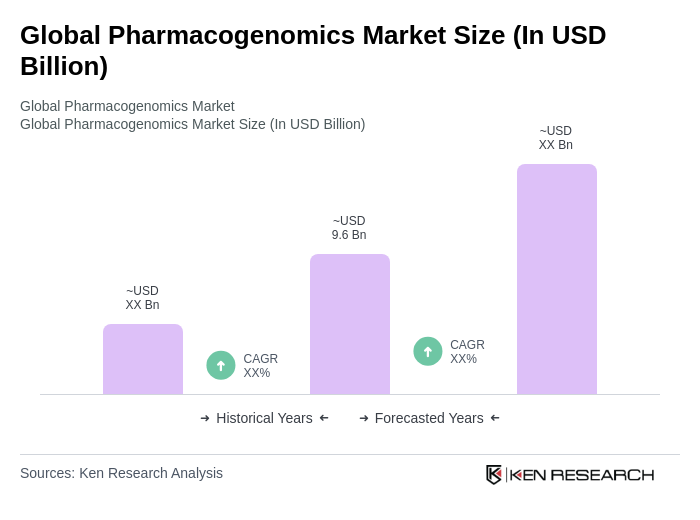
- The Global Pharmacogenomics Market is valued at USD 9.6 billion, based on a five-year historical analysis. Growth is driven by increased adoption of precision medicine, wider use of next-generation sequencing and PCR-based assays, and the need to reduce adverse drug reactions through genotype-guided therapy. Industry trackers place the market in the high-single to low-double-digit billion range in recent years, reflecting steady uptake across hospitals, labs, and biopharma .
- The United States, Germany, and Japan remain leading markets due to strong healthcare infrastructure, substantial R&D investment, and mature adoption of genomic technologies in clinical workflows and drug development. North America is consistently reported as the largest regional market, supported by payer coverage advancements and integration of PGx in health systems, while Europe (notably Germany) and advanced Asian markets (including Japan) show robust clinical and research adoption .
- U.S. FDA guidance and labeling resources continue to encourage the use of pharmacogenomic information in drug development and labeling, supporting clinician use of genetic data in prescribing. The FDA maintains and updates drug labeling with pharmacogenomic biomarkers and has issued multiple guidances on PGx considerations in development and labeling, which underpin greater clinical adoption and payer interest in PGx testing .
Global Pharmacogenomics Market Segmentation
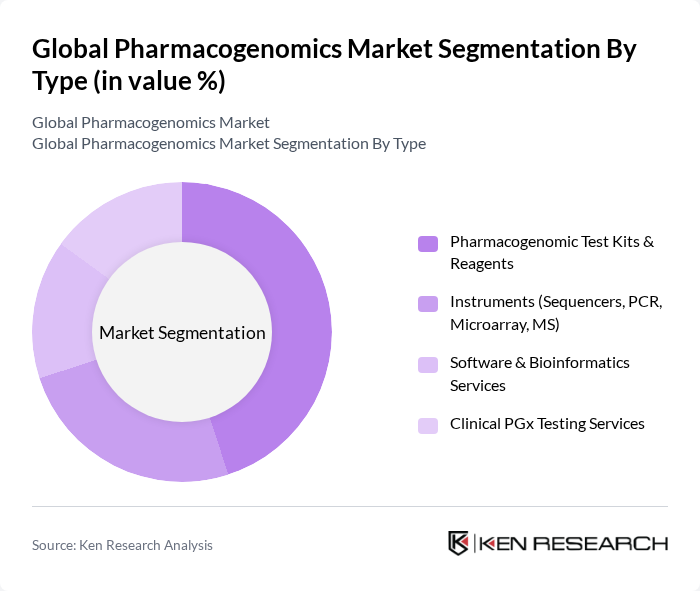
By Type:The market is segmented into various types, including Pharmacogenomic Test Kits & Reagents, Instruments (Sequencers, PCR, Microarray, MS), Software & Bioinformatics Services, and Clinical PGx Testing Services. Among these, Pharmacogenomic Test Kits & Reagents are leading the market due to their essential role in enabling personalized medicine, supporting high-volume genotyping of actionable genes (e.g., CYP2D6, CYP2C19, SLCO1B1), and improving therapeutic outcomes through rapid, standardized workflows in clinical labs .
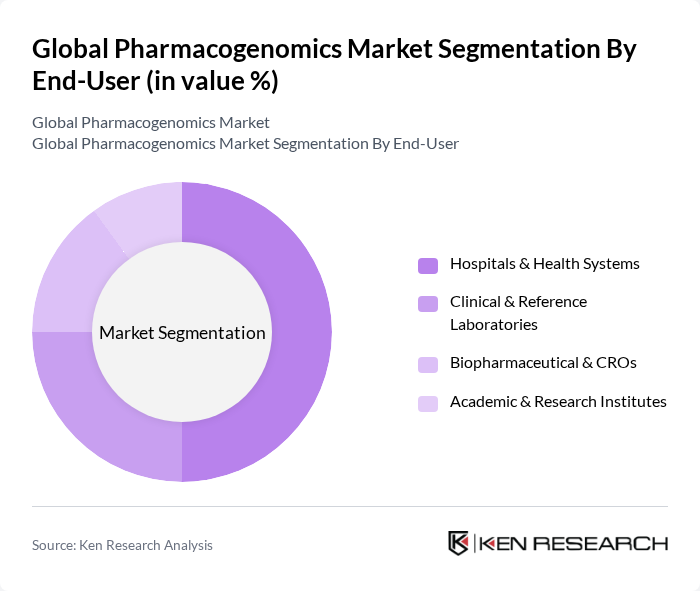
By End-User:The end-user segmentation includes Hospitals & Health Systems, Clinical & Reference Laboratories, Biopharmaceutical & CROs, and Academic & Research Institutes. Hospitals & Health Systems are the dominant end-users, driven by the increasing adoption of personalized medicine, formulary stewardship programs leveraging CPIC/PharmGKB guidance, and integration of PGx into EHR clinical decision support for medication optimization .
Global Pharmacogenomics Market Competitive Landscape
The Global Pharmacogenomics Market is characterized by a dynamic mix of regional and international players. Leading participants such as Thermo Fisher Scientific Inc., Illumina, Inc., F. Hoffmann-La Roche Ltd, Agilent Technologies, Inc., QIAGEN N.V., Myriad Genetics, Inc., Siemens Healthineers AG, Abbott Laboratories, Genomictree, Inc., Revvity, Inc. (formerly PerkinElmer), BGI Genomics Co., Ltd., Eurofins Scientific SE, Personalis, Inc., Foundation Medicine, Inc., Invitae Corporation, Natera, Inc., Color Health, Inc. (formerly Color Genomics), OneOme, LLC, 23andMe Holding Co., OPKO Health, Inc. (GeneDx) contribute to innovation, geographic expansion, and service delivery in this space .
Global Pharmacogenomics Market Industry Analysis
Growth Drivers
- Increasing Demand for Personalized Medicine:The global personalized medicine market is projected to reach $2.4 trillion in future, driven by the need for tailored therapies. This demand is fueled by the rising awareness of genetic factors in drug response, with 73% of healthcare professionals recognizing the importance of pharmacogenomics in treatment plans. As patients seek more effective and individualized treatments, the pharmacogenomics sector is positioned for significant growth, particularly in regions with advanced healthcare systems.
- Advancements in Genomic Technologies:The global genomics market is expected to exceed $62 billion in future, reflecting rapid advancements in sequencing technologies. Innovations such as next-generation sequencing (NGS) have reduced costs significantly, with the price of sequencing a human genome dropping to approximately $1,000. These technological improvements enhance the accessibility and accuracy of genetic testing, driving adoption in clinical settings and expanding the pharmacogenomics landscape in future.
- Rising Prevalence of Chronic Diseases:Chronic diseases, which account for 70% of all deaths globally, are increasingly driving the need for effective treatment strategies. In future, the global burden of chronic diseases is projected to cost healthcare systems over $47 trillion. This rising prevalence necessitates personalized treatment approaches, making pharmacogenomics essential for optimizing drug efficacy and minimizing adverse effects, particularly in regions with high chronic disease rates.
Market Challenges
- High Costs of Genetic Testing:The average cost of comprehensive genetic testing can range from $500 to $3,000, posing a significant barrier to widespread adoption. Many healthcare providers and patients are deterred by these costs, especially in regions with limited healthcare budgets. As a result, the high financial burden associated with genetic testing remains a critical challenge for the pharmacogenomics market, hindering its growth potential.
- Limited Awareness Among Healthcare Providers:A survey indicated that only 30% of healthcare providers are familiar with pharmacogenomic testing and its benefits. This lack of awareness can lead to underutilization of genetic testing in clinical practice, limiting the potential for personalized medicine. Educational initiatives and training programs are essential to bridge this knowledge gap and promote the integration of pharmacogenomics into standard healthcare practices.
Global Pharmacogenomics Market Future Outlook
The future of the pharmacogenomics market appears promising, driven by technological advancements and increasing healthcare investments. As healthcare systems prioritize personalized medicine, the integration of pharmacogenomics into clinical workflows is expected to accelerate. Additionally, the collaboration between technology firms and biopharmaceutical companies will likely enhance the development of innovative testing platforms, further expanding the market's reach and effectiveness in treating chronic diseases and optimizing drug therapies.
Market Opportunities
- Expansion in Emerging Markets:Emerging markets, particularly in Asia-Pacific, are witnessing a surge in healthcare investments, with spending projected to reach $1.5 trillion in future. This growth presents significant opportunities for pharmacogenomics companies to establish a presence and cater to the increasing demand for personalized medicine in these regions, where chronic diseases are on the rise.
- Integration of AI in Pharmacogenomics:The application of artificial intelligence in pharmacogenomics is expected to enhance data analysis and interpretation, improving patient outcomes. By future, the AI healthcare market is projected to reach $36 billion, indicating a robust opportunity for pharmacogenomics firms to leverage AI technologies for more accurate genetic testing and personalized treatment plans.
Scope of the Report
| Segment | Sub-Segments |
|---|---|
| By Type | Pharmacogenomic Test Kits & Reagents Instruments (Sequencers, PCR, Microarray, MS) Software & Bioinformatics Services Clinical PGx Testing Services |
| By End-User | Hospitals & Health Systems Clinical & Reference Laboratories Biopharmaceutical & CROs Academic & Research Institutes |
| By Application | Oncology Cardiology Psychiatry/Neurology Infectious Diseases & Pain Management |
| By Region | North America Europe Asia-Pacific Latin America Middle East & Africa |
| By Distribution Channel | Direct (Enterprise/Provider Contracts) Channel Partners & Distributors Online (eCommerce, Digital Ordering) Group Purchasing Organizations (GPOs) |
| By Pricing Model | Per-Test Fee Subscription/SaaS (Software & Decision Support) Bundled Panels/Pathways Value-Based/Outcome-Linked Pricing |
| By Research Type | Clinical Implementation & Utility Studies Preclinical/Discovery PGx Translational & Real-World Evidence Health Economics & Outcomes Research (HEOR) |
Key Target Audience
Investors and Venture Capitalist Firms
Government and Regulatory Bodies (e.g., U.S. Food and Drug Administration, European Medicines Agency)
Pharmaceutical Companies
Biotechnology Firms
Clinical Laboratories
Healthcare Providers and Institutions
Health Insurance Companies
Diagnostic Test Manufacturers
Players Mentioned in the Report:
Thermo Fisher Scientific Inc.
Illumina, Inc.
F. Hoffmann-La Roche Ltd
Agilent Technologies, Inc.
QIAGEN N.V.
Myriad Genetics, Inc.
Siemens Healthineers AG
Abbott Laboratories
Genomictree, Inc.
Revvity, Inc. (formerly PerkinElmer)
BGI Genomics Co., Ltd.
Eurofins Scientific SE
Personalis, Inc.
Foundation Medicine, Inc.
Invitae Corporation
Natera, Inc.
Color Health, Inc. (formerly Color Genomics)
OneOme, LLC
23andMe Holding Co.
OPKO Health, Inc. (GeneDx)
Table of Contents
Market Assessment Phase
1. Executive Summary and Approach
2. Global Pharmacogenomics Market Overview
2.1 Key Insights and Strategic Recommendations
2.2 Global Pharmacogenomics Market Overview
2.3 Definition and Scope
2.4 Evolution of Market Ecosystem
2.5 Timeline of Key Regulatory Milestones
2.6 Value Chain & Stakeholder Mapping
2.7 Business Cycle Analysis
2.8 Policy & Incentive Landscape
3. Global Pharmacogenomics Market Analysis
3.1 Growth Drivers
3.1.1 Increasing Demand for Personalized Medicine
3.1.2 Advancements in Genomic Technologies
3.1.3 Rising Prevalence of Chronic Diseases
3.1.4 Supportive Government Initiatives
3.2 Market Challenges
3.2.1 High Costs of Genetic Testing
3.2.2 Limited Awareness Among Healthcare Providers
3.2.3 Regulatory Hurdles
3.2.4 Data Privacy Concerns
3.3 Market Opportunities
3.3.1 Expansion in Emerging Markets
3.3.2 Collaborations with Biopharmaceutical Companies
3.3.3 Development of New Testing Platforms
3.3.4 Integration of AI in Pharmacogenomics
3.4 Market Trends
3.4.1 Growth of Direct-to-Consumer Genetic Testing
3.4.2 Increasing Focus on Preventive Healthcare
3.4.3 Rise of Digital Health Solutions
3.4.4 Personalized Drug Development
3.5 Government Regulation
3.5.1 Genetic Information Nondiscrimination Act (GINA)
3.5.2 FDA Guidelines on Genetic Testing
3.5.3 HIPAA Regulations on Patient Data
3.5.4 European Union General Data Protection Regulation (GDPR)
4. SWOT Analysis
5. Stakeholder Analysis
6. Porter's Five Forces Analysis
7. Global Pharmacogenomics Market Market Size, 2019-2024
7.1 By Value
7.2 By Volume
7.3 By Average Selling Price
8. Global Pharmacogenomics Market Segmentation
8.1 By Type
8.1.1 Pharmacogenomic Test Kits & Reagents
8.1.2 Instruments (Sequencers, PCR, Microarray, MS)
8.1.3 Software & Bioinformatics Services
8.1.4 Clinical PGx Testing Services
8.2 By End-User
8.2.1 Hospitals & Health Systems
8.2.2 Clinical & Reference Laboratories
8.2.3 Biopharmaceutical & CROs
8.2.4 Academic & Research Institutes
8.3 By Application
8.3.1 Oncology
8.3.2 Cardiology
8.3.3 Psychiatry/Neurology
8.3.4 Infectious Diseases & Pain Management
8.4 By Region
8.4.1 North America
8.4.2 Europe
8.4.3 Asia-Pacific
8.4.4 Latin America
8.4.5 Middle East & Africa
8.5 By Distribution Channel
8.5.1 Direct (Enterprise/Provider Contracts)
8.5.2 Channel Partners & Distributors
8.5.3 Online (eCommerce, Digital Ordering)
8.5.4 Group Purchasing Organizations (GPOs)
8.6 By Pricing Model
8.6.1 Per-Test Fee
8.6.2 Subscription/SaaS (Software & Decision Support)
8.6.3 Bundled Panels/Pathways
8.6.4 Value-Based/Outcome-Linked Pricing
8.7 By Research Type
8.7.1 Clinical Implementation & Utility Studies
8.7.2 Preclinical/Discovery PGx
8.7.3 Translational & Real-World Evidence
8.7.4 Health Economics & Outcomes Research (HEOR)
9. Global Pharmacogenomics Market Competitive Analysis
9.1 Market Share of Key Players
9.2 Cross Comparison of Key Players
9.2.1 Company Name
9.2.2 Scale (Global, Regional, or Niche)
9.2.3 PGx Testing Volume (Annual Tests Processed)
9.2.4 Installed Base (Labs/Health Systems Using PGx Platform)
9.2.5 Menu Breadth (Genes/Variants, CPIC/PharmGKB Coverage)
9.2.6 Turnaround Time (Median TAT, Days)
9.2.7 Regulatory & Reimbursement Status (FDA/CE-IVD, Payer Coverage)
9.2.8 Partnerships & Pharma/CRO Collaborations
9.2.9 Revenue Growth (PGx-Specific, YoY)
9.2.10 Gross Margin (PGx Segment)
9.2.11 Price per Test/Panel (List and Net)
9.2.12 LDT vs IVD Mix
9.2.13 Digital CDS Integration (EHR/CDSS Compatibility)
9.2.14 Geographic Footprint (Countries Served)
9.3 SWOT Analysis of Top Players
9.4 Pricing Analysis
9.5 Detailed Profile of Major Companies
9.5.1 Thermo Fisher Scientific Inc.
9.5.2 Illumina, Inc.
9.5.3 F. Hoffmann-La Roche Ltd
9.5.4 Agilent Technologies, Inc.
9.5.5 QIAGEN N.V.
9.5.6 Myriad Genetics, Inc.
9.5.7 Siemens Healthineers AG
9.5.8 Abbott Laboratories
9.5.9 Genomictree, Inc.
9.5.10 Revvity, Inc. (formerly PerkinElmer)
9.5.11 BGI Genomics Co., Ltd.
9.5.12 Eurofins Scientific SE
9.5.13 Personalis, Inc.
9.5.14 Foundation Medicine, Inc.
9.5.15 Invitae Corporation
9.5.16 Natera, Inc.
9.5.17 Color Health, Inc. (formerly Color Genomics)
9.5.18 OneOme, LLC
9.5.19 23andMe Holding Co.
9.5.20 OPKO Health, Inc. (GeneDx)
10. Global Pharmacogenomics Market End-User Analysis
10.1 Procurement Behavior of Key Ministries
10.1.1 Government Health Departments
10.1.2 Research Institutions
10.1.3 Public Health Organizations
10.2 Corporate Spend on Infrastructure & Energy
10.2.1 Investment in Genomic Research
10.2.2 Funding for Clinical Trials
10.2.3 Budget Allocation for Health Technology
10.3 Pain Point Analysis by End-User Category
10.3.1 Healthcare Providers
10.3.2 Patients
10.3.3 Pharmaceutical Companies
10.4 User Readiness for Adoption
10.4.1 Awareness Levels
10.4.2 Training Needs
10.4.3 Infrastructure Readiness
10.5 Post-Deployment ROI and Use Case Expansion
10.5.1 Measurement of Outcomes
10.5.2 Scalability of Solutions
10.5.3 Long-term Benefits Analysis
11. Global Pharmacogenomics Market Future Size, 2025-2030
11.1 By Value
11.2 By Volume
11.3 By Average Selling Price
Go-To-Market Strategy Phase
1. Whitespace Analysis + Business Model Canvas
1.1 Market Gaps Identification
1.2 Value Proposition Development
1.3 Revenue Streams Analysis
1.4 Key Partnerships
1.5 Cost Structure Analysis
2. Marketing and Positioning Recommendations
2.1 Branding Strategies
2.2 Product USPs
2.3 Target Audience Segmentation
2.4 Communication Strategies
3. Distribution Plan
3.1 Urban Retail Strategies
3.2 Rural NGO Tie-ups
3.3 Online Distribution Channels
3.4 Partnerships with Healthcare Providers
4. Channel & Pricing Gaps
4.1 Underserved Routes
4.2 Pricing Bands Analysis
4.3 Competitor Pricing Strategies
5. Unmet Demand & Latent Needs
5.1 Category Gaps
5.2 Consumer Segments Analysis
5.3 Emerging Trends
6. Customer Relationship
6.1 Loyalty Programs
6.2 After-sales Service
6.3 Customer Feedback Mechanisms
7. Value Proposition
7.1 Sustainability Initiatives
7.2 Integrated Supply Chains
7.3 Competitive Advantages
8. Key Activities
8.1 Regulatory Compliance
8.2 Branding Efforts
8.3 Distribution Setup
9. Entry Strategy Evaluation
9.1 Domestic Market Entry Strategy
9.1.1 Product Mix
9.1.2 Pricing Band
9.1.3 Packaging
9.2 Export Entry Strategy
9.2.1 Target Countries
9.2.2 Compliance Roadmap
10. Entry Mode Assessment
10.1 Joint Ventures
10.2 Greenfield Investments
10.3 Mergers & Acquisitions
10.4 Distributor Model
11. Capital and Timeline Estimation
11.1 Capital Requirements
11.2 Timelines
12. Control vs Risk Trade-Off
12.1 Ownership vs Partnerships
13. Profitability Outlook
13.1 Breakeven Analysis
13.2 Long-term Sustainability
14. Potential Partner List
14.1 Distributors
14.2 Joint Ventures
14.3 Acquisition Targets
15. Execution Roadmap
15.1 Phased Plan for Market Entry
15.1.1 Market Setup
15.1.2 Market Entry
15.1.3 Growth Acceleration
15.1.4 Scale & Stabilize
15.2 Key Activities and Milestones
15.2.1 Activity Planning
15.2.2 Milestone Tracking
Research Methodology
Phase 1: Approach1
Desk Research
- Analysis of published market reports from industry associations and research firms
- Review of scientific literature and clinical studies on pharmacogenomics
- Examination of regulatory frameworks and guidelines from health authorities
Primary Research
- Interviews with key opinion leaders in pharmacogenomics, including geneticists and clinicians
- Surveys targeting pharmaceutical companies and biotech firms involved in pharmacogenomic testing
- Focus groups with healthcare providers to understand adoption barriers and facilitators
Validation & Triangulation
- Cross-validation of findings through multiple data sources, including market reports and expert insights
- Triangulation of quantitative data with qualitative insights from interviews and surveys
- Sanity checks through expert panel reviews to ensure data accuracy and relevance
Phase 2: Market Size Estimation1
Top-down Assessment
- Estimation of the global pharmacogenomics market size based on healthcare expenditure trends
- Segmentation by application areas such as oncology, cardiology, and psychiatry
- Incorporation of growth rates from emerging markets and technological advancements
Bottom-up Modeling
- Collection of sales data from leading pharmacogenomic testing laboratories
- Estimation of market share based on the number of tests conducted and pricing models
- Volume x price analysis for different pharmacogenomic tests and services
Forecasting & Scenario Analysis
- Multi-factor regression analysis incorporating factors such as healthcare policy changes and technological innovations
- Scenario modeling based on varying levels of market penetration and regulatory impacts
- Development of baseline, optimistic, and pessimistic forecasts through 2030
Phase 3: CATI Sample Composition1
| Scope Item/Segment | Sample Size | Target Respondent Profiles |
|---|---|---|
| Pharmacogenomic Testing Laboratories | 100 | Laboratory Directors, Genetic Counselors |
| Pharmaceutical Companies | 80 | Product Managers, R&D Heads |
| Healthcare Providers | 120 | Physicians, Pharmacists |
| Regulatory Bodies | 50 | Policy Makers, Compliance Officers |
| Patients and Advocacy Groups | 70 | Patient Advocates, Community Health Workers |
Frequently Asked Questions
What is the current value of the Global Pharmacogenomics Market?
The Global Pharmacogenomics Market is valued at approximately USD 9.6 billion, reflecting steady growth driven by the adoption of precision medicine and advancements in genomic technologies, including next-generation sequencing and PCR-based assays.
What factors are driving the growth of the Pharmacogenomics Market?
Which regions are leading in the Pharmacogenomics Market?
What are the main types of products in the Pharmacogenomics Market?
Other Regional/Country Reports
Indonesia Pharmacogenomics Market
Malaysia Pharmacogenomics Market
APAC Pharmacogenomics Market
SEA Pharmacogenomics Market
Why Buy From Us?

What makes us stand out is that our consultants follow Robust, Refine and Result (RRR) methodology. Robust for clear definitions, approaches and sanity checking, Refine for differentiating respondents' facts and opinions, and Result for presenting data with story.

We have set a benchmark in the industry by offering our clients with syndicated and customized market research reports featuring coverage of entire market as well as meticulous research and analyst insights.

While we don't replace traditional research, we flip the method upside down. Our dual approach of Top Bottom & Bottom Top ensures quality deliverable by not just verifying company fundamentals but also looking at the sector and macroeconomic factors.

With one step in the future, our research team constantly tries to show you the bigger picture. We help with some of the tough questions you may encounter along the way: How is the industry positioned? Best marketing channel? KPI's of competitors? By aligning every element, we help maximize success.

Our report gives you instant access to the answers and sources that other companies might choose to hide. We elaborate each steps of research methodology we have used and showcase you the sample size to earn your trust.

If you need any support, we are here! We pride ourselves on universe strength, data quality, and quick, friendly, and professional service.