About the Report
Base Year 2024Listen to the audio summary
Global Photochromic Lenses Market Overview
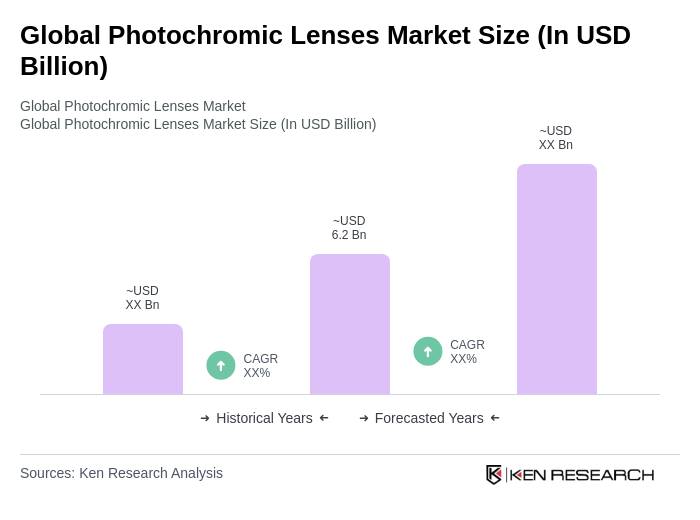
- The Global Photochromic Lenses Market is valued at USD 6.2 billion, based on a five-year historical analysis . This growth is primarily driven by increasing consumer awareness regarding eye protection from UV rays, coupled with the rising prevalence of vision disorders. The demand for photochromic lenses has surged as they offer convenience and comfort, adapting to varying light conditions, which appeals to a broad consumer base .
- Key players in this market are predominantly located in North America and Europe, with the United States and Germany leading due to their advanced healthcare systems and high disposable incomes. These regions have a strong presence of optical retail chains and a growing trend towards personalized eyewear solutions, which further drives market growth .
- In 2023, the European Union implemented regulations mandating that all optical products must meet specific safety and quality standards. This regulation aims to enhance consumer safety and ensure that photochromic lenses provide adequate UV protection, thereby fostering trust and encouraging higher adoption rates among consumers .
Global Photochromic Lenses Market Segmentation
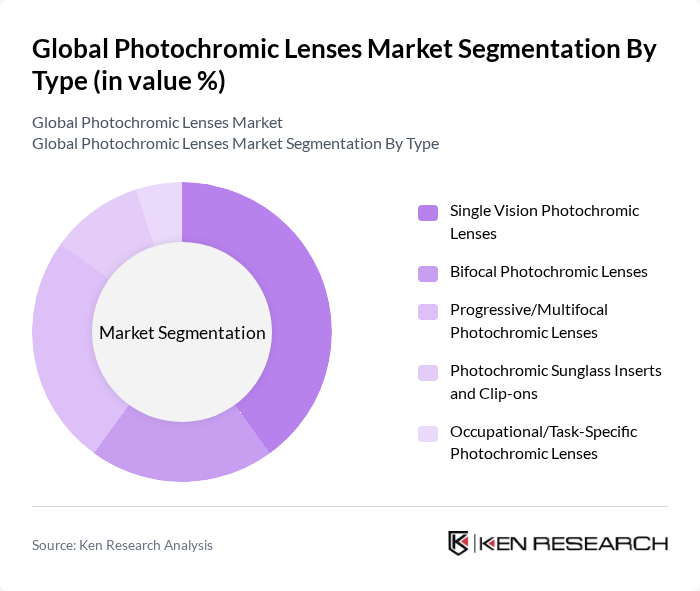
By Type:The market is segmented into various types of photochromic lenses, including Single Vision, Bifocal, Progressive/Multifocal, Photochromic Sunglass Inserts and Clip-ons, and Occupational/Task-Specific lenses. Among these, Single Vision Photochromic Lenses dominate the market due to their widespread use in corrective eyewear, catering to a large consumer base. The convenience and adaptability of these lenses to different lighting conditions make them a preferred choice for everyday use .
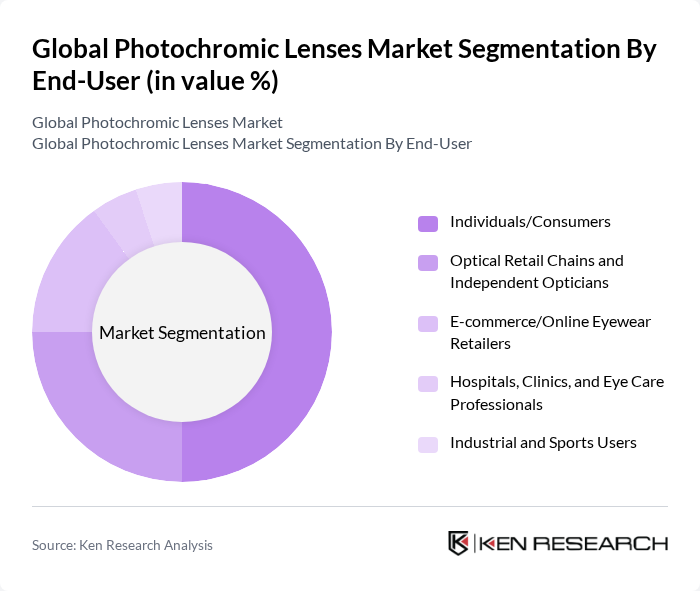
By End-User:The end-user segmentation includes Individuals/Consumers, Optical Retail Chains and Independent Opticians, E-commerce/Online Eyewear Retailers, Hospitals, Clinics, and Eye Care Professionals, and Industrial and Sports Users. The Individuals/Consumers segment leads the market, driven by the increasing trend of personalized eyewear and the growing awareness of eye health. This segment's growth is further supported by the rise of e-commerce platforms, making photochromic lenses more accessible to a wider audience .
Global Photochromic Lenses Market Competitive Landscape
The Global Photochromic Lenses Market is characterized by a dynamic mix of regional and international players. Leading participants such as EssilorLuxottica (Transitions Optical), Carl Zeiss Vision, HOYA Vision Care, Nikon Lenswear, Shamir Optical Industry, Rodenstock Group, BBGR (Essilor Group), Vision-Ease Lens, Corning Incorporated, Opto Tech, Indo-MIM (photochromic materials), Tokai Optical Co., Ltd., Jiangsu Green Stone Optical (China), Younger Optics, Mitsui Chemicals (SunSensors) contribute to innovation, geographic expansion, and service delivery in this space.
Global Photochromic Lenses Market Industry Analysis
Growth Drivers
- Increasing Demand for UV Protection:The global rise in skin cancer cases, with over 1.5 million new cases reported annually, has heightened awareness of UV protection. In future, the World Health Organization estimates that 90% of skin cancers are linked to UV exposure. This has led to a surge in demand for photochromic lenses, which provide essential UV protection, driving market growth as consumers prioritize eye safety alongside skin health.
- Rising Awareness of Eye Health:With the increasing prevalence of digital eye strain affecting approximately 60% of adults, there is a growing focus on eye health. The American Optometric Association reports that 75% of adults use digital devices for over two hours daily. This trend has prompted consumers to seek photochromic lenses that reduce glare and enhance visual comfort, thereby boosting market demand significantly in future.
- Technological Advancements in Lens Manufacturing:Innovations in lens technology, such as the introduction of faster-reacting photochromic materials, have improved product performance. In future, manufacturers are expected to invest over $200 million in R&D to enhance lens durability and responsiveness. These advancements not only attract consumers but also enable manufacturers to differentiate their products, fostering competitive growth in the photochromic lenses market.
Market Challenges
- High Cost of Photochromic Lenses:The average price of photochromic lenses ranges from $200 to $500, which can deter price-sensitive consumers. In future, the economic impact of inflation is projected to reduce disposable income for many households, making it challenging for consumers to justify the investment in premium eyewear. This high cost remains a significant barrier to widespread adoption in various markets.
- Competition from Non-Photochromic Alternatives:The market faces stiff competition from non-photochromic lenses, which are often priced lower and perceived as sufficient for basic needs. In future, non-photochromic lens sales are expected to exceed 150 million units globally, highlighting the challenge photochromic lenses face in convincing consumers of their added value. This competition can hinder market growth and limit market share for photochromic products.
Global Photochromic Lenses Market Future Outlook
The future of the photochromic lenses market appears promising, driven by increasing consumer awareness of eye health and the growing demand for UV protection. As technological advancements continue to enhance product offerings, manufacturers are likely to focus on developing innovative solutions that cater to evolving consumer preferences. Additionally, the expansion of online sales channels will facilitate greater accessibility, allowing consumers to explore a wider range of options and driving market growth in the coming years.
Market Opportunities
- Expansion in Emerging Markets:Emerging markets, particularly in Asia and Africa, present significant growth opportunities. With a combined population exceeding 3 billion, increasing disposable incomes are expected to drive demand for photochromic lenses. In future, these regions are projected to see a 20% increase in eyewear sales, creating a fertile ground for market expansion and new customer acquisition.
- Development of Smart Lenses:The integration of smart technology into lenses, such as augmented reality features, is an emerging opportunity. By future, the smart eyewear market is anticipated to reach $10 billion, with photochromic lenses playing a crucial role. This innovation can attract tech-savvy consumers, enhancing the appeal of photochromic lenses and driving market growth through diversification.
Scope of the Report
| Segment | Sub-Segments |
|---|---|
| By Type | Single Vision Photochromic Lenses Bifocal Photochromic Lenses Progressive/Multifocal Photochromic Lenses Photochromic Sunglass Inserts and Clip-ons Occupational/Task-Specific Photochromic Lenses |
| By End-User | Individuals/Consumers Optical Retail Chains and Independent Opticians E-commerce/Online Eyewear Retailers Hospitals, Clinics, and Eye Care Professionals Industrial and Sports Users |
| By Distribution Channel | Optical Stores and Specialty Clinics E-commerce Platforms OEM/Direct-to-Brand Partnerships Wholesalers and Distributors |
| By Material | Plastic (CR-39) Polycarbonate Trivex High-Index Plastic Glass |
| By Technology | UV-Activated Photochromics Visible-Light-Activated Photochromics Imbibed/Trans-bonded In-Mass (Bulk) Technology Other Coating and Film Technologies |
| By Application | Corrective (Prescription) Eyewear Preventive/Non-Prescription Eyewear Sports and Safety Eyewear |
| By Price Range | Budget Mid-Range Premium |
| By Region | North America Europe Asia-Pacific Middle East & Africa South America |
Key Target Audience
Investors and Venture Capitalist Firms
Government and Regulatory Bodies (e.g., Food and Drug Administration, European Medicines Agency)
Manufacturers and Producers
Distributors and Retailers
Optical Lens Designers and Developers
Healthcare Providers and Eye Care Professionals
Industry Associations (e.g., Optical Manufacturers Association)
Financial Institutions and Investment Banks
Players Mentioned in the Report:
EssilorLuxottica (Transitions Optical)
Carl Zeiss Vision
HOYA Vision Care
Nikon Lenswear
Shamir Optical Industry
Rodenstock Group
BBGR (Essilor Group)
Vision-Ease Lens
Corning Incorporated
Opto Tech
Indo-MIM (photochromic materials)
Tokai Optical Co., Ltd.
Jiangsu Green Stone Optical (China)
Younger Optics
Mitsui Chemicals (SunSensors)
Table of Contents
Market Assessment Phase
1. Executive Summary and Approach
2. Global Photochromic Lenses Market Overview
2.1 Key Insights and Strategic Recommendations
2.2 Global Photochromic Lenses Market Overview
2.3 Definition and Scope
2.4 Evolution of Market Ecosystem
2.5 Timeline of Key Regulatory Milestones
2.6 Value Chain & Stakeholder Mapping
2.7 Business Cycle Analysis
2.8 Policy & Incentive Landscape
3. Global Photochromic Lenses Market Analysis
3.1 Growth Drivers
3.1.1 Increasing Demand for UV Protection
3.1.2 Rising Awareness of Eye Health
3.1.3 Technological Advancements in Lens Manufacturing
3.1.4 Growth in Eyewear Fashion Trends
3.2 Market Challenges
3.2.1 High Cost of Photochromic Lenses
3.2.2 Competition from Non-Photochromic Alternatives
3.2.3 Limited Consumer Awareness in Emerging Markets
3.2.4 Regulatory Hurdles in Different Regions
3.3 Market Opportunities
3.3.1 Expansion in Emerging Markets
3.3.2 Development of Smart Lenses
3.3.3 Collaborations with Eyewear Retailers
3.3.4 Increasing Online Sales Channels
3.4 Market Trends
3.4.1 Customization and Personalization of Lenses
3.4.2 Integration of Digital Technologies
3.4.3 Sustainable and Eco-Friendly Lens Options
3.4.4 Growth of Prescription Photochromic Lenses
3.5 Government Regulation
3.5.1 Standards for UV Protection
3.5.2 Regulations on Lens Manufacturing Materials
3.5.3 Guidelines for Marketing and Advertising
3.5.4 Compliance with Health and Safety Standards
4. SWOT Analysis
5. Stakeholder Analysis
6. Porter's Five Forces Analysis
7. Global Photochromic Lenses Market Market Size, 2019-2024
7.1 By Value
7.2 By Volume
7.3 By Average Selling Price
8. Global Photochromic Lenses Market Segmentation
8.1 By Type
8.1.1 Single Vision Photochromic Lenses
8.1.2 Bifocal Photochromic Lenses
8.1.3 Progressive/Multifocal Photochromic Lenses
8.1.4 Photochromic Sunglass Inserts and Clip-ons
8.1.5 Occupational/Task-Specific Photochromic Lenses
8.2 By End-User
8.2.1 Individuals/Consumers
8.2.2 Optical Retail Chains and Independent Opticians
8.2.3 E-commerce/Online Eyewear Retailers
8.2.4 Hospitals, Clinics, and Eye Care Professionals
8.2.5 Industrial and Sports Users
8.3 By Distribution Channel
8.3.1 Optical Stores and Specialty Clinics
8.3.2 E-commerce Platforms
8.3.3 OEM/Direct-to-Brand Partnerships
8.3.4 Wholesalers and Distributors
8.4 By Material
8.4.1 Plastic (CR-39)
8.4.2 Polycarbonate
8.4.3 Trivex
8.4.4 High-Index Plastic
8.4.5 Glass
8.5 By Technology
8.5.1 UV-Activated Photochromics
8.5.2 Visible-Light-Activated Photochromics
8.5.3 Imbibed/Trans-bonded
8.5.4 In-Mass (Bulk) Technology
8.5.5 Other Coating and Film Technologies
8.6 By Application
8.6.1 Corrective (Prescription) Eyewear
8.6.2 Preventive/Non-Prescription Eyewear
8.6.3 Sports and Safety Eyewear
8.7 By Price Range
8.7.1 Budget
8.7.2 Mid-Range
8.7.3 Premium
8.8 By Region
8.8.1 North America
8.8.2 Europe
8.8.3 Asia-Pacific
8.8.4 Middle East & Africa
8.8.5 South America
9. Global Photochromic Lenses Market Competitive Analysis
9.1 Market Share of Key Players
9.2 Cross Comparison of Key Players
9.2.1 Company Name
9.2.2 Group Size (Large, Medium, or Small as per industry convention)
9.2.3 Global Ophthalmic Revenue and Photochromic Revenue Mix (%)
9.2.4 Geographic Revenue Split (NA, EU, APAC, RoW)
9.2.5 Installed Lab Capacity/Surfacing-Edging Footprint
9.2.6 Market Penetration in Optical Chains (doors/partnerships)
9.2.7 Average Selling Price Positioning (Budget/Mid/Premium)
9.2.8 Product Innovation Rate (new SKUs/features per year)
9.2.9 Photochromic Activation/Deactivation Performance Benchmarks
9.2.10 Share of Sales via E-commerce/Direct-to-Consumer (%)
9.2.11 Patent Portfolio Strength (active grants/applications)
9.2.12 Strategic Alliances and OEM Partnerships Count
9.2.13 Customer Satisfaction/Net Promoter Score (NPS)
9.2.14 Sustainability Metrics (recycled content, energy intensity)
9.3 SWOT Analysis of Top Players
9.4 Pricing Analysis
9.5 Detailed Profile of Major Companies
9.5.1 EssilorLuxottica (Transitions Optical)
9.5.2 Carl Zeiss Vision
9.5.3 HOYA Vision Care
9.5.4 Nikon Lenswear
9.5.5 Shamir Optical Industry
9.5.6 Rodenstock Group
9.5.7 BBGR (Essilor Group)
9.5.8 Vision-Ease Lens
9.5.9 Corning Incorporated
9.5.10 Opto Tech
9.5.11 Indo-MIM (photochromic materials)
9.5.12 Tokai Optical Co., Ltd.
9.5.13 Jiangsu Green Stone Optical (China)
9.5.14 Younger Optics
9.5.15 Mitsui Chemicals (SunSensors)
10. Global Photochromic Lenses Market End-User Analysis
10.1 Procurement Behavior of Key Ministries
10.1.1 Government Procurement Policies
10.1.2 Budget Allocations for Eye Care
10.1.3 Collaboration with Private Sector
10.2 Corporate Spend on Infrastructure & Energy
10.2.1 Investment in Eye Care Facilities
10.2.2 Funding for Vision Health Programs
10.2.3 Corporate Social Responsibility Initiatives
10.3 Pain Point Analysis by End-User Category
10.3.1 Accessibility to Quality Lenses
10.3.2 Affordability of Photochromic Options
10.3.3 Awareness of Benefits
10.4 User Readiness for Adoption
10.4.1 Consumer Education Initiatives
10.4.2 Availability of Trial Products
10.4.3 Feedback Mechanisms
10.5 Post-Deployment ROI and Use Case Expansion
10.5.1 Long-term Cost Savings
10.5.2 Enhanced User Experience
10.5.3 Opportunities for Upselling
11. Global Photochromic Lenses Market Future Size, 2025-2030
11.1 By Value
11.2 By Volume
11.3 By Average Selling Price
Go-To-Market Strategy Phase
1. Whitespace Analysis + Business Model Canvas
1.1 Market Gaps Identification
1.2 Value Proposition Development
1.3 Revenue Streams Analysis
1.4 Customer Segmentation
1.5 Key Partnerships
1.6 Cost Structure Analysis
1.7 Channels of Distribution
2. Marketing and Positioning Recommendations
2.1 Branding Strategies
2.2 Product USPs
2.3 Target Audience Identification
2.4 Communication Strategies
2.5 Digital Marketing Approaches
3. Distribution Plan
3.1 Urban Retail Strategies
3.2 Rural NGO Tie-ups
3.3 Online Distribution Channels
3.4 Partnerships with Optical Stores
4. Channel & Pricing Gaps
4.1 Underserved Routes
4.2 Pricing Bands Analysis
4.3 Competitor Pricing Strategies
5. Unmet Demand & Latent Needs
5.1 Category Gaps
5.2 Consumer Segments Analysis
5.3 Product Development Opportunities
6. Customer Relationship
6.1 Loyalty Programs
6.2 After-sales Service
6.3 Customer Feedback Mechanisms
7. Value Proposition
7.1 Sustainability Initiatives
7.2 Integrated Supply Chains
7.3 Customer-Centric Innovations
8. Key Activities
8.1 Regulatory Compliance
8.2 Branding Initiatives
8.3 Distribution Setup
9. Entry Strategy Evaluation
9.1 Domestic Market Entry Strategy
9.1.1 Product Mix Considerations
9.1.2 Pricing Band Strategy
9.1.3 Packaging Innovations
9.2 Export Entry Strategy
9.2.1 Target Countries Identification
9.2.2 Compliance Roadmap Development
10. Entry Mode Assessment
10.1 Joint Ventures
10.2 Greenfield Investments
10.3 Mergers & Acquisitions
10.4 Distributor Model Evaluation
11. Capital and Timeline Estimation
11.1 Capital Requirements
11.2 Timelines for Market Entry
12. Control vs Risk Trade-Off
12.1 Ownership vs Partnerships
13. Profitability Outlook
13.1 Breakeven Analysis
13.2 Long-term Sustainability Strategies
14. Potential Partner List
14.1 Distributors
14.2 Joint Ventures
14.3 Acquisition Targets
15. Execution Roadmap
15.1 Phased Plan for Market Entry
15.1.1 Market Setup
15.1.2 Market Entry
15.1.3 Growth Acceleration
15.1.4 Scale & Stabilize
15.2 Key Activities and Milestones
15.2.1 Milestone Planning
15.2.2 Activity Tracking
Research Methodology
Phase 1: Approach1
Desk Research
- Industry reports from optical associations and market research firms
- Published articles and white papers on advancements in photochromic technology
- Statistical data from government agencies on eyewear consumption trends
Primary Research
- Interviews with optical retailers and distributors to understand market dynamics
- Surveys with ophthalmologists and optometrists regarding consumer preferences
- Field interviews with manufacturers of photochromic lenses to gather insights on production processes
Validation & Triangulation
- Cross-validation of data from multiple sources including trade publications and expert opinions
- Triangulation of market size estimates using sales data and consumer surveys
- Sanity checks through expert panel reviews comprising industry veterans
Phase 2: Market Size Estimation1
Top-down Assessment
- Analysis of global eyewear market size to estimate the share of photochromic lenses
- Segmentation by geographic regions and demographic factors influencing demand
- Incorporation of trends in vision correction and outdoor activities impacting lens usage
Bottom-up Modeling
- Volume estimates based on production data from leading photochromic lens manufacturers
- Pricing analysis based on retail price points across different regions
- Calculation of market size using unit sales multiplied by average selling price
Forecasting & Scenario Analysis
- Multi-factor regression analysis incorporating factors such as aging population and UV awareness
- Scenario modeling based on potential regulatory changes affecting lens materials
- Baseline, optimistic, and pessimistic forecasts through 2030 based on market trends
Phase 3: CATI Sample Composition1
| Scope Item/Segment | Sample Size | Target Respondent Profiles |
|---|---|---|
| Optical Retailers | 150 | Store Managers, Sales Representatives |
| Ophthalmologists | 100 | Eye Care Professionals, Clinic Directors |
| Photochromic Lens Manufacturers | 80 | Production Managers, R&D Heads |
| Consumers of Photochromic Lenses | 150 | End-users, Age 18-65, Active Lifestyle Participants |
| Industry Experts | 50 | Market Analysts, Consultants in Optical Industry |
Frequently Asked Questions
What is the current value of the Global Photochromic Lenses Market?
The Global Photochromic Lenses Market is valued at approximately USD 6.2 billion, reflecting a significant growth trend driven by increasing consumer awareness of eye protection and the rising prevalence of vision disorders.
What factors are driving the growth of the photochromic lenses market?
Which regions are leading in the photochromic lenses market?
What types of photochromic lenses are available in the market?
Other Regional/Country Reports
Indonesia Photochromic Lenses Market
Malaysia Photochromic Lenses Market
APAC Photochromic Lenses Market
SEA Photochromic Lenses Market
Why Buy From Us?

What makes us stand out is that our consultants follow Robust, Refine and Result (RRR) methodology. Robust for clear definitions, approaches and sanity checking, Refine for differentiating respondents' facts and opinions, and Result for presenting data with story.

We have set a benchmark in the industry by offering our clients with syndicated and customized market research reports featuring coverage of entire market as well as meticulous research and analyst insights.

While we don't replace traditional research, we flip the method upside down. Our dual approach of Top Bottom & Bottom Top ensures quality deliverable by not just verifying company fundamentals but also looking at the sector and macroeconomic factors.

With one step in the future, our research team constantly tries to show you the bigger picture. We help with some of the tough questions you may encounter along the way: How is the industry positioned? Best marketing channel? KPI's of competitors? By aligning every element, we help maximize success.

Our report gives you instant access to the answers and sources that other companies might choose to hide. We elaborate each steps of research methodology we have used and showcase you the sample size to earn your trust.

If you need any support, we are here! We pride ourselves on universe strength, data quality, and quick, friendly, and professional service.