Region:Global
Author(s):Dev
Product Code:KRAC0489
Pages:84
Published On:August 2025
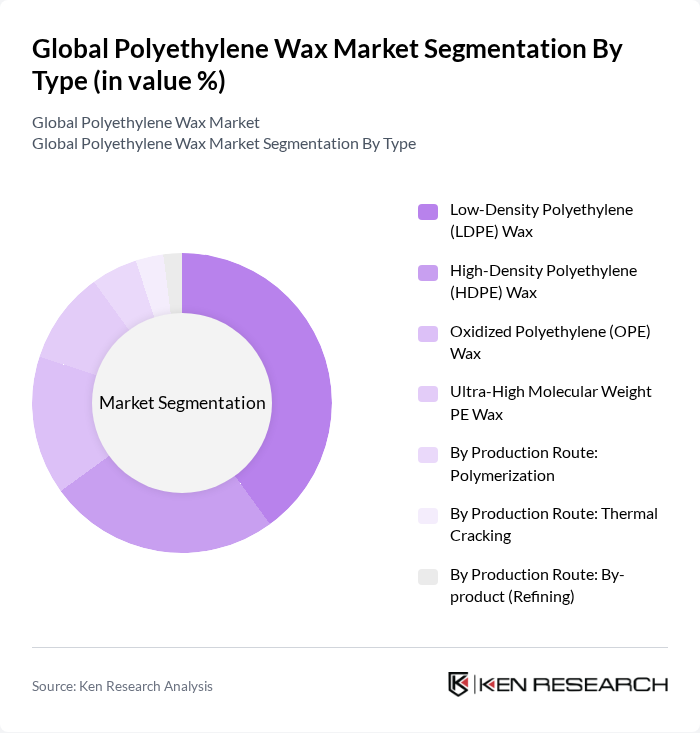
By Type:The polyethylene wax market can be segmented into various types, including Low-Density Polyethylene (LDPE) Wax, High-Density Polyethylene (HDPE) Wax, Oxidized Polyethylene (OPE) Wax, Ultra-High Molecular Weight PE Wax, and production routes such as Polymerization, Thermal Cracking, and by-product (Refining). Among these, LDPE Wax and OPE Wax are widely used for dispersion, lubrication, and surface modification in plastics, inks, and coatings due to good compatibility and processability, while UHMW PE wax provides abrasion resistance and slip in coatings and inks .
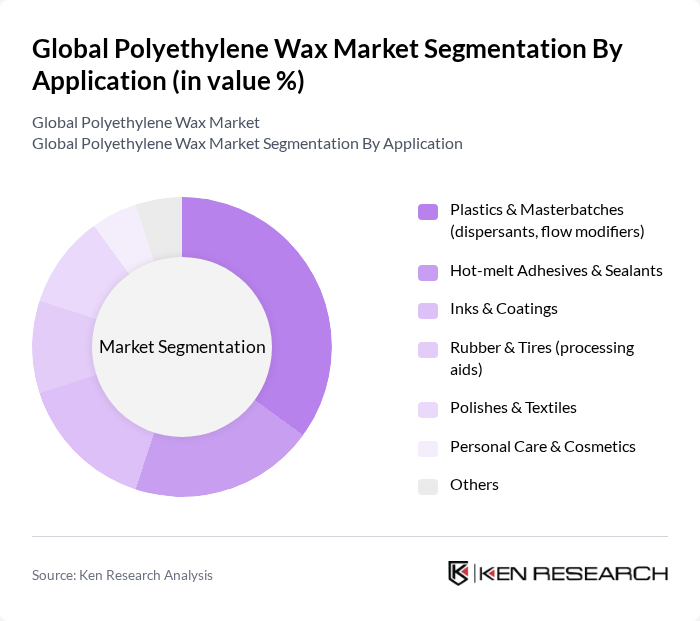
By Application:The applications of polyethylene wax are diverse, including Plastics & Masterbatches (dispersants, flow modifiers), Hot-melt Adhesives & Sealants, Inks & Coatings, Rubber & Tires (processing aids), Polishes & Textiles, Personal Care & Cosmetics, and others. Plastics and masterbatches lead because PE wax enhances melt flow, dispersion of pigments and fillers, mold release, and surface finish; it also improves scratch resistance and slip in inks/coatings and adjusts open time and viscosity in hot-melt adhesives .
The Global Polyethylene Wax Market is characterized by a dynamic mix of regional and international players. Leading participants such as BASF SE, Honeywell International Inc., Clariant AG, Mitsui Chemicals, Inc., INEOS Group Holdings S.A., The Lubrizol Corporation, Trecora Resources, Marcus Oil & Chemical Company, SCG Chemicals Public Company Limited (SCGC), Westlake Corporation, LyondellBasell Industries N.V., Qingdao Sainuo New Materials Co., Ltd., Clariant Masterbatches (now part of Avient Corporation), Micro Powders, Inc., The International Group, Inc. (IGI Wax) contribute to innovation, geographic expansion, and service delivery in this space .
The future of the polyethylene wax market appears promising, driven by a growing emphasis on sustainability and innovation. As industries increasingly adopt eco-friendly practices, the demand for bio-based polyethylene wax is expected to rise significantly. Additionally, advancements in production technologies will likely enhance efficiency and reduce costs, enabling manufacturers to meet the evolving needs of various sectors. Strategic collaborations and partnerships will further facilitate market expansion, allowing companies to leverage shared resources and expertise for competitive advantage.
| Segment | Sub-Segments |
|---|---|
| By Type | Low-Density Polyethylene (LDPE) Wax High-Density Polyethylene (HDPE) Wax Oxidized Polyethylene (OPE) Wax Ultra-High Molecular Weight PE Wax By Production Route: Polymerization, Thermal Cracking, and by-product (Refining) |
| By Application | Plastics & Masterbatches (dispersants, flow modifiers) Hot-melt Adhesives & Sealants Inks & Coatings Rubber & Tires (processing aids) Polishes & Textiles Personal Care & Cosmetics Others |
| By End-User | Packaging Automotive Construction & Building Materials Printing & Publishing Consumer Goods Industrial & Chemicals Others |
| By Sales Channel | Direct (Producers to Converters/OEMs) Distributors/Traders Online/B2B Platforms Others |
| By Distribution Mode | Bulk Distribution (tankers, big-bag) Packaged Distribution (bags, sacks, drums) Others |
| By Price Range | Economy Mid-Range Premium |
| By Region | North America Europe Asia-Pacific Latin America Middle East & Africa |
| Scope Item/Segment | Sample Size | Target Respondent Profiles |
|---|---|---|
| Coatings Industry | 100 | Product Development Managers, Technical Directors |
| Adhesives Sector | 80 | Procurement Managers, R&D Specialists |
| Plastics Manufacturing | 90 | Operations Managers, Quality Control Analysts |
| Cosmetics and Personal Care | 70 | Formulation Chemists, Brand Managers |
| Food Packaging Applications | 60 | Supply Chain Managers, Regulatory Affairs Specialists |
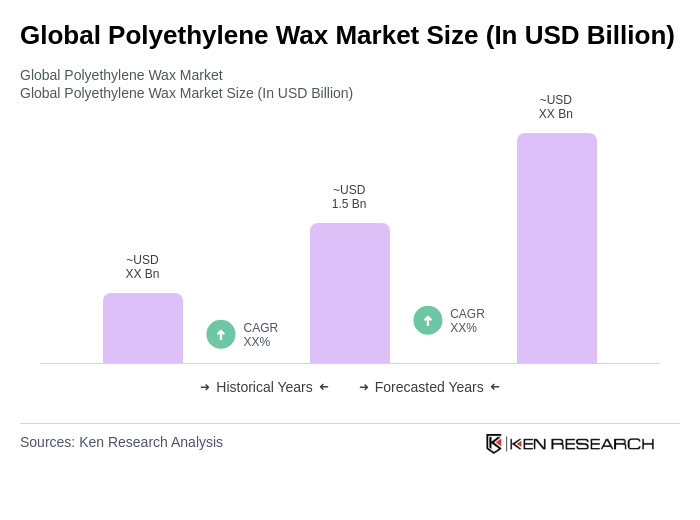
The Global Polyethylene Wax Market is valued at approximately USD 1.5 billion, reflecting demand across various industries such as plastics, coatings, and adhesives, where polyethylene wax is utilized for its lubrication, thermal stability, and chemical resistance properties.

What makes us stand out is that our consultants follow Robust, Refine and Result (RRR) methodology. Robust for clear definitions, approaches and sanity checking, Refine for differentiating respondents' facts and opinions, and Result for presenting data with story.

We have set a benchmark in the industry by offering our clients with syndicated and customized market research reports featuring coverage of entire market as well as meticulous research and analyst insights.

While we don't replace traditional research, we flip the method upside down. Our dual approach of Top Bottom & Bottom Top ensures quality deliverable by not just verifying company fundamentals but also looking at the sector and macroeconomic factors.

With one step in the future, our research team constantly tries to show you the bigger picture. We help with some of the tough questions you may encounter along the way: How is the industry positioned? Best marketing channel? KPI's of competitors? By aligning every element, we help maximize success.

Our report gives you instant access to the answers and sources that other companies might choose to hide. We elaborate each steps of research methodology we have used and showcase you the sample size to earn your trust.

If you need any support, we are here! We pride ourselves on universe strength, data quality, and quick, friendly, and professional service.













