About the Report
Base Year 2024Global Polyphthalamide Ppa Market Overview
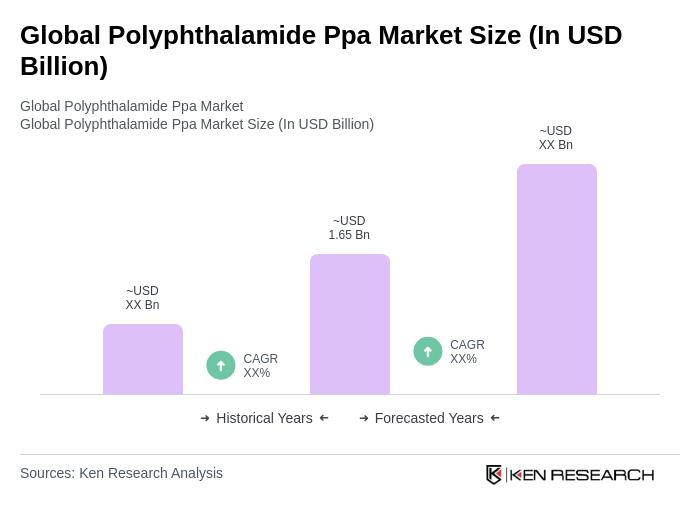
- The Global Polyphthalamide PPA Market is valued at approximately USD 1.65 billion, based on a five-year analysis. Recent industry estimates place the market near USD 1.65 billion and USD 1.7 billion, with momentum driven by automotive and electrical/electronics demand for high-heat, chemically resistant engineering plastics .
- Key demand centers include the United States, Germany, and Japan, supported by deep automotive and electronics value chains; Asia Pacific is the largest regional market by share, with China, South Korea, and Japan leading electronics manufacturing, while the United States and Germany anchor automotive and e-mobility components .
- The European Union has tightened circularity and sustainability rules affecting engineering plastics through measures such as the Single-Use Plastics framework, Ecodesign for Sustainable Products Regulation, and the Circular Economy Action Plan, which collectively drive recyclability, recycled content, and design-for-circularity expectations for plastic materials and components, influencing PPA selection toward halogen?free FR grades and lower?CO2 solutions .
Global Polyphthalamide Ppa Market Segmentation
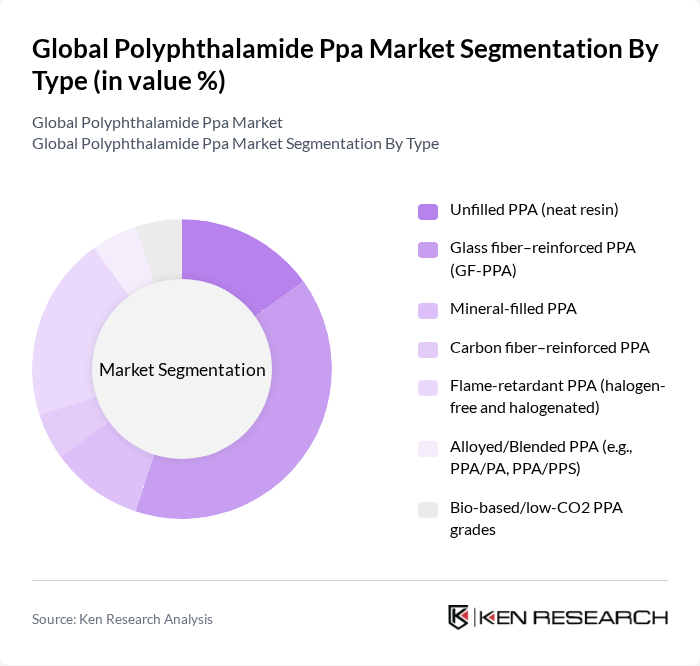
By Type:The polyphthalamide market is segmented into various types, including Unfilled PPA (neat resin), Glass fiber–reinforced PPA (GF-PPA), Mineral-filled PPA, Carbon fiber–reinforced PPA, Flame-retardant PPA (halogen-free and halogenated), Alloyed/Blended PPA (e.g., PPA/PA, PPA/PPS), and Bio-based/low-CO2 PPA grades. Among these, Glass fiber–reinforced PPA (GF-PPA) is the leading subsegment due to its superior mechanical properties and thermal stability, making it ideal for automotive and electrical applications .
By End-User:The end-user segmentation includes Automotive & Transportation, Electrical & Electronics, Industrial & Energy (machinery, oil & gas, fluid handling), Consumer Goods & Appliances, Healthcare & Medical Devices, and Others. The Automotive & Transportation sector is the dominant segment, driven by the increasing demand for lightweight materials that enhance fuel efficiency and reduce emissions in vehicles; PPA’s high heat resistance and chemical durability also underpin fast growth in miniaturized E&E connectors, LED housings, and high-voltage EV components .

Global Polyphthalamide Ppa Market Competitive Landscape
The Global Polyphthalamide PPA Market is characterized by a dynamic mix of regional and international players. Leading participants such as Solvay S.A. (Amodel PPA), DuPont de Nemours, Inc. (Zytel HTN), Arkema S.A. (Kepstan and specialty PPA compounds), Evonik Industries AG, and BASF SE (Ultramid Advanced PA) contribute to innovation, geographic expansion, and service delivery in this space.
Global Polyphthalamide Ppa Market Industry Analysis
Growth Drivers
- Increasing Demand from Automotive Industry:The automotive sector is projected to consume approximately 30,000 tons of polyphthalamide (PPA) in the future, driven by the need for lightweight and durable materials. The global automotive production is expected to reach 90 million units in the future, with a significant shift towards high-performance plastics. This trend is supported by the International Organization of Motor Vehicle Manufacturers, which indicates a 5% annual growth in vehicle production, enhancing the demand for PPA in automotive applications.
- Rising Adoption in Electrical & Electronics:The electrical and electronics sector is anticipated to utilize around 25,000 tons of PPA in the future, fueled by the increasing integration of advanced materials in devices. The global electronics market is projected to grow to $1.5 trillion, with a notable rise in demand for components that require high thermal stability and electrical insulation. This growth is corroborated by the Semiconductor Industry Association, which forecasts a 7% increase in semiconductor sales, further driving PPA adoption.
- Growth in Consumer Goods Sector:The consumer goods sector is expected to account for approximately 20,000 tons of PPA usage in the future, as manufacturers seek materials that enhance product durability and aesthetics. The global consumer goods market is projected to reach $12 trillion, with a growing emphasis on innovative packaging and durable household products. According to Statista, the demand for high-performance materials in consumer goods is set to increase by 6% annually, supporting PPA's market growth.
Market Challenges
- High Production Costs:The production costs of polyphthalamide remain a significant barrier, with estimates indicating that manufacturing PPA can exceed $5,000 per ton. This high cost is primarily due to the complex synthesis processes and the need for specialized equipment. As a result, many manufacturers are hesitant to adopt PPA, especially in price-sensitive markets. The World Bank reports that raw material prices are expected to rise by 3% in the future, further exacerbating this challenge.
- Limited Awareness Among End-Users:A considerable challenge in the PPA market is the limited awareness among potential end-users regarding the benefits of polyphthalamide. Many industries, particularly small and medium enterprises, lack knowledge about PPA's superior properties, such as heat resistance and mechanical strength. According to a recent industry survey, over 40% of manufacturers in emerging markets are unaware of PPA's applications, hindering market penetration and growth.
Global Polyphthalamide Ppa Market Future Outlook
The future of the polyphthalamide market appears promising, driven by technological advancements and increasing applications across various industries. The automotive and electronics sectors are expected to lead the demand, with innovations in lightweight materials and smart technologies. Additionally, the focus on sustainability will likely push manufacturers to explore eco-friendly production methods. As awareness grows, the adoption of PPA is anticipated to rise, creating a more competitive landscape and fostering collaborations among industry players.
Market Opportunities
- Expansion in Emerging Markets:Emerging markets, particularly in Asia-Pacific, present significant opportunities for PPA growth. With a projected increase in manufacturing activities and urbanization, the demand for high-performance materials is expected to rise. The Asian Development Bank estimates that infrastructure investments in the region will exceed $1.7 trillion in the future, creating a favorable environment for PPA adoption.
- Innovations in Product Development:Continuous innovations in PPA formulations and applications are set to create new market opportunities. Companies investing in R&D are likely to develop specialized grades of PPA that cater to niche applications, enhancing performance characteristics. The global investment in polymer research is projected to reach $10 billion in the future, indicating a robust pipeline for innovative PPA products.
Scope of the Report
| Segment | Sub-Segments |
|---|---|
| By Type | Unfilled PPA (neat resin) Glass fiber–reinforced PPA (GF-PPA) Mineral-filled PPA Carbon fiber–reinforced PPA Flame-retardant PPA (halogen-free and halogenated) Alloyed/Blended PPA (e.g., PPA/PA, PPA/PPS) Bio-based/low-CO2 PPA grades |
| By End-User | Automotive & Transportation Electrical & Electronics Industrial & Energy (machinery, oil & gas, fluid handling) Consumer Goods & Appliances Healthcare & Medical Devices Others |
| By Application | Automotive components (under?the?hood, fuel/EV thermal, connectors) E&E components (connectors, LED housings, breakers, sockets) Fluid handling (pumps, valves, fittings, gears) Industrial equipment (compressors, bearings, structural parts) Consumer electronics & appliance parts Oil & gas seals, gaskets, and tubing Others |
| By Distribution Channel | Direct sales (producers to OEMs/molders) Authorized distributors & compounders Online/marketplace sales (specialty resin platforms) Regional resin traders Others |
| By Region | North America Europe Asia-Pacific Latin America Middle East & Africa |
| By Price Range | Standard grades Specialty/high-performance grades Custom-compounded grades |
| By Product Form | Pellets/Granules Powders Precompounded concentrates (masterbatch) Others |
Key Target Audience
Investors and Venture Capitalist Firms
Government and Regulatory Bodies (e.g., Environmental Protection Agency, Occupational Safety and Health Administration)
Manufacturers and Producers
Distributors and Retailers
Automotive Industry Stakeholders
Aerospace Industry Stakeholders
Plastics and Polymer Industry Associations
Financial Institutions
Players Mentioned in the Report:
Solvay S.A. (Amodel PPA)
DuPont de Nemours, Inc. (Zytel HTN)
Arkema S.A. (Kepstan and specialty PPA compounds)
Evonik Industries AG
EMSChemie Holding AG (Grivory HT, Grilamid HT)
BASF SE (Ultramid Advanced PA)
Celanese Corporation (previously DuPont M&M integration scope)
Royal DSM (now Envalior; Stanyl/Arnite portfolio integration)
SABIC (specialty PA and PPA compounds)
Toray Industries, Inc.
KURARAY CO., LTD.
Kingfa Science & Technology Co., Ltd.
RTP Company
Ensinger GmbH
Ascend Performance Materials
Table of Contents
Market Assessment Phase
1. Executive Summary and Approach
2. Global Polyphthalamide Ppa Market Overview
2.1 Key Insights and Strategic Recommendations
2.2 Global Polyphthalamide Ppa Market Overview
2.3 Definition and Scope
2.4 Evolution of Market Ecosystem
2.5 Timeline of Key Regulatory Milestones
2.6 Value Chain & Stakeholder Mapping
2.7 Business Cycle Analysis
2.8 Policy & Incentive Landscape
3. Global Polyphthalamide Ppa Market Analysis
3.1 Growth Drivers
3.1.1 Increasing Demand from Automotive Industry
3.1.2 Rising Adoption in Electrical & Electronics
3.1.3 Growth in Consumer Goods Sector
3.1.4 Advancements in Manufacturing Technologies
3.2 Market Challenges
3.2.1 High Production Costs
3.2.2 Limited Awareness Among End-Users
3.2.3 Stringent Environmental Regulations
3.2.4 Competition from Alternative Materials
3.3 Market Opportunities
3.3.1 Expansion in Emerging Markets
3.3.2 Innovations in Product Development
3.3.3 Collaborations and Partnerships
3.3.4 Increasing Focus on Sustainability
3.4 Market Trends
3.4.1 Shift Towards Lightweight Materials
3.4.2 Growing Use in 3D Printing Applications
3.4.3 Integration of Smart Technologies
3.4.4 Customization and Personalization in Products
3.5 Government Regulation
3.5.1 Compliance with REACH Regulations
3.5.2 Implementation of Waste Management Policies
3.5.3 Standards for Material Safety
3.5.4 Incentives for Sustainable Practices
4. SWOT Analysis
5. Stakeholder Analysis
6. Porter's Five Forces Analysis
7. Global Polyphthalamide Ppa Market Market Size, 2019-2024
7.1 By Value
7.2 By Volume
7.3 By Average Selling Price
8. Global Polyphthalamide Ppa Market Segmentation
8.1 By Type
8.1.1 Unfilled PPA (neat resin)
8.1.2 Glass fiber–reinforced PPA (GF-PPA)
8.1.3 Mineral-filled PPA
8.1.4 Carbon fiber–reinforced PPA
8.1.5 Flame-retardant PPA (halogen-free and halogenated)
8.1.6 Alloyed/Blended PPA (e.g., PPA/PA, PPA/PPS)
8.1.7 Bio-based/low-CO2 PPA grades
8.2 By End-User
8.2.1 Automotive & Transportation
8.2.2 Electrical & Electronics
8.2.3 Industrial & Energy (machinery, oil & gas, fluid handling)
8.2.4 Consumer Goods & Appliances
8.2.5 Healthcare & Medical Devices
8.2.6 Others
8.3 By Application
8.3.1 Automotive components (under?the?hood, fuel/EV thermal, connectors)
8.3.2 E&E components (connectors, LED housings, breakers, sockets)
8.3.3 Fluid handling (pumps, valves, fittings, gears)
8.3.4 Industrial equipment (compressors, bearings, structural parts)
8.3.5 Consumer electronics & appliance parts
8.3.6 Oil & gas seals, gaskets, and tubing
8.3.7 Others
8.4 By Distribution Channel
8.4.1 Direct sales (producers to OEMs/molders)
8.4.2 Authorized distributors & compounders
8.4.3 Online/marketplace sales (specialty resin platforms)
8.4.4 Regional resin traders
8.4.5 Others
8.5 By Region
8.5.1 North America
8.5.2 Europe
8.5.3 Asia-Pacific
8.5.4 Latin America
8.5.5 Middle East & Africa
8.6 By Price Range
8.6.1 Standard grades
8.6.2 Specialty/high-performance grades
8.6.3 Custom-compounded grades
8.7 By Product Form
8.7.1 Pellets/Granules
8.7.2 Powders
8.7.3 Precompounded concentrates (masterbatch)
8.7.4 Others
9. Global Polyphthalamide Ppa Market Competitive Analysis
9.1 Market Share of Key Players
9.2 Cross Comparison of Key Players
9.2.1 Company name (PPA portfolio owner or major compounder)
9.2.2 Group size (Global, Regional, Niche)
9.2.3 PPA revenue and growth rate (segment-specific)
9.2.4 Geographic penetration (regions served, APAC/EU/NA share)
9.2.5 End-market mix (Auto, E&E, Industrial, Others %)
9.2.6 Pricing band by grade (standard vs specialty)
9.2.7 Product innovation rate (new PPA grades launched/yr, patents)
9.2.8 Qualification footprint (OEM/Tier-1 approvals, UL files)
9.2.9 Supply chain resilience (back-integration, multi-site plants)
9.2.10 Capacity & utilization (ktpa, utilization %)
9.2.11 Sustainability metrics (recycled/bio-based share, CO2/ton)
9.2.12 Customer retention/stickiness (program lifetime, re-spec rate)
9.2.13 Time-to-serve (lead times, regional inventory coverage)
9.3 SWOT Analysis of Top Players
9.4 Pricing Analysis
9.5 Detailed Profile of Major Companies
9.5.1 Solvay S.A. (Amodel PPA)
9.5.2 DuPont de Nemours, Inc. (Zytel HTN)
9.5.3 Arkema S.A. (Kepstan and specialty PPA compounds)
9.5.4 Evonik Industries AG
9.5.5 EMS?Chemie Holding AG (Grivory HT, Grilamid HT)
9.5.6 BASF SE (Ultramid Advanced PA)
9.5.7 Celanese Corporation (previously DuPont M&M integration scope)
9.5.8 Royal DSM (now Envalior; Stanyl/Arnite portfolio integration)
9.5.9 SABIC (specialty PA and PPA compounds)
9.5.10 Toray Industries, Inc.
9.5.11 KURARAY CO., LTD.
9.5.12 Kingfa Science & Technology Co., Ltd.
9.5.13 RTP Company
9.5.14 Ensinger GmbH
9.5.15 Ascend Performance Materials
10. Global Polyphthalamide Ppa Market End-User Analysis
10.1 Procurement Behavior of Key Ministries
10.1.1 Budget Allocation Trends
10.1.2 Decision-Making Processes
10.1.3 Supplier Selection Criteria
10.1.4 Contract Management Practices
10.2 Corporate Spend on Infrastructure & Energy
10.2.1 Investment Priorities
10.2.2 Spending Patterns
10.2.3 Budgeting for Sustainability
10.3 Pain Point Analysis by End-User Category
10.3.1 Quality Assurance Issues
10.3.2 Supply Chain Disruptions
10.3.3 Cost Management Challenges
10.4 User Readiness for Adoption
10.4.1 Training and Support Needs
10.4.2 Technology Adoption Barriers
10.5 Post-Deployment ROI and Use Case Expansion
10.5.1 Performance Metrics
10.5.2 Case Studies of Successful Implementations
10.5.3 Future Use Case Opportunities
11. Global Polyphthalamide Ppa Market Future Size, 2025-2030
11.1 By Value
11.2 By Volume
11.3 By Average Selling Price
Go-To-Market Strategy Phase
1. Whitespace Analysis + Business Model Canvas
1.1 Market Gaps Identification
1.2 Value Proposition Development
1.3 Revenue Streams Analysis
1.4 Cost Structure Evaluation
1.5 Key Partnerships Exploration
1.6 Customer Segmentation
1.7 Channels of Distribution
2. Marketing and Positioning Recommendations
2.1 Branding Strategies
2.2 Product USPs
2.3 Target Market Identification
2.4 Communication Strategies
2.5 Digital Marketing Approaches
3. Distribution Plan
3.1 Urban Retail Strategies
3.2 Rural NGO Tie-Ups
3.3 E-commerce Integration
3.4 Logistics and Supply Chain Management
4. Channel & Pricing Gaps
4.1 Underserved Routes
4.2 Pricing Bands Analysis
4.3 Competitor Pricing Strategies
5. Unmet Demand & Latent Needs
5.1 Category Gaps Identification
5.2 Consumer Segments Analysis
5.3 Future Demand Projections
6. Customer Relationship
6.1 Loyalty Programs
6.2 After-sales Service
6.3 Customer Feedback Mechanisms
7. Value Proposition
7.1 Sustainability Initiatives
7.2 Integrated Supply Chains
7.3 Competitive Advantages
8. Key Activities
8.1 Regulatory Compliance
8.2 Branding Initiatives
8.3 Distribution Setup
9. Entry Strategy Evaluation
9.1 Domestic Market Entry Strategy
9.1.1 Product Mix Considerations
9.1.2 Pricing Band Strategy
9.1.3 Packaging Innovations
9.2 Export Entry Strategy
9.2.1 Target Countries Analysis
9.2.2 Compliance Roadmap Development
10. Entry Mode Assessment
10.1 Joint Ventures
10.2 Greenfield Investments
10.3 Mergers & Acquisitions
10.4 Distributor Model Evaluation
11. Capital and Timeline Estimation
11.1 Capital Requirements
11.2 Timelines for Implementation
12. Control vs Risk Trade-Off
12.1 Ownership vs Partnerships
13. Profitability Outlook
13.1 Breakeven Analysis
13.2 Long-term Sustainability Strategies
14. Potential Partner List
14.1 Distributors
14.2 Joint Ventures
14.3 Acquisition Targets
15. Execution Roadmap
15.1 Phased Plan for Market Entry
15.1.1 Market Setup
15.1.2 Market Entry
15.1.3 Growth Acceleration
15.1.4 Scale & Stabilize
15.2 Key Activities and Milestones
15.2.1 Milestone Planning
15.2.2 Activity Tracking
Research Methodology
Phase 1: Approach1
Desk Research
- Industry reports from chemical associations and market research firms
- Analysis of trade statistics from global trade databases and customs data
- Review of academic journals and publications on polyphthalamide applications
Primary Research
- Interviews with product managers at leading polyphthalamide manufacturers
- Surveys with end-users in automotive, electronics, and aerospace sectors
- Focus groups with industry experts and consultants specializing in polymers
Validation & Triangulation
- Cross-referencing data from multiple industry sources for accuracy
- Triangulation of findings from primary interviews and secondary data
- Expert panel reviews to validate assumptions and projections
Phase 2: Market Size Estimation1
Top-down Assessment
- Analysis of global polyphthalamide market size based on revenue from major regions
- Segmentation by application areas such as automotive, electronics, and industrial
- Incorporation of macroeconomic indicators influencing demand trends
Bottom-up Modeling
- Estimation of production capacities and output from key manufacturers
- Cost analysis based on raw material prices and production processes
- Volume estimates derived from end-user consumption patterns and forecasts
Forecasting & Scenario Analysis
- Utilization of time-series analysis to project future market trends
- Scenario modeling based on regulatory changes and technological advancements
- Development of best-case, worst-case, and most-likely market scenarios through 2030
Phase 3: CATI Sample Composition1
| Scope Item/Segment | Sample Size | Target Respondent Profiles |
|---|---|---|
| Automotive Applications | 120 | Product Engineers, Procurement Managers |
| Electronics Manufacturing | 90 | Design Engineers, Supply Chain Analysts |
| Aerospace Components | 60 | Quality Assurance Managers, R&D Directors |
| Industrial Applications | 70 | Operations Managers, Technical Sales Representatives |
| Consumer Goods | 50 | Product Development Managers, Marketing Executives |
Frequently Asked Questions
What is the current value of the Global Polyphthalamide PPA Market?
The Global Polyphthalamide PPA Market is valued at approximately USD 1.65 billion, with estimates suggesting it could reach between USD 1.65 billion and USD 1.7 billion, driven primarily by demand in the automotive and electrical/electronics sectors.
Which regions are the key demand centers for Polyphthalamide PPA?
What are the main types of Polyphthalamide PPA?
What industries are the primary end-users of Polyphthalamide PPA?
Other Regional/Country Reports
Indonesia Polyphthalamide Ppa Market
Malaysia Polyphthalamide Ppa Market
APAC Polyphthalamide Ppa Market
SEA Polyphthalamide Ppa Market
Why Buy From Us?

What makes us stand out is that our consultants follow Robust, Refine and Result (RRR) methodology. Robust for clear definitions, approaches and sanity checking, Refine for differentiating respondents' facts and opinions, and Result for presenting data with story.

We have set a benchmark in the industry by offering our clients with syndicated and customized market research reports featuring coverage of entire market as well as meticulous research and analyst insights.

While we don't replace traditional research, we flip the method upside down. Our dual approach of Top Bottom & Bottom Top ensures quality deliverable by not just verifying company fundamentals but also looking at the sector and macroeconomic factors.

With one step in the future, our research team constantly tries to show you the bigger picture. We help with some of the tough questions you may encounter along the way: How is the industry positioned? Best marketing channel? KPI's of competitors? By aligning every element, we help maximize success.

Our report gives you instant access to the answers and sources that other companies might choose to hide. We elaborate each steps of research methodology we have used and showcase you the sample size to earn your trust.

If you need any support, we are here! We pride ourselves on universe strength, data quality, and quick, friendly, and professional service.