Global Polyurethane Pu Synthetic Leather Artificial Leather Market Size, Share, Growth Drivers, Trends, Opportunities & Forecast 2025–2030

The global PU synthetic leather market, valued at USD 20 billion, is driven by eco-friendly trends and applications in automotive and fashion, with strong growth in Asia-Pacific.

Region:Global

Author(s):Dev

Product Code:KRAD7790

Pages:83

Published On:December 2025
About the Report

Base Year 2024

Global Polyurethane PU Synthetic Leather Artificial Leather Market Overview

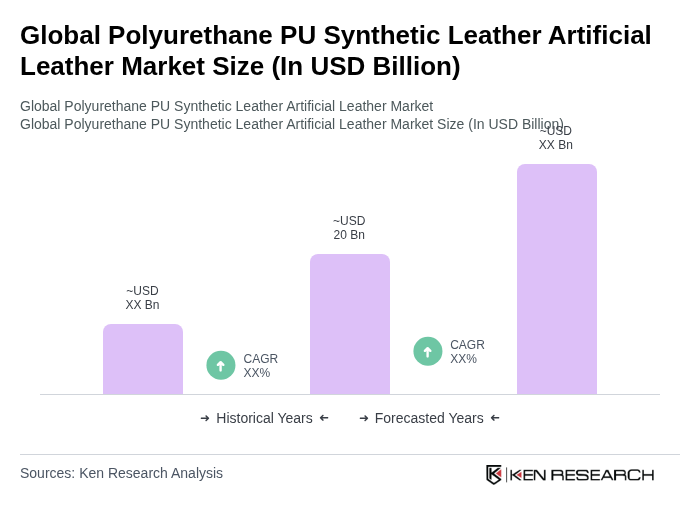
  • The Global Polyurethane PU Synthetic Leather Artificial Leather Market is valued at USD 20 billion, based on a five-year historical analysis. This growth is primarily driven by the increasing demand for sustainable and eco-friendly materials in various industries, including automotive, fashion, and furniture, along with rising adoption of bio-based PU synthetic leather and strong manufacturing in Asia-Pacific. The shift towards synthetic alternatives due to their durability and versatility has further propelled market expansion.
  • Key players in this market are concentrated in regions such as North America, Europe, and Asia-Pacific. Countries like the United States, Germany, and China dominate the market due to their robust manufacturing capabilities, technological advancements, and high consumer demand for synthetic leather products. The presence of established brands and a growing trend towards sustainable materials also contribute to their market leadership.
  • The REACH Regulation (EC) No 1907/2006, issued by the European Parliament and the Council in 2006, requires manufacturers, importers, and downstream users to register substances manufactured or imported in quantities of one tonne or more per year, evaluate risks, and obtain authorizations for substances of very high concern, ensuring safety and sustainability in the production of synthetic leather through chemical disclosure and restriction of hazardous substances.
Global Polyurethane PU Synthetic Leather Artificial Leather Market Size

Global Polyurethane PU Synthetic Leather Artificial Leather Market Segmentation

By Type:The market is segmented into various types of PU synthetic leather, each catering to different consumer needs and preferences. The dominant sub-segment is Dry PU Synthetic Leather, which is favored for its durability and ease of maintenance. Wet PU Synthetic Leather follows closely, known for its softness and flexibility, making it popular in fashion and upholstery applications. Solvent-free / Waterborne PU Synthetic Leather is gaining traction due to increasing environmental concerns, while Bio-based / Recycled PU Synthetic Leather is emerging as a sustainable alternative. The "Others" category includes niche products that cater to specific market demands.

Global Polyurethane PU Synthetic Leather Artificial Leather Market segmentation by Type.

By End-User:The end-user segmentation highlights the diverse applications of PU synthetic leather across various industries. Automotive OEMs represent the largest segment, driven by the demand for high-quality interiors. Footwear Manufacturers follow, as synthetic leather is increasingly preferred for its durability and aesthetic appeal. Furniture & Furnishing Manufacturers utilize PU leather for its versatility, while Fashion & Apparel Brands leverage it for trendy designs. Bags, Luggage & Wallet Manufacturers and Electronics & Consumer Goods also contribute significantly, with the "Others" category capturing niche applications.

Global Polyurethane PU Synthetic Leather Artificial Leather Market segmentation by End-User.

Global Polyurethane PU Synthetic Leather Artificial Leather Market Competitive Landscape

The Global Polyurethane PU Synthetic Leather Artificial Leather Market is characterized by a dynamic mix of regional and international players. Leading participants such as Teijin Limited, Toray Industries, Inc., Kuraray Co., Ltd., San Fang Chemical Industry Co., Ltd., Mayur Uniquoters Limited, Alfatex Spó?ka z o.o., Yantai Wanhua Synthetic Leather Group Co., Ltd., Zhejiang Hexin Industry Group Co., Ltd., Zhejiang Yongfa Synthetic Leather Co., Ltd., Nan Ya Plastics Corporation, Anhui Anli Material Technology Co., Ltd., Filwel Co., Ltd., H.R. Polycoats Pvt. Ltd., Fujian Polytech Technology Corp., Ltd., Shandong Jinfeng Artificial Leather Co., Ltd. contribute to innovation, geographic expansion, and service delivery in this space.

Teijin Limited

1918

Tokyo, Japan

Toray Industries, Inc.

1926

Tokyo, Japan

Kuraray Co., Ltd.

1926

Osaka, Japan

San Fang Chemical Industry Co., Ltd.

1969

Tainan, Taiwan

Mayur Uniquoters Limited

1992

Rajasthan, India

Company

Establishment Year

Headquarters

PU Synthetic Leather Revenue (USD Million)

PU Synthetic Leather Revenue Growth Rate (CAGR, %)

PU Synthetic Leather Sales Volume (Million m² / Tons)

Average Realized Price (USD per m² / per kg)

PU Synthetic Leather Market Share by Application (Footwear, Automotive, Furnishing, etc.)

Geographic Revenue Mix (APAC, Europe, North America, Others)

Global Polyurethane PU Synthetic Leather Artificial Leather Market Industry Analysis

Growth Drivers

  • Increasing Demand for Sustainable Materials:The global shift towards sustainability is driving the demand for polyurethane synthetic leather, with the market expected to reach $1.5 billion in future. According to the World Bank, the eco-friendly materials sector is projected to grow at a rate of 8% annually, reflecting a significant consumer preference for sustainable alternatives. This trend is further supported by the European Union's Green Deal, which aims to reduce carbon emissions by 55% in future, promoting sustainable production practices.
  • Rising Consumer Preference for Cruelty-Free Products:The increasing awareness of animal welfare is propelling the demand for cruelty-free synthetic leather. In future, the global vegan leather market is anticipated to reach $1.2 billion, driven by a 20% increase in consumer interest in ethical fashion. Reports from the Vegan Society indicate that 60% of consumers are willing to pay more for products that do not involve animal cruelty, highlighting a significant shift in purchasing behavior towards synthetic alternatives.
  • Expanding Applications in Automotive and Fashion Industries:The automotive and fashion sectors are increasingly adopting polyurethane synthetic leather due to its versatility and durability. The automotive industry alone is projected to utilize synthetic leather in 30% of new vehicle interiors in future, as per industry reports. Additionally, the fashion industry is expected to see a 15% rise in the use of synthetic leather for apparel and accessories, driven by collaborations with eco-conscious brands and designers.

Market Challenges

  • Fluctuating Raw Material Prices:The volatility in the prices of raw materials, such as petroleum-based products used in synthetic leather production, poses a significant challenge. In future, crude oil prices are projected to fluctuate between $70 and $90 per barrel, impacting production costs. This unpredictability can lead to increased prices for synthetic leather, making it less competitive against traditional leather products, which may deter potential buyers.
  • Competition from Traditional Leather Products:Traditional leather continues to dominate the market, with a valuation of approximately $400 billion in future. The established reputation of genuine leather for quality and durability presents a formidable challenge for synthetic alternatives. Additionally, the cultural significance of leather in various regions further complicates market penetration for synthetic leather, necessitating strategic marketing efforts to highlight its benefits.

Global Polyurethane PU Synthetic Leather Artificial Leather Market Future Outlook

The future of the polyurethane synthetic leather market appears promising, driven by increasing consumer demand for sustainable and cruelty-free products. As technological advancements continue to enhance the quality and functionality of synthetic leather, manufacturers are likely to invest in innovative production processes. Furthermore, the rise of e-commerce platforms is expected to facilitate greater market access, allowing brands to reach a broader audience and cater to the growing interest in eco-friendly fashion.

Market Opportunities

  • Growth in E-Commerce and Online Retailing:The surge in online shopping is creating significant opportunities for synthetic leather brands. With e-commerce sales projected to reach $6.4 trillion in future, companies can leverage digital platforms to promote their sustainable products, reaching environmentally conscious consumers more effectively.
  • Expansion into Emerging Markets:Emerging markets, particularly in Asia-Pacific, present lucrative opportunities for synthetic leather growth. With a projected increase in disposable income and a rising middle class, demand for affordable, sustainable alternatives is expected to grow, allowing brands to tap into new customer bases and expand their market presence.

Scope of the Report

SegmentSub-Segments
By Type

Dry PU Synthetic Leather

Wet PU Synthetic Leather

Solvent-free / Waterborne PU Synthetic Leather

Bio-based / Recycled PU Synthetic Leather

Others

By End-User

Automotive OEMs

Footwear Manufacturers

Furniture & Furnishing Manufacturers

Fashion & Apparel Brands

Bags, Luggage & Wallet Manufacturers

Electronics & Consumer Goods

Others

By Application

Furnishing & Upholstery

Automotive Interiors (Seats, Door Trims, Dashboards)

Footwear Uppers & Linings

Bags, Luggage & Wallets

Clothing & Fashion Accessories

Sports Goods & Protective Gear

Others

By Region

North America

Europe

Asia-Pacific

Latin America

Middle East & Africa

By Performance Grade

Standard Grade PU Synthetic Leather

High-Performance / Automotive Grade

Luxury / Premium Grade

Others

By Surface Finish

Smooth / Plain

Textured

Embossed & Printed

Perforated & Breathable

Others

By Distribution Channel

Direct Sales to OEMs

Distributors & Traders

Online / E-commerce

Others

Key Target Audience

Investors and Venture Capitalist Firms

Government and Regulatory Bodies (e.g., Environmental Protection Agency, Department of Commerce)

Manufacturers and Producers

Distributors and Retailers

Automotive Industry Stakeholders

Footwear and Apparel Brands

Textile and Material Suppliers

Financial Institutions

Players Mentioned in the Report:

Teijin Limited

Toray Industries, Inc.

Kuraray Co., Ltd.

San Fang Chemical Industry Co., Ltd.

Mayur Uniquoters Limited

Alfatex Spoka z o.o.

Yantai Wanhua Synthetic Leather Group Co., Ltd.

Zhejiang Hexin Industry Group Co., Ltd.

Zhejiang Yongfa Synthetic Leather Co., Ltd.

Nan Ya Plastics Corporation

Anhui Anli Material Technology Co., Ltd.

Filwel Co., Ltd.

H.R. Polycoats Pvt. Ltd.

Fujian Polytech Technology Corp., Ltd.

Shandong Jinfeng Artificial Leather Co., Ltd.

Table of Contents

Market Assessment Phase

1. Executive Summary and Approach


2. Global Polyurethane PU Synthetic Leather Artificial Leather Market Overview

2.1 Key Insights and Strategic Recommendations

2.2 Global Polyurethane PU Synthetic Leather Artificial Leather Market Overview

2.3 Definition and Scope

2.4 Evolution of Market Ecosystem

2.5 Timeline of Key Regulatory Milestones

2.6 Value Chain & Stakeholder Mapping

2.7 Business Cycle Analysis

2.8 Policy & Incentive Landscape


3. Global Polyurethane PU Synthetic Leather Artificial Leather Market Analysis

3.1 Growth Drivers

3.1.1 Increasing demand for sustainable materials
3.1.2 Rising consumer preference for cruelty-free products
3.1.3 Expanding applications in automotive and fashion industries
3.1.4 Technological advancements in production processes

3.2 Market Challenges

3.2.1 Fluctuating raw material prices
3.2.2 Competition from traditional leather products
3.2.3 Regulatory compliance and environmental concerns
3.2.4 Limited consumer awareness about synthetic leather benefits

3.3 Market Opportunities

3.3.1 Growth in e-commerce and online retailing
3.3.2 Expansion into emerging markets
3.3.3 Innovations in product design and functionality
3.3.4 Collaborations with fashion brands for exclusive collections

3.4 Market Trends

3.4.1 Shift towards eco-friendly and biodegradable materials
3.4.2 Increasing customization options for consumers
3.4.3 Rise of smart textiles incorporating synthetic leather
3.4.4 Growing popularity of vegan and sustainable fashion

3.5 Government Regulation

3.5.1 Environmental protection regulations impacting production
3.5.2 Standards for chemical safety in synthetic materials
3.5.3 Trade policies affecting import/export of synthetic leather
3.5.4 Incentives for sustainable manufacturing practices

4. SWOT Analysis


5. Stakeholder Analysis


6. Porter's Five Forces Analysis


7. Global Polyurethane PU Synthetic Leather Artificial Leather Market Size, 2019-2024

7.1 By Value

7.2 By Volume

7.3 By Average Selling Price


8. Global Polyurethane PU Synthetic Leather Artificial Leather Market Segmentation

8.1 By Type

8.1.1 Dry PU Synthetic Leather
8.1.2 Wet PU Synthetic Leather
8.1.3 Solvent-free / Waterborne PU Synthetic Leather
8.1.4 Bio-based / Recycled PU Synthetic Leather
8.1.5 Others

8.2 By End-User

8.2.1 Automotive OEMs
8.2.2 Footwear Manufacturers
8.2.3 Furniture & Furnishing Manufacturers
8.2.4 Fashion & Apparel Brands
8.2.5 Bags, Luggage & Wallet Manufacturers
8.2.6 Electronics & Consumer Goods
8.2.7 Others

8.3 By Application

8.3.1 Furnishing & Upholstery
8.3.2 Automotive Interiors (Seats, Door Trims, Dashboards)
8.3.3 Footwear Uppers & Linings
8.3.4 Bags, Luggage & Wallets
8.3.5 Clothing & Fashion Accessories
8.3.6 Sports Goods & Protective Gear
8.3.7 Others

8.4 By Region

8.4.1 North America
8.4.2 Europe
8.4.3 Asia-Pacific
8.4.4 Latin America
8.4.5 Middle East & Africa

8.5 By Performance Grade

8.5.1 Standard Grade PU Synthetic Leather
8.5.2 High-Performance / Automotive Grade
8.5.3 Luxury / Premium Grade
8.5.4 Others

8.6 By Surface Finish

8.6.1 Smooth / Plain
8.6.2 Textured
8.6.3 Embossed & Printed
8.6.4 Perforated & Breathable
8.6.5 Others

8.7 By Distribution Channel

8.7.1 Direct Sales to OEMs
8.7.2 Distributors & Traders
8.7.3 Online / E-commerce
8.7.4 Others

9. Global Polyurethane PU Synthetic Leather Artificial Leather Market Competitive Analysis

9.1 Market Share of Key Players

9.2 Cross Comparison of Key Players

9.2.1 Company Name
9.2.2 PU Synthetic Leather Revenue (USD Million)
9.2.3 PU Synthetic Leather Revenue Growth Rate (CAGR, %)
9.2.4 PU Synthetic Leather Sales Volume (Million m² / Tons)
9.2.5 Average Realized Price (USD per m² / per kg)
9.2.6 PU Synthetic Leather Market Share by Application (Footwear, Automotive, Furnishing, etc.)
9.2.7 Geographic Revenue Mix (APAC, Europe, North America, Others)
9.2.8 Capacity & Capacity Utilization Rate
9.2.9 R&D Intensity (% of Revenue)
9.2.10 Number of PU Grades / SKUs Offered
9.2.11 ESG / Sustainability Score (e.g., share of solvent-free / bio-based PU)
9.2.12 Key OEM Relationships (Automotive, Footwear, Furniture)

9.3 SWOT Analysis of Top Players

9.4 Pricing Analysis

9.5 Detailed Profile of Major Companies

9.5.1 Teijin Limited
9.5.2 Toray Industries, Inc.
9.5.3 Kuraray Co., Ltd.
9.5.4 San Fang Chemical Industry Co., Ltd.
9.5.5 Mayur Uniquoters Limited
9.5.6 Alfatex Spó?ka z o.o.
9.5.7 Yantai Wanhua Synthetic Leather Group Co., Ltd.
9.5.8 Zhejiang Hexin Industry Group Co., Ltd.
9.5.9 Zhejiang Yongfa Synthetic Leather Co., Ltd.
9.5.10 Nan Ya Plastics Corporation
9.5.11 Anhui Anli Material Technology Co., Ltd.
9.5.12 Filwel Co., Ltd.
9.5.13 H.R. Polycoats Pvt. Ltd.
9.5.14 Fujian Polytech Technology Corp., Ltd.
9.5.15 Shandong Jinfeng Artificial Leather Co., Ltd.

10. Global Polyurethane PU Synthetic Leather Artificial Leather Market End-User Analysis

10.1 Procurement Behavior of Key Ministries

10.1.1 Government contracts for synthetic leather
10.1.2 Budget allocation for sustainable materials
10.1.3 Evaluation criteria for suppliers
10.1.4 Compliance with environmental standards

10.2 Corporate Spend on Infrastructure & Energy

10.2.1 Investment in sustainable manufacturing
10.2.2 Budget for R&D in synthetic materials
10.2.3 Expenditure on marketing and branding
10.2.4 Partnerships with eco-friendly suppliers

10.3 Pain Point Analysis by End-User Category

10.3.1 Quality concerns in synthetic leather
10.3.2 Availability of diverse product ranges
10.3.3 Price sensitivity among consumers
10.3.4 Need for customization options

10.4 User Readiness for Adoption

10.4.1 Awareness of synthetic leather benefits
10.4.2 Willingness to switch from traditional leather
10.4.3 Perceived value of synthetic leather products
10.4.4 Availability of information and resources

10.5 Post-Deployment ROI and Use Case Expansion

10.5.1 Cost savings from synthetic leather use
10.5.2 Performance metrics post-adoption
10.5.3 Expansion into new product lines
10.5.4 Long-term sustainability benefits

11. Global Polyurethane PU Synthetic Leather Artificial Leather Market Future Size, 2025-2030

11.1 By Value

11.2 By Volume

11.3 By Average Selling Price


Go-To-Market Strategy Phase

1. Whitespace Analysis + Business Model Canvas

1.1 Market Gaps Identification

1.2 Business Model Framework


2. Marketing and Positioning Recommendations

2.1 Branding Strategies

2.2 Product USPs


3. Distribution Plan

3.1 Urban Retail vs Rural NGO Tie-ups


4. Channel & Pricing Gaps

4.1 Underserved Routes

4.2 Pricing Bands


5. Unmet Demand & Latent Needs

5.1 Category Gaps

5.2 Consumer Segments


6. Customer Relationship

6.1 Loyalty Programs

6.2 After-sales Service


7. Value Proposition

7.1 Sustainability

7.2 Integrated Supply Chains


8. Key Activities

8.1 Regulatory Compliance

8.2 Branding

8.3 Distribution Setup


9. Entry Strategy Evaluation

9.1 Domestic Market Entry Strategy

9.1.1 Product Mix
9.1.2 Pricing Band
9.1.3 Packaging

9.2 Export Entry Strategy

9.2.1 Target Countries
9.2.2 Compliance Roadmap

10. Entry Mode Assessment

10.1 JV

10.2 Greenfield

10.3 M&A

10.4 Distributor Model


11. Capital and Timeline Estimation

11.1 Capital Requirements

11.2 Timelines


12. Control vs Risk Trade-Off

12.1 Ownership vs Partnerships


13. Profitability Outlook

13.1 Breakeven Analysis

13.2 Long-term Sustainability


14. Potential Partner List

14.1 Distributors

14.2 JVs

14.3 Acquisition Targets


15. Execution Roadmap

15.1 Phased Plan for Market Entry

15.1.1 Market Setup
15.1.2 Market Entry
15.1.3 Growth Acceleration
15.1.4 Scale & Stabilize

15.2 Key Activities and Milestones

15.2.1 Activity Timeline
15.2.2 Milestone Tracking

Research Methodology

ApproachModellingSample

Phase 1: Approach1

Desk Research

  • Industry reports from market research firms focusing on synthetic leather trends
  • Trade publications and journals detailing advancements in polyurethane technology
  • Government publications and statistics on synthetic leather production and consumption

Primary Research

  • Interviews with product managers at leading synthetic leather manufacturers
  • Surveys with designers and buyers in the fashion and automotive industries
  • Field interviews with raw material suppliers and distributors in the PU leather market

Validation & Triangulation

  • Cross-validation of data from multiple industry sources to ensure accuracy
  • Triangulation of market size estimates using production, sales, and import/export data
  • Sanity checks through expert reviews and feedback from industry stakeholders

Phase 2: Market Size Estimation1

Top-down Assessment

  • Analysis of global PU synthetic leather market size based on regional consumption patterns
  • Segmentation by application areas such as automotive, fashion, and upholstery
  • Incorporation of macroeconomic factors influencing demand, such as GDP growth

Bottom-up Modeling

  • Estimation of production capacities of major PU synthetic leather manufacturers
  • Analysis of sales data from key distributors and retailers in the market
  • Volume and pricing analysis based on product categories and end-user applications

Forecasting & Scenario Analysis

  • Multi-variable forecasting models incorporating trends in sustainability and consumer preferences
  • Scenario analysis based on potential regulatory changes affecting synthetic materials
  • Development of baseline, optimistic, and pessimistic market growth projections through 2030

Phase 3: CATI Sample Composition1

Scope Item/SegmentSample SizeTarget Respondent Profiles
Fashion Industry Applications45Fashion Designers, Product Development Managers
Automotive Interior Materials80Automotive Engineers, Procurement Managers
Upholstery and Furniture70Interior Designers, Furniture Manufacturers
Footwear Sector Insights50Footwear Designers, Brand Managers
Consumer Preferences and Trends55Market Analysts, Retail Buyers

Frequently Asked Questions

What is the current value of the Global Polyurethane PU Synthetic Leather Market?

The Global Polyurethane PU Synthetic Leather Market is valued at approximately USD 20 billion, reflecting a significant growth trend driven by the demand for sustainable materials across various industries, including automotive, fashion, and furniture.

What are the main drivers of growth in the PU Synthetic Leather Market?

Which regions dominate the PU Synthetic Leather Market?

What are the different types of PU Synthetic Leather available in the market?

Other Regional/Country Reports

Indonesia Polyurethane Pu Synthetic Leather Artificial Leather Market

Malaysia Polyurethane Pu Synthetic Leather Artificial Leather Market

KSA Polyurethane Pu Synthetic Leather Artificial Leather Market

APAC Polyurethane Pu Synthetic Leather Artificial Leather Market

SEA Polyurethane Pu Synthetic Leather Artificial Leather Market

Vietnam Polyurethane Pu Synthetic Leather Artificial Leather Market

Other Adjacent Reports

Japan Automotive Upholstery Market

Belgium Footwear Materials Market

South Korea Furniture Fabrics Market

Mexico Fashion Apparel Market

Australia Bags and Luggage Market Outlook 2027F

Japan Vegan Leather Market

South Africa Bio-based Leather Market

Thailand PVC Synthetic Leather Market

Singapore Microfiber Leather Market

Egypt Sustainable Textiles Market

Why Buy From Us?

Refine Robust Result (RRR) Framework

What makes us stand out is that our consultants follow Robust, Refine and Result (RRR) methodology. Robust for clear definitions, approaches and sanity checking, Refine for differentiating respondents' facts and opinions, and Result for presenting data with story.

Our Reach Is Unmatched

We have set a benchmark in the industry by offering our clients with syndicated and customized market research reports featuring coverage of entire market as well as meticulous research and analyst insights.

Shifting the Research Paradigm

While we don't replace traditional research, we flip the method upside down. Our dual approach of Top Bottom & Bottom Top ensures quality deliverable by not just verifying company fundamentals but also looking at the sector and macroeconomic factors.

More Insights-Better Decisions

With one step in the future, our research team constantly tries to show you the bigger picture. We help with some of the tough questions you may encounter along the way: How is the industry positioned? Best marketing channel? KPI's of competitors? By aligning every element, we help maximize success.

Transparency and Trust

Our report gives you instant access to the answers and sources that other companies might choose to hide. We elaborate each steps of research methodology we have used and showcase you the sample size to earn your trust.

Round the Clock Support

If you need any support, we are here! We pride ourselves on universe strength, data quality, and quick, friendly, and professional service.

Why Clients Choose Us?

400000+
Reports in repository
150+
Consulting projects a year
100+
Analysts
8000+
Client Queries in 2022








