About the Report
Base Year 2024Listen to the audio summary
Global Powersports Market Overview
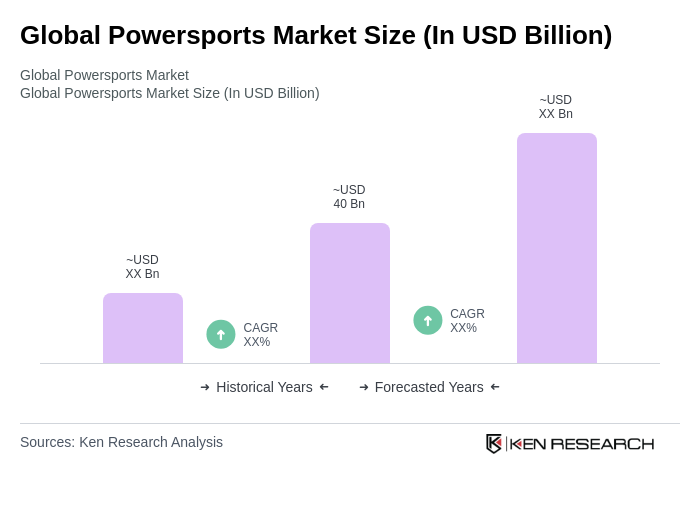
- The Global Powersports Market is valued at approximately USD 40 billion, based on a five-year historical analysis. This level aligns with multiple industry trackers that place the market in the low-to-mid USD 30s in earlier recent years and near USD 40 billion in the latest period, underpinned by sustained demand across ATVs/UTVs, motorcycles, snowmobiles, and personal watercrafts . This growth is primarily driven by increasing consumer interest in recreational activities, advancements in technology (including electric and connected features), and rising disposable income that supports leisure vehicle purchases; elevated participation in outdoor and adventure activities since the pandemic has further supported demand .
- Key players in this market include the United States, Canada, and Japan, which dominate due to strong manufacturing capabilities, established distribution networks, and a culture that embraces motorsports and outdoor recreation. North America remains the largest regional market, reflecting deep dealer networks and brand presence from manufacturers in the U.S. and Canada, while Japan anchors leading motorcycle and PWC production with extensive global distribution .
- In 2023, the U.S. government implemented new regulations aimed at reducing emissions from off-road vehicles, mandating that all new models meet stricter environmental standards. Federal and state-level actions have tightened requirements on small off-road engines and off-highway vehicles, accelerating a shift toward cleaner technologies and compliance updates by manufacturers in the powersports industry .
Global Powersports Market Segmentation
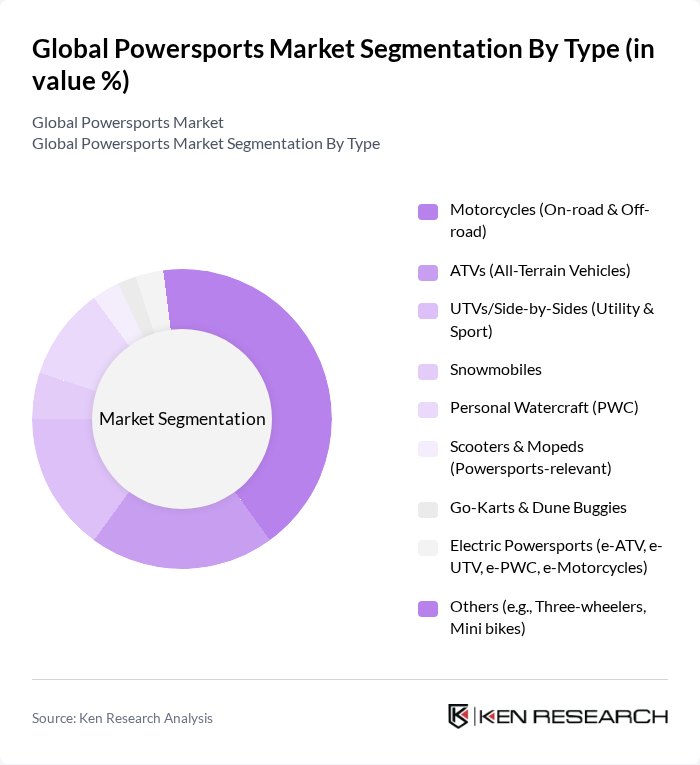
By Type:The powersports market is segmented into various types, including motorcycles, ATVs, UTVs, snowmobiles, personal watercraft, scooters, go-karts, electric powersports, and others. Among these, motorcycles and all-terrain/side-by-side categories collectively form the largest volume, with ATVs/UTVs holding the leading share in many markets by value due to higher average selling prices. Off-road motorcycles remain significant for recreation and sport, supported by adventure and trail-riding trends, while UTVs/side-by-sides have expanded rapidly in both recreational and utility applications .
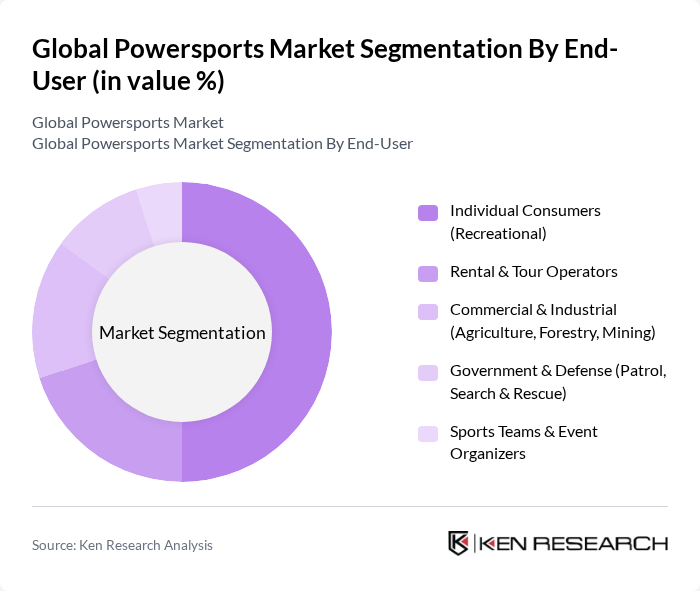
By End-User:The end-user segmentation includes individual consumers, rental and tour operators, commercial and industrial users, government and defense, and sports teams. Individual consumers, particularly those engaged in recreational activities, represent the largest segment. Growth is reinforced by outdoor recreation participation, while rental/tour operators and subscription models are gaining traction as alternative access channels, especially in tourism-oriented markets .
Global Powersports Market Competitive Landscape
The Global Powersports Market is characterized by a dynamic mix of regional and international players. Leading participants such as Polaris Inc., Yamaha Motor Co., Ltd., Honda Motor Co., Ltd., Kawasaki Heavy Industries, Ltd., BRP Inc. (Bombardier Recreational Products), Suzuki Motor Corporation, KTM AG, Husqvarna Motorcycles GmbH, Triumph Motorcycles Ltd, Ducati Motor Holding S.p.A., BMW Motorrad (BMW AG), CFMoto (Zhejiang CFMoto Power Co., Ltd.), Hisun Motors, Textron Inc. (Arctic Cat), Segway Powersports (Ninebot Group), SANY Motor (Shanyang Motor) – Benelli QJ Motor Group, Rieju S.A., Beta Motor S.p.A., GasGas (Pierer Mobility AG), OSET Bikes Ltd contribute to innovation, geographic expansion, and service delivery in this space.
Global Powersports Market Industry Analysis
Growth Drivers
- Increasing Consumer Interest in Outdoor Recreational Activities:The global outdoor recreation market is projected to reach $1,200 billion in the future, driven by a growing consumer preference for adventure and leisure activities. In the future, approximately 60% of consumers reported engaging in outdoor activities, reflecting a significant increase from previous years. This trend is particularly evident in regions with vast natural landscapes, where powersport vehicles are increasingly utilized for exploration and recreation, thus boosting demand in the powersports sector.
- Technological Advancements in Powersport Vehicles:The powersports industry is witnessing rapid technological innovations, with investments in electric and hybrid vehicle technologies expected to exceed $5 billion in the future. Enhanced features such as GPS navigation, advanced safety systems, and improved fuel efficiency are attracting consumers. For instance, electric powersport vehicle sales surged by 30% in the future, indicating a shift towards more sustainable options, which is likely to further stimulate market growth in the coming years.
- Rising Disposable Income Among Consumers:Global disposable income is projected to increase by 4.5% in the future, reaching an average of $12,500 per capita. This rise in income levels is enabling consumers to allocate more funds towards recreational activities, including powersports. In regions like North America and Europe, where disposable income is significantly higher, the demand for premium powersport vehicles is expected to grow, further driving market expansion and consumer engagement in outdoor activities.
Market Challenges
- High Maintenance Costs of Powersport Vehicles:The average annual maintenance cost for powersport vehicles can range from $500 to $1,500, depending on the type and usage. This financial burden can deter potential buyers, particularly in regions where economic conditions are less favorable. As consumers become more budget-conscious, the high upkeep costs may limit market penetration and growth, especially among first-time buyers and younger demographics.
- Regulatory Compliance and Safety Standards:The powersports industry faces stringent regulatory requirements, including safety standards and emission regulations. For instance, the U.S. Environmental Protection Agency (EPA) has set new emission standards that will require manufacturers to invest significantly in compliance technologies, estimated at $2 billion in the future. These regulations can increase production costs and complicate market entry for new players, posing a challenge to overall industry growth.
Global Powersports Market Future Outlook
The future of the powersports market appears promising, driven by increasing consumer interest in adventure tourism and a shift towards eco-friendly vehicle options. As more consumers prioritize sustainability, manufacturers are likely to invest in electric and hybrid technologies, enhancing their product offerings. Additionally, the rise of online sales channels is expected to facilitate easier access to powersport vehicles, further expanding the market. These trends indicate a dynamic landscape that will evolve in response to consumer preferences and regulatory changes.
Market Opportunities
- Growth in Electric Powersport Vehicles:The electric powersport vehicle segment is anticipated to grow significantly, with sales projected to reach 1 million units in the future. This growth is fueled by increasing environmental awareness and government incentives for electric vehicle adoption, presenting a lucrative opportunity for manufacturers to innovate and capture market share.
- Expansion into Emerging Markets:Emerging markets, particularly in Asia-Pacific and Latin America, are witnessing a surge in disposable income and interest in recreational activities. In the future, these regions are expected to contribute over $300 billion to the global powersports market, offering manufacturers a chance to expand their reach and diversify their customer base.
Scope of the Report
| Segment | Sub-Segments |
|---|---|
| By Type | Motorcycles (On-road & Off-road) ATVs (All-Terrain Vehicles) UTVs/Side-by-Sides (Utility & Sport) Snowmobiles Personal Watercraft (PWC) Scooters & Mopeds (Powersports-relevant) Go-Karts & Dune Buggies Electric Powersports (e-ATV, e-UTV, e-PWC, e-Motorcycles) Others (e.g., Three-wheelers, Mini bikes) |
| By End-User | Individual Consumers (Recreational) Rental & Tour Operators Commercial & Industrial (Agriculture, Forestry, Mining) Government & Defense (Patrol, Search & Rescue) Sports Teams & Event Organizers |
| By Sales Channel | Franchised Dealerships Independent Dealers Online Direct-to-Consumer Distributors & Importers Rental/Subscription Platforms |
| By Region | North America Europe Asia-Pacific Latin America Middle East & Africa |
| By Price Range | Entry/Budget Mid-Range Premium Ultra-Premium/Performance |
| By Vehicle Size/Displacement | Small (?300cc or equivalent) Medium (301–800cc or equivalent) Large (?801cc or equivalent) |
| By Usage Type | Recreational Competitive/Racing Utility/Work Marine/Water Recreation Snow/Arctic Mobility |
Key Target Audience
Investors and Venture Capitalist Firms
Government and Regulatory Bodies (e.g., National Highway Traffic Safety Administration, Environmental Protection Agency)
Manufacturers and Producers
Distributors and Retailers
Motorcycle and ATV Clubs
Insurance Companies
Event Organizers and Promoters
Parts and Accessories Suppliers
Players Mentioned in the Report:
Polaris Inc.
Yamaha Motor Co., Ltd.
Honda Motor Co., Ltd.
Kawasaki Heavy Industries, Ltd.
BRP Inc. (Bombardier Recreational Products)
Suzuki Motor Corporation
KTM AG
Husqvarna Motorcycles GmbH
Triumph Motorcycles Ltd
Ducati Motor Holding S.p.A.
BMW Motorrad (BMW AG)
CFMoto (Zhejiang CFMoto Power Co., Ltd.)
Hisun Motors
Textron Inc. (Arctic Cat)
Segway Powersports (Ninebot Group)
SANY Motor (Shanyang Motor) Benelli QJ Motor Group
Rieju S.A.
Beta Motor S.p.A.
GasGas (Pierer Mobility AG)
OSET Bikes Ltd
Table of Contents
Market Assessment Phase
1. Executive Summary and Approach
2. Global Powersports Market Overview
2.1 Key Insights and Strategic Recommendations
2.2 Global Powersports Market Overview
2.3 Definition and Scope
2.4 Evolution of Market Ecosystem
2.5 Timeline of Key Regulatory Milestones
2.6 Value Chain & Stakeholder Mapping
2.7 Business Cycle Analysis
2.8 Policy & Incentive Landscape
3. Global Powersports Market Analysis
3.1 Growth Drivers
3.1.1 Increasing consumer interest in outdoor recreational activities
3.1.2 Technological advancements in powersport vehicles
3.1.3 Rising disposable income among consumers
3.1.4 Expansion of distribution networks
3.2 Market Challenges
3.2.1 High maintenance costs of powersport vehicles
3.2.2 Regulatory compliance and safety standards
3.2.3 Environmental concerns and sustainability issues
3.2.4 Competition from alternative recreational activities
3.3 Market Opportunities
3.3.1 Growth in electric powersport vehicles
3.3.2 Expansion into emerging markets
3.3.3 Development of innovative financing options
3.3.4 Collaborations with tourism and adventure companies
3.4 Market Trends
3.4.1 Increasing popularity of adventure tourism
3.4.2 Shift towards eco-friendly powersport options
3.4.3 Rise of online sales channels
3.4.4 Customization and personalization of vehicles
3.5 Government Regulation
3.5.1 Emission standards for powersport vehicles
3.5.2 Safety regulations for vehicle manufacturing
3.5.3 Licensing requirements for operators
3.5.4 Land use regulations for recreational areas
4. SWOT Analysis
5. Stakeholder Analysis
6. Porter's Five Forces Analysis
7. Global Powersports Market Market Size, 2019-2024
7.1 By Value
7.2 By Volume
7.3 By Average Selling Price
8. Global Powersports Market Segmentation
8.1 By Type
8.1.1 Motorcycles (On-road & Off-road)
8.1.2 ATVs (All-Terrain Vehicles)
8.1.3 UTVs/Side-by-Sides (Utility & Sport)
8.1.4 Snowmobiles
8.1.5 Personal Watercraft (PWC)
8.1.6 Scooters & Mopeds (Powersports-relevant)
8.1.7 Go-Karts & Dune Buggies
8.1.8 Electric Powersports (e-ATV, e-UTV, e-PWC, e-Motorcycles)
8.1.9 Others (e.g., Three-wheelers, Mini bikes)
8.2 By End-User
8.2.1 Individual Consumers (Recreational)
8.2.2 Rental & Tour Operators
8.2.3 Commercial & Industrial (Agriculture, Forestry, Mining)
8.2.4 Government & Defense (Patrol, Search & Rescue)
8.2.5 Sports Teams & Event Organizers
8.3 By Sales Channel
8.3.1 Franchised Dealerships
8.3.2 Independent Dealers
8.3.3 Online Direct-to-Consumer
8.3.4 Distributors & Importers
8.3.5 Rental/Subscription Platforms
8.4 By Region
8.4.1 North America
8.4.2 Europe
8.4.3 Asia-Pacific
8.4.4 Latin America
8.4.5 Middle East & Africa
8.5 By Price Range
8.5.1 Entry/Budget
8.5.2 Mid-Range
8.5.3 Premium
8.5.4 Ultra-Premium/Performance
8.6 By Vehicle Size/Displacement
8.6.1 Small (?300cc or equivalent)
8.6.2 Medium (301–800cc or equivalent)
8.6.3 Large (?801cc or equivalent)
8.7 By Usage Type
8.7.1 Recreational
8.7.2 Competitive/Racing
8.7.3 Utility/Work
8.7.4 Marine/Water Recreation
8.7.5 Snow/Arctic Mobility
9. Global Powersports Market Competitive Analysis
9.1 Market Share of Key Players
9.2 Cross Comparison of Key Players
9.2.1 Company Name
9.2.2 Group Size (Global, Regional, Niche)
9.2.3 Powersports Revenue (USD, latest FY)
9.2.4 YoY Revenue Growth (%)
9.2.5 Geographic Mix (NA/EU/APAC share, %)
9.2.6 Product Mix (ATV/UTV/Motorcycle/PWC/Snowmobile, %)
9.2.7 Dealer Network Size (locations, count)
9.2.8 Retail Sales Units (latest FY, units)
9.2.9 Average Selling Price (ASP, USD)
9.2.10 R&D Intensity (% of revenue)
9.2.11 Electrified Portfolio Share (% of SKUs or units)
9.2.12 Aftermarket/Parts Share (% of revenue)
9.2.13 Warranty Claim Rate (% of units)
9.2.14 Brand Consideration/Awareness (survey index)
9.2.15 Inventory Turns (times/year)
9.3 SWOT Analysis of Top Players
9.4 Pricing Analysis
9.5 Detailed Profile of Major Companies
9.5.1 Polaris Inc.
9.5.2 Yamaha Motor Co., Ltd.
9.5.3 Honda Motor Co., Ltd.
9.5.4 Kawasaki Heavy Industries, Ltd.
9.5.5 BRP Inc. (Bombardier Recreational Products)
9.5.6 Suzuki Motor Corporation
9.5.7 KTM AG
9.5.8 Husqvarna Motorcycles GmbH
9.5.9 Triumph Motorcycles Ltd
9.5.10 Ducati Motor Holding S.p.A.
9.5.11 BMW Motorrad (BMW AG)
9.5.12 CFMoto (Zhejiang CFMoto Power Co., Ltd.)
9.5.13 Hisun Motors
9.5.14 Textron Inc. (Arctic Cat)
9.5.15 Segway Powersports (Ninebot Group)
9.5.16 SANY Motor (Shanyang Motor) – Benelli QJ Motor Group
9.5.17 Rieju S.A.
9.5.18 Beta Motor S.p.A.
9.5.19 GasGas (Pierer Mobility AG)
9.5.20 OSET Bikes Ltd
10. Global Powersports Market End-User Analysis
10.1 Procurement Behavior of Key Ministries
10.1.1 Government procurement policies
10.1.2 Budget allocation for recreational vehicles
10.1.3 Evaluation criteria for suppliers
10.1.4 Trends in government contracts
10.2 Corporate Spend on Infrastructure & Energy
10.2.1 Investment in recreational infrastructure
10.2.2 Corporate sponsorships in powersport events
10.2.3 Partnerships with powersport manufacturers
10.3 Pain Point Analysis by End-User Category
10.3.1 Cost of ownership
10.3.2 Availability of service and parts
10.3.3 Safety concerns
10.4 User Readiness for Adoption
10.4.1 Awareness of powersport options
10.4.2 Financial readiness for purchase
10.4.3 Interest in electric powersport vehicles
10.5 Post-Deployment ROI and Use Case Expansion
10.5.1 Analysis of user satisfaction
10.5.2 Opportunities for upselling
10.5.3 Expansion into new user segments
11. Global Powersports Market Future Size, 2025-2030
11.1 By Value
11.2 By Volume
11.3 By Average Selling Price
Go-To-Market Strategy Phase
1. Whitespace Analysis + Business Model Canvas
1.1 Identification of market gaps
1.2 Business model options
1.3 Value proposition development
1.4 Revenue stream analysis
1.5 Cost structure evaluation
1.6 Key partnerships
1.7 Customer segments
2. Marketing and Positioning Recommendations
2.1 Branding strategies
2.2 Product USPs
2.3 Target audience identification
2.4 Marketing channels
2.5 Promotional tactics
2.6 Customer engagement strategies
3. Distribution Plan
3.1 Urban retail strategies
3.2 Rural NGO tie-ups
3.3 Online distribution channels
3.4 Partnerships with local dealers
3.5 Logistics and supply chain management
4. Channel & Pricing Gaps
4.1 Underserved routes
4.2 Pricing bands analysis
4.3 Competitor pricing strategies
4.4 Customer willingness to pay
5. Unmet Demand & Latent Needs
5.1 Category gaps
5.2 Consumer segments analysis
5.3 Emerging trends
5.4 Feedback from current users
6. Customer Relationship
6.1 Loyalty programs
6.2 After-sales service
6.3 Customer feedback mechanisms
6.4 Community engagement initiatives
7. Value Proposition
7.1 Sustainability initiatives
7.2 Integrated supply chains
7.3 Unique selling points
7.4 Customer-centric approach
8. Key Activities
8.1 Regulatory compliance
8.2 Branding efforts
8.3 Distribution setup
8.4 Training and development
9. Entry Strategy Evaluation
9.1 Domestic Market Entry Strategy
9.1.1 Product mix considerations
9.1.2 Pricing band analysis
9.1.3 Packaging strategies
9.2 Export Entry Strategy
9.2.1 Target countries identification
9.2.2 Compliance roadmap development
10. Entry Mode Assessment
10.1 Joint Ventures
10.2 Greenfield investments
10.3 Mergers & Acquisitions
10.4 Distributor Model
11. Capital and Timeline Estimation
11.1 Capital requirements
11.2 Timelines for market entry
12. Control vs Risk Trade-Off
12.1 Ownership considerations
12.2 Partnerships evaluation
13. Profitability Outlook
13.1 Breakeven analysis
13.2 Long-term sustainability strategies
14. Potential Partner List
14.1 Distributors
14.2 Joint Ventures
14.3 Acquisition targets
15. Execution Roadmap
15.1 Phased Plan for Market Entry
15.1.1 Market Setup
15.1.2 Market Entry
15.1.3 Growth Acceleration
15.1.4 Scale & Stabilize
15.2 Key Activities and Milestones
15.2.1 Milestone tracking
15.2.2 Activity scheduling
Research Methodology
Phase 1: Approach1
Desk Research
- Industry reports from leading powersports associations and market research firms
- Analysis of sales data from major powersports manufacturers and distributors
- Review of regulatory frameworks and safety standards impacting the powersports sector
Primary Research
- Interviews with product managers at leading powersports companies
- Surveys with dealership owners and operators across various regions
- Focus groups with end-users to understand preferences and buying behavior
Validation & Triangulation
- Cross-validation of findings through multiple data sources including sales and consumer insights
- Triangulation of market trends with expert opinions from industry veterans
- Sanity checks through peer reviews and feedback from market analysts
Phase 2: Market Size Estimation1
Top-down Assessment
- Estimation of total market size based on global powersports sales figures
- Segmentation by vehicle type, including motorcycles, ATVs, and personal watercraft
- Incorporation of regional growth trends and economic indicators
Bottom-up Modeling
- Volume estimates derived from dealership sales data and registration statistics
- Cost analysis based on average selling prices and market penetration rates
- Assessment of aftermarket sales and service revenue streams
Forecasting & Scenario Analysis
- Multi-variable forecasting using historical sales data and economic growth projections
- Scenario modeling based on consumer trends, technological advancements, and regulatory changes
- Development of baseline, optimistic, and pessimistic market growth scenarios through 2030
Phase 3: CATI Sample Composition1
| Scope Item/Segment | Sample Size | Target Respondent Profiles |
|---|---|---|
| Motorcycle Retail Market | 150 | Dealership Owners, Sales Managers |
| ATV and UTV Market | 100 | Product Managers, Marketing Directors |
| Personal Watercraft Sales | 80 | Retail Managers, Customer Experience Specialists |
| Aftermarket Parts and Accessories | 70 | Supply Chain Managers, Procurement Officers |
| Powersports Financing and Insurance | 90 | Financial Advisors, Insurance Brokers |
Frequently Asked Questions
What is the current value of the Global Powersports Market?
The Global Powersports Market is valued at approximately USD 40 billion, reflecting a significant increase driven by sustained demand for ATVs, UTVs, motorcycles, snowmobiles, and personal watercrafts, alongside rising consumer interest in recreational activities and advancements in technology.
Which regions dominate the Global Powersports Market?
What are the main types of vehicles in the Global Powersports Market?
What factors are driving growth in the Global Powersports Market?
Other Regional/Country Reports
Indonesia Powersports Market
Malaysia Powersports Market
APAC Powersports Market
SEA Powersports Market
Why Buy From Us?

What makes us stand out is that our consultants follow Robust, Refine and Result (RRR) methodology. Robust for clear definitions, approaches and sanity checking, Refine for differentiating respondents' facts and opinions, and Result for presenting data with story.

We have set a benchmark in the industry by offering our clients with syndicated and customized market research reports featuring coverage of entire market as well as meticulous research and analyst insights.

While we don't replace traditional research, we flip the method upside down. Our dual approach of Top Bottom & Bottom Top ensures quality deliverable by not just verifying company fundamentals but also looking at the sector and macroeconomic factors.

With one step in the future, our research team constantly tries to show you the bigger picture. We help with some of the tough questions you may encounter along the way: How is the industry positioned? Best marketing channel? KPI's of competitors? By aligning every element, we help maximize success.

Our report gives you instant access to the answers and sources that other companies might choose to hide. We elaborate each steps of research methodology we have used and showcase you the sample size to earn your trust.

If you need any support, we are here! We pride ourselves on universe strength, data quality, and quick, friendly, and professional service.