About the Report
Base Year 2024Global Precision Guided Artillery Ammunition Market Overview
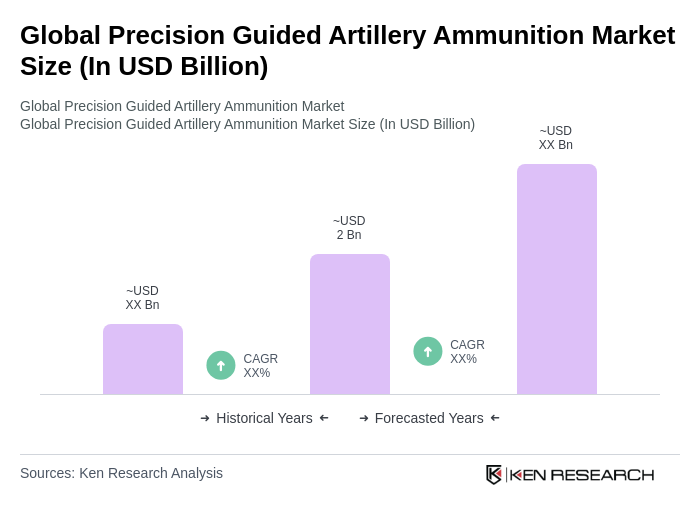
- The Global Precision Guided Artillery Ammunition Market is valued at USD 2 billion, based on a five-year historical analysis. This growth is primarily driven by increasing military expenditures, advancements in technology, and the rising demand for precision strike capabilities in modern warfare. The focus on enhancing the accuracy and effectiveness of artillery systems has led to significant investments in research and development, further propelling market growth.
- Key players in this market include the United States, Russia, and China, which dominate due to their substantial defense budgets and ongoing military modernization programs. The U.S. leads in technological advancements and innovation, while Russia and China are rapidly expanding their capabilities to enhance their military effectiveness. These countries' strategic focus on precision-guided munitions has solidified their positions in the global market.
- In 2023, the U.S. Department of Defense did not issue a blanket regulation mandating advanced guidance systems for all artillery munitions; however, the DoD continued large-scale procurement and modernization programs for precision artillery (e.g., Excalibur, PGK) in alignment with precision fires doctrine and Joint All-Domain Command and Control objectives, reflecting the broader shift toward precision warfare and resilient PNT-enabled effects.
Global Precision Guided Artillery Ammunition Market Segmentation
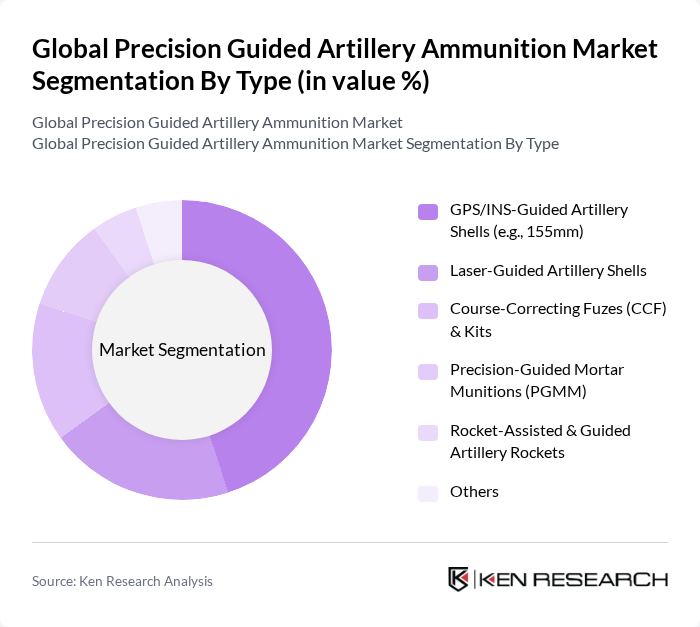
By Type:The market is segmented into various types of precision-guided artillery ammunition, including GPS/INS-Guided Artillery Shells, Laser-Guided Artillery Shells, Course-Correcting Fuzes (CCF) & Kits, Precision-Guided Mortar Munitions (PGMM), Rocket-Assisted & Guided Artillery Rockets, and Others. Among these, GPS/INS-Guided Artillery Shells are the most dominant due to their widespread adoption and proven effectiveness in various military operations. The increasing demand for high-precision strikes and the ability to engage targets at long ranges have made this sub-segment particularly attractive to defense forces worldwide.
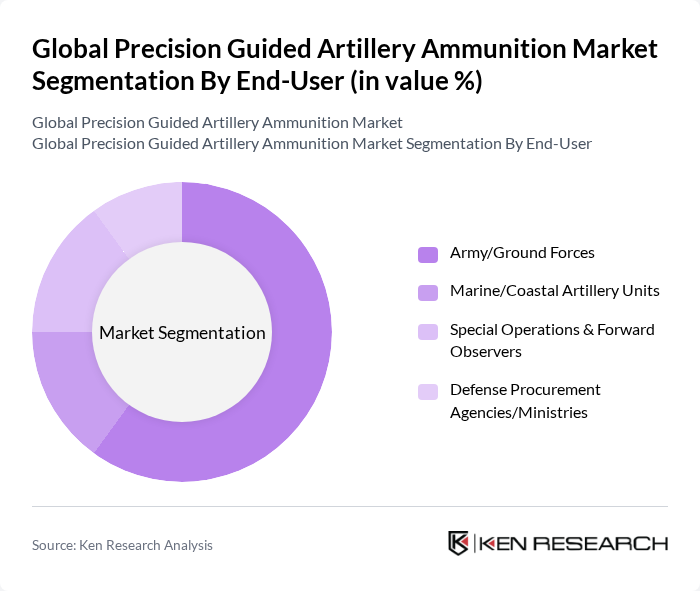
By End-User:The end-user segmentation includes Army/Ground Forces, Marine/Coastal Artillery Units, Special Operations & Forward Observers, and Defense Procurement Agencies/Ministries. The Army/Ground Forces segment is the largest due to the extensive use of precision-guided artillery in ground operations. The increasing focus on enhancing ground force capabilities and the need for effective artillery support in combat scenarios have driven the demand in this segment.
Global Precision Guided Artillery Ammunition Market Competitive Landscape
The Global Precision Guided Artillery Ammunition Market is characterized by a dynamic mix of regional and international players. Leading participants such as RTX (Raytheon) – maker of 155mm M982 Excalibur, XM1156 PGK, BAE Systems plc – BONUS (with Nexter), 155mm precision solutions, General Dynamics Ordnance and Tactical Systems (GD-OTS), Rheinmetall AG, Nexter (KNDS France) – BONUS, Katana 155mm guided shell, Leonardo S.p.A. – 155mm/127mm Vulcano guided ammunition, Elbit Systems Ltd. – Iron Sting 120mm precision mortar, artillery C2, Israel Aerospace Industries (IAI) – guidance/seeker kits and artillery rockets, Nammo AS, Hanwha Aerospace – K9/K10 ecosystem and guided artillery integration, Saab AB – artillery and mortar precision effects, guidance subsystems, Thales Group – laser designation, fuzes, precision fire support, MBDA – precision effectors and artillery rocket guidance collaborations, Kongsberg Gruppen ASA – fire control, remote systems, precision integration, Denel SOC Ltd. – Assegai family, guided artillery initiatives contribute to innovation, geographic expansion, and service delivery in this space.
Global Precision Guided Artillery Ammunition Market Industry Analysis
Growth Drivers
- Increasing Defense Budgets:Global defense spending reached approximately $2.44 trillion, with countries like the U.S. allocating $916 billion. This trend is expected to continue, as nations prioritize military modernization and readiness. For instance, NATO members aim to meet the 2% GDP defense spending guideline, driving demand for advanced munitions. The U.S. alone plans to increase its defense budget by 5% in future, directly benefiting precision guided artillery ammunition manufacturers.
- Technological Advancements in Munitions:The global market for smart munitions is projected to grow significantly, with investments in R&D reaching $15 billion in future. Innovations such as GPS-guided systems and enhanced targeting capabilities are revolutionizing artillery effectiveness. For example, the U.S. Army's Precision Guidance Kit (PGK) program aims to improve artillery accuracy, reducing collateral damage and increasing operational efficiency, thus driving demand for precision guided artillery ammunition.
- Rising Demand for Precision Warfare:The shift towards precision warfare is evident, with military operations increasingly focusing on minimizing civilian casualties and maximizing target effectiveness. In future, the U.S. military reported a 30% increase in the use of precision-guided munitions in conflict zones. This trend is supported by the growing recognition of the strategic advantages offered by precision artillery, leading to increased procurement and development of advanced munitions systems globally.
Market Challenges
- High Development and Production Costs:The development of precision guided artillery ammunition involves significant financial investment, with costs often exceeding $1 million per unit for advanced systems. This high cost can deter smaller defense contractors from entering the market, limiting competition. Additionally, the need for specialized materials and technologies further escalates production expenses, impacting overall market growth and accessibility for various nations.
- Stringent Regulatory Compliance:The defense sector is heavily regulated, with compliance costs estimated at around $200 million annually for major manufacturers. Regulations such as the International Traffic in Arms Regulations (ITAR) impose strict controls on the export of military technologies, complicating international sales. These compliance requirements can hinder market entry for new players and slow down the pace of innovation within the precision guided artillery ammunition sector.
Global Precision Guided Artillery Ammunition Market Future Outlook
The future of the precision guided artillery ammunition market appears promising, driven by ongoing technological advancements and increasing defense budgets. As nations continue to invest in military modernization, the demand for innovative munitions is expected to rise. Furthermore, the integration of artificial intelligence and autonomous systems into artillery operations will enhance targeting accuracy and operational efficiency, positioning the market for significant growth in the coming years.
Market Opportunities
- Expansion in Emerging Markets:Emerging economies are ramping up their defense capabilities, with countries like India and Brazil increasing military spending by 10% in future. This growth presents opportunities for precision guided artillery ammunition manufacturers to enter new markets and establish partnerships, catering to the rising demand for advanced military technologies in these regions.
- Collaborations with Defense Contractors:Strategic partnerships between established defense contractors and innovative startups are becoming increasingly common. Collaborations can lead to the development of cutting-edge technologies, with joint ventures projected to increase R&D investments by 20% in future. Such alliances will enhance product offerings and accelerate the introduction of advanced precision guided artillery systems to the market.
Scope of the Report
| Segment | Sub-Segments |
|---|---|
| By Type | GPS/INS-Guided Artillery Shells (e.g., 155mm) Laser-Guided Artillery Shells Course-Correcting Fuzes (CCF) & Kits Precision-Guided Mortar Munitions (PGMM) Rocket-Assisted & Guided Artillery Rockets Others |
| By End-User | Army/Ground Forces Marine/Coastal Artillery Units Special Operations & Forward Observers Defense Procurement Agencies/Ministries |
| By Application | Counter-Battery and Suppression of Enemy Artillery (SEAD) Close Support and Urban Operations Precision Strike on High-Value/Time-Sensitive Targets Area Denial and Deep Fires |
| By Distribution Channel | Direct Government-to-Contractor (G2C) Procurement Foreign Military Sales (FMS)/Government-to-Government OEM-Prime with Tiered Subcontractors Others |
| By Region | North America Europe Asia-Pacific Middle East & Africa Latin America |
| By Guidance/Navigation Technology | GPS/INS Semi-Active Laser Anti-Jam/Alternative PNT (e.g., M?Code, Resilient GNSS) Terminal Seeker/SAL-Homing Others |
| By Caliber | mm (Mortar) mm–130mm mm–155mm mm and Above |
Key Target Audience
Investors and Venture Capitalist Firms
Government and Regulatory Bodies (e.g., Department of Defense, NATO)
Manufacturers and Producers
Defense Contractors
Military Procurement Agencies
Armed Forces and Military Organizations
Industry Associations (e.g., National Defense Industrial Association)
Financial Institutions
Players Mentioned in the Report:
RTX (Raytheon) maker of 155mm M982 Excalibur, XM1156 PGK
BAE Systems plc BONUS (with Nexter), 155mm precision solutions
General Dynamics Ordnance and Tactical Systems (GD-OTS)
Rheinmetall AG
Nexter (KNDS France) BONUS, Katana 155mm guided shell
Leonardo S.p.A. 155mm/127mm Vulcano guided ammunition
Elbit Systems Ltd. Iron Sting 120mm precision mortar, artillery C2
Israel Aerospace Industries (IAI) guidance/seeker kits and artillery rockets
Nammo AS
Hanwha Aerospace K9/K10 ecosystem and guided artillery integration
Saab AB artillery and mortar precision effects, guidance subsystems
Thales Group laser designation, fuzes, precision fire support
MBDA precision effectors and artillery rocket guidance collaborations
Kongsberg Gruppen ASA fire control, remote systems, precision integration
Denel SOC Ltd. Assegai family, guided artillery initiatives
Table of Contents
Market Assessment Phase
1. Executive Summary and Approach
2. Global Precision Guided Artillery Ammunition Market Overview
2.1 Key Insights and Strategic Recommendations
2.2 Global Precision Guided Artillery Ammunition Market Overview
2.3 Definition and Scope
2.4 Evolution of Market Ecosystem
2.5 Timeline of Key Regulatory Milestones
2.6 Value Chain & Stakeholder Mapping
2.7 Business Cycle Analysis
2.8 Policy & Incentive Landscape
3. Global Precision Guided Artillery Ammunition Market Analysis
3.1 Growth Drivers
3.1.1 Increasing Defense Budgets
3.1.2 Technological Advancements in Munitions
3.1.3 Rising Demand for Precision Warfare
3.1.4 Geopolitical Tensions and Conflicts
3.2 Market Challenges
3.2.1 High Development and Production Costs
3.2.2 Stringent Regulatory Compliance
3.2.3 Supply Chain Disruptions
3.2.4 Competition from Conventional Ammunition
3.3 Market Opportunities
3.3.1 Expansion in Emerging Markets
3.3.2 Collaborations with Defense Contractors
3.3.3 Innovations in Smart Munitions
3.3.4 Increased Focus on R&D
3.4 Market Trends
3.4.1 Shift Towards Autonomous Systems
3.4.2 Integration of AI in Targeting Systems
3.4.3 Growing Emphasis on Sustainability
3.4.4 Enhanced Training and Simulation Technologies
3.5 Government Regulation
3.5.1 Export Control Regulations
3.5.2 Environmental Compliance Standards
3.5.3 Safety and Quality Assurance Regulations
3.5.4 Defense Procurement Policies
4. SWOT Analysis
5. Stakeholder Analysis
6. Porter's Five Forces Analysis
7. Global Precision Guided Artillery Ammunition Market Market Size, 2019-2024
7.1 By Value
7.2 By Volume
7.3 By Average Selling Price
8. Global Precision Guided Artillery Ammunition Market Segmentation
8.1 By Type
8.1.1 GPS/INS-Guided Artillery Shells (e.g., 155mm)
8.1.2 Laser-Guided Artillery Shells
8.1.3 Course-Correcting Fuzes (CCF) & Kits
8.1.4 Precision-Guided Mortar Munitions (PGMM)
8.1.5 Rocket-Assisted & Guided Artillery Rockets
8.1.6 Others
8.2 By End-User
8.2.1 Army/Ground Forces
8.2.2 Marine/Coastal Artillery Units
8.2.3 Special Operations & Forward Observers
8.2.4 Defense Procurement Agencies/Ministries
8.3 By Application
8.3.1 Counter-Battery and Suppression of Enemy Artillery (SEAD)
8.3.2 Close Support and Urban Operations
8.3.3 Precision Strike on High-Value/Time-Sensitive Targets
8.3.4 Area Denial and Deep Fires
8.4 By Distribution Channel
8.4.1 Direct Government-to-Contractor (G2C) Procurement
8.4.2 Foreign Military Sales (FMS)/Government-to-Government
8.4.3 OEM-Prime with Tiered Subcontractors
8.4.4 Others
8.5 By Region
8.5.1 North America
8.5.2 Europe
8.5.3 Asia-Pacific
8.5.4 Middle East & Africa
8.5.5 Latin America
8.6 By Guidance/Navigation Technology
8.6.1 GPS/INS
8.6.2 Semi-Active Laser
8.6.3 Anti-Jam/Alternative PNT (e.g., M?Code, Resilient GNSS)
8.6.4 Terminal Seeker/SAL-Homing
8.6.5 Others
8.7 By Caliber
8.7.1 120mm (Mortar)
8.7.2 122mm–130mm
8.7.3 152mm–155mm
8.7.4 203mm and Above
9. Global Precision Guided Artillery Ammunition Market Competitive Analysis
9.1 Market Share of Key Players
9.2 Cross Comparison of Key Players
9.2.1 Company Name (OEM/Prime or Specialist)
9.2.2 Relevant Product Portfolio Coverage (e.g., Excalibur, Vulcano, BONUS, PGK, GMLRS)
9.2.3 Active Programs and Contracts (Backlog, FMS awards, modernization)
9.2.4 Geographic Reach (production sites, export footprint)
9.2.5 Revenue Exposure to Precision-Guided Artillery (% of total defense sales)
9.2.6 R&D Intensity (R&D spend %, patents, trials)
9.2.7 Guidance/Navigation Capability (GPS/INS, SAL, anti-jam, alternative PNT)
9.2.8 Range/Accuracy Performance (CEP metrics, extended-range compatibility)
9.2.9 Production Capacity and Surge Ability (annual rounds, multi-source supply)
9.2.10 Cost per Effect/Per-Round Pricing Bands
9.2.11 Interoperability and Platform Compatibility (NATO calibers, 52-cal guns, M109/K9, etc.)
9.2.12 Partnership Ecosystem (JVs, co-development, offset, local assembly)
9.3 SWOT Analysis of Top Players
9.4 Pricing Analysis
9.5 Detailed Profile of Major Companies
9.5.1 RTX (Raytheon) – maker of 155mm M982 Excalibur, XM1156 PGK
9.5.2 BAE Systems plc – BONUS (with Nexter), 155mm precision solutions
9.5.3 General Dynamics Ordnance and Tactical Systems (GD-OTS)
9.5.4 Rheinmetall AG
9.5.5 Nexter (KNDS France) – BONUS, Katana 155mm guided shell
9.5.6 Leonardo S.p.A. – 155mm/127mm Vulcano guided ammunition
9.5.7 Elbit Systems Ltd. – Iron Sting 120mm precision mortar, artillery C2
9.5.8 Israel Aerospace Industries (IAI) – guidance/seeker kits and artillery rockets
9.5.9 Nammo AS
9.5.10 Hanwha Aerospace – K9/K10 ecosystem and guided artillery integration
9.5.11 Saab AB – artillery and mortar precision effects, guidance subsystems
9.5.12 Thales Group – laser designation, fuzes, precision fire support
9.5.13 MBDA – precision effectors and artillery rocket guidance collaborations
9.5.14 Kongsberg Gruppen ASA – fire control, remote systems, precision integration
9.5.15 Denel SOC Ltd. – Assegai family, guided artillery initiatives
10. Global Precision Guided Artillery Ammunition Market End-User Analysis
10.1 Procurement Behavior of Key Ministries
10.1.1 Defense Procurement Trends
10.1.2 Budget Allocation Strategies
10.1.3 Supplier Selection Criteria
10.1.4 Contracting Processes
10.2 Corporate Spend on Infrastructure & Energy
10.2.1 Investment in Defense Infrastructure
10.2.2 Funding for R&D Initiatives
10.2.3 Budgeting for Training Programs
10.3 Pain Point Analysis by End-User Category
10.3.1 Challenges in Procurement
10.3.2 Issues with Supply Chain Management
10.3.3 Limitations in Technology Adoption
10.4 User Readiness for Adoption
10.4.1 Training and Skill Development Needs
10.4.2 Infrastructure Readiness
10.4.3 Acceptance of New Technologies
10.5 Post-Deployment ROI and Use Case Expansion
10.5.1 Evaluation of Performance Metrics
10.5.2 Feedback Mechanisms for Improvement
10.5.3 Opportunities for Upgrades
11. Global Precision Guided Artillery Ammunition Market Future Size, 2025-2030
11.1 By Value
11.2 By Volume
11.3 By Average Selling Price
Go-To-Market Strategy Phase
1. Whitespace Analysis + Business Model Canvas
1.1 Market Gaps Identification
1.2 Business Model Framework
2. Marketing and Positioning Recommendations
2.1 Branding Strategies
2.2 Product USPs
3. Distribution Plan
3.1 Urban Retail Strategies
3.2 Rural NGO Tie-Ups
4. Channel & Pricing Gaps
4.1 Underserved Routes
4.2 Pricing Bands Analysis
5. Unmet Demand & Latent Needs
5.1 Category Gaps
5.2 Consumer Segments
6. Customer Relationship
6.1 Loyalty Programs
6.2 After-Sales Service
7. Value Proposition
7.1 Sustainability Initiatives
7.2 Integrated Supply Chains
8. Key Activities
8.1 Regulatory Compliance
8.2 Branding Efforts
8.3 Distribution Setup
9. Entry Strategy Evaluation
9.1 Domestic Market Entry Strategy
9.1.1 Product Mix Considerations
9.1.2 Pricing Band Strategy
9.1.3 Packaging Solutions
9.2 Export Entry Strategy
9.2.1 Target Countries
9.2.2 Compliance Roadmap
10. Entry Mode Assessment
10.1 Joint Ventures
10.2 Greenfield Investments
10.3 Mergers & Acquisitions
10.4 Distributor Model
11. Capital and Timeline Estimation
11.1 Capital Requirements
11.2 Timelines for Implementation
12. Control vs Risk Trade-Off
12.1 Ownership Considerations
12.2 Partnerships Evaluation
13. Profitability Outlook
13.1 Breakeven Analysis
13.2 Long-Term Sustainability
14. Potential Partner List
14.1 Distributors
14.2 Joint Ventures
14.3 Acquisition Targets
15. Execution Roadmap
15.1 Phased Plan for Market Entry
15.1.1 Market Setup
15.1.2 Market Entry
15.1.3 Growth Acceleration
15.1.4 Scale & Stabilize
15.2 Key Activities and Milestones
15.2.1 Milestone Planning
15.2.2 Activity Tracking
Research Methodology
Phase 1: Approach1
Desk Research
- Analysis of industry reports from defense and military publications
- Review of government defense budgets and procurement documents
- Examination of market trends through academic journals and white papers
Primary Research
- Interviews with military procurement officers and defense analysts
- Surveys targeting artillery manufacturers and suppliers
- Field interviews with military strategists and operational planners
Validation & Triangulation
- Cross-validation of findings with multiple industry sources and reports
- Triangulation of data from primary interviews and secondary research
- Sanity checks through expert panels comprising military and defense experts
Phase 2: Market Size Estimation1
Top-down Assessment
- Estimation of total defense spending allocated to artillery systems
- Segmentation of market size by geographical regions and military branches
- Incorporation of emerging trends in precision-guided munitions
Bottom-up Modeling
- Volume estimates based on production capacities of leading manufacturers
- Cost analysis derived from historical pricing of precision-guided artillery
- Assessment of demand from military exercises and international contracts
Forecasting & Scenario Analysis
- Multi-factor regression analysis considering geopolitical tensions and defense policies
- Scenario modeling based on technological advancements and military needs
- Baseline, optimistic, and pessimistic forecasts through 2035
Phase 3: CATI Sample Composition1
| Scope Item/Segment | Sample Size | Target Respondent Profiles |
|---|---|---|
| Military Procurement Departments | 120 | Procurement Officers, Defense Budget Analysts |
| Artillery Manufacturers | 90 | Product Managers, R&D Engineers |
| Defense Contractors | 80 | Business Development Managers, Sales Directors |
| Military Strategy Experts | 60 | Military Analysts, Strategic Planners |
| International Defense Agencies | 50 | Policy Makers, Defense Attachés |
Frequently Asked Questions
What is the current value of the Global Precision Guided Artillery Ammunition Market?
The Global Precision Guided Artillery Ammunition Market is valued at approximately USD 2 billion, driven by increasing military expenditures and advancements in technology aimed at enhancing precision strike capabilities in modern warfare.
Which countries are the key players in the Global Precision Guided Artillery Ammunition Market?
What are the main types of precision-guided artillery ammunition?
What are the primary growth drivers for the precision guided artillery ammunition market?
Other Regional/Country Reports
Indonesia Precision Guided Artillery Ammunition Market
Malaysia Precision Guided Artillery Ammunition Market
APAC Precision Guided Artillery Ammunition Market
SEA Precision Guided Artillery Ammunition Market
Why Buy From Us?

What makes us stand out is that our consultants follow Robust, Refine and Result (RRR) methodology. Robust for clear definitions, approaches and sanity checking, Refine for differentiating respondents' facts and opinions, and Result for presenting data with story.

We have set a benchmark in the industry by offering our clients with syndicated and customized market research reports featuring coverage of entire market as well as meticulous research and analyst insights.

While we don't replace traditional research, we flip the method upside down. Our dual approach of Top Bottom & Bottom Top ensures quality deliverable by not just verifying company fundamentals but also looking at the sector and macroeconomic factors.

With one step in the future, our research team constantly tries to show you the bigger picture. We help with some of the tough questions you may encounter along the way: How is the industry positioned? Best marketing channel? KPI's of competitors? By aligning every element, we help maximize success.

Our report gives you instant access to the answers and sources that other companies might choose to hide. We elaborate each steps of research methodology we have used and showcase you the sample size to earn your trust.

If you need any support, we are here! We pride ourselves on universe strength, data quality, and quick, friendly, and professional service.