About the Report
Base Year 2024Global Printed Circuit Board Inspection Equipment Market Overview
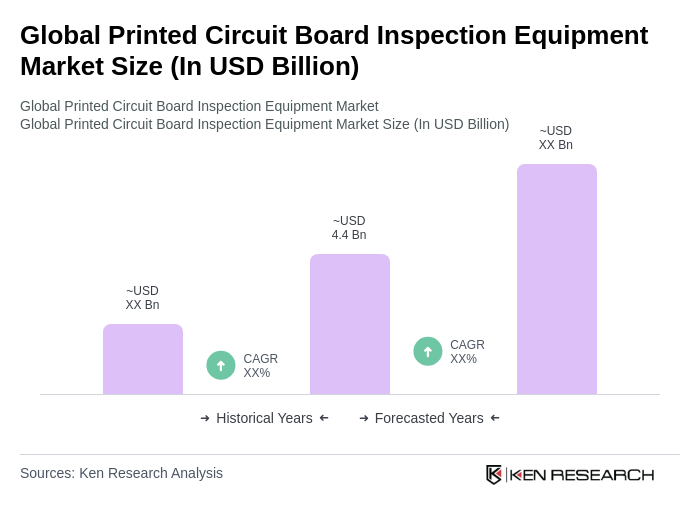
- The Global Printed Circuit Board Inspection Equipment Market is valued at USD 4.4 billion, based on a five-year historical analysis. This growth is primarily driven by the increasing demand for high-quality electronic components, rapid advancements in inspection technology, and the rising complexity and miniaturization of PCB designs. The need for efficient inspection processes to ensure product reliability and performance has further fueled market expansion, particularly as manufacturers adopt automated solutions to meet stringent quality standards .
- Key players in this market are concentrated in regions such as North America, Europe, and Asia-Pacific. Countries like the United States, Germany, and China dominate due to their robust electronics manufacturing sectors, continuous technological innovation, and significant investments in research and development. These regions are also home to major companies that drive innovation and set industry standards .
- In recent years, regulatory authorities in the United States have strengthened quality control requirements for electronic components, including PCBs. These measures are designed to enhance product safety and reliability, compelling manufacturers to adopt advanced inspection technologies. Compliance with these standards is essential for companies to maintain market access and ensure consumer trust .
Global Printed Circuit Board Inspection Equipment Market Segmentation
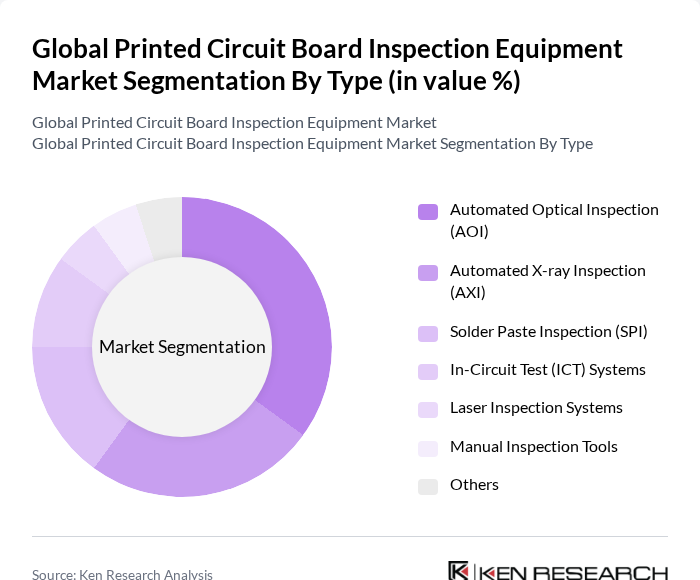
By Type:The market is segmented into various types of inspection equipment, including Automated Optical Inspection (AOI), Automated X-ray Inspection (AXI), Solder Paste Inspection (SPI), In-Circuit Test (ICT) Systems, Laser Inspection Systems, Manual Inspection Tools, and Others. Among these, Automated Optical Inspection (AOI) is the leading sub-segment due to its efficiency in detecting defects in PCB assemblies, which is crucial for maintaining high-quality standards in electronics manufacturing. The adoption of AOI and AXI systems is accelerating as manufacturers seek to address the challenges of miniaturized and densely packed PCB layouts .
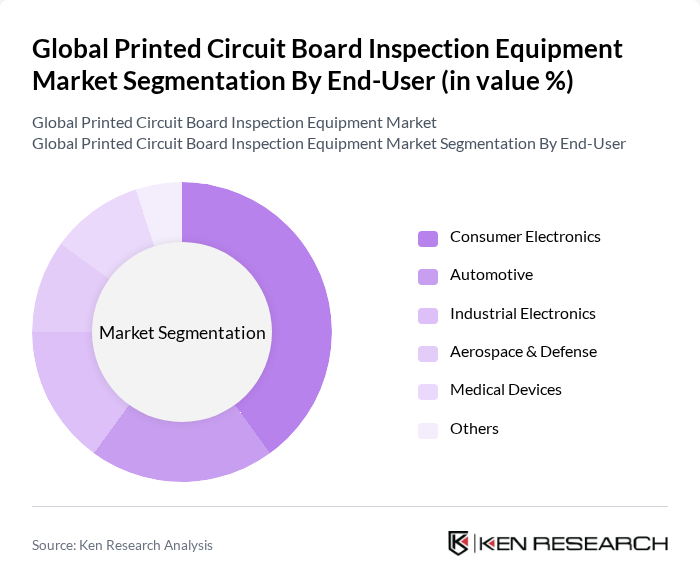
By End-User:The end-user segmentation includes Consumer Electronics, Automotive, Industrial Electronics, Aerospace & Defense, Medical Devices, and Others. The Consumer Electronics segment is the dominant sub-segment, driven by the increasing demand for smartphones, tablets, wearables, and other connected devices that require high-quality PCBs for optimal performance. The automotive and industrial electronics sectors are also experiencing notable growth, supported by the proliferation of electric vehicles and automation technologies .
Global Printed Circuit Board Inspection Equipment Market Competitive Landscape
The Global Printed Circuit Board Inspection Equipment Market is characterized by a dynamic mix of regional and international players. Leading participants such as Koh Young Technology Inc., Omron Corporation, Viscom AG, CyberOptics Corporation (a Nordson Company), Test Research, Inc. (TRI), Saki Corporation, Yxlon International (Comet Group), GÖPEL electronic GmbH, Juki Corporation, Fuji Corporation, Nikon Metrology NV, Keyence Corporation, KLA Corporation, Nordson YESTECH Inc., Cognex Corporation contribute to innovation, geographic expansion, and service delivery in this space.
Global Printed Circuit Board Inspection Equipment Market Industry Analysis
Growth Drivers
- Increasing Demand for Miniaturization in Electronics:The global electronics market is projected to reach $3 trillion by future, driven by the demand for smaller, more efficient devices. This trend necessitates advanced printed circuit board (PCB) inspection equipment to ensure quality and reliability. As devices shrink, the complexity of PCBs increases, requiring sophisticated inspection technologies. The miniaturization trend is expected to boost the PCB inspection equipment market significantly, with an estimated increase in demand by 12% annually.
- Rising Complexity of Electronic Components:The complexity of electronic components has surged, with the average number of components per PCB increasing from 50 in 2010 to over 250 in future. This complexity necessitates advanced inspection solutions to detect defects and ensure functionality. The need for high-precision inspection systems is underscored by the fact that 25% of electronic failures are attributed to PCB defects. Consequently, manufacturers are investing heavily in inspection technologies to maintain product quality and reliability.
- Growing Emphasis on Quality Assurance in Manufacturing:Quality assurance has become a critical focus in manufacturing, with companies investing approximately $1.5 billion in quality control technologies in future. This investment is driven by the need to reduce defects and enhance customer satisfaction. As a result, the demand for PCB inspection equipment is expected to rise, with manufacturers increasingly adopting automated inspection systems to ensure compliance with international quality standards, thereby enhancing operational efficiency.
Market Challenges
- High Initial Investment Costs:The initial investment for advanced PCB inspection equipment can exceed $600,000, posing a significant barrier for small to medium-sized enterprises. This high cost limits access to cutting-edge technologies, hindering their ability to compete in a rapidly evolving market. As a result, many manufacturers are reluctant to invest in new inspection systems, which can lead to quality issues and increased production costs in the long run.
- Rapid Technological Changes:The PCB inspection equipment market is characterized by rapid technological advancements, with new technologies emerging every year. This fast-paced environment creates challenges for manufacturers who must continuously upgrade their systems to remain competitive. Companies that fail to keep pace with technological changes risk obsolescence, as evidenced by the fact that 35% of firms reported difficulties in adapting to new inspection technologies in future, impacting their operational efficiency.
Global Printed Circuit Board Inspection Equipment Market Future Outlook
The future of the PCB inspection equipment market is poised for significant transformation, driven by advancements in automation and artificial intelligence. As manufacturers increasingly adopt smart manufacturing practices, the integration of AI in inspection processes will enhance accuracy and efficiency. Furthermore, the growing focus on sustainability will lead to the development of eco-friendly inspection solutions, aligning with global environmental goals. These trends are expected to reshape the market landscape, fostering innovation and improving product quality across the industry.
Market Opportunities
- Expansion in Emerging Markets:Emerging markets, particularly in Asia-Pacific, are witnessing rapid industrialization, with electronics manufacturing expected to grow by 25% annually. This growth presents significant opportunities for PCB inspection equipment suppliers to establish a foothold in these regions, catering to the increasing demand for quality assurance in manufacturing processes.
- Integration of AI and Machine Learning:The integration of AI and machine learning in inspection processes is projected to enhance defect detection rates by up to 60%. This technological advancement not only improves efficiency but also reduces operational costs. Companies that leverage these technologies can gain a competitive edge, positioning themselves as leaders in the PCB inspection equipment market.
Scope of the Report
| Segment | Sub-Segments |
|---|---|
| By Type | Automated Optical Inspection (AOI) Automated X-ray Inspection (AXI) Solder Paste Inspection (SPI) In-Circuit Test (ICT) Systems Laser Inspection Systems Manual Inspection Tools Others |
| By End-User | Consumer Electronics Automotive Industrial Electronics Aerospace & Defense Medical Devices Others |
| By Inspection Method | Visual Inspection Automated Inspection Hybrid Inspection Others |
| By Component Type | PCB Assemblies Integrated Circuits (ICs) Connectors Passive Components Others |
| By Region | North America Europe Asia-Pacific Latin America Middle East & Africa |
| By Technology | D Inspection D Inspection X-ray Inspection Machine Vision Inspection Others |
| By Application | Manufacturing Quality Control Research & Development Failure Analysis Others |
Key Target Audience
Investors and Venture Capitalist Firms
Government and Regulatory Bodies (e.g., Federal Communications Commission, International Electrotechnical Commission)
Manufacturers and Producers
Distributors and Retailers
Original Equipment Manufacturers (OEMs)
Technology Providers
Industry Associations (e.g., IPC - Association Connecting Electronics Industries)
Financial Institutions
Players Mentioned in the Report:
Koh Young Technology Inc.
Omron Corporation
Viscom AG
CyberOptics Corporation (a Nordson Company)
Test Research, Inc. (TRI)
Saki Corporation
Yxlon International (Comet Group)
GOPEL electronic GmbH
Juki Corporation
Fuji Corporation
Nikon Metrology NV
Keyence Corporation
KLA Corporation
Nordson YESTECH Inc.
Cognex Corporation
Table of Contents
Market Assessment Phase
1. Executive Summary and Approach
2. Global Printed Circuit Board Inspection Equipment Market Overview
2.1 Key Insights and Strategic Recommendations
2.2 Global Printed Circuit Board Inspection Equipment Market Overview
2.3 Definition and Scope
2.4 Evolution of Market Ecosystem
2.5 Timeline of Key Regulatory Milestones
2.6 Value Chain & Stakeholder Mapping
2.7 Business Cycle Analysis
2.8 Policy & Incentive Landscape
3. Global Printed Circuit Board Inspection Equipment Market Analysis
3.1 Growth Drivers
3.1.1 Increasing demand for miniaturization in electronics
3.1.2 Rising complexity of electronic components
3.1.3 Growing emphasis on quality assurance in manufacturing
3.1.4 Advancements in inspection technologies
3.2 Market Challenges
3.2.1 High initial investment costs
3.2.2 Rapid technological changes
3.2.3 Short product life cycles
3.2.4 Limited skilled workforce
3.3 Market Opportunities
3.3.1 Expansion in emerging markets
3.3.2 Integration of AI and machine learning in inspection processes
3.3.3 Increasing adoption of automation in manufacturing
3.3.4 Development of eco-friendly inspection solutions
3.4 Market Trends
3.4.1 Shift towards smart manufacturing
3.4.2 Growing use of 3D inspection technologies
3.4.3 Increasing focus on sustainability
3.4.4 Rise in demand for real-time inspection data
3.5 Government Regulation
3.5.1 Compliance with international quality standards
3.5.2 Regulations on electronic waste management
3.5.3 Safety standards for manufacturing equipment
3.5.4 Incentives for adopting advanced manufacturing technologies
4. SWOT Analysis
5. Stakeholder Analysis
6. Porter's Five Forces Analysis
7. Global Printed Circuit Board Inspection Equipment Market Market Size, 2019-2024
7.1 By Value
7.2 By Volume
7.3 By Average Selling Price
8. Global Printed Circuit Board Inspection Equipment Market Segmentation
8.1 By Type
8.1.1 Automated Optical Inspection (AOI)
8.1.2 Automated X-ray Inspection (AXI)
8.1.3 Solder Paste Inspection (SPI)
8.1.4 In-Circuit Test (ICT) Systems
8.1.5 Laser Inspection Systems
8.1.6 Manual Inspection Tools
8.1.7 Others
8.2 By End-User
8.2.1 Consumer Electronics
8.2.2 Automotive
8.2.3 Industrial Electronics
8.2.4 Aerospace & Defense
8.2.5 Medical Devices
8.2.6 Others
8.3 By Inspection Method
8.3.1 Visual Inspection
8.3.2 Automated Inspection
8.3.3 Hybrid Inspection
8.3.4 Others
8.4 By Component Type
8.4.1 PCB Assemblies
8.4.2 Integrated Circuits (ICs)
8.4.3 Connectors
8.4.4 Passive Components
8.4.5 Others
8.5 By Region
8.5.1 North America
8.5.2 Europe
8.5.3 Asia-Pacific
8.5.4 Latin America
8.5.5 Middle East & Africa
8.6 By Technology
8.6.1 2D Inspection
8.6.2 3D Inspection
8.6.3 X-ray Inspection
8.6.4 Machine Vision Inspection
8.6.5 Others
8.7 By Application
8.7.1 Manufacturing
8.7.2 Quality Control
8.7.3 Research & Development
8.7.4 Failure Analysis
8.7.5 Others
9. Global Printed Circuit Board Inspection Equipment Market Competitive Analysis
9.1 Market Share of Key Players
9.2 Cross Comparison of Key Players
9.2.1 Company Name
9.2.2 Company Size (Large, Medium, Small as per industry convention)
9.2.3 Revenue (USD Million/Billion)
9.2.4 Revenue Growth Rate (%)
9.2.5 Market Share (%)
9.2.6 Geographic Presence (Number of countries/regions served)
9.2.7 R&D Expenditure (% of revenue)
9.2.8 Product Portfolio Breadth (Number of inspection solutions offered)
9.2.9 Key End-User Segments Served
9.2.10 Installed Base (Number of systems deployed)
9.2.11 Customer Retention Rate (%)
9.2.12 Average Lead Time (weeks/days)
9.2.13 After-Sales Service Coverage
9.2.14 Product Innovation Rate (Number of new products launched/year)
9.2.15 Patent Portfolio (Number of active patents)
9.2.16 Sustainability Initiatives (ESG disclosures, green products, etc.)
9.3 SWOT Analysis of Top Players
9.4 Pricing Analysis
9.5 Detailed Profile of Major Companies
9.5.1 Koh Young Technology Inc.
9.5.2 Omron Corporation
9.5.3 Viscom AG
9.5.4 CyberOptics Corporation (a Nordson Company)
9.5.5 Test Research, Inc. (TRI)
9.5.6 Saki Corporation
9.5.7 Yxlon International (Comet Group)
9.5.8 GÖPEL electronic GmbH
9.5.9 Juki Corporation
9.5.10 Fuji Corporation
9.5.11 Nikon Metrology NV
9.5.12 Keyence Corporation
9.5.13 KLA Corporation
9.5.14 Nordson YESTECH Inc.
9.5.15 Cognex Corporation
10. Global Printed Circuit Board Inspection Equipment Market End-User Analysis
10.1 Procurement Behavior of Key Ministries
10.1.1 Government procurement policies
10.1.2 Budget allocation for technology upgrades
10.1.3 Collaboration with private sectors
10.1.4 Compliance with international standards
10.2 Corporate Spend on Infrastructure & Energy
10.2.1 Investment in manufacturing facilities
10.2.2 Spending on quality assurance technologies
10.2.3 Budget for R&D in inspection technologies
10.2.4 Allocation for training and development
10.3 Pain Point Analysis by End-User Category
10.3.1 Quality control challenges
10.3.2 Cost management issues
10.3.3 Technology integration difficulties
10.3.4 Workforce skill gaps
10.4 User Readiness for Adoption
10.4.1 Awareness of inspection technologies
10.4.2 Willingness to invest in new solutions
10.4.3 Training needs for staff
10.4.4 Support for transition to automated systems
10.5 Post-Deployment ROI and Use Case Expansion
10.5.1 Measurement of efficiency gains
10.5.2 Analysis of cost savings
10.5.3 Expansion into new applications
10.5.4 Long-term sustainability assessments
11. Global Printed Circuit Board Inspection Equipment Market Future Size, 2025-2030
11.1 By Value
11.2 By Volume
11.3 By Average Selling Price
Go-To-Market Strategy Phase
1. Whitespace Analysis + Business Model Canvas
1.1 Market gaps identification
1.2 Value proposition development
1.3 Revenue model exploration
1.4 Customer segmentation analysis
1.5 Competitive landscape assessment
1.6 Key partnerships identification
1.7 Resource allocation strategy
2. Marketing and Positioning Recommendations
2.1 Branding strategies
2.2 Product USPs
2.3 Target audience identification
2.4 Communication strategy
2.5 Digital marketing approach
2.6 Trade show participation
2.7 Customer engagement tactics
3. Distribution Plan
3.1 Urban retail vs rural NGO tie-ups
3.2 Online vs offline distribution channels
3.3 Logistics and supply chain management
3.4 Partnership with distributors
3.5 Inventory management strategies
3.6 Regional distribution strategies
3.7 Customer service and support
4. Channel & Pricing Gaps
4.1 Underserved routes
4.2 Pricing bands
4.3 Competitor pricing analysis
4.4 Value-based pricing strategies
4.5 Discounts and promotions
4.6 Bundling strategies
4.7 Price elasticity considerations
5. Unmet Demand & Latent Needs
5.1 Category gaps
5.2 Consumer segments
5.3 Emerging trends analysis
5.4 Feedback from current users
5.5 Future needs forecasting
5.6 Product development opportunities
5.7 Market entry barriers
6. Customer Relationship
6.1 Loyalty programs
6.2 After-sales service
6.3 Customer feedback mechanisms
6.4 Community building initiatives
6.5 Customer education and training
6.6 Relationship management tools
6.7 Customer satisfaction measurement
7. Value Proposition
7.1 Sustainability
7.2 Integrated supply chains
7.3 Cost-effectiveness
7.4 Quality assurance
7.5 Innovation and technology
7.6 Customer-centric solutions
7.7 Competitive advantage
8. Key Activities
8.1 Regulatory compliance
8.2 Branding
8.3 Distribution setup
8.4 Training and development
8.5 Market research
8.6 Partnership development
8.7 Performance monitoring
9. Entry Strategy Evaluation
9.1 Domestic Market Entry Strategy
9.1.1 Product mix
9.1.2 Pricing band
9.1.3 Packaging
9.2 Export Entry Strategy
9.2.1 Target countries
9.2.2 Compliance roadmap
10. Entry Mode Assessment
10.1 JV
10.2 Greenfield
10.3 M&A
10.4 Distributor Model
11. Capital and Timeline Estimation
11.1 Capital requirements
11.2 Timelines
12. Control vs Risk Trade-Off
12.1 Ownership vs Partnerships
13. Profitability Outlook
13.1 Breakeven analysis
13.2 Long-term sustainability
14. Potential Partner List
14.1 Distributors
14.2 JVs
14.3 Acquisition targets
15. Execution Roadmap
15.1 Phased Plan for Market Entry
15.1.1 Market Setup
15.1.2 Market Entry
15.1.3 Growth Acceleration
15.1.4 Scale & Stabilize
15.2 Key Activities and Milestones
15.2.1 Milestone tracking
15.2.2 Activity scheduling
15.2.3 Resource allocation
Research Methodology
Phase 1: Approach1
Desk Research
- Industry reports from market research firms focusing on printed circuit board technologies
- Technical publications and white papers detailing advancements in inspection equipment
- Statistical data from trade associations and government agencies related to electronics manufacturing
Primary Research
- Interviews with engineers and quality assurance managers in PCB manufacturing firms
- Surveys targeting procurement specialists in electronics companies
- Field visits to manufacturing plants to observe inspection processes and equipment usage
Validation & Triangulation
- Cross-validation of findings through multiple expert interviews and industry reports
- Triangulation of data from primary and secondary sources to ensure consistency
- Sanity checks through feedback from industry panels and focus groups
Phase 2: Market Size Estimation1
Top-down Assessment
- Analysis of global electronics manufacturing output to estimate PCB inspection equipment demand
- Segmentation of the market by application areas such as automotive, consumer electronics, and telecommunications
- Incorporation of trends in automation and quality control standards in manufacturing
Bottom-up Modeling
- Estimation of market size based on unit sales data from leading PCB inspection equipment manufacturers
- Cost analysis of inspection equipment, including initial purchase and maintenance costs
- Volume projections based on historical sales data and growth rates in the electronics sector
Forecasting & Scenario Analysis
- Multi-variable forecasting models incorporating technological advancements and market trends
- Scenario analysis based on potential regulatory changes and shifts in manufacturing practices
- Development of baseline, optimistic, and pessimistic market growth projections through 2030
Phase 3: CATI Sample Composition1
| Scope Item/Segment | Sample Size | Target Respondent Profiles |
|---|---|---|
| Automotive PCB Manufacturers | 60 | Quality Control Managers, Production Supervisors |
| Consumer Electronics Assembly Firms | 50 | Procurement Managers, R&D Engineers |
| Telecommunications Equipment Producers | 40 | Operations Managers, Technical Directors |
| Medical Device Manufacturers | 45 | Compliance Officers, Manufacturing Engineers |
| Industrial Electronics Suppliers | 55 | Supply Chain Managers, Product Quality Analysts |
Frequently Asked Questions
What is the current value of the Global Printed Circuit Board Inspection Equipment Market?
The Global Printed Circuit Board Inspection Equipment Market is valued at approximately USD 4.4 billion, reflecting a significant growth driven by the demand for high-quality electronic components and advancements in inspection technology.
What factors are driving the growth of the PCB inspection equipment market?
Which regions dominate the PCB inspection equipment market?
What are the main types of PCB inspection equipment?
Other Regional/Country Reports
Indonesia Printed Circuit Board Inspection Equipment Market
Malaysia Printed Circuit Board Inspection Equipment Market
APAC Printed Circuit Board Inspection Equipment Market
SEA Printed Circuit Board Inspection Equipment Market
Why Buy From Us?

What makes us stand out is that our consultants follow Robust, Refine and Result (RRR) methodology. Robust for clear definitions, approaches and sanity checking, Refine for differentiating respondents' facts and opinions, and Result for presenting data with story.

We have set a benchmark in the industry by offering our clients with syndicated and customized market research reports featuring coverage of entire market as well as meticulous research and analyst insights.

While we don't replace traditional research, we flip the method upside down. Our dual approach of Top Bottom & Bottom Top ensures quality deliverable by not just verifying company fundamentals but also looking at the sector and macroeconomic factors.

With one step in the future, our research team constantly tries to show you the bigger picture. We help with some of the tough questions you may encounter along the way: How is the industry positioned? Best marketing channel? KPI's of competitors? By aligning every element, we help maximize success.

Our report gives you instant access to the answers and sources that other companies might choose to hide. We elaborate each steps of research methodology we have used and showcase you the sample size to earn your trust.

If you need any support, we are here! We pride ourselves on universe strength, data quality, and quick, friendly, and professional service.