About the Report
Base Year 2024Global Recreational Vehicle Parks And Campgrounds Market Overview
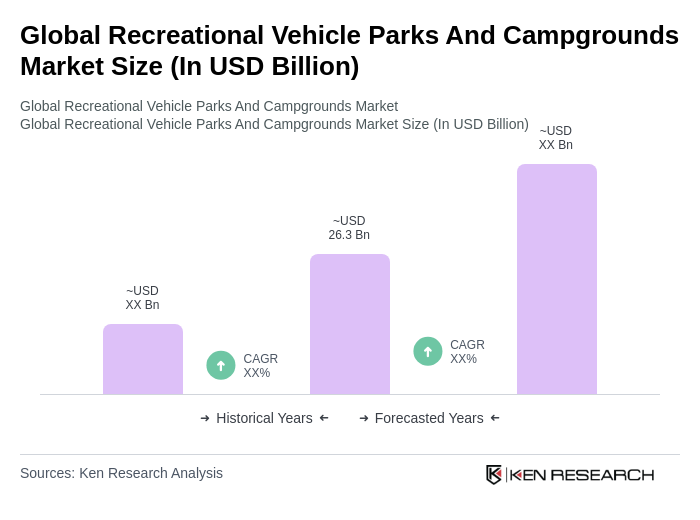
- The Global Recreational Vehicle Parks and Campgrounds Market is valued at USD 26.3 billion, based on a five-year historical analysis. This growth is primarily driven by the increasing popularity of outdoor recreational activities, a rise in domestic tourism, and the growing trend of RV ownership among consumers seeking flexible travel options; participation in camping and the installed base of RV owners have expanded in North America and Europe, underpinning higher campsite demand and site upgrades. The market has seen a significant uptick in demand for camping experiences that offer both adventure and comfort, with operators adding amenities such as full hookups, Wi?Fi, and resort-style features to attract diverse traveler segments.
- Key players in this market include the United States, Canada, Australia, and several European countries. The dominance of these regions can be attributed to their vast natural landscapes, established camping infrastructure, and a strong culture of outdoor activities; North America accounts for the largest regional share by revenue. The U.S. remains a leader due to its extensive network of national parks and campgrounds, which attract millions of visitors annually, alongside a large RV owner base supported by private operators and membership networks such as Thousand Trails.
- In 2023, the U.S. government implemented new regulations aimed at enhancing safety and environmental standards in recreational vehicle parks and campgrounds. These regulations require park operators to adhere to stricter waste management practices and provide adequate facilities for waste disposal, ensuring a cleaner and more sustainable camping experience for visitors; operators have been aligning with updated sanitation, wastewater, and environmental compliance frameworks across federal land agencies and state health codes influencing campground operations.
Global Recreational Vehicle Parks And Campgrounds Market Segmentation
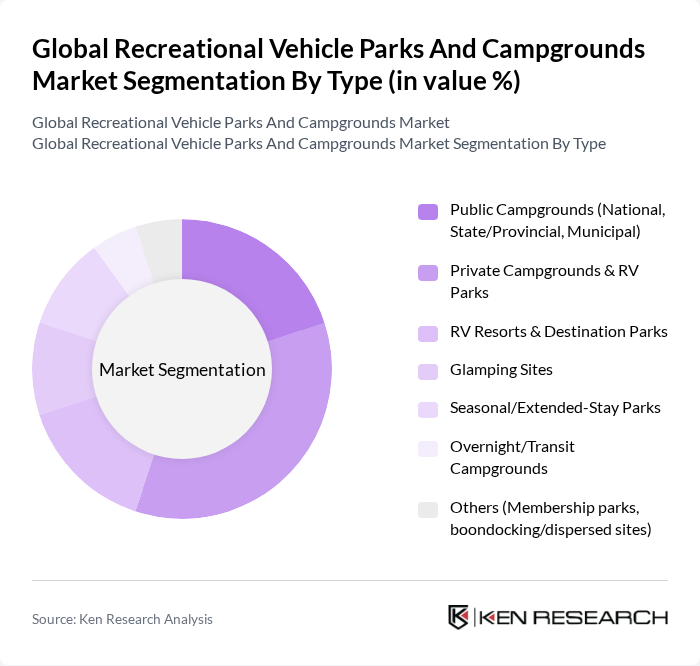
By Type:The market is segmented into various types, including Public Campgrounds (National, State/Provincial, Municipal), Private Campgrounds & RV Parks, RV Resorts & Destination Parks, Glamping Sites, Seasonal/Extended-Stay Parks, Overnight/Transit Campgrounds, and Others (Membership parks, boondocking/dispersed sites). Among these, Private Campgrounds & RV Parks dominate the market due to their ability to offer personalized services and amenities that cater to diverse consumer preferences; private operators have expanded with resort-style amenities and membership models that boost utilization and yield.
By End-User:The end-user segmentation includes Families, Solo Travelers, Groups (Clubs, Friends), Corporate & Event Retreats, and Senior/Retiree Travelers (Snowbirds). Families represent the largest segment, driven by the desire for affordable vacation options and the appeal of outdoor experiences that cater to all ages; demand is further supported by multi-generational travel, pet-friendly policies, and value-oriented lodging alternatives to hotels.

Global Recreational Vehicle Parks And Campgrounds Market Competitive Landscape
The Global Recreational Vehicle Parks And Campgrounds Market is characterized by a dynamic mix of regional and international players. Leading participants such as Kampgrounds of America, Inc. (KOA), Yogi Bear’s Jellystone Park Camp-Resorts (Northgate Resorts), Thousand Trails (Equity LifeStyle Properties, Inc.), Sun Outdoors (Sun Communities, Inc.), Equity LifeStyle Properties, Inc. (ELS), Blue Water Development Corp., RVC Outdoor Destinations, Good Sam (Camping World Holdings, Inc.), Harvest Hosts, Hipcamp, Kampgrounds of Australia (BIG4 Holiday Parks), Discovery Parks (G’day Group Holdings), Parkdean Resorts, EuroParcs Group, Roompot Parks contribute to innovation, geographic expansion, and service delivery in this space; North America remains the largest revenue base for consolidated operators.
Global Recreational Vehicle Parks And Campgrounds Market Industry Analysis
Growth Drivers
- Increasing Popularity of Outdoor Recreational Activities:The global outdoor recreation market is projected to reach $887 billion in the future, driven by a growing interest in activities such as hiking, camping, and fishing. This trend is supported by the World Bank's report indicating that 60% of consumers are prioritizing outdoor experiences over traditional vacations. The rise in outdoor participation is significantly boosting demand for RV parks and campgrounds, as more individuals seek immersive nature experiences.
- Rising Disposable Income Among Consumers:According to the IMF, global disposable income is expected to increase by approximately $1.5 trillion in the future, leading to greater spending on leisure activities. This increase in disposable income allows families to invest in recreational vehicles and camping experiences. As a result, RV parks and campgrounds are witnessing a surge in visitors, with an estimated 20% increase in occupancy rates projected for the upcoming year, reflecting this economic trend.
- Growth in Domestic Tourism:The domestic tourism sector is anticipated to grow by 7% in the future, as reported by the United Nations World Tourism Organization. This growth is fueled by consumers' preference for local travel experiences, particularly in the wake of the pandemic. As families opt for road trips and camping vacations, RV parks and campgrounds are becoming increasingly popular, with a projected increase of 15 million domestic travelers choosing these accommodations in the coming year.
Market Challenges
- Seasonal Fluctuations in Demand:The RV park and campground industry faces significant seasonal demand fluctuations, with peak seasons typically occurring during summer months. For instance, data from the National Association of RV Parks and Campgrounds indicates that occupancy rates can drop by 50% during off-peak seasons. This variability poses challenges for park management in maintaining consistent revenue streams and managing operational costs throughout the year.
- High Operational Costs for Park Management:Managing RV parks and campgrounds incurs substantial operational costs, including maintenance, staffing, and utilities. According to industry reports, average annual operational costs can exceed $300,000 for mid-sized parks. These high expenses can strain profitability, particularly for smaller operators who may struggle to cover costs during low-demand periods, leading to potential closures or reduced services.
Global Recreational Vehicle Parks And Campgrounds Market Future Outlook
The future of the RV parks and campgrounds market appears promising, driven by evolving consumer preferences towards outdoor experiences and sustainable tourism. As more travelers seek unique and luxurious camping options, the industry is likely to adapt by enhancing amenities and services. Additionally, the integration of technology in park management will streamline operations and improve customer experiences, positioning the market for sustained growth in the coming years.
Market Opportunities
- Development of Eco-Friendly Campgrounds:There is a growing demand for eco-friendly camping options, with consumers increasingly prioritizing sustainability. Parks that implement green practices, such as solar energy and waste reduction, can attract environmentally conscious travelers. This trend is supported by a 30% increase in bookings for eco-friendly accommodations reported in the future, indicating a significant market opportunity for sustainable campground development.
- Integration of Technology in Park Management:The adoption of technology in campground operations, such as online booking systems and mobile apps, is becoming essential. A report from the Camping and RVing Industry Association indicates that 40% of campers prefer digital platforms for reservations. By investing in technology, parks can enhance customer engagement and streamline operations, leading to improved occupancy rates and customer satisfaction.
Scope of the Report
| Segment | Sub-Segments |
|---|---|
| By Type | Public Campgrounds (National, State/Provincial, Municipal) Private Campgrounds & RV Parks RV Resorts & Destination Parks Glamping Sites Seasonal/Extended-Stay Parks Overnight/Transit Campgrounds Others (Membership parks, boondocking/dispersed sites) |
| By End-User | Families Solo Travelers Groups (Clubs, Friends) Corporate & Event Retreats Senior/Retiree Travelers (Snowbirds) |
| By Amenities Offered | Basic Amenities (water, restrooms, dump station) Full Hook-Up Sites (electric, water, sewer) Premium Facilities (pools, Wi?Fi, cabins, recreation) Pet-Friendly & Accessibility Features |
| By Booking Channel | Online Travel Agencies (OTAs) and Aggregators Direct Bookings (park websites, phone) Membership/Third-Party Platforms (e.g., Good Sam, Passport America) |
| By Location | Urban/Peri-Urban Rural In/Adjacent to National & State Parks Coastal/Waterfront Mountain/Forest/Desert |
| By Duration of Stay | Nightly/Short-Term Monthly/Long-Term Seasonal |
| By Price Range | Budget Mid-Range Premium/Luxury |
Key Target Audience
Investors and Venture Capitalist Firms
Government and Regulatory Bodies (e.g., National Park Service, Bureau of Land Management)
Manufacturers and Producers of Recreational Vehicles
Campground and RV Park Operators
Tourism Boards and Destination Marketing Organizations
Real Estate Developers focusing on Recreational Properties
Insurance Companies specializing in Recreational Vehicle Coverage
Environmental and Conservation Organizations
Players Mentioned in the Report:
Kampgrounds of America, Inc. (KOA)
Yogi Bears Jellystone Park Camp-Resorts (Northgate Resorts)
Thousand Trails (Equity LifeStyle Properties, Inc.)
Sun Outdoors (Sun Communities, Inc.)
Equity LifeStyle Properties, Inc. (ELS)
Blue Water Development Corp.
RVC Outdoor Destinations
Good Sam (Camping World Holdings, Inc.)
Harvest Hosts
Hipcamp
Kampgrounds of Australia (BIG4 Holiday Parks)
Discovery Parks (Gday Group Holdings)
Parkdean Resorts
EuroParcs Group
Roompot Parks
Table of Contents
Market Assessment Phase
1. Executive Summary and Approach
2. Global Recreational Vehicle Parks And Campgrounds Market Overview
2.1 Key Insights and Strategic Recommendations
2.2 Global Recreational Vehicle Parks And Campgrounds Market Overview
2.3 Definition and Scope
2.4 Evolution of Market Ecosystem
2.5 Timeline of Key Regulatory Milestones
2.6 Value Chain & Stakeholder Mapping
2.7 Business Cycle Analysis
2.8 Policy & Incentive Landscape
3. Global Recreational Vehicle Parks And Campgrounds Market Analysis
3.1 Growth Drivers
3.1.1 Increasing popularity of outdoor recreational activities
3.1.2 Rising disposable income among consumers
3.1.3 Growth in domestic tourism
3.1.4 Expansion of RV manufacturing and sales
3.2 Market Challenges
3.2.1 Seasonal fluctuations in demand
3.2.2 High operational costs for park management
3.2.3 Regulatory compliance issues
3.2.4 Competition from alternative accommodation options
3.3 Market Opportunities
3.3.1 Development of eco-friendly campgrounds
3.3.2 Integration of technology in park management
3.3.3 Expansion into emerging markets
3.3.4 Partnerships with tourism agencies
3.4 Market Trends
3.4.1 Increasing demand for luxury camping experiences
3.4.2 Growth of glamping as a popular trend
3.4.3 Focus on sustainability and eco-tourism
3.4.4 Rise of digital platforms for booking and reviews
3.5 Government Regulation
3.5.1 Zoning laws affecting campground locations
3.5.2 Health and safety regulations for campgrounds
3.5.3 Environmental protection laws
3.5.4 Licensing requirements for RV parks
4. SWOT Analysis
5. Stakeholder Analysis
6. Porter's Five Forces Analysis
7. Global Recreational Vehicle Parks And Campgrounds Market Market Size, 2019-2024
7.1 By Value
7.2 By Volume
7.3 By Average Selling Price
8. Global Recreational Vehicle Parks And Campgrounds Market Segmentation
8.1 By Type
8.1.1 Public Campgrounds (National, State/Provincial, Municipal)
8.1.2 Private Campgrounds & RV Parks
8.1.3 RV Resorts & Destination Parks
8.1.4 Glamping Sites
8.1.5 Seasonal/Extended-Stay Parks
8.1.6 Overnight/Transit Campgrounds
8.1.7 Others (Membership parks, boondocking/dispersed sites)
8.2 By End-User
8.2.1 Families
8.2.2 Solo Travelers
8.2.3 Groups (Clubs, Friends)
8.2.4 Corporate & Event Retreats
8.2.5 Senior/Retiree Travelers (Snowbirds)
8.3 By Amenities Offered
8.3.1 Basic Amenities (water, restrooms, dump station)
8.3.2 Full Hook-Up Sites (electric, water, sewer)
8.3.3 Premium Facilities (pools, Wi?Fi, cabins, recreation)
8.3.4 Pet-Friendly & Accessibility Features
8.4 By Booking Channel
8.4.1 Online Travel Agencies (OTAs) and Aggregators
8.4.2 Direct Bookings (park websites, phone)
8.4.3 Membership/Third-Party Platforms (e.g., Good Sam, Passport America)
8.5 By Location
8.5.1 Urban/Peri-Urban
8.5.2 Rural
8.5.3 In/Adjacent to National & State Parks
8.5.4 Coastal/Waterfront
8.5.5 Mountain/Forest/Desert
8.6 By Duration of Stay
8.6.1 Nightly/Short-Term
8.6.2 Monthly/Long-Term
8.6.3 Seasonal
8.7 By Price Range
8.7.1 Budget
8.7.2 Mid-Range
8.7.3 Premium/Luxury
9. Global Recreational Vehicle Parks And Campgrounds Market Competitive Analysis
9.1 Market Share of Key Players
9.2 Cross Comparison of Key Players
9.2.1 Company Name
9.2.2 Portfolio Scale (sites/locations, pads)
9.2.3 Occupancy Rate (%)
9.2.4 Average Daily Rate (ADR)
9.2.5 Revenue per Available Pad (RevPAP)
9.2.6 Same-Park NOI Growth (YoY)
9.2.7 Average Length of Stay (nights)
9.2.8 Membership Base/Subscriptions (count)
9.2.9 Pipeline (sites under development/acquisition)
9.2.10 Digital Booking Mix (% direct vs. OTA)
9.2.11 Ancillary Revenue Share (retail, activities, cabins)
9.2.12 Customer Satisfaction/NPS
9.3 SWOT Analysis of Top Players
9.4 Pricing Analysis
9.5 Detailed Profile of Major Companies
9.5.1 Kampgrounds of America, Inc. (KOA)
9.5.2 Yogi Bear’s Jellystone Park Camp-Resorts (Northgate Resorts)
9.5.3 Thousand Trails (Equity LifeStyle Properties, Inc.)
9.5.4 Sun Outdoors (Sun Communities, Inc.)
9.5.5 Equity LifeStyle Properties, Inc. (ELS)
9.5.6 Blue Water Development Corp.
9.5.7 RVC Outdoor Destinations
9.5.8 Good Sam (Camping World Holdings, Inc.)
9.5.9 Harvest Hosts
9.5.10 Hipcamp
9.5.11 Kampgrounds of Australia (BIG4 Holiday Parks)
9.5.12 Discovery Parks (G’day Group Holdings)
9.5.13 Parkdean Resorts
9.5.14 EuroParcs Group
9.5.15 Roompot Parks
10. Global Recreational Vehicle Parks And Campgrounds Market End-User Analysis
10.1 Procurement Behavior of Key Ministries
10.1.1 Budget Allocation for Recreational Facilities
10.1.2 Policy Support for Outdoor Activities
10.1.3 Collaboration with Private Sector
10.2 Corporate Spend on Infrastructure & Energy
10.2.1 Investment in Campground Development
10.2.2 Funding for Eco-Friendly Initiatives
10.2.3 Expenditure on Marketing and Promotion
10.3 Pain Point Analysis by End-User Category
10.3.1 Accessibility Issues
10.3.2 Quality of Amenities
10.3.3 Pricing Concerns
10.4 User Readiness for Adoption
10.4.1 Awareness of Campground Options
10.4.2 Willingness to Pay for Premium Services
10.4.3 Interest in Sustainable Practices
10.5 Post-Deployment ROI and Use Case Expansion
10.5.1 Revenue Growth from Repeat Customers
10.5.2 Expansion of Service Offerings
10.5.3 Increased Brand Loyalty
11. Global Recreational Vehicle Parks And Campgrounds Market Future Size, 2025-2030
11.1 By Value
11.2 By Volume
11.3 By Average Selling Price
Go-To-Market Strategy Phase
1. Whitespace Analysis + Business Model Canvas
1.1 Market Gaps Identification
1.2 Value Proposition Development
1.3 Revenue Streams Analysis
1.4 Cost Structure Evaluation
1.5 Key Partnerships
1.6 Customer Segments
1.7 Channels
2. Marketing and Positioning Recommendations
2.1 Branding Strategies
2.2 Product USPs
2.3 Target Audience Identification
2.4 Marketing Channels
2.5 Promotional Activities
3. Distribution Plan
3.1 Urban Retail Strategies
3.2 Rural NGO Tie-Ups
3.3 Online Distribution Channels
3.4 Partnerships with Travel Agencies
4. Channel & Pricing Gaps
4.1 Underserved Routes
4.2 Pricing Bands Analysis
4.3 Competitor Pricing Comparison
5. Unmet Demand & Latent Needs
5.1 Category Gaps
5.2 Consumer Segments Analysis
5.3 Emerging Trends
6. Customer Relationship
6.1 Loyalty Programs
6.2 After-Sales Service
6.3 Customer Feedback Mechanisms
7. Value Proposition
7.1 Sustainability Initiatives
7.2 Integrated Supply Chains
7.3 Unique Selling Points
8. Key Activities
8.1 Regulatory Compliance
8.2 Branding Efforts
8.3 Distribution Setup
9. Entry Strategy Evaluation
9.1 Domestic Market Entry Strategy
9.1.1 Product Mix
9.1.2 Pricing Band
9.1.3 Packaging
9.2 Export Entry Strategy
9.2.1 Target Countries
9.2.2 Compliance Roadmap
10. Entry Mode Assessment
10.1 Joint Ventures
10.2 Greenfield Investments
10.3 Mergers & Acquisitions
10.4 Distributor Model
11. Capital and Timeline Estimation
11.1 Capital Requirements
11.2 Timelines
12. Control vs Risk Trade-Off
12.1 Ownership vs Partnerships
13. Profitability Outlook
13.1 Breakeven Analysis
13.2 Long-Term Sustainability
14. Potential Partner List
14.1 Distributors
14.2 Joint Ventures
14.3 Acquisition Targets
15. Execution Roadmap
15.1 Phased Plan for Market Entry
15.1.1 Market Setup
15.1.2 Market Entry
15.1.3 Growth Acceleration
15.1.4 Scale & Stabilize
15.2 Key Activities and Milestones
15.2.1 Activity Planning
15.2.2 Milestone Tracking
Research Methodology
Phase 1: Approach1
Desk Research
- Analysis of industry reports from global recreational vehicle associations and tourism boards
- Review of market trends and statistics from government publications and travel agencies
- Examination of demographic data and consumer behavior studies related to outdoor recreation
Primary Research
- Interviews with campground owners and operators to gather insights on operational challenges
- Surveys targeting RV users to understand preferences and spending habits
- Focus groups with outdoor enthusiasts to explore trends in camping and RV usage
Validation & Triangulation
- Cross-validation of findings through multiple data sources, including trade publications and consumer surveys
- Triangulation of qualitative insights from interviews with quantitative data from surveys
- Sanity checks conducted through expert panel reviews comprising industry veterans
Phase 2: Market Size Estimation1
Top-down Assessment
- Estimation of market size based on national tourism expenditure and RV ownership statistics
- Segmentation of the market by types of campgrounds (public vs. private) and geographical regions
- Incorporation of growth rates from historical data and projected tourism trends
Bottom-up Modeling
- Collection of revenue data from a sample of campgrounds and RV parks across key regions
- Estimation of average daily rates and occupancy rates to calculate potential revenue
- Analysis of ancillary revenue streams such as amenities and services offered at campgrounds
Forecasting & Scenario Analysis
- Multi-factor regression analysis incorporating variables such as economic indicators and consumer confidence
- Scenario modeling based on potential impacts of environmental regulations and travel restrictions
- Development of baseline, optimistic, and pessimistic forecasts through 2030
Phase 3: CATI Sample Composition1
| Scope Item/Segment | Sample Size | Target Respondent Profiles |
|---|---|---|
| Private Campground Operators | 100 | Owners, General Managers |
| Public Campground Administrators | 80 | Park Managers, Local Government Officials |
| RV Owners and Users | 120 | Recreational Vehicle Enthusiasts, Family Campers |
| Outdoor Recreation Associations | 60 | Board Members, Policy Advocates |
| Tourism and Travel Agencies | 70 | Travel Agents, Marketing Directors |
Frequently Asked Questions
What is the current value of the Global Recreational Vehicle Parks and Campgrounds Market?
The Global Recreational Vehicle Parks and Campgrounds Market is valued at approximately USD 26.3 billion, reflecting a significant growth trend driven by increased outdoor recreational activities and rising RV ownership among consumers.
What factors are driving the growth of the RV parks and campgrounds market?
Which regions dominate the Global Recreational Vehicle Parks and Campgrounds Market?
What types of campgrounds are included in the market segmentation?
Other Regional/Country Reports
Indonesia Recreational Vehicle Parks And Campgrounds Market
Malaysia Recreational Vehicle Parks And Campgrounds Market
APAC Recreational Vehicle Parks And Campgrounds Market
SEA Recreational Vehicle Parks And Campgrounds Market
Why Buy From Us?

What makes us stand out is that our consultants follow Robust, Refine and Result (RRR) methodology. Robust for clear definitions, approaches and sanity checking, Refine for differentiating respondents' facts and opinions, and Result for presenting data with story.

We have set a benchmark in the industry by offering our clients with syndicated and customized market research reports featuring coverage of entire market as well as meticulous research and analyst insights.

While we don't replace traditional research, we flip the method upside down. Our dual approach of Top Bottom & Bottom Top ensures quality deliverable by not just verifying company fundamentals but also looking at the sector and macroeconomic factors.

With one step in the future, our research team constantly tries to show you the bigger picture. We help with some of the tough questions you may encounter along the way: How is the industry positioned? Best marketing channel? KPI's of competitors? By aligning every element, we help maximize success.

Our report gives you instant access to the answers and sources that other companies might choose to hide. We elaborate each steps of research methodology we have used and showcase you the sample size to earn your trust.

If you need any support, we are here! We pride ourselves on universe strength, data quality, and quick, friendly, and professional service.