About the Report
Base Year 2024Listen to the audio summary
Global Rice Trade Market Overview
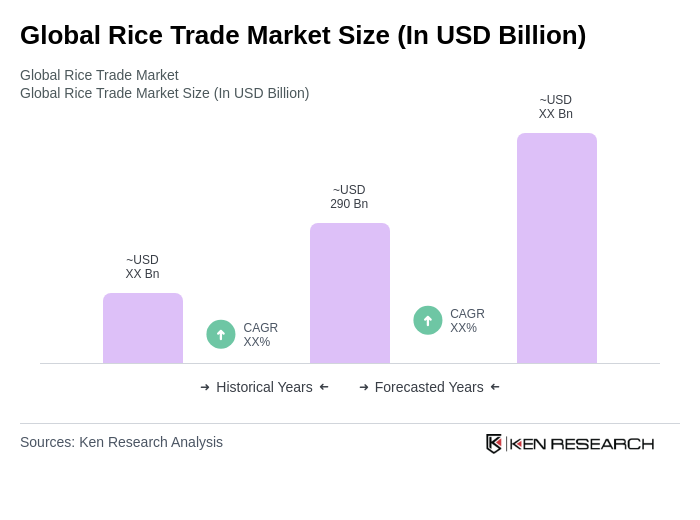
- The Global Rice Trade Market is valued at USD 290 billion, based on a five?year historical analysis. This growth is primarily driven by increasing global demand for rice as a staple food, particularly in developing countries, alongside rising export activities from major rice-producing nations. The market is also influenced by factors such as changing dietary preferences, the growing popularity of rice-based products, and technological advancements in agricultural practices, including high-yielding varieties and precision farming methods .
- Key players in this market include countries likeIndia, Thailand, Vietnam, and the United States, which dominate due to their extensive agricultural practices, favorable climatic conditions, and established export infrastructures. These nations have developed strong supply chains and trade relationships, enabling them to meet global demand effectively. India remains the largest exporter, with Vietnam and Thailand following closely, while the United States maintains a significant share in premium rice varieties .
- In 2023, the Indian government implemented theNational Food Security Mission (NFSM) – Rice, issued by the Ministry of Agriculture & Farmers Welfare, Government of India (2023), aimed at enhancing rice production efficiency through the introduction of high-yielding varieties and improved irrigation techniques. This initiative is expected to bolster India's position as a leading exporter in the global rice market, ensuring food security and supporting rural livelihoods. The program mandates adoption of modern agronomic practices, seed distribution, and water management standards for participating states .
Global Rice Trade Market Segmentation
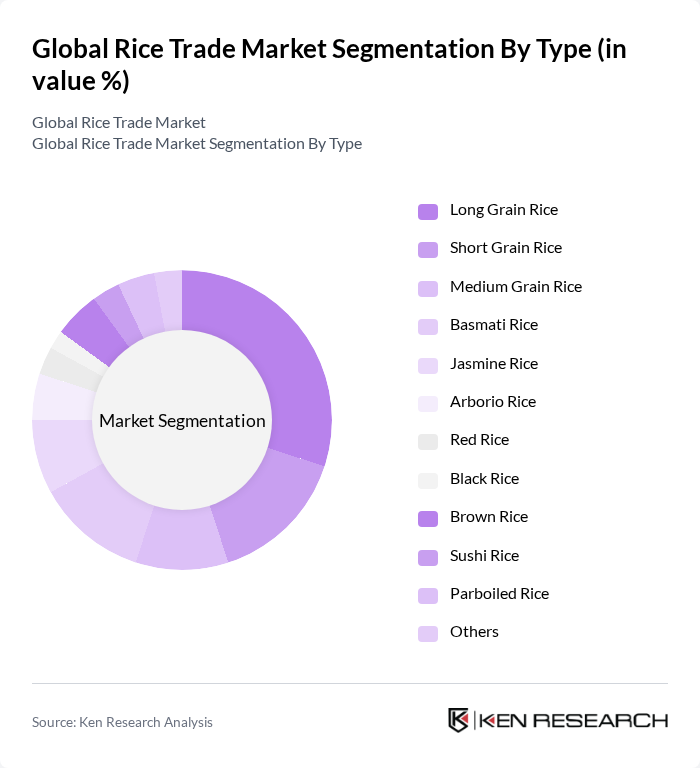
By Type:The rice market is segmented into various types, includingLong Grain Rice, Short Grain Rice, Medium Grain Rice, Basmati Rice, Jasmine Rice, Arborio Rice, Red Rice, Black Rice, Brown Rice, Sushi Rice, Parboiled Rice, and Others. Each type caters to different consumer preferences and culinary uses, influencing market dynamics significantly. Long grain rice dominates global consumption, especially in Asia and Africa, while specialty varieties like Basmati and Jasmine hold premium positions in international trade .
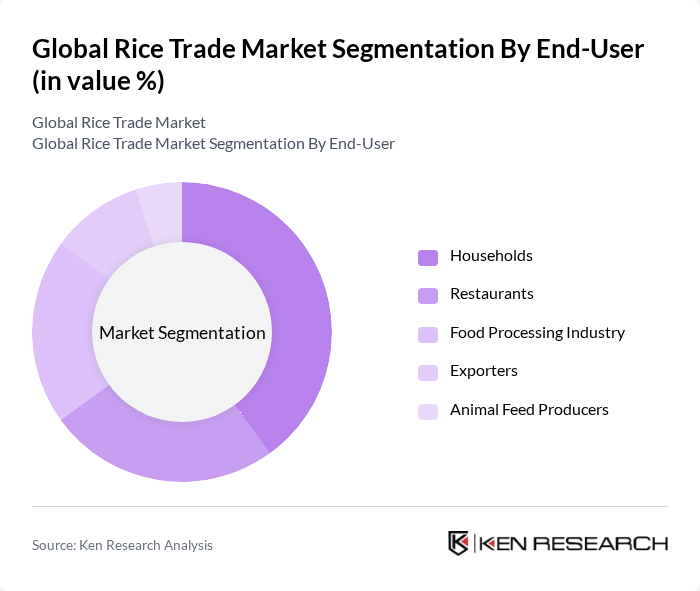
By End-User:The end-user segmentation includesHouseholds, Restaurants, Food Processing Industry, Exporters, and Animal Feed Producers. Each segment has distinct requirements and consumption patterns, which shape the overall market landscape. Households represent the largest share, followed by commercial food service and processing industries, reflecting rice’s role as a staple and ingredient in diverse cuisines .
Global Rice Trade Market Competitive Landscape
The Global Rice Trade Market is characterized by a dynamic mix of regional and international players. Leading participants such asOlam International, Riceland Foods, Inc., SunRice, Tilda Ltd., Thai Rice Exporters Association, Vietnam Southern Food Corporation (Vinafood II), Amira Nature Foods Ltd., Ebro Foods, S.A., Cargill, Inc., Adani Wilmar Ltd., LT Foods Ltd. (Daawat), Khao Shong Rice Co., Ltd., Kisan Rice Mill, Khao Hoon Rice Co., Ltd., Tohoku Seiko Co., Ltd., Vinh Long Food Corporation, Charoen Pokphand Foods PCL, American Rice, Inc., KRBL Limited, Asia Golden Rice Co., Ltd.contribute to innovation, geographic expansion, and service delivery in this space. These companies leverage advanced supply chain management, product diversification, and strategic partnerships to maintain competitive advantage .
Global Rice Trade Market Industry Analysis
Growth Drivers
- Increasing Global Demand for Rice:The global rice consumption reached approximately520 million metric tonsin future, driven by population growth and dietary preferences. The United Nations projects that the world population will exceed 9.7 billion in future, significantly increasing rice demand. Countries like India and China account for over 50% of global rice consumption, with India alone consuming around110 million metric tons annually. This rising demand is a crucial driver for the rice trade market in None.
- Technological Advancements in Rice Production:Innovations in agricultural technology have led to a15% increase in rice yields over the past decade. Techniques such as precision farming and genetically modified organisms (GMOs) are enhancing productivity. For instance, the introduction of hybrid rice varieties has resulted in yields of up to10 tons per hectare, compared to traditional varieties yielding around4–5 tons. These advancements are vital for meeting the growing demand in None and improving trade dynamics.
- Expansion of Export Markets:The global rice export market was valued at approximatelyUSD 28 billionin future, with countries like Thailand and Vietnam leading the way. The expansion of trade agreements, such as the Regional Comprehensive Economic Partnership (RCEP), has opened new markets for rice exporters. In None, the increase in exports is projected to rise byin future, driven by demand from emerging markets in Africa and the Middle East, enhancing the overall trade landscape.
Market Challenges
- Price Volatility:The rice market is subject to significant price fluctuations, with prices varying fromUSD 400 to USD 600 per metric tonin future. Factors such as weather conditions, global supply chain disruptions, and geopolitical tensions contribute to this volatility. For instance, the recent droughts in key producing regions have led to a20% increase in prices, impacting both producers and consumers in None, creating uncertainty in the market.
- Climate Change Impact on Production:Climate change poses a severe threat to rice production, with projections indicating a potential yield reduction of10–15% in futuredue to rising temperatures and erratic rainfall patterns. In None, regions heavily reliant on rice farming are experiencing increased flooding and droughts, which disrupt planting and harvesting cycles. This environmental challenge not only affects local food security but also impacts trade dynamics and pricing stability.
Global Rice Trade Market Future Outlook
The future of the rice trade market in None is poised for transformation, driven by sustainability and technological integration. As consumers increasingly prioritize environmentally friendly practices, the demand for sustainably produced rice is expected to rise. Additionally, advancements in digital supply chain management will enhance efficiency and transparency, allowing for better tracking of rice from farm to table. These trends will shape the market landscape, fostering resilience against challenges and promoting growth in the sector.
Market Opportunities
- Organic Rice Market Growth:The organic rice segment is experiencing rapid growth, with sales projected to reachin future. This trend is driven by increasing health consciousness among consumers in None, who are willing to pay a premium for organic products. The shift towards organic farming practices not only meets consumer demand but also supports sustainable agricultural practices, presenting a lucrative opportunity for producers and exporters.
- E-commerce Expansion for Rice Sales:The rise of e-commerce platforms has revolutionized rice sales, with online sales expected to account forof total rice sales in future. This shift is particularly evident in urban areas of None, where consumers prefer the convenience of online shopping. E-commerce allows for direct-to-consumer sales, reducing reliance on traditional distribution channels and enhancing market reach for rice producers.
Scope of the Report
| Segment | Sub-Segments |
|---|---|
| By Type | Long Grain Rice Short Grain Rice Medium Grain Rice Basmati Rice Jasmine Rice Arborio Rice Red Rice Black Rice Brown Rice Sushi Rice Parboiled Rice Others |
| By End-User | Households Restaurants Food Processing Industry Exporters Animal Feed Producers |
| By Sales Channel | Online Retail Supermarkets/Hypermarkets Wholesale Distributors Direct Sales Convenience Stores |
| By Distribution Mode | Bulk Distribution Packaged Distribution |
| By Price Range | Economy Mid-Range Premium |
| By Packaging Type | Bags Boxes Bulk Containers Vacuum Packs |
| By Quality Grade | Grade A Grade B Organic Specialty |
Key Target Audience
Investors and Venture Capitalist Firms
Government and Regulatory Bodies (e.g., Food and Agriculture Organization, U.S. Department of Agriculture)
Rice Producers and Exporters
Importing Countries' Trade Ministries
Logistics and Supply Chain Companies
Food Processing Companies
International Trade Organizations
Commodity Exchanges
Players Mentioned in the Report:
Olam International
Riceland Foods, Inc.
SunRice
Tilda Ltd.
Thai Rice Exporters Association
Vietnam Southern Food Corporation (Vinafood II)
Amira Nature Foods Ltd.
Ebro Foods, S.A.
Cargill, Inc.
Adani Wilmar Ltd.
LT Foods Ltd. (Daawat)
Khao Shong Rice Co., Ltd.
Kisan Rice Mill
Khao Hoon Rice Co., Ltd.
Tohoku Seiko Co., Ltd.
Vinh Long Food Corporation
Charoen Pokphand Foods PCL
American Rice, Inc.
KRBL Limited
Asia Golden Rice Co., Ltd.
Table of Contents
Market Assessment Phase
1. Executive Summary and Approach
2. Global Rice Trade Market Overview
2.1 Key Insights and Strategic Recommendations
2.2 Global Rice Trade Market Overview
2.3 Definition and Scope
2.4 Evolution of Market Ecosystem
2.5 Timeline of Key Regulatory Milestones
2.6 Value Chain & Stakeholder Mapping
2.7 Business Cycle Analysis
2.8 Policy & Incentive Landscape
3. Global Rice Trade Market Analysis
3.1 Growth Drivers
3.1.1 Increasing Global Demand for Rice
3.1.2 Technological Advancements in Rice Production
3.1.3 Expansion of Export Markets
3.1.4 Government Support and Subsidies
3.2 Market Challenges
3.2.1 Price Volatility
3.2.2 Climate Change Impact on Production
3.2.3 Trade Barriers and Tariffs
3.2.4 Supply Chain Disruptions
3.3 Market Opportunities
3.3.1 Organic Rice Market Growth
3.3.2 E-commerce Expansion for Rice Sales
3.3.3 Innovations in Packaging and Distribution
3.3.4 Strategic Partnerships and Collaborations
3.4 Market Trends
3.4.1 Shift Towards Sustainable Farming Practices
3.4.2 Increasing Consumer Preference for Quality
3.4.3 Rise of Specialty Rice Varieties
3.4.4 Digital Transformation in Supply Chain Management
3.5 Government Regulation
3.5.1 Import and Export Regulations
3.5.2 Food Safety Standards
3.5.3 Environmental Regulations
3.5.4 Subsidy Programs for Farmers
4. SWOT Analysis
5. Stakeholder Analysis
6. Porter's Five Forces Analysis
7. Global Rice Trade Market Market Size, 2019-2024
7.1 By Value
7.2 By Volume
7.3 By Average Selling Price
8. Global Rice Trade Market Segmentation
8.1 By Type
8.1.1 Long Grain Rice
8.1.2 Short Grain Rice
8.1.3 Medium Grain Rice
8.1.4 Basmati Rice
8.1.5 Jasmine Rice
8.1.6 Arborio Rice
8.1.7 Red Rice
8.1.8 Black Rice
8.1.9 Brown Rice
8.1.10 Sushi Rice
8.1.11 Parboiled Rice
8.1.12 Others
8.2 By End-User
8.2.1 Households
8.2.2 Restaurants
8.2.3 Food Processing Industry
8.2.4 Exporters
8.2.5 Animal Feed Producers
8.3 By Sales Channel
8.3.1 Online Retail
8.3.2 Supermarkets/Hypermarkets
8.3.3 Wholesale Distributors
8.3.4 Direct Sales
8.3.5 Convenience Stores
8.4 By Distribution Mode
8.4.1 Bulk Distribution
8.4.2 Packaged Distribution
8.5 By Price Range
8.5.1 Economy
8.5.2 Mid-Range
8.5.3 Premium
8.6 By Packaging Type
8.6.1 Bags
8.6.2 Boxes
8.6.3 Bulk Containers
8.6.4 Vacuum Packs
8.7 By Quality Grade
8.7.1 Grade A
8.7.2 Grade B
8.7.3 Organic
8.7.4 Specialty
9. Global Rice Trade Market Competitive Analysis
9.1 Market Share of Key Players
9.2 Cross Comparison of Key Players
9.2.1 Company Name
9.2.2 Group Size (Large, Medium, or Small as per industry convention)
9.2.3 Revenue Growth Rate (annual %)
9.2.4 Export Volume (metric tons/year)
9.2.5 Market Share (%)
9.2.6 Geographic Presence (number of countries/regions)
9.2.7 Product Portfolio Diversity (number of rice types/brands)
9.2.8 Supply Chain Efficiency (lead time, logistics KPIs)
9.2.9 Quality Certifications (ISO, HACCP, Organic, etc.)
9.2.10 Sustainability Initiatives (certified acreage, emissions, water use)
9.2.11 Pricing Strategy
9.2.12 Brand Recognition Score
9.2.13 Innovation Rate (new products/processes launched/year)
9.3 SWOT Analysis of Top Players
9.4 Pricing Analysis
9.5 Detailed Profile of Major Companies
9.5.1 Olam International
9.5.2 Riceland Foods, Inc.
9.5.3 SunRice
9.5.4 Tilda Ltd.
9.5.5 Thai Rice Exporters Association
9.5.6 Vietnam Southern Food Corporation (Vinafood II)
9.5.7 Amira Nature Foods Ltd.
9.5.8 Ebro Foods, S.A.
9.5.9 Cargill, Inc.
9.5.10 Adani Wilmar Ltd.
9.5.11 LT Foods Ltd. (Daawat)
9.5.12 Khao Shong Rice Co., Ltd.
9.5.13 Kisan Rice Mill
9.5.14 Khao Hoon Rice Co., Ltd.
9.5.15 Tohoku Seiko Co., Ltd.
9.5.16 Vinh Long Food Corporation
9.5.17 Charoen Pokphand Foods PCL
9.5.18 American Rice, Inc.
9.5.19 KRBL Limited
9.5.20 Asia Golden Rice Co., Ltd.
10. Global Rice Trade Market End-User Analysis
10.1 Procurement Behavior of Key Ministries
10.1.1 Government Procurement Policies
10.1.2 Budget Allocations for Rice Imports
10.1.3 Supplier Selection Criteria
10.1.4 Contract Management Practices
10.2 Corporate Spend on Infrastructure & Energy
10.2.1 Investment in Rice Processing Facilities
10.2.2 Expenditure on Supply Chain Logistics
10.2.3 Funding for Research and Development
10.3 Pain Point Analysis by End-User Category
10.3.1 Quality Assurance Issues
10.3.2 Supply Chain Disruptions
10.3.3 Price Fluctuations
10.4 User Readiness for Adoption
10.4.1 Awareness of New Rice Varieties
10.4.2 Readiness for E-commerce Solutions
10.4.3 Adoption of Sustainable Practices
10.5 Post-Deployment ROI and Use Case Expansion
10.5.1 Measurement of Cost Savings
10.5.2 Expansion into New Markets
10.5.3 Customer Satisfaction Metrics
11. Global Rice Trade Market Future Size, 2025-2030
11.1 By Value
11.2 By Volume
11.3 By Average Selling Price
Go-To-Market Strategy Phase
1. Whitespace Analysis + Business Model Canvas
1.1 Market Gaps Identification
1.2 Value Proposition Development
1.3 Revenue Streams Analysis
1.4 Cost Structure Evaluation
1.5 Key Partnerships Exploration
1.6 Customer Segmentation
1.7 Channels of Distribution
2. Marketing and Positioning Recommendations
2.1 Branding Strategies
2.2 Product USPs
2.3 Target Market Identification
2.4 Communication Strategy
2.5 Digital Marketing Approaches
3. Distribution Plan
3.1 Urban Retail Strategies
3.2 Rural NGO Tie-ups
3.3 Logistics Optimization
3.4 Inventory Management
4. Channel & Pricing Gaps
4.1 Underserved Routes
4.2 Pricing Bands Analysis
4.3 Competitor Pricing Strategies
5. Unmet Demand & Latent Needs
5.1 Category Gaps
5.2 Consumer Segments Analysis
5.3 Emerging Trends Identification
6. Customer Relationship
6.1 Loyalty Programs
6.2 After-sales Service
6.3 Customer Feedback Mechanisms
7. Value Proposition
7.1 Sustainability Initiatives
7.2 Integrated Supply Chains
7.3 Competitive Advantages
8. Key Activities
8.1 Regulatory Compliance
8.2 Branding Efforts
8.3 Distribution Setup
9. Entry Strategy Evaluation
9.1 Domestic Market Entry Strategy
9.1.1 Product Mix Considerations
9.1.2 Pricing Band Strategy
9.1.3 Packaging Innovations
9.2 Export Entry Strategy
9.2.1 Target Countries Identification
9.2.2 Compliance Roadmap Development
10. Entry Mode Assessment
10.1 Joint Ventures
10.2 Greenfield Investments
10.3 Mergers & Acquisitions
10.4 Distributor Model Evaluation
11. Capital and Timeline Estimation
11.1 Capital Requirements
11.2 Timelines for Implementation
12. Control vs Risk Trade-Off
12.1 Ownership vs Partnerships
13. Profitability Outlook
13.1 Breakeven Analysis
13.2 Long-term Sustainability
14. Potential Partner List
14.1 Distributors
14.2 Joint Ventures
14.3 Acquisition Targets
15. Execution Roadmap
15.1 Phased Plan for Market Entry
15.1.1 Market Setup
15.1.2 Market Entry
15.1.3 Growth Acceleration
15.1.4 Scale & Stabilize
15.2 Key Activities and Milestones
15.2.1 Milestone Planning
15.2.2 Activity Tracking
Research Methodology
Phase 1: Approach1
Desk Research
- Analysis of global rice trade statistics from FAO and USDA databases
- Review of market reports and white papers from agricultural organizations
- Examination of trade policies and tariffs from government publications
Primary Research
- Interviews with key stakeholders in rice exporting and importing countries
- Surveys targeting rice mill operators and distributors
- Field visits to major rice markets and trade fairs for firsthand insights
Validation & Triangulation
- Cross-validation of data through multiple industry reports and trade journals
- Triangulation of findings from primary interviews with secondary data sources
- Sanity checks conducted through expert panels comprising agronomists and economists
Phase 2: Market Size Estimation1
Top-down Assessment
- Estimation of global rice consumption trends based on population growth
- Analysis of export-import ratios across major rice-producing countries
- Incorporation of economic indicators affecting rice prices and demand
Bottom-up Modeling
- Volume estimates derived from production data of leading rice exporters
- Cost analysis based on logistics and distribution expenses in key markets
- Calculation of market size using price per ton multiplied by estimated volumes
Forecasting & Scenario Analysis
- Multi-variable regression analysis incorporating climate change impacts on yield
- Scenario modeling based on trade agreements and geopolitical tensions
- Development of baseline, optimistic, and pessimistic forecasts through 2030
Phase 3: CATI Sample Composition1
| Scope Item/Segment | Sample Size | Target Respondent Profiles |
|---|---|---|
| Rice Exporters | 100 | Export Managers, Trade Compliance Officers |
| Rice Importers | 80 | Procurement Managers, Supply Chain Analysts |
| Rice Mill Operators | 60 | Operations Managers, Quality Control Supervisors |
| Agricultural Economists | 40 | Market Analysts, Policy Advisors |
| Retail Sector Buyers | 50 | Category Managers, Merchandising Directors |
Frequently Asked Questions
What is the current value of the Global Rice Trade Market?
The Global Rice Trade Market is valued at approximately USD 290 billion, driven by increasing global demand for rice as a staple food, particularly in developing countries, and rising export activities from major rice-producing nations.
Which countries are the largest exporters of rice?
What factors are driving the growth of the rice market?
How has technology impacted rice production?
Other Regional/Country Reports
Indonesia Rice Trade Market
Malaysia Rice Trade Market
APAC Rice Trade Market
SEA Rice Trade Market
Why Buy From Us?

What makes us stand out is that our consultants follow Robust, Refine and Result (RRR) methodology. Robust for clear definitions, approaches and sanity checking, Refine for differentiating respondents' facts and opinions, and Result for presenting data with story.

We have set a benchmark in the industry by offering our clients with syndicated and customized market research reports featuring coverage of entire market as well as meticulous research and analyst insights.

While we don't replace traditional research, we flip the method upside down. Our dual approach of Top Bottom & Bottom Top ensures quality deliverable by not just verifying company fundamentals but also looking at the sector and macroeconomic factors.

With one step in the future, our research team constantly tries to show you the bigger picture. We help with some of the tough questions you may encounter along the way: How is the industry positioned? Best marketing channel? KPI's of competitors? By aligning every element, we help maximize success.

Our report gives you instant access to the answers and sources that other companies might choose to hide. We elaborate each steps of research methodology we have used and showcase you the sample size to earn your trust.

If you need any support, we are here! We pride ourselves on universe strength, data quality, and quick, friendly, and professional service.