Global Salt Substitutes Market

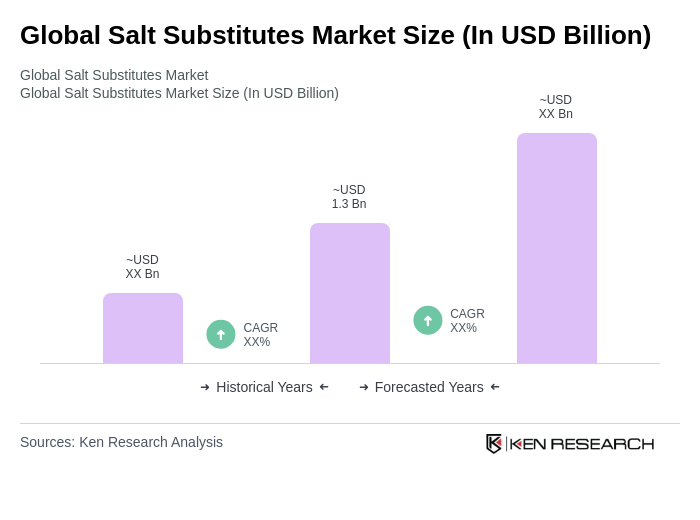
The Global Salt Substitutes Market, valued at USD 1.3 billion, is growing due to increasing health awareness, demand for natural ingredients, and government sodium reduction initiatives.

Region:Global

Author(s):Dev

Product Code:KRAC0351

Pages:89

Published On:August 2025
About the Report

Base Year 2024

Global Salt Substitutes Market Overview

  • The Global Salt Substitutes Market is valued at USD 1.3 billion, based on a five-year historical analysis. Growth is primarily driven by increasing health consciousness among consumers, rising incidences of hypertension, and a growing preference for low-sodium diets. The market is further supported by innovations in food technology that enhance the flavor profiles of salt substitutes, making them more appealing to consumers .
  • Key players in this market include the United States, Germany, and Japan. The United States leads due to its large food processing industry and high consumer awareness regarding health issues. Germany benefits from strong regulations promoting low-sodium products, while Japan's aging population drives demand for healthier food options .
  • Recent regulatory developments in the European Union have mandated clearer labeling on food products containing salt substitutes. These regulations aim to enhance consumer awareness and promote healthier dietary choices, thereby encouraging manufacturers to innovate and improve the quality of their salt substitute offerings .
Global Salt Substitutes Market Size

Global Salt Substitutes Market Segmentation

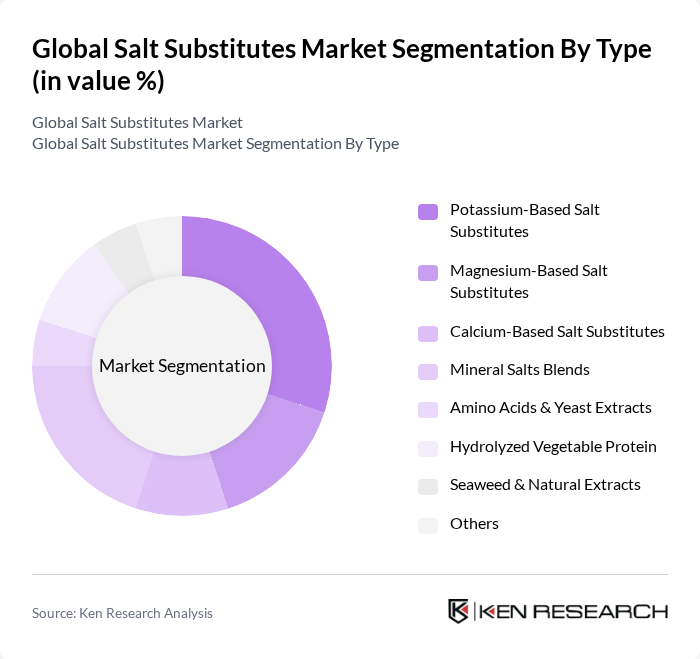
By Type:The market is segmented into various types of salt substitutes, including Potassium-Based Salt Substitutes, Magnesium-Based Salt Substitutes, Calcium-Based Salt Substitutes, Mineral Salts Blends, Amino Acids & Yeast Extracts, Hydrolyzed Vegetable Protein, Seaweed & Natural Extracts, and Others. Among these, Potassium-Based Salt Substitutes are gaining traction due to their recognized health benefits, especially for individuals with hypertension. There is also a growing consumer preference for natural and organic products, which is driving demand for Seaweed & Natural Extracts .
Global Salt Substitutes Market segmentation by Type.

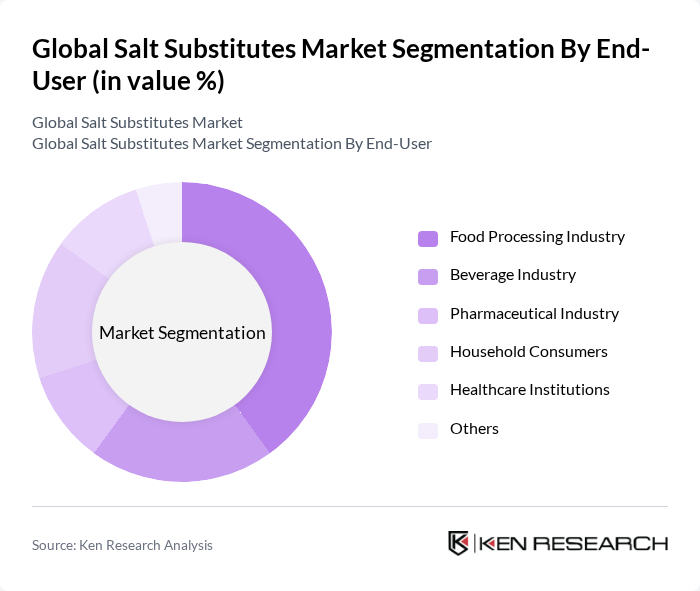
By End-User:The end-user segmentation includes the Food Processing Industry, Beverage Industry, Pharmaceutical Industry, Household Consumers, Healthcare Institutions, and Others. The Food Processing Industry is the dominant segment, driven by the increasing demand for processed foods that cater to health-conscious consumers. The Beverage Industry is also witnessing growth as manufacturers seek to reduce sodium content in their products .
Global Salt Substitutes Market segmentation by End-User.

Global Salt Substitutes Market Competitive Landscape

The Global Salt Substitutes Market is characterized by a dynamic mix of regional and international players. Leading participants such as Cargill, Incorporated, Morton Salt, Inc., Sensient Technologies Corporation, The Kraft Heinz Company, Tate & Lyle PLC, DSM Nutritional Products, Kerry Group plc, Ajinomoto Co., Inc., Ingredion Incorporated, Givaudan SA, Archer Daniels Midland Company (ADM), Unilever PLC, B&G Foods, Inc., McCormick & Company, Inc., Naturex SA, Now Foods, Savoury Systems International, Inc., Ogawa & Co., Ltd., Danisco (DuPont Nutrition & Health), Nu-Tek Salt, LLC, RS Flavor Ingredients, C&P Additives GmbH, Benson’s Gourmet Seasonings contribute to innovation, geographic expansion, and service delivery in this space.

Cargill, Incorporated

1865

Minneapolis, Minnesota, USA

Morton Salt, Inc.

1848

Chicago, Illinois, USA

Sensient Technologies Corporation

1882

Milwaukee, Wisconsin, USA

The Kraft Heinz Company

2015

Pittsburgh, Pennsylvania, USA

Tate & Lyle PLC

1921

London, United Kingdom

Company

Establishment Year

Headquarters

Group Size (Large, Medium, or Small as per industry convention)

Revenue Growth Rate (%)

Market Penetration Rate (%)

Customer Retention Rate (%)

Average Selling Price (USD/kg or equivalent)

Product Portfolio Breadth (Number of SKUs or Product Lines)

Global Salt Substitutes Market Industry Analysis

Growth Drivers

  • Increasing Health Consciousness:The global health and wellness market is projected to reach $4.5 trillion in future, reflecting a significant shift towards healthier lifestyles. This trend is driving consumers to seek alternatives to traditional salt, with 65% of consumers actively reducing sodium intake. The World Health Organization recommends a daily sodium intake of less than 2,000 mg, further encouraging the adoption of salt substitutes that align with health-conscious choices.
  • Rising Demand for Natural Ingredients:The natural food market is expected to grow to $1.2 trillion in future, with consumers increasingly favoring products made from natural ingredients. This shift is evident as 75% of consumers express a preference for natural over synthetic additives. Salt substitutes derived from natural sources, such as potassium chloride, are gaining traction, driven by this demand for clean-label products that promote health and wellness.
  • Government Initiatives to Reduce Sodium Intake:Governments worldwide are implementing sodium reduction strategies, with the U.S. aiming for a 30% reduction in sodium intake in future. The Centers for Disease Control and Prevention (CDC) reports that high sodium consumption contributes to 480,000 deaths annually. These initiatives are fostering a favorable environment for salt substitutes, as they align with public health goals and encourage manufacturers to innovate in this space.

Market Challenges

  • High Cost of Natural Salt Substitutes:The production cost of natural salt substitutes can be significantly higher than traditional salt, with estimates indicating a 25-35% price premium. This cost barrier can deter consumers and manufacturers from adopting these alternatives, especially in price-sensitive markets. As a result, the high cost remains a critical challenge for widespread acceptance and market penetration of salt substitutes.
  • Consumer Resistance to Taste Differences:Taste remains a pivotal factor in food choices, with studies showing that 60% of consumers are hesitant to switch to salt substitutes due to perceived taste differences. This resistance can hinder market growth, as many consumers prioritize flavor over health benefits. Overcoming this challenge requires effective marketing and product development to enhance the sensory experience of salt substitutes.

Global Salt Substitutes Market Future Outlook

The future of the salt substitutes market appears promising, driven by increasing health awareness and regulatory support for sodium reduction. Innovations in product formulations are expected to enhance taste profiles, addressing consumer resistance. Additionally, the expansion of e-commerce platforms will facilitate greater access to these products, particularly in emerging markets. As consumers continue to prioritize health, the demand for effective and palatable salt substitutes is likely to grow, shaping the market landscape in the coming years.

Market Opportunities

  • Growth in Vegan and Vegetarian Diets:The rise of vegan and vegetarian diets, projected to increase by 30% in future, presents a significant opportunity for salt substitutes. These diets often require flavor enhancement, making salt alternatives appealing to consumers seeking plant-based options. This trend can drive innovation in product development, catering to the unique needs of this growing demographic.
  • Innovations in Product Development:Continuous innovations in food technology are paving the way for new salt substitute formulations. With investments in R&D expected to reach $2 billion in future, companies are focusing on improving taste and functionality. This innovation can lead to the introduction of more appealing products, capturing the interest of health-conscious consumers and expanding market reach.

Scope of the Report

SegmentSub-Segments
By Type

Potassium-Based Salt Substitutes

Magnesium-Based Salt Substitutes

Calcium-Based Salt Substitutes

Mineral Salts Blends

Amino Acids & Yeast Extracts

Hydrolyzed Vegetable Protein

Seaweed & Natural Extracts

Others

By End-User

Food Processing Industry

Beverage Industry

Pharmaceutical Industry

Household Consumers

Healthcare Institutions

Others

By Distribution Channel

Supermarkets/Hypermarkets

Online Retail

Specialty Stores

Wholesalers & Distributors

Direct Sales

By Form

Powder

Granules

Liquid

Tablets

Crystals

By Application

Bakery and Confectionery

Snacks

Meat and Poultry

Beverages

Soups, Salads, Sauces, and Dressings

Food Preservation

Seasoning

Others

By Packaging Type

Bulk Packaging

Retail Packaging

Eco-Friendly Packaging

By Price Range

Economy

Mid-Range

Premium

Key Target Audience

Investors and Venture Capitalist Firms

Government and Regulatory Bodies (e.g., Food and Drug Administration, European Food Safety Authority)

Manufacturers and Producers of Salt Substitutes

Distributors and Retailers of Food Products

Health and Nutrition Organizations

Food and Beverage Industry Stakeholders

Market Analysts and Industry Experts

Health Insurance Companies

Players Mentioned in the Report:

Cargill, Incorporated

Morton Salt, Inc.

Sensient Technologies Corporation

The Kraft Heinz Company

Tate & Lyle PLC

DSM Nutritional Products

Kerry Group plc

Ajinomoto Co., Inc.

Ingredion Incorporated

Givaudan SA

Archer Daniels Midland Company (ADM)

Unilever PLC

B&G Foods, Inc.

McCormick & Company, Inc.

Naturex SA

Now Foods

Savoury Systems International, Inc.

Ogawa & Co., Ltd.

Danisco (DuPont Nutrition & Health)

Nu-Tek Salt, LLC

RS Flavor Ingredients

C&P Additives GmbH

Bensons Gourmet Seasonings

Table of Contents

Market Assessment Phase

1. Executive Summary and Approach


2. Global Salt Substitutes Market Overview

2.1 Key Insights and Strategic Recommendations

2.2 Global Salt Substitutes Market Overview

2.3 Definition and Scope

2.4 Evolution of Market Ecosystem

2.5 Timeline of Key Regulatory Milestones

2.6 Value Chain & Stakeholder Mapping

2.7 Business Cycle Analysis

2.8 Policy & Incentive Landscape


3. Global Salt Substitutes Market Analysis

3.1 Growth Drivers

3.1.1 Increasing Health Consciousness
3.1.2 Rising Demand for Natural Ingredients
3.1.3 Government Initiatives to Reduce Sodium Intake
3.1.4 Expanding Food and Beverage Industry

3.2 Market Challenges

3.2.1 High Cost of Natural Salt Substitutes
3.2.2 Consumer Resistance to Taste Differences
3.2.3 Regulatory Hurdles in Product Approval
3.2.4 Limited Awareness of Health Benefits

3.3 Market Opportunities

3.3.1 Growth in Vegan and Vegetarian Diets
3.3.2 Innovations in Product Development
3.3.3 Expansion into Emerging Markets
3.3.4 Collaborations with Food Manufacturers

3.4 Market Trends

3.4.1 Increasing Use of Potassium-Based Substitutes
3.4.2 Rise of Clean Label Products
3.4.3 Shift Towards Personalized Nutrition
3.4.4 Growth of Online Retail Channels

3.5 Government Regulation

3.5.1 Sodium Reduction Targets
3.5.2 Labeling Requirements for Salt Substitutes
3.5.3 Health Claims Regulations
3.5.4 Import Tariffs on Salt Substitutes

4. SWOT Analysis


5. Stakeholder Analysis


6. Porter's Five Forces Analysis


7. Global Salt Substitutes Market Market Size, 2019-2024

7.1 By Value

7.2 By Volume

7.3 By Average Selling Price


8. Global Salt Substitutes Market Segmentation

8.1 By Type

8.1.1 Potassium-Based Salt Substitutes
8.1.2 Magnesium-Based Salt Substitutes
8.1.3 Calcium-Based Salt Substitutes
8.1.4 Mineral Salts Blends
8.1.5 Amino Acids & Yeast Extracts
8.1.6 Hydrolyzed Vegetable Protein
8.1.7 Seaweed & Natural Extracts
8.1.8 Others

8.2 By End-User

8.2.1 Food Processing Industry
8.2.2 Beverage Industry
8.2.3 Pharmaceutical Industry
8.2.4 Household Consumers
8.2.5 Healthcare Institutions
8.2.6 Others

8.3 By Distribution Channel

8.3.1 Supermarkets/Hypermarkets
8.3.2 Online Retail
8.3.3 Specialty Stores
8.3.4 Wholesalers & Distributors
8.3.5 Direct Sales

8.4 By Form

8.4.1 Powder
8.4.2 Granules
8.4.3 Liquid
8.4.4 Tablets
8.4.5 Crystals

8.5 By Application

8.5.1 Bakery and Confectionery
8.5.2 Snacks
8.5.3 Meat and Poultry
8.5.4 Beverages
8.5.5 Soups, Salads, Sauces, and Dressings
8.5.6 Food Preservation
8.5.7 Seasoning
8.5.8 Others

8.6 By Packaging Type

8.6.1 Bulk Packaging
8.6.2 Retail Packaging
8.6.3 Eco-Friendly Packaging

8.7 By Price Range

8.7.1 Economy
8.7.2 Mid-Range
8.7.3 Premium

9. Global Salt Substitutes Market Competitive Analysis

9.1 Market Share of Key Players

9.2 Cross Comparison of Key Players

9.2.1 Company Name
9.2.2 Group Size (Large, Medium, or Small as per industry convention)
9.2.3 Revenue Growth Rate (%)
9.2.4 Market Penetration Rate (%)
9.2.5 Customer Retention Rate (%)
9.2.6 Average Selling Price (USD/kg or equivalent)
9.2.7 Product Portfolio Breadth (Number of SKUs or Product Lines)
9.2.8 Distribution Network Coverage (Number of Countries/Regions)
9.2.9 Brand Recognition Index (Survey-based or Market Share Proxy)
9.2.10 R&D/Innovation Intensity (R&D Spend as % of Revenue or Number of Patents)
9.2.11 Regulatory Compliance Score (e.g., Certifications, Claims Approved)

9.3 SWOT Analysis of Top Players

9.4 Pricing Analysis

9.5 Detailed Profile of Major Companies

9.5.1 Cargill, Incorporated
9.5.2 Morton Salt, Inc.
9.5.3 Sensient Technologies Corporation
9.5.4 The Kraft Heinz Company
9.5.5 Tate & Lyle PLC
9.5.6 DSM Nutritional Products
9.5.7 Kerry Group plc
9.5.8 Ajinomoto Co., Inc.
9.5.9 Ingredion Incorporated
9.5.10 Givaudan SA
9.5.11 Archer Daniels Midland Company (ADM)
9.5.12 Unilever PLC
9.5.13 B&G Foods, Inc.
9.5.14 McCormick & Company, Inc.
9.5.15 Naturex SA
9.5.16 Now Foods
9.5.17 Savoury Systems International, Inc.
9.5.18 Ogawa & Co., Ltd.
9.5.19 Danisco (DuPont Nutrition & Health)
9.5.20 Nu-Tek Salt, LLC
9.5.21 RS Flavor Ingredients
9.5.22 C&P Additives GmbH
9.5.23 Benson’s Gourmet Seasonings

10. Global Salt Substitutes Market End-User Analysis

10.1 Procurement Behavior of Key Ministries

10.1.1 Government Health Initiatives
10.1.2 Nutritional Guidelines Compliance
10.1.3 Public Health Campaigns

10.2 Corporate Spend on Infrastructure & Energy

10.2.1 Investment in Healthier Food Options
10.2.2 Budget Allocation for R&D

10.3 Pain Point Analysis by End-User Category

10.3.1 Taste Preferences
10.3.2 Cost Sensitivity
10.3.3 Availability of Products

10.4 User Readiness for Adoption

10.4.1 Awareness of Health Benefits
10.4.2 Willingness to Experiment

10.5 Post-Deployment ROI and Use Case Expansion

10.5.1 Long-term Cost Savings
10.5.2 Health Improvement Metrics

11. Global Salt Substitutes Market Future Size, 2025-2030

11.1 By Value

11.2 By Volume

11.3 By Average Selling Price


Go-To-Market Strategy Phase

1. Whitespace Analysis + Business Model Canvas

1.1 Market Gaps Identification

1.2 Value Proposition Development

1.3 Revenue Streams Analysis

1.4 Customer Segmentation

1.5 Key Partnerships

1.6 Cost Structure Analysis

1.7 Competitive Advantage


2. Marketing and Positioning Recommendations

2.1 Branding Strategies

2.2 Product USPs


3. Distribution Plan

3.1 Urban Retail Strategies

3.2 Rural NGO Tie-ups


4. Channel & Pricing Gaps

4.1 Underserved Routes

4.2 Pricing Bands


5. Unmet Demand & Latent Needs

5.1 Category Gaps

5.2 Consumer Segments


6. Customer Relationship

6.1 Loyalty Programs

6.2 After-sales Service


7. Value Proposition

7.1 Sustainability

7.2 Integrated Supply Chains


8. Key Activities

8.1 Regulatory Compliance

8.2 Branding

8.3 Distribution Setup


9. Entry Strategy Evaluation

9.1 Domestic Market Entry Strategy

9.1.1 Product Mix
9.1.2 Pricing Band
9.1.3 Packaging

9.2 Export Entry Strategy

9.2.1 Target Countries
9.2.2 Compliance Roadmap

10. Entry Mode Assessment

10.1 Joint Ventures

10.2 Greenfield Investments

10.3 Mergers & Acquisitions

10.4 Distributor Model


11. Capital and Timeline Estimation

11.1 Capital Requirements

11.2 Timelines


12. Control vs Risk Trade-Off

12.1 Ownership vs Partnerships


13. Profitability Outlook

13.1 Breakeven Analysis

13.2 Long-term Sustainability


14. Potential Partner List

14.1 Distributors

14.2 Joint Ventures

14.3 Acquisition Targets


15. Execution Roadmap

15.1 Phased Plan for Market Entry

15.1.1 Market Setup
15.1.2 Market Entry
15.1.3 Growth Acceleration
15.1.4 Scale & Stabilize

15.2 Key Activities and Milestones

15.2.1 Milestone Planning
15.2.2 Activity Tracking

Research Methodology

ApproachModellingSample

Phase 1: Approach1

Desk Research

  • Analysis of industry reports from food and beverage associations
  • Review of academic journals focusing on health and nutrition
  • Examination of market trends and consumer behavior studies related to salt substitutes

Primary Research

  • Interviews with product development managers at food manufacturers
  • Surveys with nutritionists and dietitians regarding consumer preferences
  • Focus groups with consumers to assess perceptions of salt substitutes

Validation & Triangulation

  • Cross-validation of findings with sales data from major retailers
  • Triangulation of insights from primary interviews and secondary data sources
  • Sanity checks through expert panels comprising industry veterans

Phase 2: Market Size Estimation1

Top-down Assessment

  • Estimation of market size based on global salt consumption statistics
  • Segmentation by product type, including potassium chloride and magnesium-based substitutes
  • Incorporation of health trends influencing consumer shift towards low-sodium diets

Bottom-up Modeling

  • Volume estimates derived from sales data of leading salt substitute brands
  • Cost analysis based on production and distribution expenses of salt alternatives
  • Market share calculations based on retailer and distributor feedback

Forecasting & Scenario Analysis

  • Multi-variable forecasting using health trend data and regulatory impacts
  • Scenario modeling based on potential shifts in consumer dietary habits
  • Baseline, optimistic, and pessimistic projections through 2030

Phase 3: CATI Sample Composition1

Scope Item/SegmentSample SizeTarget Respondent Profiles
Food Manufacturers100Product Development Managers, Quality Assurance Specialists
Health and Wellness Experts70Nutritionists, Dietitians, Health Coaches
Retail Sector Insights80Category Managers, Purchasing Agents
Consumer Preferences110General Consumers, Health-Conscious Shoppers
Market Analysts40Market Researchers, Industry Analysts

Frequently Asked Questions

What is the current value of the Global Salt Substitutes Market?

The Global Salt Substitutes Market is valued at approximately USD 1.3 billion, driven by increasing health consciousness, rising hypertension rates, and a preference for low-sodium diets among consumers.

What factors are driving the growth of the salt substitutes market?

Which countries are leading in the salt substitutes market?

What types of salt substitutes are available in the market?

Other Regional/Country Reports

UAE Salt Substitutes MarketKSA Salt Substitutes Market

Indonesia Salt Substitutes Market

Malaysia Salt Substitutes Market

APAC Salt Substitutes Market

SEA Salt Substitutes Market

Why Buy From Us?

Refine Robust Result (RRR) Framework

What makes us stand out is that our consultants follow Robust, Refine and Result (RRR) methodology. Robust for clear definitions, approaches and sanity checking, Refine for differentiating respondents' facts and opinions, and Result for presenting data with story.

Our Reach Is Unmatched

We have set a benchmark in the industry by offering our clients with syndicated and customized market research reports featuring coverage of entire market as well as meticulous research and analyst insights.

Shifting the Research Paradigm

While we don't replace traditional research, we flip the method upside down. Our dual approach of Top Bottom & Bottom Top ensures quality deliverable by not just verifying company fundamentals but also looking at the sector and macroeconomic factors.

More Insights-Better Decisions

With one step in the future, our research team constantly tries to show you the bigger picture. We help with some of the tough questions you may encounter along the way: How is the industry positioned? Best marketing channel? KPI's of competitors? By aligning every element, we help maximize success.

Transparency and Trust

Our report gives you instant access to the answers and sources that other companies might choose to hide. We elaborate each steps of research methodology we have used and showcase you the sample size to earn your trust.

Round the Clock Support

If you need any support, we are here! We pride ourselves on universe strength, data quality, and quick, friendly, and professional service.

Why Clients Choose Us?

400000+
Reports in repository
150+
Consulting projects a year
100+
Analysts
8000+
Client Queries in 2022








