Global Satellite Manufacturing And Launch Systems Market

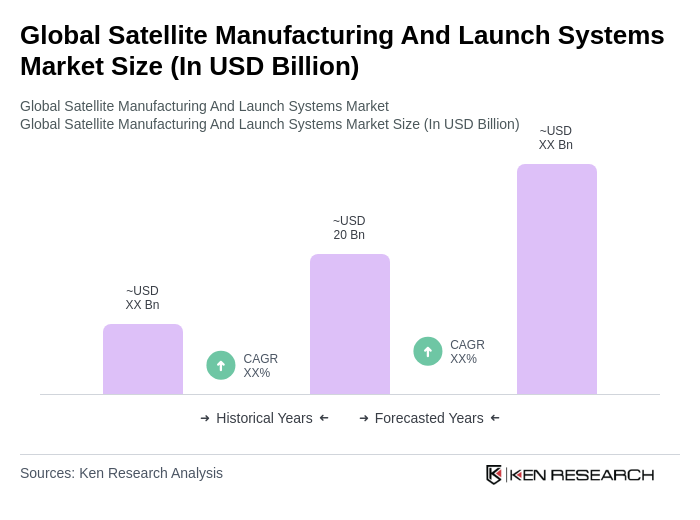
The global satellite manufacturing and launch systems market is valued at USD 20 billion, fueled by rising demand for communication satellites and advancements in launch technologies.

Region:Global

Author(s):Shubham

Product Code:KRAD0767

Pages:81

Published On:August 2025
About the Report

Base Year 2024

Global Satellite Manufacturing And Launch Systems Market Overview

  • The Global Satellite Manufacturing and Launch Systems Market is valued at USD 20 billion, based on a five?year historical analysis. This value reflects accelerating demand for satellite-based services, rapid LEO constellation production, and advancements in smallsat manufacturing and digital payloads, alongside sustained government investments that support build rates and capacity expansion.
  • Key players in this market include the United States, China, and Russia, driven by large government space budgets, established launch vehicle families, and industrial bases capable of high launch cadence and spacecraft output. North America leads by revenue due to the presence of prime contractors and private launch providers; China has rapidly expanded launch capacity and spacecraft production; Russia maintains established capabilities in manufacturing and launch infrastructure.
  • In 2023, the U.S. government’s Space Policy Directive?6 (SPD?6) set a national strategy for space nuclear power and propulsion to enable future missions and foster cross?sector collaboration; in parallel, U.S. policy and regulatory streamlining efforts (e.g., commercial launch and spectrum processes) and public?private partnerships have continued to support industry competitiveness.
Global Satellite Manufacturing And Launch Systems Market Size

Global Satellite Manufacturing And Launch Systems Market Segmentation

By Type:The market is segmented into various types of satellites, each serving distinct purposes and applications. The dominant sub-segment is Communication Satellites, which include GEO, MEO, and LEO satellites. These satellites underpin telecommunications, broadband backhaul, mobility, and broadcast, with demand bolstered by LEO broadband constellations and digital payload adoption. Earth Observation & Remote Sensing Satellites hold a substantial share, propelled by applications in agriculture, climate and environmental monitoring, insurance, and disaster management, with strong growth from high?revisit optical and SAR smallsat constellations.
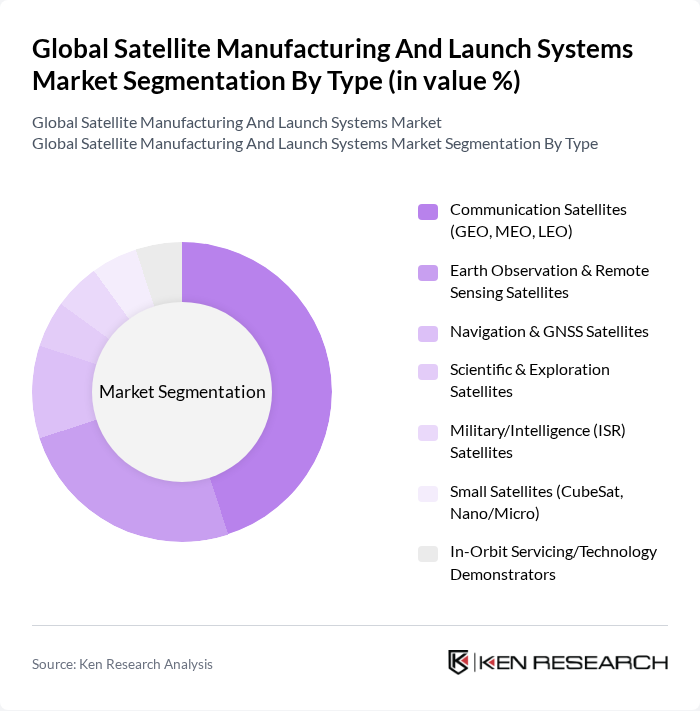
Global Satellite Manufacturing And Launch Systems Market segmentation by Type.

By End-User:The market is segmented by end-users, including Government Space Agencies, Commercial Operators, Defense & National Security, and Research Institutions & Universities. Government Space Agencies dominate in value terms due to national programs, civil science missions, and security?driven procurements. Commercial Operators are growing rapidly with LEO communications and data?as?a?service constellations. The Defense sector remains a critical customer for protected communications, ISR, missile warning, and tactical networks.
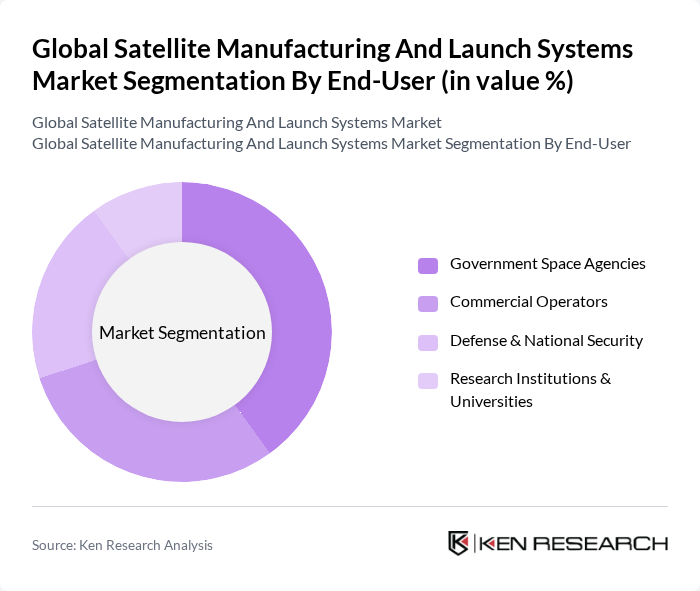
Global Satellite Manufacturing And Launch Systems Market segmentation by End-User.

Global Satellite Manufacturing And Launch Systems Market Competitive Landscape

The Global Satellite Manufacturing And Launch Systems Market is characterized by a dynamic mix of regional and international players. Leading participants such as The Boeing Company (Boeing Satellite Systems), Lockheed Martin Corporation, Northrop Grumman Corporation, Airbus Defence and Space, Thales Alenia Space, Space Exploration Technologies Corp. (SpaceX), Arianespace, OneWeb (Eutelsat Group), Planet Labs PBC, SES S.A., Iridium Communications Inc., Maxar Technologies, Rocket Lab USA, Inc., Inmarsat (a Viasat company), SSL (now Maxar Space Systems), Blue Origin, United Launch Alliance, LLC (ULA), Mitsubishi Heavy Industries (H-IIA/H3), ISRO/NSIL (Indian Space Research Organisation / NewSpace India Ltd.), China Aerospace Science and Technology Corporation (CASC) contribute to innovation, geographic expansion, and service delivery in this space.

The Boeing Company

1916

Arlington, Virginia, USA

Lockheed Martin Corporation

1995

Bethesda, Maryland, USA

Northrop Grumman Corporation

1939

Falls Church, Virginia, USA

Airbus Defence and Space

2014

Leiden, Netherlands

Space Exploration Technologies Corp. (SpaceX)

2002

Hawthorne, California, USA

Company

Establishment Year

Headquarters

Scale Tier (Global Prime, Regional Prime, Specialist)

Launch Cadence (annual launches) / Satellite Deliveries (annual units)

Order Backlog (value or satellites on order)

Revenue Growth Rate (YoY)

Constellation Size/Managed Fleet (satellites in-orbit)

R&D Intensity (% of revenue; reusability, in?orbit servicing, propulsion)

Global Satellite Manufacturing And Launch Systems Market Industry Analysis

Growth Drivers

  • Increasing Demand for Communication Satellites:The global demand for communication satellites is projected to reach approximately 1,000 units in future, driven by the need for enhanced connectivity. The International Telecommunication Union (ITU) reported that global internet users reached 5.4 billion, highlighting the necessity for robust satellite infrastructure. This surge in demand is further supported by the anticipated growth in mobile data traffic, which is expected to increase by 25% annually, necessitating more communication satellites to meet user needs.
  • Advancements in Launch Vehicle Technology:The launch vehicle market is experiencing significant advancements, with the cost of launching payloads decreasing by nearly 50% since 2010. The development of reusable rocket technology, exemplified by SpaceX's Falcon 9, has revolutionized the industry, allowing for more frequent launches. In future, the global launch services market is expected to exceed $10 billion, driven by these technological innovations, which enhance accessibility and affordability for satellite manufacturers and operators.
  • Rising Investments in Space Exploration:Global investments in space exploration are projected to surpass $30 billion in future, fueled by both government and private sector initiatives. NASA's budget for future is set at $27 billion, focusing on lunar missions and Mars exploration. Additionally, private companies are increasingly investing in satellite technologies, with over $5 billion raised recently. This influx of capital is expected to drive innovation and expand the satellite manufacturing sector significantly.

Market Challenges

  • High Capital Investment Requirements:The satellite manufacturing and launch systems sector faces substantial capital investment requirements, with costs for developing a single satellite often exceeding $500 million. This financial barrier limits entry for new players and constrains innovation. Furthermore, the high costs associated with launch services, averaging around $10,000 per kilogram to low Earth orbit, pose significant challenges for companies seeking to deploy satellites economically, impacting overall market growth.
  • Stringent Regulatory Compliance:The satellite industry is heavily regulated, with compliance costs reaching up to $2 million per satellite for licensing and environmental assessments. Regulatory bodies, such as the Federal Aviation Administration (FAA) and the International Telecommunication Union (ITU), impose strict guidelines that can delay project timelines. In future, the increasing complexity of international regulations may hinder market entry for new companies, creating additional challenges for existing players in maintaining compliance.

Global Satellite Manufacturing And Launch Systems Market Future Outlook

The future of the satellite manufacturing and launch systems market appears promising, driven by technological advancements and increasing global connectivity demands. The integration of artificial intelligence in satellite operations is expected to enhance efficiency and operational capabilities. Additionally, the focus on sustainable practices in space exploration will likely lead to innovative solutions that minimize environmental impact. As governments and private entities continue to invest in space initiatives, the market is poised for significant growth, fostering a competitive landscape that encourages innovation and collaboration.

Market Opportunities

  • Expansion of Satellite Internet Services:The demand for satellite internet services is projected to grow, with an estimated 500 million new users expected in future. This growth presents a lucrative opportunity for satellite manufacturers to develop advanced communication satellites that cater to underserved regions, enhancing global connectivity and driving revenue growth in the sector.
  • Development of Small Satellite Technologies:The small satellite market is anticipated to reach $7 billion in future, driven by the increasing need for cost-effective solutions. Innovations in miniaturization and launch capabilities are enabling the deployment of small satellites for various applications, including Earth observation and communication, creating significant opportunities for manufacturers to capitalize on this growing segment.

Scope of the Report

SegmentSub-Segments
By Type

Communication Satellites (GEO, MEO, LEO)

Earth Observation & Remote Sensing Satellites

Navigation & GNSS Satellites

Scientific & Exploration Satellites

Military/Intelligence (ISR) Satellites

Small Satellites (CubeSat, Nano/Micro)

In-Orbit Servicing/Technology Demonstrators

By End-User

Government Space Agencies

Commercial Operators

Defense & National Security

Research Institutions & Universities

By Application

Telecommunications & Broadband

Earth Observation & Analytics

Science & Technology Demonstration

Navigation/Positioning/Timing

Space Situational Awareness (SSA) & Space Safety

By Launch Vehicle Type

Expendable Launch Vehicles (ELV)

Reusable Launch Vehicles (RLV)

Small Launch Vehicles (Dedicated Small-Lift)

By Payload Mass Class

Small Payloads (?500 kg)

Medium Payloads (501–2,500 kg)

Heavy Payloads (>2,500 kg)

By Contracting Model

Direct Government/Agency Contracts

Commercial Procurement (Operators)

Rideshare/Brokered Launch Services

By Investment Source

Private Capital (VC/PE/Corporate)

Government Funding & Grants

Public–Private Partnerships (PPP)

Export Credit/Development Finance

Key Target Audience

Investors and Venture Capitalist Firms

Government and Regulatory Bodies (e.g., Federal Aviation Administration, European Space Agency)

Satellite Manufacturers and Producers

Launch Service Providers

Aerospace and Defense Contractors

Telecommunications Companies

Space Research Organizations

Insurance Companies Specializing in Aerospace

Players Mentioned in the Report:

The Boeing Company (Boeing Satellite Systems)

Lockheed Martin Corporation

Northrop Grumman Corporation

Airbus Defence and Space

Thales Alenia Space

Space Exploration Technologies Corp. (SpaceX)

Arianespace

OneWeb (Eutelsat Group)

Planet Labs PBC

SES S.A.

Iridium Communications Inc.

Maxar Technologies

Rocket Lab USA, Inc.

Inmarsat (a Viasat company)

SSL (now Maxar Space Systems)

Blue Origin

United Launch Alliance, LLC (ULA)

Mitsubishi Heavy Industries (H-IIA/H3)

ISRO/NSIL (Indian Space Research Organisation / NewSpace India Ltd.)

China Aerospace Science and Technology Corporation (CASC)

Table of Contents

Market Assessment Phase

1. Executive Summary and Approach


2. Global Satellite Manufacturing And Launch Systems Market Overview

2.1 Key Insights and Strategic Recommendations

2.2 Global Satellite Manufacturing And Launch Systems Market Overview

2.3 Definition and Scope

2.4 Evolution of Market Ecosystem

2.5 Timeline of Key Regulatory Milestones

2.6 Value Chain & Stakeholder Mapping

2.7 Business Cycle Analysis

2.8 Policy & Incentive Landscape


3. Global Satellite Manufacturing And Launch Systems Market Analysis

3.1 Growth Drivers

3.1.1 Increasing Demand for Communication Satellites
3.1.2 Advancements in Launch Vehicle Technology
3.1.3 Rising Investments in Space Exploration
3.1.4 Growing Need for Earth Observation Satellites

3.2 Market Challenges

3.2.1 High Capital Investment Requirements
3.2.2 Stringent Regulatory Compliance
3.2.3 Technological Obsolescence
3.2.4 Competition from Emerging Players

3.3 Market Opportunities

3.3.1 Expansion of Satellite Internet Services
3.3.2 Development of Small Satellite Technologies
3.3.3 Partnerships with Commercial Space Companies
3.3.4 Increased Government Funding for Space Programs

3.4 Market Trends

3.4.1 Miniaturization of Satellite Technology
3.4.2 Rise of Mega-Constellations
3.4.3 Integration of AI in Satellite Operations
3.4.4 Focus on Sustainable Space Practices

3.5 Government Regulation

3.5.1 International Space Treaties
3.5.2 National Space Policies
3.5.3 Licensing Requirements for Satellite Launches
3.5.4 Environmental Regulations for Launch Sites

4. SWOT Analysis


5. Stakeholder Analysis


6. Porter's Five Forces Analysis


7. Global Satellite Manufacturing And Launch Systems Market Market Size, 2019-2024

7.1 By Value

7.2 By Volume

7.3 By Average Selling Price


8. Global Satellite Manufacturing And Launch Systems Market Segmentation

8.1 By Type

8.1.1 Communication Satellites (GEO, MEO, LEO)
8.1.2 Earth Observation & Remote Sensing Satellites
8.1.3 Navigation & GNSS Satellites
8.1.4 Scientific & Exploration Satellites
8.1.5 Military/Intelligence (ISR) Satellites
8.1.6 Small Satellites (CubeSat, Nano/Micro)
8.1.7 In-Orbit Servicing/Technology Demonstrators

8.2 By End-User

8.2.1 Government Space Agencies
8.2.2 Commercial Operators
8.2.3 Defense & National Security
8.2.4 Research Institutions & Universities

8.3 By Application

8.3.1 Telecommunications & Broadband
8.3.2 Earth Observation & Analytics
8.3.3 Science & Technology Demonstration
8.3.4 Navigation/Positioning/Timing
8.3.5 Space Situational Awareness (SSA) & Space Safety

8.4 By Launch Vehicle Type

8.4.1 Expendable Launch Vehicles (ELV)
8.4.2 Reusable Launch Vehicles (RLV)
8.4.3 Small Launch Vehicles (Dedicated Small-Lift)

8.5 By Payload Mass Class

8.5.1 Small Payloads (?500 kg)
8.5.2 Medium Payloads (501–2,500 kg)
8.5.3 Heavy Payloads (>2,500 kg)

8.6 By Contracting Model

8.6.1 Direct Government/Agency Contracts
8.6.2 Commercial Procurement (Operators)
8.6.3 Rideshare/Brokered Launch Services

8.7 By Investment Source

8.7.1 Private Capital (VC/PE/Corporate)
8.7.2 Government Funding & Grants
8.7.3 Public–Private Partnerships (PPP)
8.7.4 Export Credit/Development Finance

9. Global Satellite Manufacturing And Launch Systems Market Competitive Analysis

9.1 Market Share of Key Players

9.2 Cross Comparison of Key Players

9.2.1 Company Name (Prime/Launcher/Operator)
9.2.2 Scale Tier (Global Prime, Regional Prime, Specialist)
9.2.3 Launch Cadence (annual launches) / Satellite Deliveries (annual units)
9.2.4 Order Backlog (value or satellites on order)
9.2.5 Revenue Growth Rate (YoY)
9.2.6 Constellation Size/Managed Fleet (satellites in-orbit)
9.2.7 R&D Intensity (% of revenue; reusability, in?orbit servicing, propulsion)
9.2.8 Cost per Kilogram to Orbit (LEO/MEO/GEO where applicable)
9.2.9 Average Contract Value (manufacture/launch/service)
9.2.10 On?Time Delivery/Launch Success Rate (%)
9.2.11 Vertical Integration Index (in?house vs outsourced subsystems)
9.2.12 ESG/Space Sustainability Metrics (debris mitigation, disposal compliance)

9.3 SWOT Analysis of Top Players

9.4 Pricing Analysis

9.5 Detailed Profile of Major Companies

9.5.1 The Boeing Company (Boeing Satellite Systems)
9.5.2 Lockheed Martin Corporation
9.5.3 Northrop Grumman Corporation
9.5.4 Airbus Defence and Space
9.5.5 Thales Alenia Space
9.5.6 Space Exploration Technologies Corp. (SpaceX)
9.5.7 Arianespace
9.5.8 OneWeb (Eutelsat Group)
9.5.9 Planet Labs PBC
9.5.10 SES S.A.
9.5.11 Iridium Communications Inc.
9.5.12 Maxar Technologies
9.5.13 Rocket Lab USA, Inc.
9.5.14 Inmarsat (a Viasat company)
9.5.15 SSL (now Maxar Space Systems)
9.5.16 Blue Origin
9.5.17 United Launch Alliance, LLC (ULA)
9.5.18 Mitsubishi Heavy Industries (H-IIA/H3)
9.5.19 ISRO/NSIL (Indian Space Research Organisation / NewSpace India Ltd.)
9.5.20 China Aerospace Science and Technology Corporation (CASC)

10. Global Satellite Manufacturing And Launch Systems Market End-User Analysis

10.1 Procurement Behavior of Key Ministries

10.1.1 Defense Ministries
10.1.2 Communication Ministries
10.1.3 Research and Development Ministries

10.2 Corporate Spend on Infrastructure & Energy

10.2.1 Telecommunications Companies
10.2.2 Government Agencies
10.2.3 Private Space Companies

10.3 Pain Point Analysis by End-User Category

10.3.1 Budget Constraints
10.3.2 Technological Limitations
10.3.3 Regulatory Hurdles

10.4 User Readiness for Adoption

10.4.1 Awareness of Satellite Benefits
10.4.2 Training and Skill Development Needs

10.5 Post-Deployment ROI and Use Case Expansion

10.5.1 Performance Metrics Tracking
10.5.2 Scalability of Solutions
10.5.3 Long-term Maintenance Costs

11. Global Satellite Manufacturing And Launch Systems Market Future Size, 2025-2030

11.1 By Value

11.2 By Volume

11.3 By Average Selling Price


Go-To-Market Strategy Phase

1. Whitespace Analysis + Business Model Canvas

1.1 Market Gaps Identification

1.2 Value Proposition Development

1.3 Revenue Streams Analysis

1.4 Cost Structure Evaluation

1.5 Key Partnerships Exploration

1.6 Customer Segmentation

1.7 Channels of Distribution


2. Marketing and Positioning Recommendations

2.1 Branding Strategies

2.2 Product USPs


3. Distribution Plan

3.1 Urban Retail Strategies

3.2 Rural NGO Tie-ups


4. Channel & Pricing Gaps

4.1 Underserved Routes

4.2 Pricing Bands Analysis


5. Unmet Demand & Latent Needs

5.1 Category Gaps

5.2 Consumer Segments


6. Customer Relationship

6.1 Loyalty Programs

6.2 After-sales Service


7. Value Proposition

7.1 Sustainability Initiatives

7.2 Integrated Supply Chains


8. Key Activities

8.1 Regulatory Compliance

8.2 Branding Efforts

8.3 Distribution Setup


9. Entry Strategy Evaluation

9.1 Domestic Market Entry Strategy

9.1.1 Product Mix Considerations
9.1.2 Pricing Band Strategy
9.1.3 Packaging Options

9.2 Export Entry Strategy

9.2.1 Target Countries Identification
9.2.2 Compliance Roadmap Development

10. Entry Mode Assessment

10.1 Joint Ventures

10.2 Greenfield Investments

10.3 Mergers & Acquisitions

10.4 Distributor Model Evaluation


11. Capital and Timeline Estimation

11.1 Capital Requirements Analysis

11.2 Timelines for Implementation


12. Control vs Risk Trade-Off

12.1 Ownership vs Partnerships


13. Profitability Outlook

13.1 Breakeven Analysis

13.2 Long-term Sustainability Strategies


14. Potential Partner List

14.1 Distributors

14.2 Joint Ventures

14.3 Acquisition Targets


15. Execution Roadmap

15.1 Phased Plan for Market Entry

15.1.1 Market Setup
15.1.2 Market Entry
15.1.3 Growth Acceleration
15.1.4 Scale & Stabilize

15.2 Key Activities and Milestones

15.2.1 Milestone Planning
15.2.2 Activity Tracking

Research Methodology

ApproachModellingSample

Phase 1: Approach1

Desk Research

  • Industry reports from space agencies and satellite manufacturers
  • Market analysis publications from aerospace and defense organizations
  • Government and regulatory documents related to satellite launches and manufacturing

Primary Research

  • Interviews with executives from leading satellite manufacturing companies
  • Surveys with aerospace engineers and project managers in launch systems
  • Field interviews with regulatory bodies overseeing satellite launches

Validation & Triangulation

  • Cross-validation of market data with historical launch statistics
  • Triangulation of insights from industry experts and market reports
  • Sanity checks through peer reviews and expert panel discussions

Phase 2: Market Size Estimation1

Top-down Assessment

  • Analysis of global space budgets and government spending on satellite programs
  • Segmentation of the market by satellite type (e.g., communication, earth observation)
  • Incorporation of trends in commercial satellite launches and private sector investments

Bottom-up Modeling

  • Volume estimates based on production rates of satellite units by major manufacturers
  • Cost analysis derived from historical pricing of satellite launches and manufacturing
  • Estimation of market size based on projected growth in satellite applications

Forecasting & Scenario Analysis

  • Multi-variable regression analysis incorporating technological advancements and market demand
  • Scenario modeling based on geopolitical factors affecting satellite launches
  • Baseline, optimistic, and pessimistic forecasts through 2035

Phase 3: CATI Sample Composition1

Scope Item/SegmentSample SizeTarget Respondent Profiles
Commercial Satellite Manufacturing100Manufacturing Directors, Product Managers
Launch Service Providers80Operations Managers, Launch Directors
Government Space Agencies60Policy Makers, Program Managers
Satellite Technology Developers70R&D Engineers, Technology Officers
End-User Industries (Telecom, Defense)90Procurement Managers, Strategic Planners

Frequently Asked Questions

What is the current value of the Global Satellite Manufacturing and Launch Systems Market?

The Global Satellite Manufacturing and Launch Systems Market is valued at approximately USD 20 billion, reflecting a historical analysis over five years. This valuation is driven by increasing demand for satellite services and advancements in satellite technology.

Which countries are the key players in the satellite manufacturing and launch systems market?

What are the main types of satellites in the market?

What are the primary end-users of satellite manufacturing and launch systems?

Other Regional/Country Reports

UAE Satellite Manufacturing And Launch Systems MarketKSA Satellite Manufacturing And Launch Systems Market

Indonesia Satellite Manufacturing And Launch Systems Market

Malaysia Satellite Manufacturing And Launch Systems Market

APAC Satellite Manufacturing And Launch Systems Market

SEA Satellite Manufacturing And Launch Systems Market

Why Buy From Us?

Refine Robust Result (RRR) Framework

What makes us stand out is that our consultants follow Robust, Refine and Result (RRR) methodology. Robust for clear definitions, approaches and sanity checking, Refine for differentiating respondents' facts and opinions, and Result for presenting data with story.

Our Reach Is Unmatched

We have set a benchmark in the industry by offering our clients with syndicated and customized market research reports featuring coverage of entire market as well as meticulous research and analyst insights.

Shifting the Research Paradigm

While we don't replace traditional research, we flip the method upside down. Our dual approach of Top Bottom & Bottom Top ensures quality deliverable by not just verifying company fundamentals but also looking at the sector and macroeconomic factors.

More Insights-Better Decisions

With one step in the future, our research team constantly tries to show you the bigger picture. We help with some of the tough questions you may encounter along the way: How is the industry positioned? Best marketing channel? KPI's of competitors? By aligning every element, we help maximize success.

Transparency and Trust

Our report gives you instant access to the answers and sources that other companies might choose to hide. We elaborate each steps of research methodology we have used and showcase you the sample size to earn your trust.

Round the Clock Support

If you need any support, we are here! We pride ourselves on universe strength, data quality, and quick, friendly, and professional service.

Why Clients Choose Us?

400000+
Reports in repository
150+
Consulting projects a year
100+
Analysts
8000+
Client Queries in 2022








