Region:Global
Author(s):Rebecca
Product Code:KRAB0202
Pages:93
Published On:August 2025
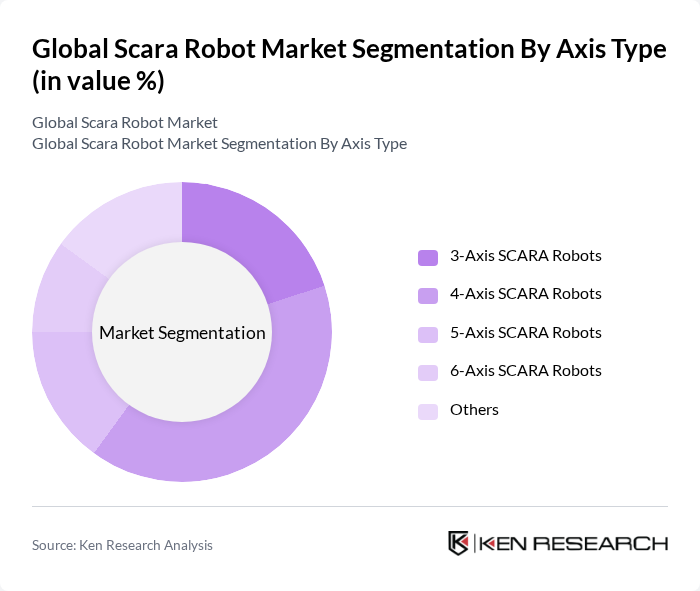
By Axis Type:The axis type segmentation covers several SCARA robot configurations, tailored for diverse industrial applications. The subsegments include 3-Axis SCARA Robots, 4-Axis SCARA Robots, 5-Axis SCARA Robots, 6-Axis SCARA Robots, and Others. Among these, 4-Axis SCARA Robots hold the largest market share, attributed to their versatility, high-speed operation, and suitability for complex assembly and pick-and-place tasks. Their widespread use in electronics, automotive, and consumer goods manufacturing underpins their dominance .
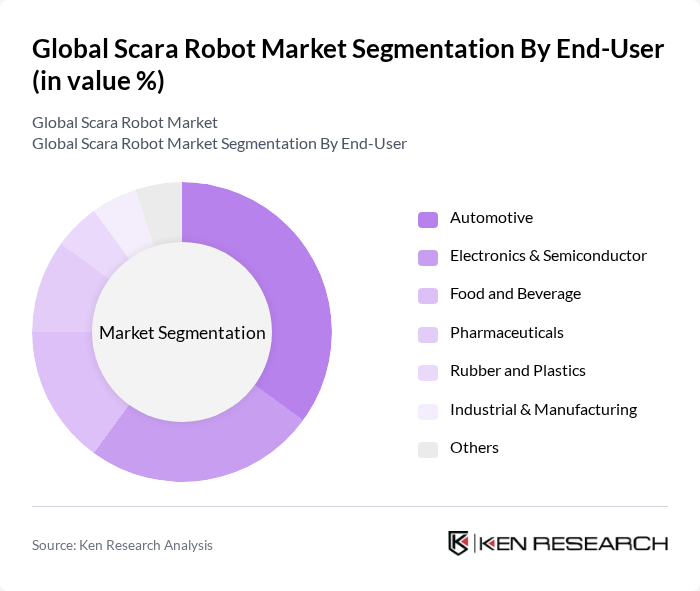
By End-User:The end-user segmentation includes Automotive, Electronics & Semiconductor, Food and Beverage, Pharmaceuticals, Rubber and Plastics, Industrial & Manufacturing, and Others. The Automotive sector remains the leading end-user, driven by the need for automation in assembly lines to improve productivity and reduce operational costs. Electronics & Semiconductor follows closely, leveraging SCARA robots for high-precision, high-volume assembly and inspection processes. Food and Beverage, Pharmaceuticals, and other sectors are also increasing adoption, benefitting from advancements in hygiene, speed, and flexibility .
The Global Scara Robot Market is characterized by a dynamic mix of regional and international players. Leading participants such as ABB Ltd., FANUC Corporation, Yaskawa Electric Corporation, KUKA AG, Mitsubishi Electric Corporation, Universal Robots A/S, Omron Corporation, Epson Robots (Seiko Epson Corporation), Denso Corporation, Stäubli Robotics, Shibaura Machine Co., Ltd. (formerly Toshiba Machine), Kawasaki Heavy Industries, Ltd., Seiko Epson Corporation, Rockwell Automation, Inc., Nachi-Fujikoshi Corp. contribute to innovation, geographic expansion, and service delivery in this space.
As the demand for automation continues to rise, the SCARA robot market is poised for significant advancements. The integration of artificial intelligence and machine learning into robotic systems is expected to enhance operational capabilities, allowing for smarter and more adaptable manufacturing processes. Additionally, the trend towards modular robotics will facilitate easier upgrades and customization, making SCARA robots more appealing to a broader range of industries. This evolution will likely lead to increased adoption rates and innovation within the sector.
| Segment | Sub-Segments |
|---|---|
| By Axis Type | Axis SCARA Robots Axis SCARA Robots Axis SCARA Robots Axis SCARA Robots Others |
| By End-User | Automotive Electronics & Semiconductor Food and Beverage Pharmaceuticals Rubber and Plastics Industrial & Manufacturing Others |
| By Application | Assembly Packaging Material Handling Inspection/Quality Control Transport Others |
| By Payload Capacity | Up to 5 kg –15 kg More than 15 kg |
| By Distribution Channel | Direct Sales Distributors Online Sales Others |
| By Region | North America Europe Asia-Pacific Latin America Middle East & Africa |
| Scope Item/Segment | Sample Size | Target Respondent Profiles |
|---|---|---|
| Manufacturing Automation | 100 | Production Managers, Automation Engineers |
| Electronics Assembly | 80 | Operations Directors, Quality Control Managers |
| Food and Beverage Packaging | 60 | Plant Managers, Supply Chain Coordinators |
| Pharmaceutical Production | 50 | Regulatory Affairs Managers, Production Supervisors |
| Automotive Component Manufacturing | 70 | Engineering Managers, Procurement Specialists |
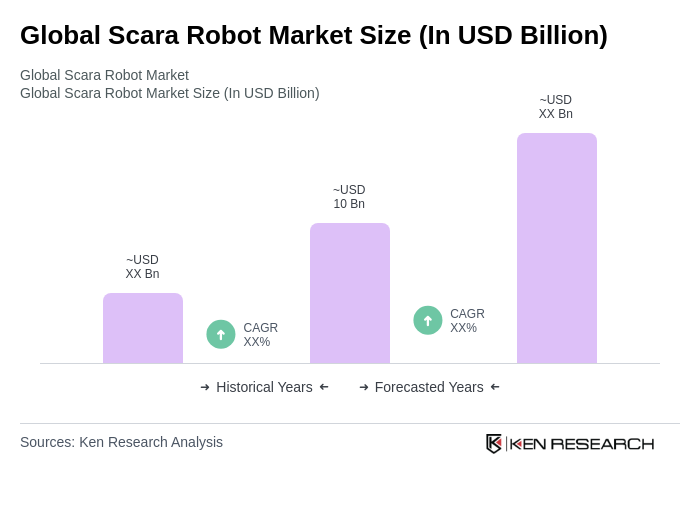
The Global Scara Robot Market is valued at approximately USD 10 billion, driven by increasing automation demands in manufacturing, electronics, and logistics sectors, along with the need for high precision and shorter production cycles.

What makes us stand out is that our consultants follow Robust, Refine and Result (RRR) methodology. Robust for clear definitions, approaches and sanity checking, Refine for differentiating respondents' facts and opinions, and Result for presenting data with story.

We have set a benchmark in the industry by offering our clients with syndicated and customized market research reports featuring coverage of entire market as well as meticulous research and analyst insights.

While we don't replace traditional research, we flip the method upside down. Our dual approach of Top Bottom & Bottom Top ensures quality deliverable by not just verifying company fundamentals but also looking at the sector and macroeconomic factors.

With one step in the future, our research team constantly tries to show you the bigger picture. We help with some of the tough questions you may encounter along the way: How is the industry positioned? Best marketing channel? KPI's of competitors? By aligning every element, we help maximize success.

Our report gives you instant access to the answers and sources that other companies might choose to hide. We elaborate each steps of research methodology we have used and showcase you the sample size to earn your trust.

If you need any support, we are here! We pride ourselves on universe strength, data quality, and quick, friendly, and professional service.













