About the Report
Base Year 2024Global Scleral Lens Market Overview
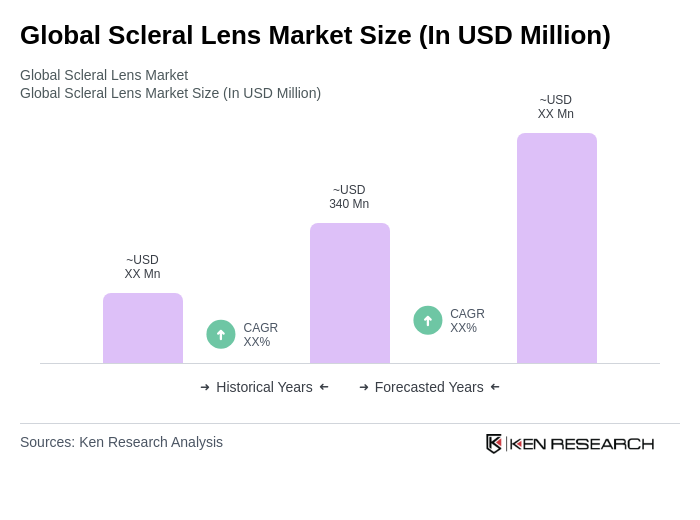
- The Global Scleral Lens Market is valued at USD 340 million, based on a five-year historical analysis. This growth is primarily driven by the increasing prevalence of ocular conditions such as keratoconus and severe dry eye, alongside rising consumer awareness regarding the benefits of scleral lenses over traditional contact lenses. The market is also supported by advancements in lens technology and materials, enhancing comfort and usability for patients.
- Key players in this market are predominantly located in North America and Europe, with the United States and Germany leading due to their advanced healthcare infrastructure, high disposable incomes, and strong emphasis on eye care. The presence of major manufacturers and research institutions in these regions further solidifies their dominance, facilitating innovation and distribution of scleral lenses.
- In 2023, the U.S. Food and Drug Administration (FDA) implemented new regulations aimed at enhancing the safety and efficacy of scleral lenses. These regulations require manufacturers to conduct more rigorous clinical trials and provide comprehensive data on lens performance, ensuring that products meet high safety standards before reaching the market. This initiative is expected to bolster consumer confidence and drive market growth.
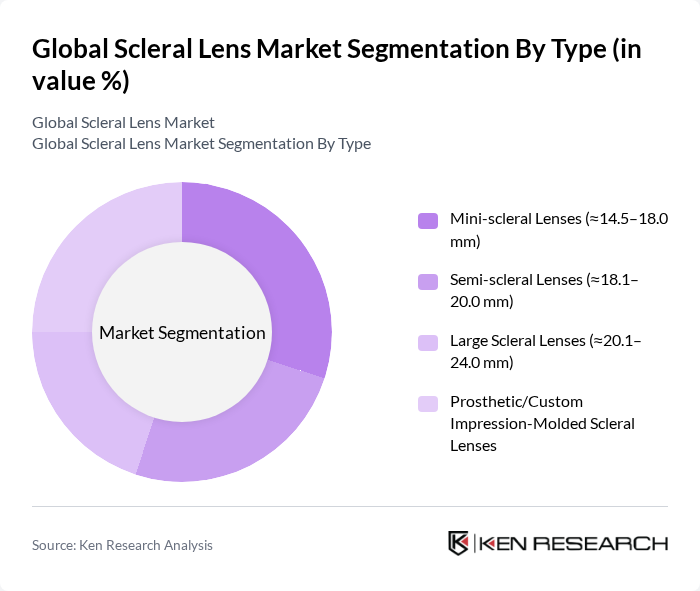
Global Scleral Lens Market Segmentation
By Type:The scleral lens market is segmented into four main types: Mini-scleral Lenses, Semi-scleral Lenses, Large Scleral Lenses, and Prosthetic/Custom Impression-Molded Scleral Lenses. Mini-scleral lenses, which range from approximately 14.5 to 18.0 mm, are gaining popularity due to their comfort and ease of use. Semi-scleral lenses (18.1 to 20.0 mm) and large scleral lenses (20.1 to 24.0 mm) are preferred for more severe ocular conditions, while prosthetic lenses are tailored for specific patient needs, driving their demand in specialized markets.
By End-User:The end-user segmentation includes Eye Clinics/Optometry Practices, Hospital Ophthalmology Departments, Specialty Contact Lens Laboratories, and Academic/Research Institutes. Eye clinics and optometry practices are the primary consumers of scleral lenses due to their direct interaction with patients. Hospital ophthalmology departments also play a significant role, particularly in managing complex ocular conditions. Specialty laboratories cater to the growing demand for customized lenses, while academic institutions contribute to research and development in this field.

Global Scleral Lens Market Competitive Landscape
The Global Scleral Lens Market is characterized by a dynamic mix of regional and international players. Leading participants such as Bausch + Lomb (Zenlens, Zen RC), CooperVision Specialty EyeCare (Blanchard Onefit, Onefit MED), Johnson & Johnson Vision (SightGlass/portfolio; specialty initiatives), Alcon Vision LLC (material partnerships; specialty channels), Menicon Co., Ltd. (Menicon Z materials; specialty labs), Art Optical Contact Lens, Inc. (Ampleye), BostonSight (BostonSight SCLERAL; non-profit innovation), Visionary Optics (Europa, Latitude), EyePrint Prosthetics (EyePrintPRO impression-based), SynergEyes, Inc. (SynergEyes VS; hybrid and scleral), Hispace/EssilorLuxottica Specialty Labs (Europa EU distribution partners), AccuLens (Maxim 3D), TruForm Optics (Europa derivative, custom designs), Valley Contax, Inc. (Custom Stable), Paragon Vision Sciences (materials; ortho-k and specialty) contribute to innovation, geographic expansion, and service delivery in this space.
Global Scleral Lens Market Industry Analysis
Growth Drivers
- Increasing Prevalence of Eye Disorders:The global rise in eye disorders, particularly conditions like keratoconus and severe dry eye, is a significant growth driver for the scleral lens market. According to the World Health Organization, at least 2.2 billion people have a vision impairment or blindness globally, of whom at least 1 billion have a vision impairment that could have been prevented or is yet to be addressed. In the None region, the prevalence of keratoconus is estimated at 1 in 2,000 individuals, leading to a growing demand for specialized lenses that can provide better vision correction and comfort.
- Rising Awareness About Scleral Lenses:Increased awareness and education regarding the benefits of scleral lenses are driving market growth. A survey by the American Academy of Ophthalmology indicated that 60% of eye care professionals reported a rise in patient inquiries about scleral lenses in the last year. This trend is particularly evident in the None region, where educational campaigns have reached over 1 million individuals, enhancing understanding and acceptance of these advanced vision correction solutions.
- Technological Advancements in Lens Manufacturing:Innovations in lens manufacturing technology are enhancing the quality and comfort of scleral lenses. For instance, the introduction of digital manufacturing techniques has reduced production time by 30%, allowing for quicker delivery to patients. In the None region, companies are investing over fifty million dollars annually in R&D to develop customized lens solutions, which is expected to significantly boost market growth as patient-specific needs are increasingly met.
Market Challenges
- High Cost of Scleral Lenses:The high cost associated with scleral lenses remains a significant barrier to market growth. Prices can range widely and often run higher than standard contact lenses due to customization and fitting requirements; costs vary by country, provider, and insurance coverage. In the None region, where the average annual income is approximately thirty thousand dollars, many potential users find these costs prohibitive, limiting the market's expansion and adoption rates among lower-income groups.
- Limited Availability in Certain Regions:Access to scleral lenses is uneven, with many rural areas in the None region lacking specialized eye care facilities. According to the National Eye Institute, nearly 40% of individuals in these areas report difficulties in obtaining necessary eye care services. This limited availability restricts the potential customer base and hinders the overall growth of the scleral lens market in underserved regions.
Global Scleral Lens Market Future Outlook
The future of the scleral lens market appears promising, driven by ongoing advancements in technology and increasing consumer awareness. As the demand for personalized eye care solutions rises, manufacturers are likely to focus on developing innovative products tailored to individual needs. Additionally, the expansion of online sales channels will facilitate greater access to scleral lenses, particularly in underserved regions, thereby enhancing market penetration and consumer adoption in the coming years.
Market Opportunities
- Expansion into Emerging Markets:There is a significant opportunity for market players to expand into emerging markets where awareness and availability of scleral lenses are currently low. With a growing middle class and increasing healthcare expenditure, regions like Southeast Asia and Africa present untapped potential for market growth, estimated to reach over two hundred million dollars in future.
- Development of Customized Lens Solutions:The trend towards personalized healthcare solutions offers a lucrative opportunity for the scleral lens market. By investing in R&D to create customized lenses that cater to specific patient needs, companies can differentiate themselves. This approach is projected to increase customer satisfaction and loyalty, potentially boosting sales by 15% annually in the None region.
Scope of the Report
| Segment | Sub-Segments |
|---|---|
| By Type | Mini-scleral Lenses (?14.5–18.0 mm) Semi-scleral Lenses (?18.1–20.0 mm) Large Scleral Lenses (?20.1–24.0 mm) Prosthetic/Custom Impression-Molded Scleral Lenses |
| By End-User | Eye Clinics/Optometry Practices Hospital Ophthalmology Departments Specialty Contact Lens Laboratories (B2B fitting/support) Academic/Research Institutes |
| By Material | Fluoro-silicone Acrylate (RGP) High Dk Fluoro-silicone Acrylate (e.g., Boston XO, Hexa100) PMMA (legacy/limited use) Surface-treated/Coated Materials (e.g., Hydra-PEG) |
| By Indication | Corneal Irregularity (e.g., Keratoconus, PMD, post-LASIK/RK) Ocular Surface Disease (e.g., Severe Dry Eye, GVHD, SJS) Aphakia/High Refractive Error and Presbyopia Post-surgical/Trauma Rehabilitation |
| By Distribution Channel | Direct-to-Clinic Sales (manufacturer to ECP) Authorized Distributors/Regional Labs Online Professional Portals (B2B ordering by ECPs) Institutional/Group Purchasing |
| By Price Range (Per Pair, Professional Market) | Entry (basic designs) Mid (customized, high Dk) Premium (impression-based/prosthetic, advanced coatings) |
| By Region | North America Europe Asia-Pacific Latin America Middle East & Africa |
Key Target Audience
Investors and Venture Capitalist Firms
Government and Regulatory Bodies (e.g., U.S. Food and Drug Administration, European Medicines Agency)
Manufacturers and Producers
Distributors and Retailers
Healthcare Providers and Clinics
Optometry and Ophthalmology Associations
Insurance Companies and Payers
Market Analysts and Industry Experts
Players Mentioned in the Report:
Bausch + Lomb (Zenlens, Zen RC)
CooperVision Specialty EyeCare (Blanchard Onefit, Onefit MED)
Johnson & Johnson Vision (SightGlass/portfolio; specialty initiatives)
Alcon Vision LLC (material partnerships; specialty channels)
Menicon Co., Ltd. (Menicon Z materials; specialty labs)
Art Optical Contact Lens, Inc. (Ampleye)
BostonSight (BostonSight SCLERAL; non-profit innovation)
Visionary Optics (Europa, Latitude)
EyePrint Prosthetics (EyePrintPRO impression-based)
SynergEyes, Inc. (SynergEyes VS; hybrid and scleral)
Hispace/EssilorLuxottica Specialty Labs (Europa EU distribution partners)
AccuLens (Maxim 3D)
TruForm Optics (Europa derivative, custom designs)
Valley Contax, Inc. (Custom Stable)
Paragon Vision Sciences (materials; ortho-k and specialty)
Table of Contents
Market Assessment Phase
1. Executive Summary and Approach
2. Global Scleral Lens Market Overview
2.1 Key Insights and Strategic Recommendations
2.2 Global Scleral Lens Market Overview
2.3 Definition and Scope
2.4 Evolution of Market Ecosystem
2.5 Timeline of Key Regulatory Milestones
2.6 Value Chain & Stakeholder Mapping
2.7 Business Cycle Analysis
2.8 Policy & Incentive Landscape
3. Global Scleral Lens Market Analysis
3.1 Growth Drivers
3.1.1 Increasing prevalence of eye disorders
3.1.2 Rising awareness about scleral lenses
3.1.3 Technological advancements in lens manufacturing
3.1.4 Growing geriatric population
3.2 Market Challenges
3.2.1 High cost of scleral lenses
3.2.2 Limited availability in certain regions
3.2.3 Lack of trained professionals for fitting
3.2.4 Competing alternatives in vision correction
3.3 Market Opportunities
3.3.1 Expansion into emerging markets
3.3.2 Development of customized lens solutions
3.3.3 Collaborations with eye care professionals
3.3.4 Increasing online sales channels
3.4 Market Trends
3.4.1 Growing demand for specialty lenses
3.4.2 Shift towards personalized eye care solutions
3.4.3 Integration of smart technology in lenses
3.4.4 Focus on sustainable and eco-friendly materials
3.5 Government Regulation
3.5.1 Stricter quality control standards
3.5.2 Regulatory approvals for new products
3.5.3 Guidelines for lens fitting and usage
3.5.4 Incentives for research and development
4. SWOT Analysis
5. Stakeholder Analysis
6. Porter's Five Forces Analysis
7. Global Scleral Lens Market Market Size, 2019-2024
7.1 By Value
7.2 By Volume
7.3 By Average Selling Price
8. Global Scleral Lens Market Segmentation
8.1 By Type
8.1.1 Mini-scleral Lenses (?14.5–18.0 mm)
8.1.2 Semi-scleral Lenses (?18.1–20.0 mm)
8.1.3 Large Scleral Lenses (?20.1–24.0 mm)
8.1.4 Prosthetic/Custom Impression-Molded Scleral Lenses
8.2 By End-User
8.2.1 Eye Clinics/Optometry Practices
8.2.2 Hospital Ophthalmology Departments
8.2.3 Specialty Contact Lens Laboratories (B2B fitting/support)
8.2.4 Academic/Research Institutes
8.3 By Material
8.3.1 Fluoro-silicone Acrylate (RGP)
8.3.2 High Dk Fluoro-silicone Acrylate (e.g., Boston XO, Hexa100)
8.3.3 PMMA (legacy/limited use)
8.3.4 Surface-treated/Coated Materials (e.g., Hydra-PEG)
8.4 By Indication
8.4.1 Corneal Irregularity (e.g., Keratoconus, PMD, post-LASIK/RK)
8.4.2 Ocular Surface Disease (e.g., Severe Dry Eye, GVHD, SJS)
8.4.3 Aphakia/High Refractive Error and Presbyopia
8.4.4 Post-surgical/Trauma Rehabilitation
8.5 By Distribution Channel
8.5.1 Direct-to-Clinic Sales (manufacturer to ECP)
8.5.2 Authorized Distributors/Regional Labs
8.5.3 Online Professional Portals (B2B ordering by ECPs)
8.5.4 Institutional/Group Purchasing
8.6 By Price Range (Per Pair, Professional Market)
8.6.1 Entry (basic designs)
8.6.2 Mid (customized, high Dk)
8.6.3 Premium (impression-based/prosthetic, advanced coatings)
8.7 By Region
8.7.1 North America
8.7.2 Europe
8.7.3 Asia-Pacific
8.7.4 Latin America
8.7.5 Middle East & Africa
9. Global Scleral Lens Market Competitive Analysis
9.1 Market Share of Key Players
9.2 Cross Comparison of Key Players
9.2.1 Company Name (scleral lens-focused or significant portfolio)
9.2.2 Installed Fitting Footprint (number of trained/fitting accounts)
9.2.3 Scleral Lens Revenue CAGR (3–5 years)
9.2.4 Geographic Coverage (regions/countries served)
9.2.5 Product Portfolio Breadth (mini/semi/large; coatings; toric; multifocal)
9.2.6 Average Lead Time (order-to-delivery, days)
9.2.7 First-fit Success Rate (%)
9.2.8 Remake/Return Rate (%)
9.2.9 Average Dk/t of Flagship Material
9.2.10 Clinical Support Depth (consultants per 100 active accounts)
9.2.11 R&D Intensity (% of revenue spent on product development)
9.2.12 Regulatory Approvals Portfolio (e.g., FDA 510(k), CE Mark)
9.2.13 Pricing Positioning (entry/mid/premium)
9.2.14 Warranty/Guarantee Terms (trial period, remake policy)
9.3 SWOT Analysis of Top Players
9.4 Pricing Analysis
9.5 Detailed Profile of Major Companies
9.5.1 Bausch + Lomb (Zenlens, Zen RC)
9.5.2 CooperVision Specialty EyeCare (Blanchard Onefit, Onefit MED)
9.5.3 Johnson & Johnson Vision (SightGlass/portfolio; specialty initiatives)
9.5.4 Alcon Vision LLC (material partnerships; specialty channels)
9.5.5 Menicon Co., Ltd. (Menicon Z materials; specialty labs)
9.5.6 Art Optical Contact Lens, Inc. (Ampleye)
9.5.7 BostonSight (BostonSight SCLERAL; non-profit innovation)
9.5.8 Visionary Optics (Europa, Latitude)
9.5.9 EyePrint Prosthetics (EyePrintPRO impression-based)
9.5.10 SynergEyes, Inc. (SynergEyes VS; hybrid and scleral)
9.5.11 Hispace/EssilorLuxottica Specialty Labs (Europa EU distribution partners)
9.5.12 AccuLens (Maxim 3D)
9.5.13 TruForm Optics (Europa derivative, custom designs)
9.5.14 Valley Contax, Inc. (Custom Stable)
9.5.15 Paragon Vision Sciences (materials; ortho-k and specialty)
10. Global Scleral Lens Market End-User Analysis
10.1 Procurement Behavior of Key Ministries
10.1.1 Government procurement policies
10.1.2 Budget allocation for eye care
10.1.3 Collaboration with healthcare providers
10.2 Corporate Spend on Infrastructure & Energy
10.2.1 Investment in eye care facilities
10.2.2 Funding for research and development
10.2.3 Partnerships with technology firms
10.3 Pain Point Analysis by End-User Category
10.3.1 Accessibility of scleral lenses
10.3.2 Affordability issues
10.3.3 Need for professional fitting services
10.4 User Readiness for Adoption
10.4.1 Awareness of scleral lens benefits
10.4.2 Training for eye care professionals
10.4.3 Availability of fitting resources
10.5 Post-Deployment ROI and Use Case Expansion
10.5.1 Long-term patient satisfaction
10.5.2 Cost savings for healthcare systems
10.5.3 Opportunities for product upgrades
11. Global Scleral Lens Market Future Size, 2025-2030
11.1 By Value
11.2 By Volume
11.3 By Average Selling Price
Go-To-Market Strategy Phase
1. Whitespace Analysis + Business Model Canvas
1.1 Market gaps identification
1.2 Value proposition development
1.3 Revenue model exploration
1.4 Customer segmentation analysis
1.5 Competitive landscape assessment
1.6 Key partnerships identification
1.7 Resource allocation strategy
2. Marketing and Positioning Recommendations
2.1 Branding strategies
2.2 Product USPs
2.3 Target audience engagement
2.4 Digital marketing tactics
2.5 Offline marketing initiatives
2.6 Customer feedback integration
3. Distribution Plan
3.1 Urban retail strategies
3.2 Rural NGO tie-ups
3.3 E-commerce platform utilization
3.4 Direct-to-consumer models
3.5 Partnerships with healthcare providers
4. Channel & Pricing Gaps
4.1 Underserved routes
4.2 Pricing bands analysis
4.3 Competitor pricing comparison
4.4 Value-based pricing strategies
4.5 Discounts and promotions
5. Unmet Demand & Latent Needs
5.1 Category gaps identification
5.2 Consumer segments analysis
5.3 Emerging trends exploration
5.4 Feedback from end-users
5.5 Future product development needs
6. Customer Relationship
6.1 Loyalty programs
6.2 After-sales service
6.3 Customer engagement strategies
6.4 Feedback mechanisms
6.5 Community building initiatives
7. Value Proposition
7.1 Sustainability initiatives
7.2 Integrated supply chains
7.3 Customer-centric product development
7.4 Competitive differentiation
7.5 Long-term value creation
8. Key Activities
8.1 Regulatory compliance
8.2 Branding efforts
8.3 Distribution setup
8.4 Training and development
8.5 Market research and analysis
9. Entry Strategy Evaluation
9.1 Domestic Market Entry Strategy
9.1.1 Product mix considerations
9.1.2 Pricing band analysis
9.1.3 Packaging strategies
9.2 Export Entry Strategy
9.2.1 Target countries selection
9.2.2 Compliance roadmap development
10. Entry Mode Assessment
10.1 Joint Ventures
10.2 Greenfield investments
10.3 Mergers & Acquisitions
10.4 Distributor Model
11. Capital and Timeline Estimation
11.1 Capital requirements
11.2 Timelines for market entry
12. Control vs Risk Trade-Off
12.1 Ownership considerations
12.2 Partnerships evaluation
13. Profitability Outlook
13.1 Breakeven analysis
13.2 Long-term sustainability strategies
14. Potential Partner List
14.1 Distributors
14.2 Joint Ventures
14.3 Acquisition targets
15. Execution Roadmap
15.1 Phased Plan for Market Entry
15.1.1 Market Setup
15.1.2 Market Entry
15.1.3 Growth Acceleration
15.1.4 Scale & Stabilize
15.2 Key Activities and Milestones
15.2.1 Activity timelines
15.2.2 Milestone tracking
Research Methodology
Phase 1: Approach1
Desk Research
- Industry reports from ophthalmic associations and global health organizations
- Market analysis publications focusing on scleral lens technology and trends
- Regulatory documents and guidelines from health authorities regarding scleral lens usage
Primary Research
- Interviews with ophthalmologists specializing in contact lenses and vision correction
- Surveys with optometrists to gather insights on patient preferences and trends
- Field interviews with manufacturers and suppliers of scleral lenses
Validation & Triangulation
- Cross-validation of findings through multiple expert interviews and industry reports
- Triangulation of data from clinical studies, market trends, and consumer feedback
- Sanity checks through expert panel reviews and consensus meetings
Phase 2: Market Size Estimation1
Top-down Assessment
- Analysis of global vision correction market size and growth rates
- Segmentation of the scleral lens market by region, application, and demographic factors
- Incorporation of trends in myopia and other vision disorders affecting demand
Bottom-up Modeling
- Volume estimates based on sales data from leading scleral lens manufacturers
- Cost analysis of scleral lens production and pricing strategies
- Estimation of market share based on distribution channels and end-user segments
Forecasting & Scenario Analysis
- Multi-factor regression analysis incorporating demographic shifts and healthcare access
- Scenario modeling based on technological advancements and regulatory changes
- Baseline, optimistic, and pessimistic forecasts through 2030
Phase 3: CATI Sample Composition1
| Scope Item/Segment | Sample Size | Target Respondent Profiles |
|---|---|---|
| Ophthalmologists | 140 | Eye Care Specialists, Vision Correction Experts |
| Optometrists | 120 | Optometry Practitioners, Contact Lens Fitters |
| Scleral Lens Manufacturers | 80 | Product Development Managers, Sales Directors |
| Patients using Scleral Lenses | 100 | End-users, Patient Advocacy Group Members |
| Healthcare Policy Makers | 50 | Regulatory Affairs Specialists, Health Economists |
Frequently Asked Questions
What is the current value of the Global Scleral Lens Market?
The Global Scleral Lens Market is valued at approximately USD 340 million, reflecting a significant growth trend driven by increasing ocular conditions and advancements in lens technology, enhancing patient comfort and usability.
What factors are driving the growth of the scleral lens market?
Which regions dominate the Global Scleral Lens Market?
What are the new FDA regulations regarding scleral lenses?
Other Regional/Country Reports
Indonesia Scleral Lens Market
Malaysia Scleral Lens Market
APAC Scleral Lens Market
SEA Scleral Lens Market
Why Buy From Us?

What makes us stand out is that our consultants follow Robust, Refine and Result (RRR) methodology. Robust for clear definitions, approaches and sanity checking, Refine for differentiating respondents' facts and opinions, and Result for presenting data with story.

We have set a benchmark in the industry by offering our clients with syndicated and customized market research reports featuring coverage of entire market as well as meticulous research and analyst insights.

While we don't replace traditional research, we flip the method upside down. Our dual approach of Top Bottom & Bottom Top ensures quality deliverable by not just verifying company fundamentals but also looking at the sector and macroeconomic factors.

With one step in the future, our research team constantly tries to show you the bigger picture. We help with some of the tough questions you may encounter along the way: How is the industry positioned? Best marketing channel? KPI's of competitors? By aligning every element, we help maximize success.

Our report gives you instant access to the answers and sources that other companies might choose to hide. We elaborate each steps of research methodology we have used and showcase you the sample size to earn your trust.

If you need any support, we are here! We pride ourselves on universe strength, data quality, and quick, friendly, and professional service.