Region:Global
Author(s):Rebecca
Product Code:KRAC0180
Pages:87
Published On:August 2025
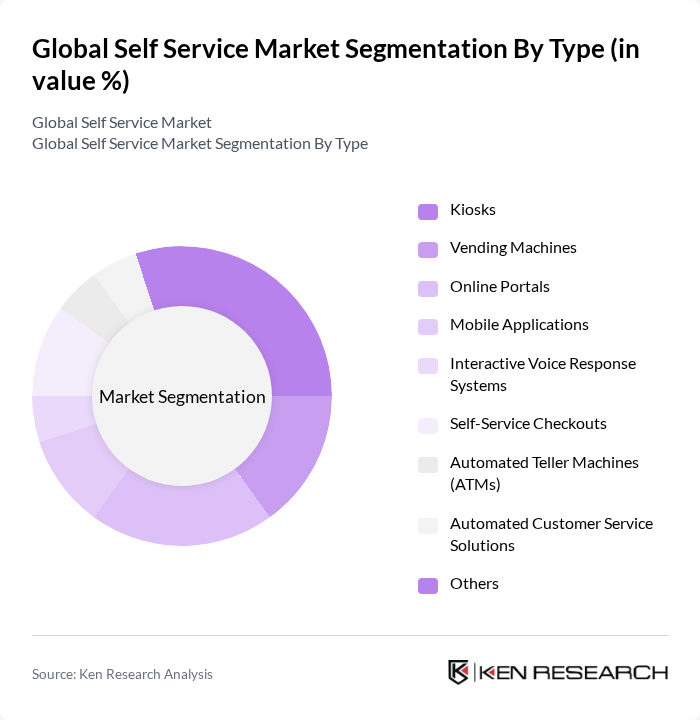
By Type:The self-service market is segmented into Kiosks, Vending Machines, Online Portals, Mobile Applications, Interactive Voice Response Systems, Self-Service Checkouts, Automated Teller Machines (ATMs), Automated Customer Service Solutions, and Others. These sub-segments are critical for enhancing customer interaction and operational efficiency. Kiosks and self-service checkouts are particularly prominent in retail and hospitality, while ATMs and automated customer service solutions are vital in banking and financial services. Mobile applications and online portals are increasingly adopted for remote and digital self-service experiences, reflecting the shift towards omnichannel service delivery .
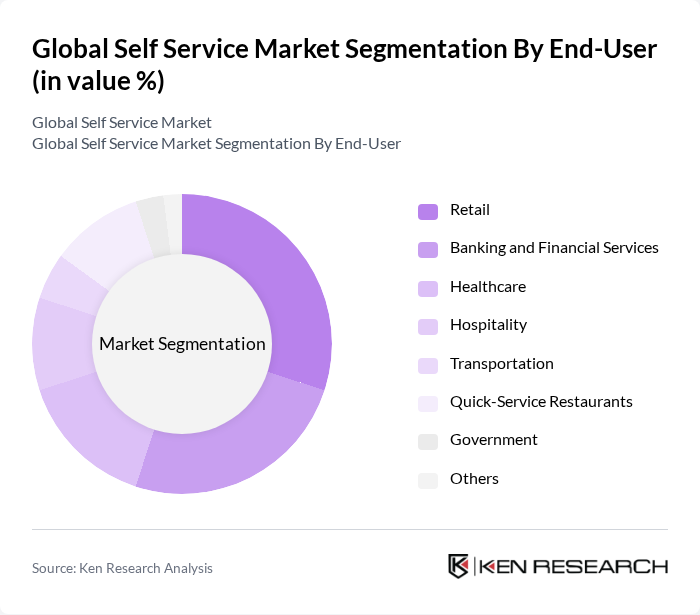
By End-User:The self-service market is categorized by end-users, including Retail, Banking and Financial Services, Healthcare, Hospitality, Transportation, Quick-Service Restaurants, Government, and Others. Retail and banking sectors are the largest adopters, leveraging self-service solutions to improve customer engagement, reduce labor costs, and streamline operations. Healthcare utilizes kiosks for patient intake and telehealth, while hospitality and transportation sectors focus on check-in and ticketing automation. Quick-service restaurants are rapidly adopting self-service kiosks to enhance order speed and accuracy .
The Global Self Service Market is characterized by a dynamic mix of regional and international players. Leading participants such as IBM Corporation, NCR Corporation, Diebold Nixdorf, Incorporated, Fujitsu Limited, Glory Global Solutions (International) Ltd., KIOSK Information Systems, Toshiba Global Commerce Solutions, Inc., Verifone Systems, Inc., Ingenico Group, Pyramid Computer GmbH, Olea Kiosks Inc., Advantech Co., Ltd., Hitachi-Omron Terminal Solutions, Corp., Wincor Nixdorf International GmbH, Zebra Technologies Corporation contribute to innovation, geographic expansion, and service delivery in this space.
The future of the self-service market appears promising, driven by ongoing technological advancements and evolving consumer preferences. As businesses increasingly adopt AI and machine learning, self-service solutions will become more sophisticated, enhancing user experience. Additionally, the expansion into emerging markets will provide new growth avenues, as these regions embrace digital transformation. Companies that prioritize innovation and customer-centric solutions will likely lead the market, adapting to changing demands and regulatory landscapes effectively.
| Segment | Sub-Segments |
|---|---|
| By Type | Kiosks Vending Machines Online Portals Mobile Applications Interactive Voice Response Systems Self-Service Checkouts Automated Teller Machines (ATMs) Automated Customer Service Solutions Others |
| By End-User | Retail Banking and Financial Services Healthcare Hospitality Transportation Quick-Service Restaurants Government Others |
| By Application | Customer Support Order Processing Information Retrieval Payment Processing Appointment Scheduling Ticketing Others |
| By Distribution Channel | Direct Sales Online Sales Retail Partnerships Resellers Others |
| By Customer Segment | B2B B2C Government Non-Profit Organizations Others |
| By Pricing Model | Subscription-Based Pay-Per-Use One-Time Purchase Freemium Others |
| By Technology | Cloud-Based Solutions On-Premise Solutions Hybrid Solutions Others |
| By Region | North America Europe Asia Pacific Latin America Middle East & Africa |
| Scope Item/Segment | Sample Size | Target Respondent Profiles |
|---|---|---|
| Retail Self-Service Kiosks | 120 | Store Managers, IT Directors |
| Banking Self-Service Solutions | 90 | Branch Managers, Operations Executives |
| Healthcare Check-in Systems | 60 | Healthcare Administrators, IT Managers |
| Hospitality Self-Service Platforms | 50 | Hotel Managers, Guest Experience Managers |
| Public Sector Self-Service Applications | 40 | Government Officials, IT Coordinators |
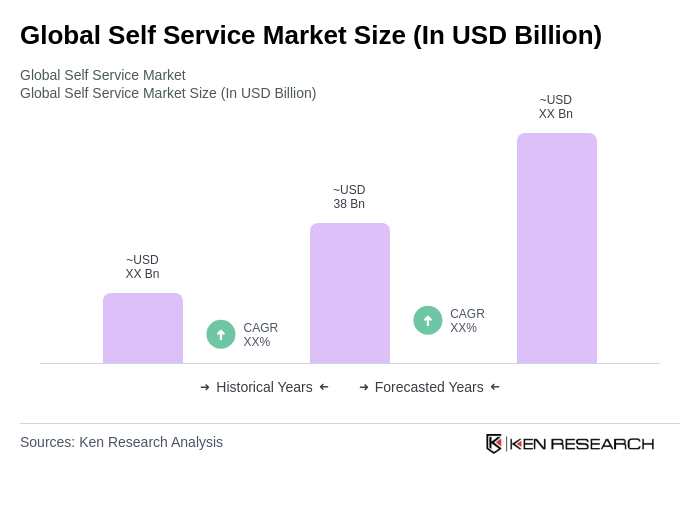
The Global Self Service Market is valued at approximately USD 38 billion, driven by increasing demand for automation and self-service solutions across various sectors, including retail, banking, and healthcare.

What makes us stand out is that our consultants follow Robust, Refine and Result (RRR) methodology. Robust for clear definitions, approaches and sanity checking, Refine for differentiating respondents' facts and opinions, and Result for presenting data with story.

We have set a benchmark in the industry by offering our clients with syndicated and customized market research reports featuring coverage of entire market as well as meticulous research and analyst insights.

While we don't replace traditional research, we flip the method upside down. Our dual approach of Top Bottom & Bottom Top ensures quality deliverable by not just verifying company fundamentals but also looking at the sector and macroeconomic factors.

With one step in the future, our research team constantly tries to show you the bigger picture. We help with some of the tough questions you may encounter along the way: How is the industry positioned? Best marketing channel? KPI's of competitors? By aligning every element, we help maximize success.

Our report gives you instant access to the answers and sources that other companies might choose to hide. We elaborate each steps of research methodology we have used and showcase you the sample size to earn your trust.

If you need any support, we are here! We pride ourselves on universe strength, data quality, and quick, friendly, and professional service.













