About the Report
Base Year 2024Global Sewing Machines Market Overview
- The Global Sewing Machines Market is valued at USD 5.6 billion, based on a five-year historical analysis. This growth is primarily driven by the increasing demand across household and industrial applications, the shift toward computerized/automated systems that improve throughput and consistency, and a broad-based rise in DIY/repair culture that boosts home machine purchases.
- Key players in this market include countries like China, Japan, and Germany, which dominate due to strong manufacturing ecosystems and technology depth. China is a major hub for production and exports of industrial sewing machines and parts; Japan hosts leading innovators and brands across household and industrial segments; Germany is recognized for high-spec industrial machinery and engineering quality.
- There is no EU-wide ecodesign regulation specifically mandating energy efficiency standards for “all new sewing machines” implemented in 2023; current EU product energy regulations cover categories like household appliances and industrial equipment but do not set a dedicated, horizontal energy consumption requirement for sewing machines. Sustainability pressure is nonetheless rising via circular economy and right-to-repair initiatives, which encourage durable, repairable products and are indirectly supportive of energy-efficient, long-life machinery.

Global Sewing Machines Market Segmentation
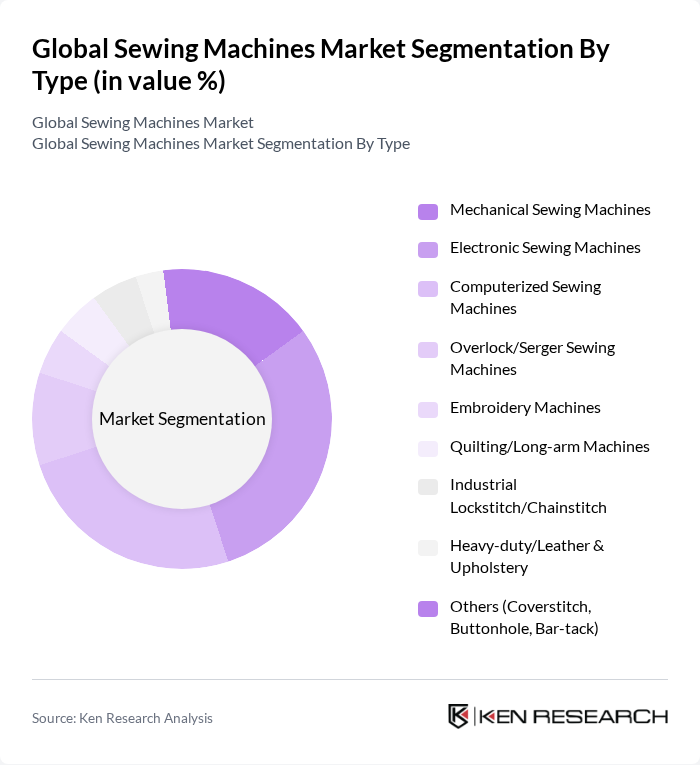
By Type:The sewing machines market is segmented into various types, including Mechanical Sewing Machines, Electronic Sewing Machines, Computerized Sewing Machines, Overlock/Serger Sewing Machines, Embroidery Machines, Quilting/Long-arm Machines, Industrial Lockstitch/Chainstitch, Heavy-duty/Leather & Upholstery, and Others (Coverstitch, Buttonhole, Bar-tack). Electronic and computerized machines are gaining traction due to user-friendly interfaces, programmable stitches, and connectivity features that support precision and automation for both hobbyists and professionals; industrial classes (lockstitch/chainstitch, overlock/coverstitch) continue to expand with apparel and technical textile demand.
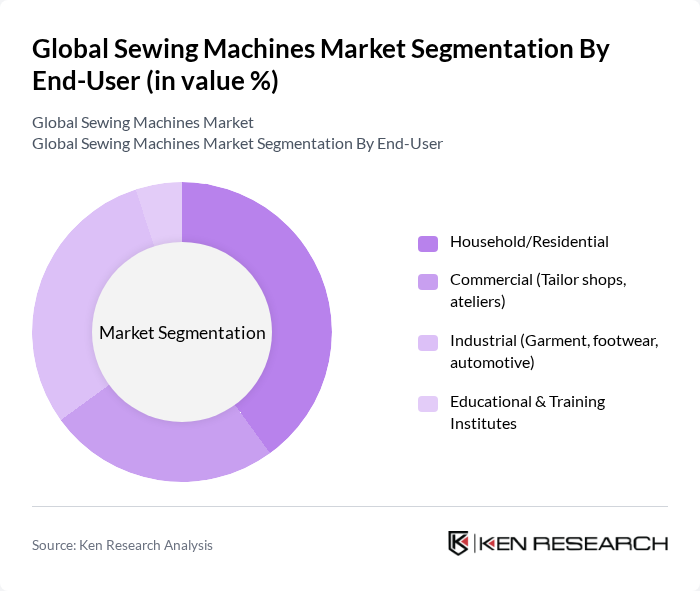
By End-User:The market is segmented by end-user into Household/Residential, Commercial (Tailor shops, ateliers), Industrial (Garment, footwear, automotive), and Educational & Training Institutes. Household/Residential demand benefits from DIY, quilting, repair-and-reuse trends, and e-commerce distribution; the Industrial segment remains robust on the back of apparel manufacturing, furniture/upholstery, automotive interiors, and technical textiles requiring high-speed, durable, and often computerized machines.
Global Sewing Machines Market Competitive Landscape
The Global Sewing Machines Market is characterized by a dynamic mix of regional and international players. Leading participants such as Brother Industries, Ltd., Janome Sewing Machine Co., Ltd., JUKI Corporation, SVP Worldwide (Singer, Husqvarna Viking, PFAFF), BERNINA International AG, Pegasus Sewing Machine Mfg. Co., Ltd., Jack Sewing Machine Co., Ltd., Zoje Sewing Machine Co., Ltd., Typical (China Typical Sewing Machine Co., Ltd.), Merrow Sewing Machine Company, Durkopp Adler GmbH, Shanggong Group Co., Ltd. (including Dürkopp Adler, Pfaff Industrial), Consew (Consolidated Sewing Machine Corp.), Tacony Corporation (Baby Lock), Toyota Industries Corporation (AISIN Group heritage) contribute to innovation, geographic expansion, and service delivery in this space.
Global Sewing Machines Market Industry Analysis
Growth Drivers
- Increasing Demand for Home Sewing:The home sewing segment has seen a significant surge, with the global market for home sewing machines reaching approximately 12 million units sold in future. This growth is driven by a 15% increase in consumer interest in DIY projects, as reported by the Craft and Hobby Association. The rise in home sewing is also supported by a 20% increase in online searches for sewing tutorials, indicating a growing community of enthusiasts and hobbyists.
- Rise in Fashion and Apparel Industry:The global fashion industry is projected to reach $3 trillion in future, with a notable increase in demand for custom and bespoke clothing. This trend has led to a 10% rise in sewing machine sales to fashion designers and small businesses, as they seek to meet consumer preferences for personalized apparel. Additionally, the growth of sustainable fashion is encouraging designers to invest in high-quality sewing machines to create eco-friendly garments.
- Technological Advancements in Sewing Machines:The introduction of smart sewing machines equipped with IoT capabilities has transformed the market, with sales of these advanced models increasing by 25% in future. Features such as automated stitching and connectivity to mobile apps enhance user experience and efficiency. The global investment in sewing machine technology is expected to exceed $500 million in future, reflecting the industry's commitment to innovation and improved functionality.
Market Challenges
- High Competition and Price Sensitivity:The sewing machine market is characterized by intense competition, with over 50 major brands vying for market share. This has led to aggressive pricing strategies, with average selling prices declining by 8% in future. Consumers are increasingly price-sensitive, making it challenging for manufacturers to maintain profit margins while investing in new technologies and features to differentiate their products.
- Supply Chain Disruptions:The global supply chain for sewing machine components has faced significant disruptions, particularly due to geopolitical tensions and the lingering effects of the COVID-19 pandemic. In future, delays in the delivery of key components increased by 30%, impacting production schedules and leading to a backlog of orders. This situation has forced manufacturers to reconsider their supply chain strategies and seek local sourcing options to mitigate risks.
Global Sewing Machines Market Future Outlook
The future of the sewing machine market appears promising, driven by technological advancements and a growing interest in sustainable practices. As consumers increasingly prioritize eco-friendly products, manufacturers are likely to innovate in creating energy-efficient machines. Additionally, the rise of online platforms for sewing education and community engagement will further stimulate demand. The integration of smart technology will continue to enhance user experience, making sewing more accessible and appealing to a broader audience.
Market Opportunities
- Expansion into Emerging Markets:Emerging markets, particularly in Asia and Africa, present significant growth opportunities for sewing machine manufacturers. With a projected increase in disposable income by 12% in these regions, more consumers are likely to invest in sewing machines for both personal and commercial use, driving demand and market penetration.
- Customization and Personalization Trends:The trend towards customization in fashion is creating opportunities for sewing machine brands to offer tailored solutions. As consumers increasingly seek unique products, manufacturers can capitalize on this demand by developing machines that cater to specific customization needs, potentially increasing sales by 15% in the next few years.
Scope of the Report
| Segment | Sub-Segments |
|---|---|
| By Type | Mechanical Sewing Machines Electronic Sewing Machines Computerized Sewing Machines Overlock/Serger Sewing Machines Embroidery Machines Quilting/Long?arm Machines Industrial Lockstitch/Chainstitch Heavy?duty/Leather & Upholstery Others (Coverstitch, Buttonhole, Bar?tack) |
| By End-User | Household/Residential Commercial (Tailor shops, ateliers) Industrial (Garment, footwear, automotive) Educational & Training Institutes |
| By Application | Apparel & Fashion Home Textiles & Furnishings Technical Textiles (automotive, medical, PPE) Leather Goods & Upholstery Crafts, Quilting & DIY |
| By Distribution Channel | Offline Retail (brand stores, dealers) Online Retail & Marketplaces Direct/Institutional Sales |
| By Price Range | Entry/Budget Mid-Range Premium/Prosumer Industrial?grade |
| By Brand Ownership | Global Brands Regional/Local Brands Private Labels |
| By Region | North America Europe Asia-Pacific Latin America Middle East & Africa |
Key Target Audience
Investors and Venture Capitalist Firms
Government and Regulatory Bodies (e.g., U.S. Department of Commerce, European Commission)
Manufacturers and Producers
Distributors and Retailers
Textile and Apparel Industry Associations
Trade Organizations
Financial Institutions
Importers and Exporters
Players Mentioned in the Report:
Brother Industries, Ltd.
Janome Sewing Machine Co., Ltd.
JUKI Corporation
SVP Worldwide (Singer, Husqvarna Viking, PFAFF)
BERNINA International AG
Pegasus Sewing Machine Mfg. Co., Ltd.
Jack Sewing Machine Co., Ltd.
Zoje Sewing Machine Co., Ltd.
Typical (China Typical Sewing Machine Co., Ltd.)
Merrow Sewing Machine Company
Durkopp Adler GmbH
Shanggong Group Co., Ltd. (including Durkopp Adler, Pfaff Industrial)
Consew (Consolidated Sewing Machine Corp.)
Tacony Corporation (Baby Lock)
Toyota Industries Corporation (AISIN Group heritage)
Table of Contents
Market Assessment Phase
1. Executive Summary and Approach
2. Global Sewing Machines Market Overview
2.1 Key Insights and Strategic Recommendations
2.2 Global Sewing Machines Market Overview
2.3 Definition and Scope
2.4 Evolution of Market Ecosystem
2.5 Timeline of Key Regulatory Milestones
2.6 Value Chain & Stakeholder Mapping
2.7 Business Cycle Analysis
2.8 Policy & Incentive Landscape
3. Global Sewing Machines Market Analysis
3.1 Growth Drivers
3.1.1 Increasing Demand for Home Sewing
3.1.2 Rise in Fashion and Apparel Industry
3.1.3 Technological Advancements in Sewing Machines
3.1.4 Growth of E-commerce Platforms
3.2 Market Challenges
3.2.1 High Competition and Price Sensitivity
3.2.2 Supply Chain Disruptions
3.2.3 Limited Awareness of Advanced Features
3.2.4 Fluctuating Raw Material Prices
3.3 Market Opportunities
3.3.1 Expansion into Emerging Markets
3.3.2 Customization and Personalization Trends
3.3.3 Eco-friendly Sewing Machines
3.3.4 Collaborations with Fashion Designers
3.4 Market Trends
3.4.1 Smart Sewing Machines with IoT Integration
3.4.2 Growth of DIY and Crafting Communities
3.4.3 Increased Focus on Sustainability
3.4.4 Online Tutorials and Learning Platforms
3.5 Government Regulation
3.5.1 Safety Standards for Electrical Appliances
3.5.2 Environmental Regulations on Manufacturing
3.5.3 Import Tariffs and Trade Policies
3.5.4 Labor Laws Affecting Manufacturing
4. SWOT Analysis
5. Stakeholder Analysis
6. Porter's Five Forces Analysis
7. Global Sewing Machines Market Market Size, 2019-2024
7.1 By Value
7.2 By Volume
7.3 By Average Selling Price
8. Global Sewing Machines Market Segmentation
8.1 By Type
8.1.1 Mechanical Sewing Machines
8.1.2 Electronic Sewing Machines
8.1.3 Computerized Sewing Machines
8.1.4 Overlock/Serger Sewing Machines
8.1.5 Embroidery Machines
8.1.6 Quilting/Long?arm Machines
8.1.7 Industrial Lockstitch/Chainstitch
8.1.8 Heavy?duty/Leather & Upholstery
8.1.9 Others (Coverstitch, Buttonhole, Bar?tack)
8.2 By End-User
8.2.1 Household/Residential
8.2.2 Commercial (Tailor shops, ateliers)
8.2.3 Industrial (Garment, footwear, automotive)
8.2.4 Educational & Training Institutes
8.3 By Application
8.3.1 Apparel & Fashion
8.3.2 Home Textiles & Furnishings
8.3.3 Technical Textiles (automotive, medical, PPE)
8.3.4 Leather Goods & Upholstery
8.3.5 Crafts, Quilting & DIY
8.4 By Distribution Channel
8.4.1 Offline Retail (brand stores, dealers)
8.4.2 Online Retail & Marketplaces
8.4.3 Direct/Institutional Sales
8.5 By Price Range
8.5.1 Entry/Budget
8.5.2 Mid-Range
8.5.3 Premium/Prosumer
8.5.4 Industrial?grade
8.6 By Brand Ownership
8.6.1 Global Brands
8.6.2 Regional/Local Brands
8.6.3 Private Labels
8.7 By Region
8.7.1 North America
8.7.2 Europe
8.7.3 Asia-Pacific
8.7.4 Latin America
8.7.5 Middle East & Africa
9. Global Sewing Machines Market Competitive Analysis
9.1 Market Share of Key Players
9.2 Cross Comparison of Key Players
9.2.1 Company Name
9.2.2 Segment Focus (Household, Industrial, or Both)
9.2.3 Global Revenue from Sewing Machines (latest FY)
9.2.4 Geographic Footprint (number of countries/distribution partners)
9.2.5 Installed Base/Units Shipped (annual or cumulative)
9.2.6 R&D Intensity (% of revenue)
9.2.7 Product Portfolio Breadth (types supported: mechanical, electronic, computerized, embroidery, overlock, industrial subclasses)
9.2.8 Automation Level (presence of computerized/IoT/servo solutions)
9.2.9 Average Selling Price Bands (entry, mid, premium, industrial)
9.2.10 After?sales Network (service centers, training academies)
9.2.11 OEM/ODM Relationships (contract manufacturing, partnerships)
9.2.12 Sustainability KPIs (energy?efficient models, repairability programs)
9.2.13 Patent/Innovation Count (last 5 years)
9.2.14 Customer Satisfaction/Net Promoter Score
9.3 SWOT Analysis of Top Players
9.4 Pricing Analysis
9.5 Detailed Profile of Major Companies
9.5.1 Brother Industries, Ltd.
9.5.2 Janome Sewing Machine Co., Ltd.
9.5.3 JUKI Corporation
9.5.4 SVP Worldwide (Singer, Husqvarna Viking, PFAFF)
9.5.5 BERNINA International AG
9.5.6 Pegasus Sewing Machine Mfg. Co., Ltd.
9.5.7 Jack Sewing Machine Co., Ltd.
9.5.8 Zoje Sewing Machine Co., Ltd.
9.5.9 Typical (China Typical Sewing Machine Co., Ltd.)
9.5.10 Merrow Sewing Machine Company
9.5.11 Durkopp Adler GmbH
9.5.12 Shanggong Group Co., Ltd. (including Dürkopp Adler, Pfaff Industrial)
9.5.13 Consew (Consolidated Sewing Machine Corp.)
9.5.14 Tacony Corporation (Baby Lock)
9.5.15 Toyota Industries Corporation (AISIN Group heritage)
10. Global Sewing Machines Market End-User Analysis
10.1 Procurement Behavior of Key Ministries
10.1.1 Government Contracts for Sewing Machines
10.1.2 Budget Allocations for Textile Industry
10.1.3 Compliance with Quality Standards
10.2 Corporate Spend on Infrastructure & Energy
10.2.1 Investment in Manufacturing Facilities
10.2.2 Energy Efficiency Initiatives
10.2.3 Upgrading Equipment and Technology
10.3 Pain Point Analysis by End-User Category
10.3.1 Challenges in Supply Chain Management
10.3.2 Need for Skilled Labor
10.3.3 Maintenance and Repair Issues
10.4 User Readiness for Adoption
10.4.1 Training and Support Requirements
10.4.2 Awareness of New Technologies
10.4.3 Financial Readiness for Investment
10.5 Post-Deployment ROI and Use Case Expansion
10.5.1 Measurement of Productivity Gains
10.5.2 Expansion into New Markets
10.5.3 Long-term Cost Savings
11. Global Sewing Machines Market Future Size, 2025-2030
11.1 By Value
11.2 By Volume
11.3 By Average Selling Price
Go-To-Market Strategy Phase
1. Whitespace Analysis + Business Model Canvas
1.1 Market Gaps Identification
1.2 Value Proposition Development
1.3 Revenue Streams Analysis
1.4 Customer Segmentation
1.5 Key Partnerships
1.6 Cost Structure Analysis
1.7 Channels of Distribution
2. Marketing and Positioning Recommendations
2.1 Branding Strategies
2.2 Product USPs
2.3 Target Audience Identification
2.4 Marketing Channels
2.5 Promotional Activities
3. Distribution Plan
3.1 Urban Retail Strategies
3.2 Rural NGO Tie-ups
3.3 Online Distribution Channels
3.4 Logistics and Supply Chain Management
4. Channel & Pricing Gaps
4.1 Underserved Routes
4.2 Pricing Bands Analysis
4.3 Competitor Pricing Strategies
4.4 Customer Price Sensitivity
5. Unmet Demand & Latent Needs
5.1 Category Gaps
5.2 Consumer Segments Analysis
5.3 Product Development Opportunities
6. Customer Relationship
6.1 Loyalty Programs
6.2 After-sales Service
6.3 Customer Feedback Mechanisms
7. Value Proposition
7.1 Sustainability Initiatives
7.2 Integrated Supply Chains
7.3 Competitive Advantages
8. Key Activities
8.1 Regulatory Compliance
8.2 Branding Activities
8.3 Distribution Setup
9. Entry Strategy Evaluation
9.1 Domestic Market Entry Strategy
9.1.1 Product Mix Considerations
9.1.2 Pricing Band Strategy
9.1.3 Packaging Solutions
9.2 Export Entry Strategy
9.2.1 Target Countries Identification
9.2.2 Compliance Roadmap Development
10. Entry Mode Assessment
10.1 Joint Ventures
10.2 Greenfield Investments
10.3 Mergers & Acquisitions
10.4 Distributor Model Evaluation
11. Capital and Timeline Estimation
11.1 Capital Requirements
11.2 Timelines for Implementation
12. Control vs Risk Trade-Off
12.1 Ownership vs Partnerships
13. Profitability Outlook
13.1 Breakeven Analysis
13.2 Long-term Sustainability
14. Potential Partner List
14.1 Distributors
14.2 Joint Ventures
14.3 Acquisition Targets
15. Execution Roadmap
15.1 Phased Plan for Market Entry
15.1.1 Market Setup
15.1.2 Market Entry
15.1.3 Growth Acceleration
15.1.4 Scale & Stabilize
15.2 Key Activities and Milestones
15.2.1 Milestone Planning
15.2.2 Activity Tracking
Research Methodology
Phase 1: Approach1
Desk Research
- Industry reports from textile and apparel associations
- Market analysis from trade publications and journals focused on sewing technology
- Statistical data from government agencies on manufacturing output and employment in the sewing machine sector
Primary Research
- Interviews with product managers at leading sewing machine manufacturers
- Surveys with retailers specializing in sewing equipment and accessories
- Field interviews with sewing machine technicians and repair service providers
Validation & Triangulation
- Cross-validation of findings through multiple industry sources and expert opinions
- Triangulation of data from sales figures, market trends, and consumer feedback
- Sanity checks conducted through expert panel discussions and workshops
Phase 2: Market Size Estimation1
Top-down Assessment
- Analysis of global sewing machine market size based on historical sales data
- Segmentation by machine type (e.g., industrial, domestic) and application (e.g., apparel, upholstery)
- Incorporation of macroeconomic factors influencing market growth, such as disposable income and fashion trends
Bottom-up Modeling
- Estimation of production volumes from major sewing machine manufacturers
- Cost analysis based on component sourcing and manufacturing processes
- Volume x price modeling to derive revenue estimates for different market segments
Forecasting & Scenario Analysis
- Multi-variable forecasting using historical growth rates and emerging market trends
- Scenario analysis based on technological advancements and shifts in consumer preferences
- Development of baseline, optimistic, and pessimistic market projections through 2030
Phase 3: CATI Sample Composition1
| Scope Item/Segment | Sample Size | Target Respondent Profiles |
|---|---|---|
| Industrial Sewing Machines | 120 | Manufacturing Managers, Production Supervisors |
| Domestic Sewing Machines | 100 | Retail Store Owners, Home Sewing Enthusiasts |
| Sewing Machine Accessories | 80 | Product Buyers, Merchandisers |
| Repair and Maintenance Services | 60 | Service Technicians, Workshop Owners |
| Emerging Markets for Sewing Machines | 90 | Market Analysts, Regional Sales Managers |
Frequently Asked Questions
What is the current value of the Global Sewing Machines Market?
The Global Sewing Machines Market is valued at approximately USD 5.6 billion, reflecting a significant growth trend driven by increasing demand in both household and industrial applications, as well as the rise of computerized and automated systems.
Which countries are the key players in the Global Sewing Machines Market?
What types of sewing machines are available in the market?
What are the main end-user segments in the sewing machines market?
Other Regional/Country Reports
Indonesia Sewing Machines Market
Malaysia Sewing Machines Market
APAC Sewing Machines Market
SEA Sewing Machines Market
Why Buy From Us?

What makes us stand out is that our consultants follow Robust, Refine and Result (RRR) methodology. Robust for clear definitions, approaches and sanity checking, Refine for differentiating respondents' facts and opinions, and Result for presenting data with story.

We have set a benchmark in the industry by offering our clients with syndicated and customized market research reports featuring coverage of entire market as well as meticulous research and analyst insights.

While we don't replace traditional research, we flip the method upside down. Our dual approach of Top Bottom & Bottom Top ensures quality deliverable by not just verifying company fundamentals but also looking at the sector and macroeconomic factors.

With one step in the future, our research team constantly tries to show you the bigger picture. We help with some of the tough questions you may encounter along the way: How is the industry positioned? Best marketing channel? KPI's of competitors? By aligning every element, we help maximize success.

Our report gives you instant access to the answers and sources that other companies might choose to hide. We elaborate each steps of research methodology we have used and showcase you the sample size to earn your trust.

If you need any support, we are here! We pride ourselves on universe strength, data quality, and quick, friendly, and professional service.