About the Report
Base Year 2024Global Sex Toys Market Overview
- The Global Sex Toys Market is valued at approximately USD 37 billion, based on a five-year historical analysis, aligning with recent estimates that place the market in the mid–thirty-billion range in the latest base year. This growth is primarily driven by increasing acceptance of sexual wellness products, rising disposable incomes, and the expansion of e-commerce platforms that facilitate discreet purchasing. The market has seen a significant shift in consumer attitudes towards sexual health and pleasure, supported by broader conversations around sexual wellness, mental health, and self-care across digital and social channels, contributing to its robust growth.
- Key players in this market include the United States, Germany, and the United Kingdom, which dominate due to their progressive attitudes towards sexual wellness, strong retail infrastructures, and high consumer spending on personal care products. North America, led by the United States, contributes the largest regional share of the market, while Europe, with mature markets such as Germany and the United Kingdom, also accounts for a substantial portion of global demand, supported by established specialty retailers, high online penetration, and strong presence of leading brands.
- In 2023, the European Union implemented regulations aimed at ensuring the safety and quality of sex toys sold within its member states, building on existing product safety and chemicals frameworks such as Regulation (EC) No 1907/2006 concerning the Registration, Evaluation, Authorisation and Restriction of Chemicals (REACH), adopted by the European Parliament and the Council, and Regulation (EU) 2019/1020 on market surveillance and compliance of products. This regulatory environment mandates that sex toys placed on the EU market comply with restrictions on hazardous substances (for example, specific phthalates and certain plasticizers) and general product safety and market-surveillance requirements, including conformity checks, documentation, and potential testing before products are marketed. These measures aim to protect consumers and promote responsible manufacturing practices within the industry, encouraging the use of body-safe materials and improved labeling and traceability.

Global Sex Toys Market Segmentation
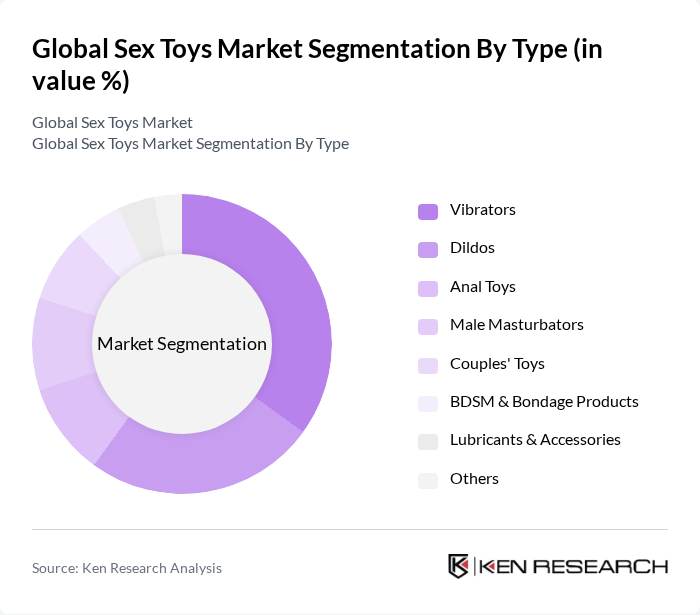
By Type:The market is segmented into various types of products, including vibrators, dildos, anal toys, male masturbators, couples' toys, BDSM & bondage products, lubricants & accessories, and others. This structure is consistent with leading industry analyses that group vibrators, dildos and anal devices, male masturbators, and couple-focused products as core product families. Among these, vibrators have emerged as the leading sub-segment due to their versatility and increasing popularity among consumers, with recent data indicating that vibrators account for the largest individual product share globally. The growing trend of self-exploration, rising comfort with discussing sexual wellness online, and the proliferation of app-connected, silent, and ergonomically designed devices have significantly contributed to the demand for vibrators, making them a staple in the market.
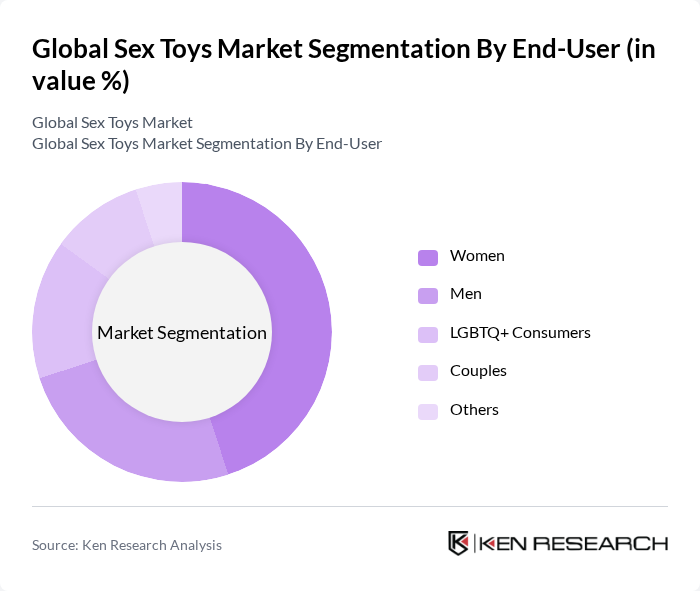
By End-User:The end-user segmentation includes women, men, LGBTQ+ consumers, couples, and others, in line with contemporary market breakdowns that differentiate adoption by gender and relationship status. Women represent the largest segment, driven by a growing focus on sexual wellness and empowerment, as well as higher visibility of female-focused brands and education initiatives. The increasing availability of products tailored specifically for women, gender-inclusive and body-safe designs, and a shift in societal attitudes towards female pleasure—amplified by social media, telehealth, and sex-positive influencers—has led to a surge in demand from this demographic.
Global Sex Toys Market Competitive Landscape
The Global Sex Toys Market is characterized by a dynamic mix of regional and international players. Leading participants such as Lovehoney Group Ltd, Adam & Eve (Eves Garden, Inc.), LELO Group AB, We-Vibe (WOW Tech Group / Lovehoney Group), Doc Johnson Enterprises, Fun Factory GmbH, Satisfyer (Triple A Import GmbH), TENGA Co., Ltd., Jimmyjane (Diamond Products, LLC), Pipedream Products, LLC, BMS Factory, Evolved Novelties (Evolved Novelties, LLC), Blush Novelties, OhMiBod (Suki, LLC), Dame Products, Inc. contribute to innovation, geographic expansion, and service delivery in this space, including investments in app-connected devices, eco-friendly materials, and gender-inclusive product lines.
Global Sex Toys Market Industry Analysis
Growth Drivers
- Increasing Acceptance of Sexual Wellness:The global shift towards sexual wellness is evident, with a reported 60% increase in consumer interest in sexual health products from 2020 to 2023. This trend is supported by the World Health Organization's emphasis on sexual health as a vital component of overall well-being. As societal norms evolve, more individuals are prioritizing sexual wellness, leading to a surge in demand for sex toys, which are increasingly viewed as essential for personal health and satisfaction.
- Rise in E-commerce Sales:E-commerce sales in the sex toy industry have surged, with online sales accounting for approximately $4 billion in future, reflecting a 25% increase from the previous year. The convenience of online shopping, coupled with discreet packaging, has encouraged consumers to purchase these products without stigma. This trend is further supported by the growth of digital payment systems, which are projected to reach $8 trillion globally in future, enhancing accessibility for consumers.
- Technological Advancements in Product Design:The integration of smart technology in sex toys has revolutionized the market, with over 45% of new products launched in future featuring app connectivity or remote control capabilities. This innovation caters to a tech-savvy consumer base, enhancing user experience and engagement. According to industry reports, the demand for technologically advanced products is expected to drive sales growth, as consumers increasingly seek personalized and interactive experiences.
Market Challenges
- Stigma Associated with Sexual Products:Despite growing acceptance, a significant stigma remains around sexual wellness products, affecting consumer purchasing behavior. A survey indicated that 35% of potential buyers feel embarrassed about purchasing sex toys, which can hinder market growth. This stigma is particularly pronounced in conservative regions, where cultural norms discourage open discussions about sexual health, limiting the potential customer base and impacting overall sales.
- Regulatory Restrictions in Various Regions:Regulatory challenges pose significant barriers to market expansion, with varying laws governing the sale of sex toys across different countries. For instance, in some regions, import restrictions can limit product availability, while others impose strict advertising regulations. These legal hurdles can lead to increased operational costs and complicate market entry strategies, ultimately affecting the growth potential of companies in the sex toy industry.
Global Sex Toys Market Future Outlook
The future of the sex toy market appears promising, driven by ongoing trends in consumer behavior and technological advancements. As acceptance of sexual wellness continues to rise, companies are likely to innovate further, focusing on smart technology and eco-friendly materials. Additionally, the expansion of e-commerce platforms will facilitate broader access to products, particularly in emerging markets. This evolving landscape suggests a dynamic market poised for growth, with opportunities for brands to engage diverse consumer segments effectively.
Market Opportunities
- Expansion into Emerging Markets:Emerging markets present significant growth opportunities, with a projected increase in disposable income and changing attitudes towards sexual wellness. Countries in Asia and Latin America are experiencing a cultural shift, leading to a growing acceptance of sex toys. This trend is supported by a 15% annual increase in online sales in these regions, indicating a ripe market for expansion and targeted marketing strategies.
- Development of Eco-friendly Products:The demand for sustainable products is on the rise, with 75% of consumers expressing interest in eco-friendly sex toys. Companies that prioritize sustainability in their product development can tap into this growing market segment. The global market for sustainable consumer goods is expected to reach $200 billion in future, highlighting the potential for brands to innovate and differentiate themselves through environmentally conscious offerings.
Scope of the Report
| Segment | Sub-Segments |
|---|---|
| By Type | Vibrators Dildos Anal Toys Male Masturbators Couples' Toys BDSM & Bondage Products Lubricants & Accessories Others |
| By End-User | Women Men LGBTQ+ Consumers Couples Others |
| By Distribution Channel | Online Retail / E-commerce Adult Stores Pharmacies & Drugstores Mass Retail (Supermarkets / Hypermarkets) Specialty Boutiques Others |
| By Material | Silicone ABS & Other Plastics Glass & Ceramic Metal Elastomers (TPE, TPR, Rubber) Others |
| By Price Range | Economy / Low-End Mid-Range Premium / High-End Luxury / Designer Others |
| By Age Group | 24 Years 34 Years 44 Years 54 Years + Years |
| By User Gender | Male Female Non-binary Others |
| By Region | North America Europe Asia-Pacific Latin America Middle East & Africa |
Key Target Audience
Investors and Venture Capitalist Firms
Government and Regulatory Bodies (e.g., Food and Drug Administration, European Medicines Agency)
Manufacturers and Producers
Distributors and Retailers
Health and Wellness Organizations
Online Marketplaces and E-commerce Platforms
Industry Associations (e.g., Adult Industry Trade Association)
Financial Institutions
Players Mentioned in the Report:
Lovehoney Group Ltd
Adam & Eve (Eves Garden, Inc.)
LELO Group AB
We-Vibe (WOW Tech Group / Lovehoney Group)
Doc Johnson Enterprises
Fun Factory GmbH
Satisfyer (Triple A Import GmbH)
TENGA Co., Ltd.
Jimmyjane (Diamond Products, LLC)
Pipedream Products, LLC
BMS Factory
Evolved Novelties (Evolved Novelties, LLC)
Blush Novelties
OhMiBod (Suki, LLC)
Dame Products, Inc.
Table of Contents
Market Assessment Phase
1. Executive Summary and Approach
2. Global Sex Toys Market Overview
2.1 Key Insights and Strategic Recommendations
2.2 Global Sex Toys Market Overview
2.3 Definition and Scope
2.4 Evolution of Market Ecosystem
2.5 Timeline of Key Regulatory Milestones
2.6 Value Chain & Stakeholder Mapping
2.7 Business Cycle Analysis
2.8 Policy & Incentive Landscape
3. Global Sex Toys Market Analysis
3.1 Growth Drivers
3.1.1 Increasing Acceptance of Sexual Wellness
3.1.2 Rise in E-commerce Sales
3.1.3 Technological Advancements in Product Design
3.1.4 Growing Focus on Personal Health and Well-being
3.2 Market Challenges
3.2.1 Stigma Associated with Sexual Products
3.2.2 Regulatory Restrictions in Various Regions
3.2.3 Competition from Alternative Products
3.2.4 Supply Chain Disruptions
3.3 Market Opportunities
3.3.1 Expansion into Emerging Markets
3.3.2 Development of Eco-friendly Products
3.3.3 Collaborations with Influencers and Brands
3.3.4 Customization and Personalization Trends
3.4 Market Trends
3.4.1 Increased Use of Smart Technology in Products
3.4.2 Growth of Subscription Services
3.4.3 Focus on Inclusivity and Diversity in Marketing
3.4.4 Rise of Online Communities and Forums
3.5 Government Regulation
3.5.1 Age Restrictions on Sales
3.5.2 Import and Export Regulations
3.5.3 Health and Safety Standards
3.5.4 Advertising Restrictions
4. SWOT Analysis
5. Stakeholder Analysis
6. Porter's Five Forces Analysis
7. Global Sex Toys Market Market Size, 2019-2024
7.1 By Value
7.2 By Volume
7.3 By Average Selling Price
8. Global Sex Toys Market Segmentation
8.1 By Type
8.1.1 Vibrators
8.1.2 Dildos
8.1.3 Anal Toys
8.1.4 Male Masturbators
8.1.5 Couples' Toys
8.1.6 BDSM & Bondage Products
8.1.7 Lubricants & Accessories
8.1.8 Others
8.2 By End-User
8.2.1 Women
8.2.2 Men
8.2.3 LGBTQ+ Consumers
8.2.4 Couples
8.2.5 Others
8.3 By Distribution Channel
8.3.1 Online Retail / E-commerce
8.3.2 Adult Stores
8.3.3 Pharmacies & Drugstores
8.3.4 Mass Retail (Supermarkets / Hypermarkets)
8.3.5 Specialty Boutiques
8.3.6 Others
8.4 By Material
8.4.1 Silicone
8.4.2 ABS & Other Plastics
8.4.3 Glass & Ceramic
8.4.4 Metal
8.4.5 Elastomers (TPE, TPR, Rubber)
8.4.6 Others
8.5 By Price Range
8.5.1 Economy / Low-End
8.5.2 Mid-Range
8.5.3 Premium / High-End
8.5.4 Luxury / Designer
8.5.5 Others
8.6 By Age Group
8.6.1 18-24 Years
8.6.2 25-34 Years
8.6.3 35-44 Years
8.6.4 45-54 Years
8.6.5 55+ Years
8.7 By User Gender
8.7.1 Male
8.7.2 Female
8.7.3 Non-binary
8.7.4 Others
8.8 By Region
8.8.1 North America
8.8.2 Europe
8.8.3 Asia-Pacific
8.8.4 Latin America
8.8.5 Middle East & Africa
9. Global Sex Toys Market Competitive Analysis
9.1 Market Share of Key Players
9.2 Cross Comparison of Key Players
9.2.1 Company Name
9.2.2 Company Size (Global, Regional, Niche)
9.2.3 Total Revenue
9.2.4 Sex Toys Revenue and Share of Total Sales
9.2.5 Revenue Growth Rate (Sex Toys Segment)
9.2.6 Geographic Footprint (Number of Countries / Regions Served)
9.2.7 Product Portfolio Breadth (Number of SKUs / Categories Covered)
9.2.8 New Product Launches per Year
9.2.9 Average Selling Price Positioning
9.2.10 Online vs Offline Sales Mix
9.2.11 E-commerce Traffic / App Downloads (Where Applicable)
9.2.12 Distribution Network Depth (Distributors / Retail Outlets)
9.2.13 Marketing & Brand Investment Intensity
9.2.14 Brand Awareness / Brand Equity Indicators
9.2.15 Customer Ratings & Review Scores (Key Platforms)
9.2.16 Return Rate / Product Complaint Rate
9.2.17 ESG & Sustainability Initiatives in Product and Packaging
9.3 SWOT Analysis of Top Players
9.4 Pricing Analysis
9.5 Detailed Profile of Major Companies
9.5.1 Lovehoney Group Ltd
9.5.2 Adam & Eve (Eves Garden, Inc.)
9.5.3 LELO Group AB
9.5.4 We-Vibe (WOW Tech Group / Lovehoney Group)
9.5.5 Doc Johnson Enterprises
9.5.6 Fun Factory GmbH
9.5.7 Satisfyer (Triple A Import GmbH)
9.5.8 TENGA Co., Ltd.
9.5.9 Jimmyjane (Diamond Products, LLC)
9.5.10 Pipedream Products, LLC
9.5.11 BMS Factory
9.5.12 Evolved Novelties (Evolved Novelties, LLC)
9.5.13 Blush Novelties
9.5.14 OhMiBod (Suki, LLC)
9.5.15 Dame Products, Inc.
10. Global Sex Toys Market End-User Analysis
10.1 Procurement Behavior of Key Ministries
10.1.1 Government Procurement Policies
10.1.2 Budget Allocations for Sexual Health
10.1.3 Partnerships with NGOs
10.1.4 Awareness Campaigns
10.2 Corporate Spend on Infrastructure & Energy
10.2.1 Investment in Sexual Wellness Programs
10.2.2 Funding for Research and Development
10.2.3 Marketing Budgets for Awareness
10.2.4 Collaborations with Health Organizations
10.3 Pain Point Analysis by End-User Category
10.3.1 Accessibility Issues
10.3.2 Product Quality Concerns
10.3.3 Stigma and Social Acceptance
10.3.4 Pricing Sensitivity
10.4 User Readiness for Adoption
10.4.1 Awareness Levels
10.4.2 Attitudes Towards Sexual Wellness
10.4.3 Availability of Products
10.4.4 Education and Information Access
10.5 Post-Deployment ROI and Use Case Expansion
10.5.1 Customer Feedback Mechanisms
10.5.2 Repeat Purchase Rates
10.5.3 Expansion into New Product Lines
10.5.4 Long-term Customer Engagement Strategies
11. Global Sex Toys Market Future Size, 2025-2030
11.1 By Value
11.2 By Volume
11.3 By Average Selling Price
Go-To-Market Strategy Phase
1. Whitespace Analysis + Business Model Canvas
1.1 Market Gaps Identification
1.2 Business Model Framework
2. Marketing and Positioning Recommendations
2.1 Branding Strategies
2.2 Product USPs
3. Distribution Plan
3.1 Urban Retail vs Rural NGO Tie-ups
4. Channel & Pricing Gaps
4.1 Underserved Routes
4.2 Pricing Bands
5. Unmet Demand & Latent Needs
5.1 Category Gaps
5.2 Consumer Segments
6. Customer Relationship
6.1 Loyalty Programs
6.2 After-sales Service
7. Value Proposition
7.1 Sustainability
7.2 Integrated Supply Chains
8. Key Activities
8.1 Regulatory Compliance
8.2 Branding
8.3 Distribution Setup
9. Entry Strategy Evaluation
9.1 Domestic Market Entry Strategy
9.1.1 Product Mix
9.1.2 Pricing Band
9.1.3 Packaging
9.2 Export Entry Strategy
9.2.1 Target Countries
9.2.2 Compliance Roadmap
10. Entry Mode Assessment
10.1 JV
10.2 Greenfield
10.3 M&A
10.4 Distributor Model
11. Capital and Timeline Estimation
11.1 Capital Requirements
11.2 Timelines
12. Control vs Risk Trade-Off
12.1 Ownership vs Partnerships
13. Profitability Outlook
13.1 Breakeven Analysis
13.2 Long-term Sustainability
14. Potential Partner List
14.1 Distributors
14.2 JVs
14.3 Acquisition Targets
15. Execution Roadmap
15.1 Phased Plan for Market Entry
15.1.1 Market Setup
15.1.2 Market Entry
15.1.3 Growth Acceleration
15.1.4 Scale & Stabilize
15.2 Key Activities and Milestones
15.2.1 Activity Timeline
15.2.2 Milestone Tracking
Research Methodology
Phase 1: Approach1
Desk Research
- Analysis of market reports from industry associations and trade publications
- Review of consumer behavior studies and demographic data related to sexual wellness
- Examination of online sales data and trends from e-commerce platforms specializing in sex toys
Primary Research
- Interviews with product managers at leading sex toy manufacturers
- Surveys conducted with retailers in the adult products sector
- Focus groups with consumers to understand preferences and purchasing behavior
Validation & Triangulation
- Cross-validation of findings through multiple data sources, including sales figures and consumer insights
- Triangulation of qualitative insights from interviews with quantitative data from surveys
- Sanity checks through expert reviews from industry analysts and market specialists
Phase 2: Market Size Estimation1
Top-down Assessment
- Estimation of total market size based on global adult product sales data
- Segmentation by product type, including vibrators, dildos, and accessories
- Incorporation of regional market trends and cultural factors influencing sales
Bottom-up Modeling
- Collection of sales data from key retailers and online platforms
- Estimation of average selling prices and volume sold per product category
- Analysis of growth rates based on historical sales data and emerging market trends
Forecasting & Scenario Analysis
- Multi-variable forecasting using factors such as changing societal attitudes and e-commerce growth
- Scenario analysis based on potential regulatory changes and market disruptions
- Development of baseline, optimistic, and pessimistic market projections through 2030
Phase 3: CATI Sample Composition1
| Scope Item/Segment | Sample Size | Target Respondent Profiles |
|---|---|---|
| Retail Sales of Sex Toys | 150 | Store Managers, Sales Representatives |
| Online Consumer Purchases | 120 | Frequent Online Shoppers, E-commerce Users |
| Market Trends in Adult Products | 100 | Industry Analysts, Market Researchers |
| Consumer Preferences and Attitudes | 120 | Focus Group Participants, Survey Respondents |
| Product Development Insights | 80 | Product Designers, R&D Managers |
Frequently Asked Questions
What is the current value of the Global Sex Toys Market?
The Global Sex Toys Market is valued at approximately USD 37 billion, reflecting a significant increase driven by growing acceptance of sexual wellness products, rising disposable incomes, and the expansion of e-commerce platforms facilitating discreet purchases.
What factors are driving the growth of the sex toys market?
Which regions dominate the Global Sex Toys Market?
What types of products are included in the sex toys market?
Other Regional/Country Reports
Indonesia Sex Toys Market
Malaysia Sex Toys Market
KSA Sex Toys Market
APAC Sex Toys Market
SEA Sex Toys Market
Vietnam Sex Toys Market
Other Adjacent Reports
Qatar Personal Lubricants Market
Bahrain Contraceptives Market
Brazil Lingerie Market
Qatar Adult Entertainment Market
Malaysia Sexual Health Supplements Market
Mexico Erotic Literature Market
Kuwait Sex Education Services Market
Vietnam Intimate Hygiene Products Market
Philippines Femtech Market
Thailand Mens Sexual Health Products Market
Why Buy From Us?

What makes us stand out is that our consultants follow Robust, Refine and Result (RRR) methodology. Robust for clear definitions, approaches and sanity checking, Refine for differentiating respondents' facts and opinions, and Result for presenting data with story.

We have set a benchmark in the industry by offering our clients with syndicated and customized market research reports featuring coverage of entire market as well as meticulous research and analyst insights.

While we don't replace traditional research, we flip the method upside down. Our dual approach of Top Bottom & Bottom Top ensures quality deliverable by not just verifying company fundamentals but also looking at the sector and macroeconomic factors.

With one step in the future, our research team constantly tries to show you the bigger picture. We help with some of the tough questions you may encounter along the way: How is the industry positioned? Best marketing channel? KPI's of competitors? By aligning every element, we help maximize success.

Our report gives you instant access to the answers and sources that other companies might choose to hide. We elaborate each steps of research methodology we have used and showcase you the sample size to earn your trust.

If you need any support, we are here! We pride ourselves on universe strength, data quality, and quick, friendly, and professional service.