Global Sexually Transmitted Diseases Std Diagnostics Market

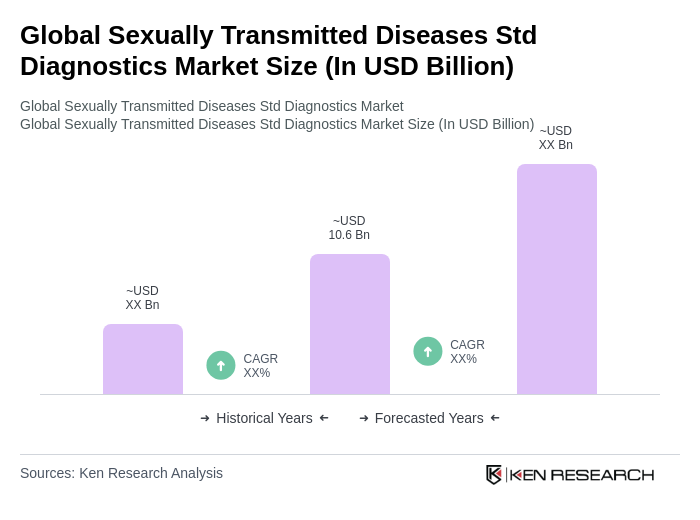
The global STD diagnostics market, valued at USD 10.6 billion, is growing due to increasing infection rates, molecular diagnostics advancements, and expanded screening in key regions like US and India.

Region:Global

Author(s):Dev

Product Code:KRAC0370

Pages:98

Published On:August 2025
About the Report

Base Year 2024

Global Sexually Transmitted Diseases Std Diagnostics Market Overview

  • The Global Sexually Transmitted Diseases (STD) Diagnostics Market is valued at USD 10.6 billion, based on a five-year historical analysis. This value aligns with multiple industry sources reporting the market in the ten-to-eleven billion range and reflects growth driven by increased infection rates, broader screening programs, and advances in molecular diagnostics and rapid testing .
  • Key players in this market include the United States, Germany, and India, which dominate due to their robust healthcare infrastructure, high rates of STD testing, and significant investments in research and development. North America holds the largest share, supported by strong screening programs and established diagnostics manufacturers; Europe benefits from stringent regulatory frameworks; and Asia Pacific (including India) is the fastest-growing region due to expanding access to testing and demand for affordable solutions .
  • In 2023, the U.S. government implemented funding mechanisms to enhance STD testing and treatment services across the country, including sustained CDC Section 318 funds for STI prevention to states and localities and targeted allocations through the Ending the HIV Epidemic initiative, which collectively support screening, partner services, and lab capacity; these federal investments aim to reduce incidence via public health campaigns and expanded diagnostic access .
Global Sexually Transmitted Diseases Std Diagnostics Market Size

Global Sexually Transmitted Diseases Std Diagnostics Market Segmentation

By Test/Technology:The STD diagnostics market is segmented by various testing technologies, each catering to different diagnostic needs. The leading sub-segment is Nucleic Acid Amplification Tests (NAATs/PCR), which are favored for their high sensitivity and specificity in detecting CT/NG, trichomonas, Mycoplasma genitalium, and other pathogens. Immunoassays, including ELISA and rapid tests, are widely used for HIV, syphilis, and HSV due to ease of use and faster turnaround, especially at point-of-care. The market is witnessing a shift towards self-collection and at-home testing kits, supported by telehealth integration and consumer demand for privacy and convenience .
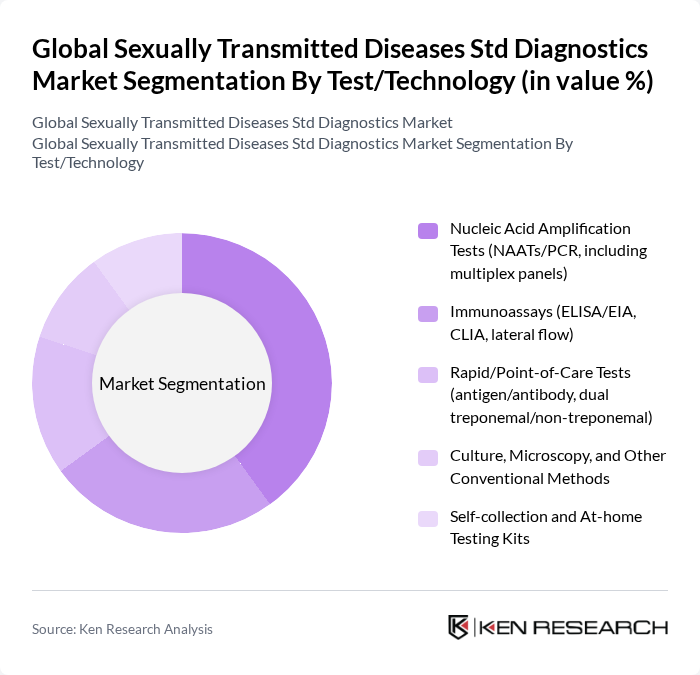
Global Sexually Transmitted Diseases Std Diagnostics Market segmentation by Test/Technology.

By Pathogen/Disease Type:The market is also segmented by the type of pathogens causing STDs. The most prevalent pathogens include Chlamydia trachomatis, Neisseria gonorrhoeae, and Treponema pallidum (syphilis). Human Immunodeficiency Virus (HIV) testing remains critical due to its global impact. The increasing awareness and education about these diseases are driving the demand for testing, particularly among high-risk populations .
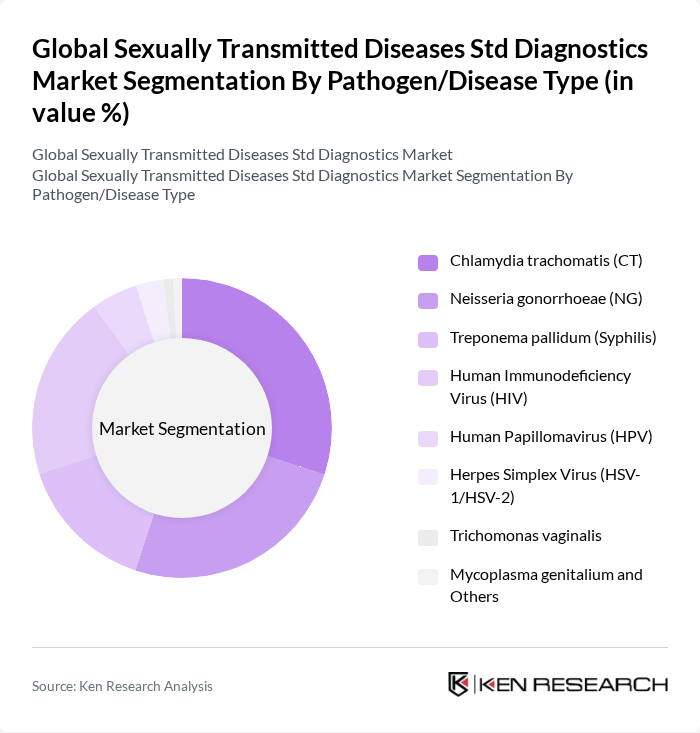
Global Sexually Transmitted Diseases Std Diagnostics Market segmentation by Pathogen/Disease Type.

Global Sexually Transmitted Diseases Std Diagnostics Market Competitive Landscape

The Global Sexually Transmitted Diseases Std Diagnostics Market is characterized by a dynamic mix of regional and international players. Leading participants such as Abbott Laboratories, Roche Diagnostics, Siemens Healthineers, Hologic, Inc., Cepheid (Danaher Corporation), Becton, Dickinson and Company (BD), Bio-Rad Laboratories, Inc., Thermo Fisher Scientific Inc., QuidelOrtho Corporation, GenMark Diagnostics, Inc. (a Roche company), OraSure Technologies, Inc., Alere Inc. (now part of Abbott Laboratories), MedMira Inc., Chembio Diagnostics, Inc., bioMérieux SA, Seegene Inc., Qiagen N.V., Trinity Biotech plc, Trinity Biotech’s subsidiary: Medusa Scientific Ltd. contribute to innovation, geographic expansion, and service delivery in this space .

Abbott Laboratories

1888

Abbott Park, Illinois, USA

Roche Diagnostics

1896

Basel, Switzerland

Siemens Healthineers

1847

Erlangen, Germany

Hologic, Inc.

1985

Marlborough, Massachusetts, USA

Cepheid (Danaher Corporation)

1996

Sunnyvale, California, USA

Company

Establishment Year

Headquarters

Group Size (Large, Medium, Small per industry convention)

STD Diagnostics Revenue (USD, latest fiscal year)

YoY Revenue Growth in STD Portfolio (%)

Installed Base of Analyzers/Platforms (units, e.g., Panther, cobas, Alinity, GeneXpert)

Test Menu Breadth (number of STD assays, incl. CT/NG, Trich, Mycoplasma, HPV, HIV, syphilis)

Geographic Reach (countries served/regions with regulatory approvals)

Global Sexually Transmitted Diseases Std Diagnostics Market Industry Analysis

Growth Drivers

  • Increasing Prevalence of STDs:The World Health Organization reports that more than 1 million curable sexually transmitted infections are acquired every day globally, with substantial burdens of chlamydia, gonorrhea, trichomoniasis, and syphilis. In the United States, the CDC reports approximately 2.6 million cases of chlamydia, gonorrhea, and syphilis reported annually, underscoring the need for effective diagnostic solutions. This rising prevalence drives demand for advanced testing methods and increased healthcare spending on STD diagnostics.
  • Advancements in Diagnostic Technologies:Molecular diagnostics methods such as PCR are widely used for STI detection and are recommended in guidelines for accurate identification, improving turnaround time and sensitivity for pathogens including chlamydia and gonorrhea. Next-generation sequencing is increasingly applied for pathogen characterization and antimicrobial resistance surveillance in public health contexts. The global market for diagnostic technologies is projected to reach $110 billion in future, driven by innovations such as molecular diagnostics and rapid testing kits.
  • Rising Awareness and Education about STDs:National public health agencies fund STI prevention and education programs to expand testing and treatment access, which increases demand for diagnostic services. For instance, the U.S. Department of Health and Human Services allocated $1.7 billion in future for STD prevention and education programs. This heightened awareness leads to more individuals seeking testing and treatment, ultimately driving the demand for STD diagnostic services and products across various demographics.

Market Challenges

  • Stigma Associated with STD Testing:Stigma and confidentiality concerns are documented barriers to STI testing and care, contributing to delayed diagnoses and continued transmission. A study published in the Journal of Sex Research indicated that nearly 42% of individuals avoid testing due to fear of judgment. This stigma can lead to delayed diagnoses and increased transmission rates, ultimately hindering market growth as individuals may refrain from seeking necessary medical care and testing services.
  • High Costs of Advanced Diagnostic Tests:The cost of advanced diagnostic tests can be prohibitive, with some tests exceeding $600. This financial barrier limits access, particularly in low-income populations and rural areas. According to the World Bank, healthcare expenditure in low-income countries averages only $60 per capita, making it challenging for these populations to afford necessary STD testing, thereby constraining market expansion.

Global Sexually Transmitted Diseases Std Diagnostics Market Future Outlook

The future of STD diagnostics is poised for transformation, driven by technological advancements and changing healthcare delivery models. The integration of telemedicine and remote testing solutions is expected to enhance accessibility, particularly in underserved regions. Additionally, the focus on personalized medicine will likely lead to tailored diagnostic approaches, improving patient outcomes. As public awareness continues to grow, the market is set to evolve, fostering innovation and collaboration among stakeholders to address the ongoing challenges in STD management.

Market Opportunities

  • Growth in Telemedicine and Remote Testing:The telemedicine market is projected to reach $500 billion in future, creating opportunities for remote STD testing solutions. This growth allows patients to access testing from home, reducing stigma and increasing testing rates, particularly in rural areas where healthcare access is limited.
  • Development of Rapid Diagnostic Tests:The demand for rapid diagnostic tests is increasing, with the market expected to grow significantly. These tests provide results within minutes, facilitating timely treatment. The global rapid test market is projected to reach $30 billion in future, indicating a substantial opportunity for innovation in STD diagnostics.

Scope of the Report

SegmentSub-Segments
By Test/Technology

Nucleic Acid Amplification Tests (NAATs/PCR, including multiplex panels)

Immunoassays (ELISA/EIA, CLIA, lateral flow)

Rapid/Point-of-Care Tests (antigen/antibody, dual treponemal/non-treponemal)

Culture, Microscopy, and Other Conventional Methods

Self-collection and At-home Testing Kits

By Pathogen/Disease Type

Chlamydia trachomatis (CT)

Neisseria gonorrhoeae (NG)

Treponema pallidum (Syphilis)

Human Immunodeficiency Virus (HIV)

Human Papillomavirus (HPV)

Herpes Simplex Virus (HSV-1/HSV-2)

Trichomonas vaginalis

Mycoplasma genitalium and Others

By Sample Type

Urine

Genital/Anorectal/Throat Swabs

Blood/Serum/Plasma

Self-collected Samples (e.g., vaginal swabs, dried blood spots)

Others

By Testing Location

Central/Reference Laboratories

Hospital and Clinic-based Labs

Point-of-Care Settings

At-home/Remote Testing

Public Health and Screening Programs

By End-User

Hospitals and Clinics

Diagnostic Laboratories

Public Health Agencies and NGOs

Home Users (Direct-to-Consumer)

Others

By Distribution Channel

Direct/Tender Sales (institutional and government)

Distributors

Online/D2C Platforms

Retail Pharmacies

Others

By Region

North America

Europe

Asia-Pacific

Latin America

Middle East & Africa

Key Target Audience

Investors and Venture Capitalist Firms

Government and Regulatory Bodies (e.g., World Health Organization, Centers for Disease Control and Prevention)

Manufacturers and Producers of Diagnostic Devices

Distributors and Retailers of Medical Supplies

Healthcare Providers and Clinics

Pharmaceutical Companies

Public Health Organizations

Health Insurance Companies

Players Mentioned in the Report:

Abbott Laboratories

Roche Diagnostics

Siemens Healthineers

Hologic, Inc.

Cepheid (Danaher Corporation)

Becton, Dickinson and Company (BD)

Bio-Rad Laboratories, Inc.

Thermo Fisher Scientific Inc.

QuidelOrtho Corporation

GenMark Diagnostics, Inc. (a Roche company)

OraSure Technologies, Inc.

Alere Inc. (now part of Abbott Laboratories)

MedMira Inc.

Chembio Diagnostics, Inc.

bioMerieux SA

Seegene Inc.

Qiagen N.V.

Trinity Biotech plc

Trinity Biotechs subsidiary: Medusa Scientific Ltd. (if profiling needed)

Mylab Discovery Solutions Pvt. Ltd.

Table of Contents

Market Assessment Phase

1. Executive Summary and Approach


2. Global Sexually Transmitted Diseases Std Diagnostics Market Overview

2.1 Key Insights and Strategic Recommendations

2.2 Global Sexually Transmitted Diseases Std Diagnostics Market Overview

2.3 Definition and Scope

2.4 Evolution of Market Ecosystem

2.5 Timeline of Key Regulatory Milestones

2.6 Value Chain & Stakeholder Mapping

2.7 Business Cycle Analysis

2.8 Policy & Incentive Landscape


3. Global Sexually Transmitted Diseases Std Diagnostics Market Analysis

3.1 Growth Drivers

3.1.1 Increasing prevalence of STDs
3.1.2 Advancements in diagnostic technologies
3.1.3 Rising awareness and education about STDs
3.1.4 Government initiatives for STD testing

3.2 Market Challenges

3.2.1 Stigma associated with STD testing
3.2.2 High costs of advanced diagnostic tests
3.2.3 Limited access to healthcare facilities in rural areas
3.2.4 Regulatory hurdles in product approvals

3.3 Market Opportunities

3.3.1 Growth in telemedicine and remote testing
3.3.2 Development of rapid diagnostic tests
3.3.3 Expansion of healthcare infrastructure
3.3.4 Increasing partnerships between public and private sectors

3.4 Market Trends

3.4.1 Shift towards point-of-care testing
3.4.2 Integration of AI in diagnostics
3.4.3 Focus on personalized medicine
3.4.4 Rise in home testing kits

3.5 Government Regulation

3.5.1 Guidelines for STD testing and treatment
3.5.2 Approval processes for diagnostic devices
3.5.3 Funding for public health initiatives
3.5.4 Regulations on data privacy in health records

4. SWOT Analysis


5. Stakeholder Analysis


6. Porter's Five Forces Analysis


7. Global Sexually Transmitted Diseases Std Diagnostics Market Market Size, 2019-2024

7.1 By Value

7.2 By Volume

7.3 By Average Selling Price


8. Global Sexually Transmitted Diseases Std Diagnostics Market Segmentation

8.1 By Test/Technology

8.1.1 Nucleic Acid Amplification Tests (NAATs/PCR, including multiplex panels)
8.1.2 Immunoassays (ELISA/EIA, CLIA, lateral flow)
8.1.3 Rapid/Point-of-Care Tests (antigen/antibody, dual treponemal/non-treponemal)
8.1.4 Culture, Microscopy, and Other Conventional Methods
8.1.5 Self-collection and At-home Testing Kits

8.2 By Pathogen/Disease Type

8.2.1 Chlamydia trachomatis (CT)
8.2.2 Neisseria gonorrhoeae (NG)
8.2.3 Treponema pallidum (Syphilis)
8.2.4 Human Immunodeficiency Virus (HIV)
8.2.5 Human Papillomavirus (HPV)
8.2.6 Herpes Simplex Virus (HSV-1/HSV-2)
8.2.7 Trichomonas vaginalis
8.2.8 Mycoplasma genitalium and Others

8.3 By Sample Type

8.3.1 Urine
8.3.2 Genital/Anorectal/Throat Swabs
8.3.3 Blood/Serum/Plasma
8.3.4 Self-collected Samples (e.g., vaginal swabs, dried blood spots)
8.3.5 Others

8.4 By Testing Location

8.4.1 Central/Reference Laboratories
8.4.2 Hospital and Clinic-based Labs
8.4.3 Point-of-Care Settings
8.4.4 At-home/Remote Testing
8.4.5 Public Health and Screening Programs

8.5 By End-User

8.5.1 Hospitals and Clinics
8.5.2 Diagnostic Laboratories
8.5.3 Public Health Agencies and NGOs
8.5.4 Home Users (Direct-to-Consumer)
8.5.5 Others

8.6 By Distribution Channel

8.6.1 Direct/Tender Sales (institutional and government)
8.6.2 Distributors
8.6.3 Online/D2C Platforms
8.6.4 Retail Pharmacies
8.6.5 Others

8.7 By Region

8.7.1 North America
8.7.2 Europe
8.7.3 Asia-Pacific
8.7.4 Latin America
8.7.5 Middle East & Africa

9. Global Sexually Transmitted Diseases Std Diagnostics Market Competitive Analysis

9.1 Market Share of Key Players

9.2 KPIs for Cross Comparison of Key Players

9.2.1 Company Name
9.2.2 Group Size (Large, Medium, Small per industry convention)
9.2.3 STD Diagnostics Revenue (USD, latest fiscal year)
9.2.4 YoY Revenue Growth in STD Portfolio (%)
9.2.5 Installed Base of Analyzers/Platforms (units, e.g., Panther, cobas, Alinity, GeneXpert)
9.2.6 Test Menu Breadth (number of STD assays, incl. CT/NG, Trich, Mycoplasma, HPV, HIV, syphilis)
9.2.7 Geographic Reach (countries served/regions with regulatory approvals)
9.2.8 Regulatory Approvals (count by FDA 510(k)/PMAs, CE-IVD/IVDR, WHO PQ)
9.2.9 Turnaround Time at POC (median minutes) / Throughput in Labs (tests per hour)
9.2.10 Sensitivity/Specificity Benchmarks (per label/peer-reviewed studies)
9.2.11 Average Selling Price (ASP) per Test (by modality)
9.2.12 Gross Margin (%) on STD Test Kits/Instruments
9.2.13 Distribution Coverage (number of distributors/tenders secured)
9.2.14 Service Uptime/Instrument Utilization (%)
9.2.15 R&D Intensity (% of revenue) and Pipeline (near-term launches)

9.3 SWOT Analysis of Top Players

9.4 Pricing Analysis

9.5 Detailed Profile of Major Companies

9.5.1 Abbott Laboratories
9.5.2 Roche Diagnostics
9.5.3 Siemens Healthineers
9.5.4 Hologic, Inc.
9.5.5 Cepheid (Danaher Corporation)
9.5.6 Becton, Dickinson and Company (BD)
9.5.7 Bio-Rad Laboratories, Inc.
9.5.8 Thermo Fisher Scientific Inc.
9.5.9 QuidelOrtho Corporation
9.5.10 GenMark Diagnostics, Inc. (a Roche company)
9.5.11 OraSure Technologies, Inc.
9.5.12 Alere Inc. (now part of Abbott Laboratories)
9.5.13 MedMira Inc.
9.5.14 Chembio Diagnostics, Inc.
9.5.15 bioMérieux SA
9.5.16 Seegene Inc.
9.5.17 Qiagen N.V.
9.5.18 Trinity Biotech plc
9.5.19 Trinity Biotech’s subsidiary: Medusa Scientific Ltd. (if profiling needed)
9.5.20 Mylab Discovery Solutions Pvt. Ltd.

10. Global Sexually Transmitted Diseases Std Diagnostics Market End-User Analysis

10.1 Procurement Behavior of Key Ministries

10.1.1 Budget Allocation for STD Programs
10.1.2 Decision-Making Processes
10.1.3 Preferred Suppliers

10.2 Corporate Spend on Infrastructure & Energy

10.2.1 Investment in Diagnostic Facilities
10.2.2 Funding for Research and Development
10.2.3 Partnerships with Healthcare Providers

10.3 Pain Point Analysis by End-User Category

10.3.1 Accessibility Issues
10.3.2 Cost Barriers
10.3.3 Quality of Testing Services

10.4 User Readiness for Adoption

10.4.1 Awareness Levels
10.4.2 Training Needs
10.4.3 Technology Acceptance

10.5 Post-Deployment ROI and Use Case Expansion

10.5.1 Measurement of Effectiveness
10.5.2 Long-term Benefits
10.5.3 Opportunities for Upscaling

11. Global Sexually Transmitted Diseases Std Diagnostics Market Future Size, 2025-2030

11.1 By Value

11.2 By Volume

11.3 By Average Selling Price


Go-To-Market Strategy Phase

1. Whitespace Analysis + Business Model Canvas

1.1 Market Gaps Identification

1.2 Business Model Framework


2. Marketing and Positioning Recommendations

2.1 Branding Strategies

2.2 Product USPs


3. Distribution Plan

3.1 Urban Retail Strategies

3.2 Rural NGO Tie-ups


4. Channel & Pricing Gaps

4.1 Underserved Routes

4.2 Pricing Bands


5. Unmet Demand & Latent Needs

5.1 Category Gaps

5.2 Consumer Segments


6. Customer Relationship

6.1 Loyalty Programs

6.2 After-sales Service


7. Value Proposition

7.1 Sustainability

7.2 Integrated Supply Chains


8. Key Activities

8.1 Regulatory Compliance

8.2 Branding

8.3 Distribution Setup


9. Entry Strategy Evaluation

9.1 Domestic Market Entry Strategy

9.1.1 Product Mix
9.1.2 Pricing Band
9.1.3 Packaging

9.2 Export Entry Strategy

9.2.1 Target Countries
9.2.2 Compliance Roadmap

10. Entry Mode Assessment

10.1 Joint Ventures

10.2 Greenfield Investments

10.3 Mergers & Acquisitions

10.4 Distributor Model


11. Capital and Timeline Estimation

11.1 Capital Requirements

11.2 Timelines


12. Control vs Risk Trade-Off

12.1 Ownership vs Partnerships


13. Profitability Outlook

13.1 Breakeven Analysis

13.2 Long-term Sustainability


14. Potential Partner List

14.1 Distributors

14.2 Joint Ventures

14.3 Acquisition Targets


15. Execution Roadmap

15.1 Phased Plan for Market Entry

15.1.1 Market Setup
15.1.2 Market Entry
15.1.3 Growth Acceleration
15.1.4 Scale & Stabilize

15.2 Key Activities and Milestones

15.2.1 Activity Timeline
15.2.2 Milestone Tracking

Research Methodology

ApproachModellingSample

Phase 1: Approach1

Desk Research

  • Analysis of global health organization reports on STD prevalence and diagnostics
  • Review of market research publications and white papers on STD diagnostics trends
  • Examination of regulatory frameworks and guidelines from health authorities

Primary Research

  • Interviews with healthcare professionals specializing in infectious diseases
  • Surveys conducted with laboratory managers in diagnostic centers
  • Focus groups with patients to understand perceptions and experiences with STD testing

Validation & Triangulation

  • Cross-validation of findings with epidemiological data and market reports
  • Triangulation of insights from healthcare providers, patients, and industry experts
  • Sanity checks through expert panel discussions and feedback sessions

Phase 2: Market Size Estimation1

Top-down Assessment

  • Estimation of market size based on global healthcare expenditure on STD diagnostics
  • Segmentation by diagnostic method (e.g., serology, molecular testing) and geography
  • Incorporation of trends in public health initiatives and funding for STD prevention

Bottom-up Modeling

  • Collection of sales data from leading diagnostic manufacturers and suppliers
  • Estimation of testing volumes based on demographic and epidemiological data
  • Cost analysis of diagnostic tests to establish pricing models and revenue potential

Forecasting & Scenario Analysis

  • Multi-variable forecasting using factors such as population growth and healthcare access
  • Scenario analysis based on potential changes in public health policies and funding
  • Development of baseline, optimistic, and pessimistic market projections through 2030

Phase 3: CATI Sample Composition1

Scope Item/SegmentSample SizeTarget Respondent Profiles
Healthcare Providers140Doctors, Nurses, Public Health Officials
Diagnostic Laboratories100Lab Technicians, Laboratory Managers
Pharmaceutical Distributors80Sales Representatives, Distribution Managers
Public Health Organizations70Policy Makers, Health Program Coordinators
Patient Advocacy Groups60Advocacy Leaders, Community Health Workers

Frequently Asked Questions

What is the current value of the Global Sexually Transmitted Diseases (STD) Diagnostics Market?

The Global STD Diagnostics Market is valued at approximately USD 10.6 billion, reflecting growth driven by increased infection rates, broader screening programs, and advancements in molecular diagnostics and rapid testing technologies.

Which regions dominate the Global STD Diagnostics Market?

What are the main drivers of growth in the STD Diagnostics Market?

What challenges does the STD Diagnostics Market face?

Other Regional/Country Reports

Indonesia Global Sexually Transmitted Diseases Std Diagnostics Market

Malaysia Global Sexually Transmitted Diseases Std Diagnostics Market

KSA Global Sexually Transmitted Diseases Std Diagnostics Market

APAC Global Sexually Transmitted Diseases Std Diagnostics Market

SEA Global Sexually Transmitted Diseases Std Diagnostics Market

Vietnam Global Sexually Transmitted Diseases Std Diagnostics Market

Why Buy From Us?

Refine Robust Result (RRR) Framework

What makes us stand out is that our consultants follow Robust, Refine and Result (RRR) methodology. Robust for clear definitions, approaches and sanity checking, Refine for differentiating respondents' facts and opinions, and Result for presenting data with story.

Our Reach Is Unmatched

We have set a benchmark in the industry by offering our clients with syndicated and customized market research reports featuring coverage of entire market as well as meticulous research and analyst insights.

Shifting the Research Paradigm

While we don't replace traditional research, we flip the method upside down. Our dual approach of Top Bottom & Bottom Top ensures quality deliverable by not just verifying company fundamentals but also looking at the sector and macroeconomic factors.

More Insights-Better Decisions

With one step in the future, our research team constantly tries to show you the bigger picture. We help with some of the tough questions you may encounter along the way: How is the industry positioned? Best marketing channel? KPI's of competitors? By aligning every element, we help maximize success.

Transparency and Trust

Our report gives you instant access to the answers and sources that other companies might choose to hide. We elaborate each steps of research methodology we have used and showcase you the sample size to earn your trust.

Round the Clock Support

If you need any support, we are here! We pride ourselves on universe strength, data quality, and quick, friendly, and professional service.

Why Clients Choose Us?

400000+
Reports in repository
150+
Consulting projects a year
100+
Analysts
8000+
Client Queries in 2022








