Global Shotgun and Rifles Market

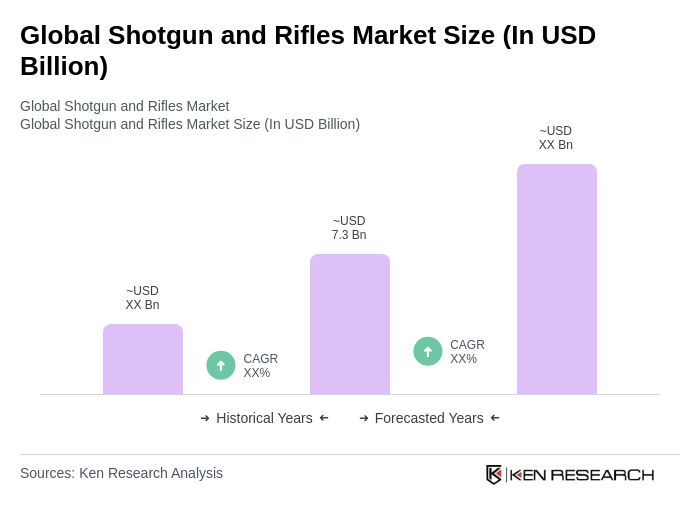
The Global Shotgun and Rifles Market, valued at USD 7.3 billion, sees growth from rising demand in hunting, self-defense, and military uses, with rifles leading segments.

Region:Global

Author(s):Shubham

Product Code:KRAA2252

Pages:100

Published On:August 2025
About the Report

Base Year 2024

Global Shotgun and Rifles Market Overview

  • The Global Shotgun and Rifles Market is valued at USD 7.3 billion, based on a five-year historical analysis. This value reflects the combined size of the global rifles and shotguns segments, with rifles accounting for a larger share and shotguns representing a significant portion of the market. Growth is primarily driven by increasing demand for hunting, sports shooting activities, and heightened security concerns that have led to a surge in military and law enforcement procurement. The market has also benefited from technological advancements in firearm manufacturing, including digital integration, improved materials, and enhanced safety features, which have elevated product performance and user experience .
  • Key players in this market include the United States, Germany, and Italy, which dominate due to their strong manufacturing capabilities, established brands, and a rich tradition of hunting and shooting sports. The U.S. is particularly significant, with a large civilian market and robust military presence, while Germany and Italy are known for high-quality craftsmanship and innovation in firearm design .
  • In 2023, the U.S. government strengthened regulations on firearm sales by mandating comprehensive background checks for all purchases, including private and online sales. This regulatory update, enacted through the Bipartisan Safer Communities Act, 2022 issued by the United States Congress, requires federally licensed firearms dealers to conduct background checks on all buyers, regardless of transaction channel. The regulation aims to enhance public safety and reduce gun violence, reflecting a growing trend toward more responsible gun ownership and control measures .
Global Shotgun and Rifles Market Size

Global Shotgun and Rifles Market Segmentation

By Type:The market is segmented into Shotguns, Rifles, Combination Guns, Air Guns, and Others. Rifles are the leading sub-segment, driven by their popularity in civilian hunting, sports shooting, and military applications. Their versatility, accuracy, and adaptability to various calibers make rifles a preferred choice for target shooting, hunting, and tactical uses. Shotguns maintain a significant share, especially in hunting and law enforcement, due to their effectiveness in close-range scenarios and versatility in ammunition types. Air Guns are gaining traction for recreational shooting and entry-level sports, supported by growing interest in competitive shooting among youth and broader demographic participation .
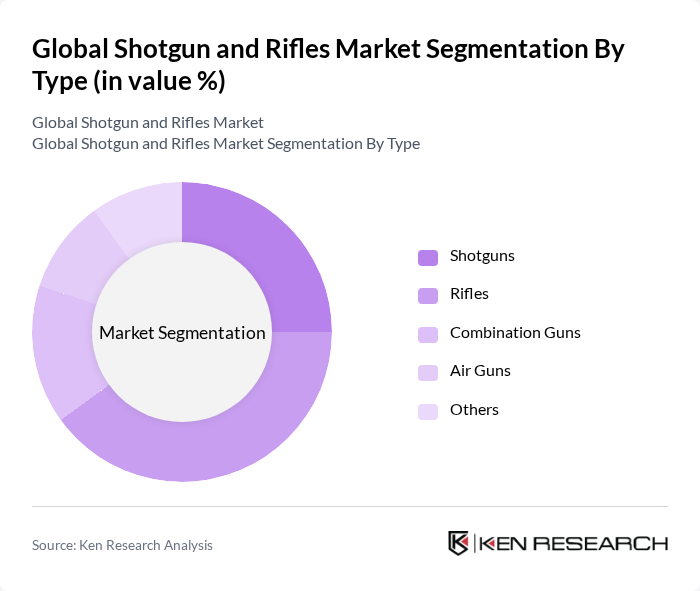
Global Shotgun and Rifles Market segmentation by Type.

By End-User:The market is categorized into Civilian, Military, Law Enforcement, Sports Shooting, and Others. The Civilian segment is the largest, fueled by rising interest in hunting, recreational shooting, and personal security. Military applications follow, with ongoing investments in advanced firearms for defense modernization and tactical operations. Law enforcement agencies require reliable and adaptable firearms for public safety and tactical response. Sports shooting is a niche but expanding segment, supported by competitive leagues and increased participation in shooting sports globally .
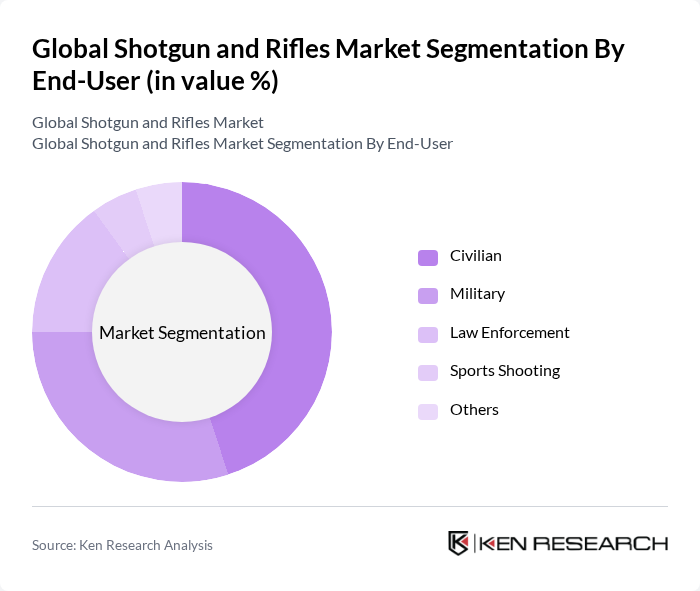
Global Shotgun and Rifles Market segmentation by End-User.

Global Shotgun and Rifles Market Competitive Landscape

The Global Shotgun and Rifles Market is characterized by a dynamic mix of regional and international players. Leading participants such as Remington Arms Company, LLC, Beretta Holding S.p.A., Sturm, Ruger & Co., Inc., Smith & Wesson Brands, Inc., Browning Arms Company, Winchester Repeating Arms Company, Savage Arms, Inc., FN Herstal S.A., Heckler & Koch GmbH, ?eská zbrojovka Uherský Brod (CZUB), Tikka (Sako Ltd.), O.F. Mossberg & Sons, Inc., Israel Weapon Industries (IWI), SIG Sauer, Inc., Taurus Holdings, Inc. contribute to innovation, geographic expansion, and service delivery in this space.

Remington Arms Company, LLC

1816

Madison, North Carolina, USA

Beretta Holding S.p.A.

1526

Gardone Val Trompia, Italy

Sturm, Ruger & Co., Inc.

1949

Southport, Connecticut, USA

Smith & Wesson Brands, Inc.

1852

Springfield, Massachusetts, USA

Browning Arms Company

1878

Morgan, Utah, USA

Company

Establishment Year

Headquarters

Company Size (Large, Medium, Small)

Annual Revenue (USD)

Revenue Growth Rate (%)

Global Market Share (%)

Geographic Presence (No. of Countries/Regions)

Product Portfolio Breadth (No. of Models/Calibers)

Global Shotgun and Rifles Market Industry Analysis

Growth Drivers

  • Increasing Demand for Hunting and Sport Shooting:The hunting and sport shooting sectors are projected to contribute significantly to market growth, with an estimated 15 million hunters in the U.S. alone as of in future. The National Shooting Sports Foundation reported that participation in shooting sports increased by 10% from 2021 to in future, indicating a robust interest. This trend is supported by a growing population of outdoor enthusiasts, with the U.S. outdoor recreation economy valued at $887 billion in future, further driving demand for shotguns and rifles.
  • Rising Interest in Self-Defense and Personal Protection:The surge in personal safety concerns has led to a notable increase in firearm ownership for self-defense. According to the Pew Research Center, 30% of U.S. adults reported owning a firearm for protection in future, up from 22% in 2020. This trend is further fueled by rising crime rates, with the FBI reporting a 5% increase in violent crime in future. Consequently, the demand for shotguns and rifles as self-defense tools is expected to continue its upward trajectory.
  • Technological Advancements in Firearm Manufacturing:Innovations in firearm technology are enhancing product appeal and performance. The introduction of smart firearms, which incorporate biometric safety features, is gaining traction. The global smart gun market is projected to reach $1.5 billion in future, reflecting a growing consumer interest in safety and technology. Additionally, advancements in materials and manufacturing processes are improving the durability and efficiency of shotguns and rifles, further stimulating market growth.

Market Challenges

  • Stringent Government Regulations and Compliance:The firearms industry faces significant regulatory challenges, with over 300 federal laws governing firearm ownership and sales in the U.S. alone. Compliance with these regulations can be costly and time-consuming for manufacturers. The Bureau of Alcohol, Tobacco, Firearms and Explosives (ATF) reported that 80% of gun dealers faced compliance audits in future, highlighting the regulatory burden that can hinder market growth and innovation.
  • Public Perception and Anti-Gun Movements:The growing anti-gun sentiment and public perception issues pose a challenge to the market. High-profile incidents of gun violence have led to increased advocacy for stricter gun control measures. A Gallup poll in future indicated that 57% of Americans support stricter laws covering the sale of firearms. This shift in public opinion can impact sales and lead to more stringent regulations, creating a challenging environment for manufacturers and retailers.

Global Shotgun and Rifles Market Future Outlook

The future of the shotgun and rifles market appears promising, driven by evolving consumer preferences and technological advancements. As the interest in shooting sports and personal protection continues to rise, manufacturers are likely to focus on innovation and customization. Additionally, the integration of digital technologies in firearms is expected to enhance user experience and safety. However, navigating regulatory challenges and public perception will be crucial for sustained growth in this dynamic market landscape.

Market Opportunities

  • Expansion into Emerging Markets:Emerging markets, particularly in Asia and Africa, present significant growth opportunities for the shotgun and rifles market. With increasing disposable incomes and a rising interest in hunting and shooting sports, these regions are expected to see a surge in firearm demand. The World Bank projects GDP growth in these regions to vary, with recent World Bank data indicating Vietnam—a key Asian emerging market—has a GDP growth forecast between 5.8% and 6.8% in future, depending on external trade conditions.
  • Increased Online Sales and E-Commerce Platforms:The shift towards online shopping is creating new avenues for firearm sales. E-commerce platforms are becoming increasingly popular, with a 20% increase in online firearm sales reported in future. This trend is expected to continue as consumers seek convenience and a wider selection of products. Leveraging digital marketing strategies can enhance brand visibility and drive sales in this evolving retail landscape.

Scope of the Report

SegmentSub-Segments
By Type

Shotguns

Rifles

Combination Guns

Air Guns

Others

By End-User

Civilian

Military

Law Enforcement

Sports Shooting

Others

By Distribution Channel

Online Retail

Specialty Stores

Department Stores

Direct Sales

Others

By Price Range

Budget

Mid-Range

Premium

Luxury

By Brand

Established Brands

Emerging Brands

Private Labels

Others

By Material

Steel

Aluminum

Polymer

Wood

Others

By Usage

Hunting

Target Shooting

Self-Defense

Military Training

Others

By Range

Short Range

Medium Range

Long Range

By Weapon Loading Mechanism

Manual

Semi-Automatic/Automatic

By Region

North America (U.S., Canada)

Europe (Germany, UK, France, Russia, Rest of Europe)

Asia-Pacific (China, India, Japan, South Korea, Rest of Asia-Pacific)

Latin America (Brazil, Mexico, Rest of Latin America)

Middle East & Africa (UAE, Saudi Arabia, Egypt, Rest of MEA)

Key Target Audience

Investors and Venture Capitalist Firms

Government and Regulatory Bodies (e.g., Bureau of Alcohol, Tobacco, Firearms and Explosives; National Rifle Association)

Manufacturers and Producers

Distributors and Retailers

Military and Defense Agencies (e.g., Department of Defense)

Law Enforcement Agencies (e.g., Federal Bureau of Investigation)

Industry Associations (e.g., National Shooting Sports Foundation)

Financial Institutions

Players Mentioned in the Report:

Remington Arms Company, LLC

Beretta Holding S.p.A.

Sturm, Ruger & Co., Inc.

Smith & Wesson Brands, Inc.

Browning Arms Company

Winchester Repeating Arms Company

Savage Arms, Inc.

FN Herstal S.A.

Heckler & Koch GmbH

Ceska zbrojovka Uhersky Brod (CZUB)

Tikka (Sako Ltd.)

O.F. Mossberg & Sons, Inc.

Israel Weapon Industries (IWI)

SIG Sauer, Inc.

Taurus Holdings, Inc.

Table of Contents

Market Assessment Phase

1. Executive Summary and Approach


2. Global Shotgun and Rifles Market Overview

2.1 Key Insights and Strategic Recommendations

2.2 Global Shotgun and Rifles Market Overview

2.3 Definition and Scope

2.4 Evolution of Market Ecosystem

2.5 Timeline of Key Regulatory Milestones

2.6 Value Chain & Stakeholder Mapping

2.7 Business Cycle Analysis

2.8 Policy & Incentive Landscape


3. Global Shotgun and Rifles Market Analysis

3.1 Growth Drivers

3.1.1 Increasing demand for hunting and sport shooting
3.1.2 Rising interest in self-defense and personal protection
3.1.3 Technological advancements in firearm manufacturing
3.1.4 Growth in military and law enforcement procurement

3.2 Market Challenges

3.2.1 Stringent government regulations and compliance
3.2.2 Public perception and anti-gun movements
3.2.3 Supply chain disruptions affecting production
3.2.4 Competition from alternative self-defense products

3.3 Market Opportunities

3.3.1 Expansion into emerging markets
3.3.2 Development of smart firearms technology
3.3.3 Increased online sales and e-commerce platforms
3.3.4 Collaborations with outdoor and sporting goods retailers

3.4 Market Trends

3.4.1 Growing popularity of shooting sports
3.4.2 Customization and personalization of firearms
3.4.3 Rise of eco-friendly and sustainable materials
3.4.4 Integration of digital technologies in firearms

3.5 Government Regulation

3.5.1 Firearm ownership laws and licensing requirements
3.5.2 Import/export regulations for firearms
3.5.3 Safety standards for firearm manufacturing
3.5.4 Restrictions on specific firearm types and accessories

4. SWOT Analysis


5. Stakeholder Analysis


6. Porter's Five Forces Analysis


7. Global Shotgun and Rifles Market Market Size, 2019-2024

7.1 By Value

7.2 By Volume

7.3 By Average Selling Price


8. Global Shotgun and Rifles Market Segmentation

8.1 By Type

8.1.1 Shotguns
8.1.2 Rifles
8.1.3 Combination Guns
8.1.4 Air Guns
8.1.5 Others

8.2 By End-User

8.2.1 Civilian
8.2.2 Military
8.2.3 Law Enforcement
8.2.4 Sports Shooting
8.2.5 Others

8.3 By Distribution Channel

8.3.1 Online Retail
8.3.2 Specialty Stores
8.3.3 Department Stores
8.3.4 Direct Sales
8.3.5 Others

8.4 By Price Range

8.4.1 Budget
8.4.2 Mid-Range
8.4.3 Premium
8.4.4 Luxury

8.5 By Brand

8.5.1 Established Brands
8.5.2 Emerging Brands
8.5.3 Private Labels
8.5.4 Others

8.6 By Material

8.6.1 Steel
8.6.2 Aluminum
8.6.3 Polymer
8.6.4 Wood
8.6.5 Others

8.7 By Usage

8.7.1 Hunting
8.7.2 Target Shooting
8.7.3 Self-Defense
8.7.4 Military Training
8.7.5 Others

8.8 By Range

8.8.1 Short Range
8.8.2 Medium Range
8.8.3 Long Range

8.9 By Weapon Loading Mechanism

8.9.1 Manual
8.9.2 Semi-Automatic/Automatic

8.10 By Region

8.10.1 North America (U.S., Canada)
8.10.2 Europe (Germany, UK, France, Russia, Rest of Europe)
8.10.3 Asia-Pacific (China, India, Japan, South Korea, Rest of Asia-Pacific)
8.10.4 Latin America (Brazil, Mexico, Rest of Latin America)
8.10.5 Middle East & Africa (UAE, Saudi Arabia, Egypt, Rest of MEA)

9. Global Shotgun and Rifles Market Competitive Analysis

9.1 Market Share of Key Players

9.2 Cross Comparison of Key Players

9.2.1 Company Name
9.2.2 Company Size (Large, Medium, Small)
9.2.3 Annual Revenue (USD)
9.2.4 Revenue Growth Rate (%)
9.2.5 Global Market Share (%)
9.2.6 Geographic Presence (No. of Countries/Regions)
9.2.7 Product Portfolio Breadth (No. of Models/Calibers)
9.2.8 R&D Investment as % of Revenue
9.2.9 Key End-User Segments Served
9.2.10 Distribution Channel Mix (%)
9.2.11 Brand Equity Score
9.2.12 Innovation Index (New Product Launches/Patents)

9.3 SWOT Analysis of Top Players

9.4 Pricing Analysis

9.5 Detailed Profile of Major Companies

9.5.1 Remington Arms Company, LLC
9.5.2 Beretta Holding S.p.A.
9.5.3 Sturm, Ruger & Co., Inc.
9.5.4 Smith & Wesson Brands, Inc.
9.5.5 Browning Arms Company
9.5.6 Winchester Repeating Arms Company
9.5.7 Savage Arms, Inc.
9.5.8 FN Herstal S.A.
9.5.9 Heckler & Koch GmbH
9.5.10 ?eská zbrojovka Uherský Brod (CZUB)
9.5.11 Tikka (Sako Ltd.)
9.5.12 O.F. Mossberg & Sons, Inc.
9.5.13 Israel Weapon Industries (IWI)
9.5.14 SIG Sauer, Inc.
9.5.15 Taurus Holdings, Inc.

10. Global Shotgun and Rifles Market End-User Analysis

10.1 Procurement Behavior of Key Ministries

10.1.1 Government procurement processes
10.1.2 Budget allocation for defense and law enforcement
10.1.3 Evaluation criteria for firearm suppliers
10.1.4 Trends in government contracts

10.2 Corporate Spend on Infrastructure & Energy

10.2.1 Investment in security infrastructure
10.2.2 Budgeting for training and equipment
10.2.3 Partnerships with firearm manufacturers

10.3 Pain Point Analysis by End-User Category

10.3.1 Challenges in procurement
10.3.2 Issues with product availability
10.3.3 Concerns over compliance and regulations

10.4 User Readiness for Adoption

10.4.1 Training requirements for new users
10.4.2 Awareness of firearm safety
10.4.3 Acceptance of new technologies

10.5 Post-Deployment ROI and Use Case Expansion

10.5.1 Evaluation of effectiveness in real scenarios
10.5.2 Feedback mechanisms for improvement
10.5.3 Opportunities for additional training programs

11. Global Shotgun and Rifles Market Future Size, 2025-2030

11.1 By Value

11.2 By Volume

11.3 By Average Selling Price


Go-To-Market Strategy Phase

1. Whitespace Analysis + Business Model Canvas

1.1 Market gaps and opportunities

1.2 Value proposition development

1.3 Revenue model exploration

1.4 Customer segmentation analysis

1.5 Competitive landscape overview

1.6 Key partnerships and alliances

1.7 Risk assessment and mitigation strategies


2. Marketing and Positioning Recommendations

2.1 Branding strategies

2.2 Product USPs

2.3 Target audience identification

2.4 Marketing channels selection

2.5 Messaging and communication strategies


3. Distribution Plan

3.1 Urban retail vs rural NGO tie-ups

3.2 E-commerce strategy

3.3 Partnerships with distributors

3.4 Logistics and supply chain management


4. Channel & Pricing Gaps

4.1 Underserved routes

4.2 Pricing bands

4.3 Competitor pricing analysis

4.4 Value-based pricing strategies


5. Unmet Demand & Latent Needs

5.1 Category gaps

5.2 Consumer segments

5.3 Emerging trends and preferences


6. Customer Relationship

6.1 Loyalty programs

6.2 After-sales service

6.3 Customer feedback mechanisms


7. Value Proposition

7.1 Sustainability

7.2 Integrated supply chains

7.3 Unique selling points


8. Key Activities

8.1 Regulatory compliance

8.2 Branding

8.3 Distribution setup


9. Entry Strategy Evaluation

9.1 Domestic Market Entry Strategy

9.1.1 Product mix
9.1.2 Pricing band
9.1.3 Packaging

9.2 Export Entry Strategy

9.2.1 Target countries
9.2.2 Compliance roadmap

10. Entry Mode Assessment

10.1 JV

10.2 Greenfield

10.3 M&A

10.4 Distributor Model


11. Capital and Timeline Estimation

11.1 Capital requirements

11.2 Timelines


12. Control vs Risk Trade-Off

12.1 Ownership vs Partnerships


13. Profitability Outlook

13.1 Breakeven analysis

13.2 Long-term sustainability


14. Potential Partner List

14.1 Distributors

14.2 JVs

14.3 Acquisition targets


15. Execution Roadmap

15.1 Phased Plan for Market Entry

15.1.1 Market Setup
15.1.2 Market Entry
15.1.3 Growth Acceleration
15.1.4 Scale & Stabilize

15.2 Key Activities and Milestones

15.2.1 Milestone planning
15.2.2 Activity tracking

Research Methodology

ApproachModellingSample

Phase 1: Approach1

Desk Research

  • Industry reports from global firearms associations and market research firms
  • Government publications on firearms regulations and import/export statistics
  • Academic journals and white papers on trends in hunting and shooting sports

Primary Research

  • Interviews with manufacturers and distributors of shotguns and rifles
  • Surveys targeting retail managers in sporting goods stores
  • Field interviews with hunting and shooting sports enthusiasts

Validation & Triangulation

  • Cross-validation of data from multiple industry sources and expert opinions
  • Triangulation of sales data with consumer behavior insights
  • Sanity checks through feedback from industry experts and stakeholders

Phase 2: Market Size Estimation1

Top-down Assessment

  • Analysis of global firearms market size and growth trends
  • Segmentation by product type, including shotguns and rifles
  • Incorporation of regional market dynamics and consumer preferences

Bottom-up Modeling

  • Volume estimates based on production data from leading manufacturers
  • Sales data from retail channels and online platforms
  • Cost analysis based on pricing strategies and market demand

Forecasting & Scenario Analysis

  • Multi-variable regression analysis considering economic indicators and consumer trends
  • Scenario planning based on potential regulatory changes and market disruptions
  • Development of baseline, optimistic, and pessimistic forecasts through 2030

Phase 3: CATI Sample Composition1

Scope Item/SegmentSample SizeTarget Respondent Profiles
Retail Sales of Shotguns100Store Managers, Sales Representatives
Rifle Manufacturing Insights80Production Managers, Quality Control Officers
Consumer Preferences in Shooting Sports120Hunting Enthusiasts, Competitive Shooters
Regulatory Impact on Firearms Sales40Legal Advisors, Compliance Officers
Market Trends in Sporting Goods Retail60Market Analysts, Retail Buyers

Frequently Asked Questions

What is the current value of the Global Shotgun and Rifles Market?

The Global Shotgun and Rifles Market is valued at approximately USD 7.3 billion, reflecting the combined size of the rifles and shotguns segments, with rifles holding a larger share due to their popularity in hunting and sports shooting.

What factors are driving growth in the shotgun and rifles market?

Which countries dominate the Global Shotgun and Rifles Market?

What are the key segments in the Global Shotgun and Rifles Market?

Other Regional/Country Reports

Indonesia Global Shotgun and Rifles Market

Malaysia Global Shotgun and Rifles Market

KSA Global Shotgun and Rifles Market

APAC Global Shotgun and Rifles Market

SEA Global Shotgun and Rifles Market

Vietnam Global Shotgun and Rifles Market

Why Buy From Us?

Refine Robust Result (RRR) Framework

What makes us stand out is that our consultants follow Robust, Refine and Result (RRR) methodology. Robust for clear definitions, approaches and sanity checking, Refine for differentiating respondents' facts and opinions, and Result for presenting data with story.

Our Reach Is Unmatched

We have set a benchmark in the industry by offering our clients with syndicated and customized market research reports featuring coverage of entire market as well as meticulous research and analyst insights.

Shifting the Research Paradigm

While we don't replace traditional research, we flip the method upside down. Our dual approach of Top Bottom & Bottom Top ensures quality deliverable by not just verifying company fundamentals but also looking at the sector and macroeconomic factors.

More Insights-Better Decisions

With one step in the future, our research team constantly tries to show you the bigger picture. We help with some of the tough questions you may encounter along the way: How is the industry positioned? Best marketing channel? KPI's of competitors? By aligning every element, we help maximize success.

Transparency and Trust

Our report gives you instant access to the answers and sources that other companies might choose to hide. We elaborate each steps of research methodology we have used and showcase you the sample size to earn your trust.

Round the Clock Support

If you need any support, we are here! We pride ourselves on universe strength, data quality, and quick, friendly, and professional service.

Why Clients Choose Us?

400000+
Reports in repository
150+
Consulting projects a year
100+
Analysts
8000+
Client Queries in 2022








