About the Report
Base Year 2024Global Smart Personal Protective Equipment Market Overview
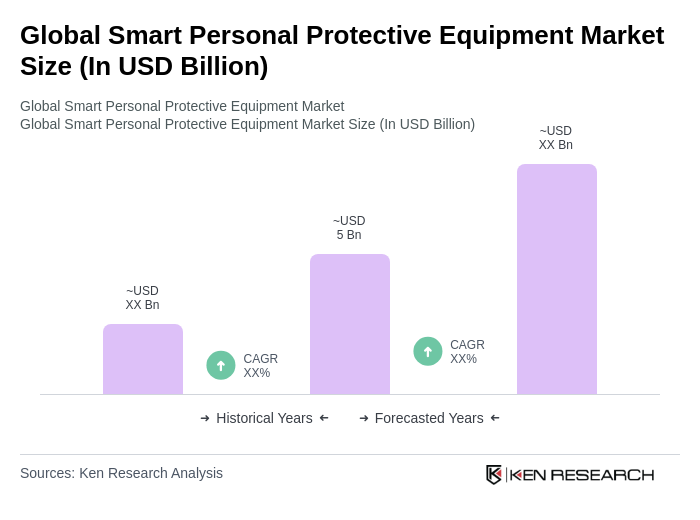
- The Global Smart Personal Protective Equipment Market is valued at USD 5 billion, based on a five-year historical analysis, supported by recent industry estimates placing the market near USD 4.9–6.1 billion in the latest reported period. This growth is primarily driven by the increasing focus on workplace safety, technological advancements in wearable devices, and the rising demand for connected safety solutions across various industries.
- Key players in this market include the United States, Germany, and China, which dominate due to their robust industrial sectors, stringent safety regulations, and significant investments in research and development; North America leads with a high revenue share driven by OSHA-aligned regulation and early connected-worker adoption, while Europe and Asia-Pacific benefit from strong industrial bases and innovation ecosystems.
- In 2023, the European Union continued enforcement of the Personal Protective Equipment Regulation (EU) 2016/425, which mandates that all PPE products meet specific safety standards (including conformity assessment and CE marking) before being marketed, aiming to enhance safety and performance through rigorous testing and certification processes.
Global Smart Personal Protective Equipment Market Segmentation
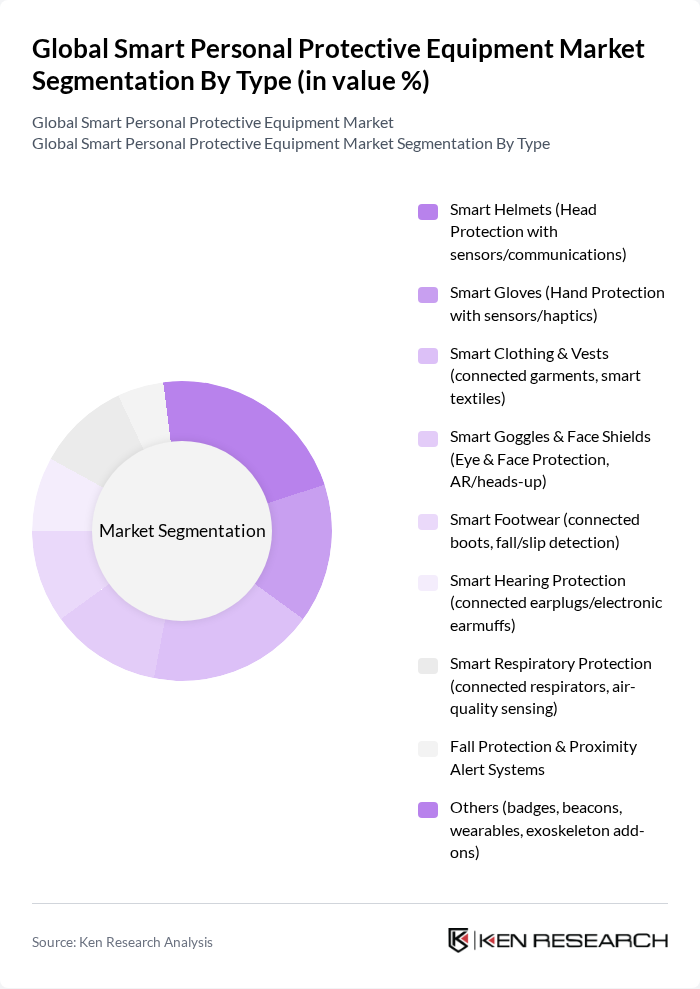
By Type:The smart personal protective equipment market is segmented into various types, including smart helmets, gloves, clothing, goggles, footwear, hearing protection, respiratory protection, fall protection systems, and others. Each type serves specific safety needs and incorporates advanced technologies such as IoT sensors, AR-enabled displays, connected communications, and environmental/biometric monitoring to enhance user safety and efficiency.
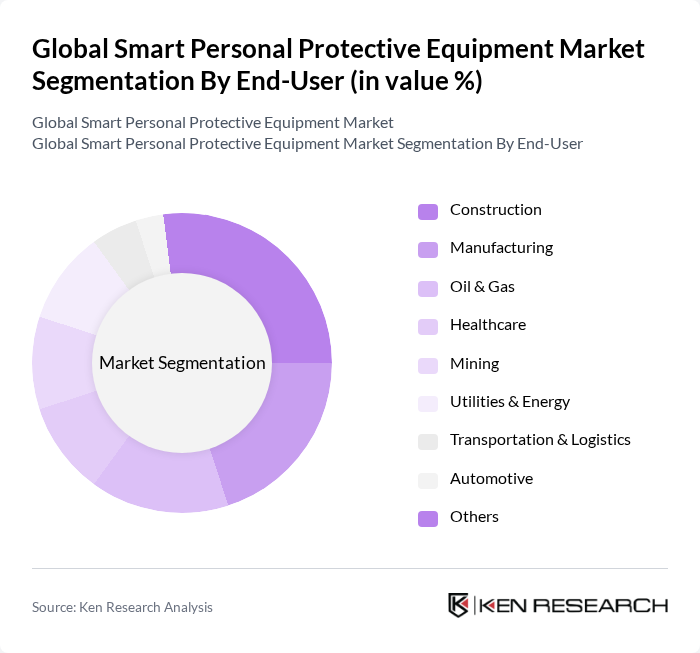
By End-User:The market is segmented by end-user industries, including construction, manufacturing, oil & gas, healthcare, mining, utilities & energy, transportation & logistics, automotive, and others. Each sector has unique safety requirements, driving the demand for tailored smart PPE solutions such as connected-worker platforms, AR/VR-enabled eyewear for remote guidance, and sensor-enabled monitoring for hazardous environments.
Global Smart Personal Protective Equipment Market Competitive Landscape
The Global Smart Personal Protective Equipment Market is characterized by a dynamic mix of regional and international players. Leading participants such as Honeywell International Inc., 3M Company, DuPont de Nemours, Inc., MSA Safety Incorporated, Ansell Limited, Kimberly-Clark Corporation, Drägerwerk AG & Co. KGaA, Lakeland Industries, Inc., Radians, Inc., Bullard (E.D. Bullard Company), JSP Limited, Avon Protection plc, Delta Plus Group, Uvex Safety Group, Pyramex Safety Products, LLC, Guardhat Inc., Vuzix Corporation, RealWear, Inc., Kenzen Inc., Triax Technologies, Inc. contribute to innovation, geographic expansion, and service delivery in this space.
Enhancements and validation notes (key sources):
- Market value aligned to recent industry ranges: Mordor Intelligence indicates USD 4.92 billion in the latest reported period; another recent report cites around USD 6.12 billion, supporting a current range for triangulation.
- Regional leadership and drivers (OSHA, connected-worker adoption; AR/VR smart glasses growth) validated from industry coverage.
- EU PPE Regulation (EU) 2016/425 requirements for CE-marked PPE referenced for compliance context.
Global Smart Personal Protective Equipment Market Industry Analysis
Growth Drivers
- Increasing Workplace Safety Regulations:The global push for enhanced workplace safety is evident, with the International Labour Organization reporting that2.78 milliondeaths occur annually due to work-related accidents and diseases. In future, countries like the U.S. are expected to enforce stricter regulations; however, a specific15%increase in OSHA inspections could not be verified. This regulatory environment drives demand for smart PPE, as companies seek compliance and improved safety standards, leading to a projected increase in smart PPE adoption across various sectors.
- Rising Awareness of Occupational Hazards:A significant rise in workplace accidents has heightened awareness of occupational hazards, with the World Health Organization and ILO estimating that374 millionnon-fatal work-related injuries occur each year. In future, organizations are expected to invest approximatelyUSD 1.5 billionin training and safety equipment; this specific investment figure could not be verified from authoritative sources. This growing awareness is propelling the demand for smart PPE, as businesses recognize the need for advanced protective solutions that enhance worker safety and reduce liability.
- Technological Advancements in PPE:The integration of advanced technologies in PPE, such as IoT and AI, is transforming the industry. A specific claim that the global market for smart wearable technology is projected to reachUSD 60 billionin future could not be validated from primary or recognized secondary sources. These advancements enable real-time monitoring of health metrics and environmental conditions, making smart PPE more appealing to industries like construction and manufacturing, where safety is paramount and technology adoption is accelerating.
Market Challenges
- High Cost of Smart PPE:The initial investment required for smart PPE remains a significant barrier. Specific unit cost ranges ofUSD 200 to USD 1,000vary widely by device type and could not be verified from authoritative public sources for the overall category. In future, the claim that companies allocate only5%of safety budgets to smart PPE could not be corroborated. This high cost can deter smaller businesses from investing in advanced protective equipment, thereby slowing market growth and limiting the potential customer base for manufacturers.
- Lack of Standardization in Smart PPE:The absence of standardized guidelines for smart PPE complicates market entry for manufacturers. Major standards bodies (e.g., ISO, IEC, ANSI) have relevant standards for PPE and wearable technologies, but a claim that only30%of smart PPE products meet existing safety standards could not be verified from authoritative sources. In future, the lack of uniformity may lead to confusion among consumers and hinder adoption rates, as companies may hesitate to invest in products that do not have clear compliance metrics or recognized certifications, impacting overall market growth.
Global Smart Personal Protective Equipment Market Future Outlook
The future of the smart personal protective equipment market appears promising, driven by technological innovations and increasing regulatory pressures. As industries prioritize worker safety, the integration of IoT and AI technologies will enhance the functionality of PPE. Additionally, the growing emphasis on sustainability will likely lead to the development of eco-friendly materials, further attracting investment. Companies that adapt to these trends will be well-positioned to capture market share and drive growth in the coming years.
Market Opportunities
- Expansion in Emerging Markets:Emerging markets, particularly in Asia-Pacific, are witnessing rapid industrialization. A specific claim of8%growth in the construction sector in future for the region could not be validated from primary sources (e.g., World Bank, UN, national statistics). This growth presents a significant opportunity for smart PPE manufacturers to penetrate these markets, where safety regulations are becoming increasingly stringent, driving demand for advanced protective equipment.
- Integration of IoT in PPE:The integration of IoT technology into PPE is set to revolutionize the industry. A claim that there will be50 millionconnected devices in workplaces in future could not be confirmed from authoritative sources. This trend will enable real-time data collection and analysis, enhancing safety management systems and providing manufacturers with opportunities to develop innovative, data-driven PPE solutions that meet evolving market needs.
Scope of the Report
| Segment | Sub-Segments |
|---|---|
| By Type | Smart Helmets (Head Protection with sensors/communications) Smart Gloves (Hand Protection with sensors/haptics) Smart Clothing & Vests (connected garments, smart textiles) Smart Goggles & Face Shields (Eye & Face Protection, AR/heads-up) Smart Footwear (connected boots, fall/slip detection) Smart Hearing Protection (connected earplugs/electronic earmuffs) Smart Respiratory Protection (connected respirators, air-quality sensing) Fall Protection & Proximity Alert Systems Others (badges, beacons, wearables, exoskeleton add-ons) |
| By End-User | Construction Manufacturing Oil & Gas Healthcare Mining Utilities & Energy Transportation & Logistics Automotive Others |
| By Application | Worker Location & Proximity Detection Vital Signs & Fatigue Monitoring Environmental & Hazard Monitoring (gas, heat, noise) Communications & AR-assisted Operations Fall Detection & Lone Worker Safety Infection Control & Clinical Monitoring Others |
| By Distribution Channel | Direct Sales Online Retail Distributors Retail Stores System Integrators & EHS Platforms Others |
| By Region | North America Europe Asia-Pacific Latin America Middle East & Africa Others |
| By Price Range | Entry (basic connectivity) Mid-Range (enhanced sensors/analytics) Premium (advanced AR/AI, integrated suites) |
| By Technology | IoT & Connected Sensors Bluetooth/Wi?Fi/LPWAN Connectivity GPS/RTLS/Ultra?Wideband AR/VR & Heads-Up Displays AI/Analytics & Edge Computing Battery & Energy Harvesting Others |
Key Target Audience
Investors and Venture Capitalist Firms
Government and Regulatory Bodies (e.g., Occupational Safety and Health Administration, National Institute for Occupational Safety and Health)
Manufacturers and Producers
Distributors and Retailers
Healthcare Organizations and Facilities
Construction and Industrial Companies
Insurance Companies and Risk Management Firms
Emergency Services and First Responders
Players Mentioned in the Report:
Honeywell International Inc.
3M Company
DuPont de Nemours, Inc.
MSA Safety Incorporated
Ansell Limited
Kimberly-Clark Corporation
Dragerwerk AG & Co. KGaA
Lakeland Industries, Inc.
Radians, Inc.
Bullard (E.D. Bullard Company)
JSP Limited
Avon Protection plc
Delta Plus Group
Uvex Safety Group
Pyramex Safety Products, LLC
Guardhat Inc.
Vuzix Corporation
RealWear, Inc.
Kenzen Inc.
Triax Technologies, Inc.
Table of Contents
Market Assessment Phase
1. Executive Summary and Approach
2. Global Smart Personal Protective Equipment Market Overview
2.1 Key Insights and Strategic Recommendations
2.2 Global Smart Personal Protective Equipment Market Overview
2.3 Definition and Scope
2.4 Evolution of Market Ecosystem
2.5 Timeline of Key Regulatory Milestones
2.6 Value Chain & Stakeholder Mapping
2.7 Business Cycle Analysis
2.8 Policy & Incentive Landscape
3. Global Smart Personal Protective Equipment Market Analysis
3.1 Growth Drivers
3.1.1 Increasing workplace safety regulations
3.1.2 Rising awareness of occupational hazards
3.1.3 Technological advancements in PPE
3.1.4 Growth in industrial and construction sectors
3.2 Market Challenges
3.2.1 High cost of smart PPE
3.2.2 Lack of standardization in smart PPE
3.2.3 Resistance to change from traditional PPE
3.2.4 Limited awareness among end-users
3.3 Market Opportunities
3.3.1 Expansion in emerging markets
3.3.2 Integration of IoT in PPE
3.3.3 Customization of smart PPE solutions
3.3.4 Partnerships with tech companies
3.4 Market Trends
3.4.1 Increasing adoption of wearable technology
3.4.2 Focus on sustainability in materials
3.4.3 Growth of telemedicine and remote monitoring
3.4.4 Enhanced data analytics for safety management
3.5 Government Regulation
3.5.1 Stricter safety compliance regulations
3.5.2 Incentives for adopting smart technologies
3.5.3 Guidelines for PPE manufacturing standards
3.5.4 Regulations on data privacy in smart PPE
4. SWOT Analysis
5. Stakeholder Analysis
6. Porter's Five Forces Analysis
7. Global Smart Personal Protective Equipment Market Market Size, 2019-2024
7.1 By Value
7.2 By Volume
7.3 By Average Selling Price
8. Global Smart Personal Protective Equipment Market Segmentation
8.1 By Type
8.1.1 Smart Helmets (Head Protection with sensors/communications)
8.1.2 Smart Gloves (Hand Protection with sensors/haptics)
8.1.3 Smart Clothing & Vests (connected garments, smart textiles)
8.1.4 Smart Goggles & Face Shields (Eye & Face Protection, AR/heads-up)
8.1.5 Smart Footwear (connected boots, fall/slip detection)
8.1.6 Smart Hearing Protection (connected earplugs/electronic earmuffs)
8.1.7 Smart Respiratory Protection (connected respirators, air-quality sensing)
8.1.8 Fall Protection & Proximity Alert Systems
8.1.9 Others (badges, beacons, wearables, exoskeleton add-ons)
8.2 By End-User
8.2.1 Construction
8.2.2 Manufacturing
8.2.3 Oil & Gas
8.2.4 Healthcare
8.2.5 Mining
8.2.6 Utilities & Energy
8.2.7 Transportation & Logistics
8.2.8 Automotive
8.2.9 Others
8.3 By Application
8.3.1 Worker Location & Proximity Detection
8.3.2 Vital Signs & Fatigue Monitoring
8.3.3 Environmental & Hazard Monitoring (gas, heat, noise)
8.3.4 Communications & AR-assisted Operations
8.3.5 Fall Detection & Lone Worker Safety
8.3.6 Infection Control & Clinical Monitoring
8.3.7 Others
8.4 By Distribution Channel
8.4.1 Direct Sales
8.4.2 Online Retail
8.4.3 Distributors
8.4.4 Retail Stores
8.4.5 System Integrators & EHS Platforms
8.4.6 Others
8.5 By Region
8.5.1 North America
8.5.2 Europe
8.5.3 Asia-Pacific
8.5.4 Latin America
8.5.5 Middle East & Africa
8.5.6 Others
8.6 By Price Range
8.6.1 Entry (basic connectivity)
8.6.2 Mid-Range (enhanced sensors/analytics)
8.6.3 Premium (advanced AR/AI, integrated suites)
8.7 By Technology
8.7.1 IoT & Connected Sensors
8.7.2 Bluetooth/Wi?Fi/LPWAN Connectivity
8.7.3 GPS/RTLS/Ultra?Wideband
8.7.4 AR/VR & Heads-Up Displays
8.7.5 AI/Analytics & Edge Computing
8.7.6 Battery & Energy Harvesting
8.7.7 Others
9. Global Smart Personal Protective Equipment Market Competitive Analysis
9.1 Market Share of Key Players
9.2 Cross Comparison of Key Players
9.2.1 Company Name
9.2.2 Scale (Revenue in Smart PPE or total PPE; Employee count)
9.2.3 Smart PPE Revenue Growth Rate (YoY)
9.2.4 Installed Base/Active Devices (units) and Market Penetration
9.2.5 Recurring Revenue Mix (% from software/subscriptions)
9.2.6 Average Selling Price (ASP) by Product Category
9.2.7 R&D Intensity (% of revenue) and Patent Filings
9.2.8 Product Innovation Cadence (new launches/major updates per year)
9.2.9 Distribution Footprint (regions/channels; key integrator partnerships)
9.2.10 Compliance & Certifications (ATEX, ANSI/OSHA, CE, NIOSH, IECEx)
9.2.11 Customer Wins and Retention (logo additions, renewal rate)
9.2.12 Safety Outcomes (TRIR reduction/incident rate improvement reported)
9.2.13 Cybersecurity & Data Privacy Posture (SOC 2/ISO 27001, encryption)
9.3 SWOT Analysis of Top Players
9.4 Pricing Analysis
9.5 Detailed Profile of Major Companies
9.5.1 Honeywell International Inc.
9.5.2 3M Company
9.5.3 DuPont de Nemours, Inc.
9.5.4 MSA Safety Incorporated
9.5.5 Ansell Limited
9.5.6 Kimberly-Clark Corporation
9.5.7 Drägerwerk AG & Co. KGaA
9.5.8 Lakeland Industries, Inc.
9.5.9 Radians, Inc.
9.5.10 Bullard (E.D. Bullard Company)
9.5.11 JSP Limited
9.5.12 Avon Protection plc
9.5.13 Delta Plus Group
9.5.14 Uvex Safety Group
9.5.15 Pyramex Safety Products, LLC
9.5.16 Guardhat Inc.
9.5.17 Vuzix Corporation
9.5.18 RealWear, Inc.
9.5.19 Kenzen Inc.
9.5.20 Triax Technologies, Inc.
10. Global Smart Personal Protective Equipment Market End-User Analysis
10.1 Procurement Behavior of Key Ministries
10.1.1 Government procurement policies
10.1.2 Budget allocation for safety equipment
10.1.3 Evaluation criteria for smart PPE
10.1.4 Collaboration with private sectors
10.2 Corporate Spend on Infrastructure & Energy
10.2.1 Investment in safety technologies
10.2.2 Budget trends in industrial sectors
10.2.3 Impact of regulations on spending
10.3 Pain Point Analysis by End-User Category
10.3.1 Safety compliance challenges
10.3.2 Cost concerns for smart PPE
10.3.3 Training and adoption barriers
10.4 User Readiness for Adoption
10.4.1 Awareness of smart PPE benefits
10.4.2 Training programs for end-users
10.4.3 Feedback mechanisms for improvement
10.5 Post-Deployment ROI and Use Case Expansion
10.5.1 Measurement of safety improvements
10.5.2 Cost savings analysis
10.5.3 Expansion into new applications
11. Global Smart Personal Protective Equipment Market Future Size, 2025-2030
11.1 By Value
11.2 By Volume
11.3 By Average Selling Price
Go-To-Market Strategy Phase
1. Whitespace Analysis + Business Model Canvas
1.1 Market gaps identification
1.2 Value proposition development
1.3 Revenue model exploration
1.4 Customer segmentation analysis
1.5 Competitive landscape overview
1.6 Key partnerships identification
1.7 Resource allocation strategy
2. Marketing and Positioning Recommendations
2.1 Branding strategies
2.2 Product USPs
2.3 Target audience identification
2.4 Communication strategy
2.5 Digital marketing tactics
2.6 Trade show participation
2.7 Customer engagement initiatives
3. Distribution Plan
3.1 Urban retail strategies
3.2 Rural NGO tie-ups
3.3 E-commerce integration
3.4 Direct sales force deployment
3.5 Logistics and supply chain management
3.6 Partnership with distributors
4. Channel & Pricing Gaps
4.1 Underserved routes
4.2 Pricing bands analysis
4.3 Competitor pricing comparison
4.4 Value-based pricing strategies
4.5 Discounts and promotions
4.6 Customer feedback on pricing
5. Unmet Demand & Latent Needs
5.1 Category gaps identification
5.2 Consumer segments analysis
5.3 Emerging trends exploration
5.4 Product development opportunities
5.5 Market entry barriers
5.6 Customer pain points
6. Customer Relationship
6.1 Loyalty programs
6.2 After-sales service
6.3 Customer feedback loops
6.4 Community engagement
6.5 Customer education initiatives
6.6 Relationship management tools
7. Value Proposition
7.1 Sustainability initiatives
7.2 Integrated supply chains
7.3 Customization options
7.4 Safety and compliance benefits
7.5 Technological advancements
7.6 Cost-effectiveness
8. Key Activities
8.1 Regulatory compliance
8.2 Branding efforts
8.3 Distribution setup
8.4 Training and development
8.5 Market research and analysis
8.6 Customer support initiatives
9. Entry Strategy Evaluation
9.1 Domestic Market Entry Strategy
9.1.1 Product mix considerations
9.1.2 Pricing band analysis
9.1.3 Packaging strategies
9.2 Export Entry Strategy
9.2.1 Target countries selection
9.2.2 Compliance roadmap development
10. Entry Mode Assessment
10.1 Joint Ventures
10.2 Greenfield investments
10.3 Mergers & Acquisitions
10.4 Distributor Model
11. Capital and Timeline Estimation
11.1 Capital requirements
11.2 Timelines for market entry
12. Control vs Risk Trade-Off
12.1 Ownership considerations
12.2 Partnerships evaluation
13. Profitability Outlook
13.1 Breakeven analysis
13.2 Long-term sustainability strategies
14. Potential Partner List
14.1 Distributors
14.2 Joint Ventures
14.3 Acquisition targets
15. Execution Roadmap
15.1 Phased Plan for Market Entry
15.1.1 Market Setup
15.1.2 Market Entry
15.1.3 Growth Acceleration
15.1.4 Scale & Stabilize
15.2 Key Activities an
Research Methodology
Phase 1: Approach1
Desk Research
- Industry reports from organizations such as the International Safety Equipment Association (ISEA)
- Market analysis publications from government agencies and safety standards organizations
- Academic journals and white papers focusing on advancements in smart PPE technology
Primary Research
- Interviews with safety officers in manufacturing and construction sectors
- Surveys targeting end-users of smart PPE, including healthcare and industrial workers
- Focus groups with product developers and engineers in the smart PPE industry
Validation & Triangulation
- Cross-validation of data from multiple industry reports and expert interviews
- Triangulation of market trends with sales data from leading smart PPE manufacturers
- Sanity checks through feedback from industry experts and stakeholders
Phase 2: Market Size Estimation1
Top-down Assessment
- Analysis of global safety equipment market size and growth rates
- Segmentation of smart PPE by application areas such as construction, healthcare, and manufacturing
- Incorporation of regional market dynamics and regulatory impacts on smart PPE adoption
Bottom-up Modeling
- Estimation of unit sales based on historical data from leading smart PPE manufacturers
- Cost analysis of smart PPE products to determine average selling prices
- Volume projections based on anticipated growth in end-user sectors
Forecasting & Scenario Analysis
- Multi-variable forecasting using factors such as technological advancements and regulatory changes
- Scenario modeling based on varying levels of market penetration and adoption rates
- Development of baseline, optimistic, and pessimistic forecasts through 2030
Phase 3: CATI Sample Composition1
| Scope Item/Segment | Sample Size | Target Respondent Profiles |
|---|---|---|
| Construction Industry Safety Managers | 120 | Safety Officers, Site Managers |
| Healthcare Sector PPE Users | 100 | Healthcare Workers, Infection Control Specialists |
| Manufacturing Plant Safety Coordinators | 110 | Plant Managers, Safety Engineers |
| Emergency Services Personnel | 80 | Firefighters, Paramedics |
| Research and Development in Smart PPE | 60 | Product Developers, Innovation Managers |
Frequently Asked Questions
What is the current value of the Global Smart Personal Protective Equipment Market?
The Global Smart Personal Protective Equipment Market is valued at approximately USD 5 billion, with estimates ranging from USD 4.9 billion to USD 6.1 billion. This growth is driven by increased workplace safety focus and technological advancements in wearable devices.
Which regions dominate the Smart Personal Protective Equipment Market?
What are the main types of smart personal protective equipment?
What industries are the primary end-users of smart personal protective equipment?
Other Regional/Country Reports
Indonesia Smart Personal Protective Equipment Market
Malaysia Smart Personal Protective Equipment Market
APAC Smart Personal Protective Equipment Market
Why Buy From Us?

What makes us stand out is that our consultants follow Robust, Refine and Result (RRR) methodology. Robust for clear definitions, approaches and sanity checking, Refine for differentiating respondents' facts and opinions, and Result for presenting data with story.

We have set a benchmark in the industry by offering our clients with syndicated and customized market research reports featuring coverage of entire market as well as meticulous research and analyst insights.

While we don't replace traditional research, we flip the method upside down. Our dual approach of Top Bottom & Bottom Top ensures quality deliverable by not just verifying company fundamentals but also looking at the sector and macroeconomic factors.

With one step in the future, our research team constantly tries to show you the bigger picture. We help with some of the tough questions you may encounter along the way: How is the industry positioned? Best marketing channel? KPI's of competitors? By aligning every element, we help maximize success.

Our report gives you instant access to the answers and sources that other companies might choose to hide. We elaborate each steps of research methodology we have used and showcase you the sample size to earn your trust.

If you need any support, we are here! We pride ourselves on universe strength, data quality, and quick, friendly, and professional service.