About the Report
Base Year 2024Global Smartphones Market Overview
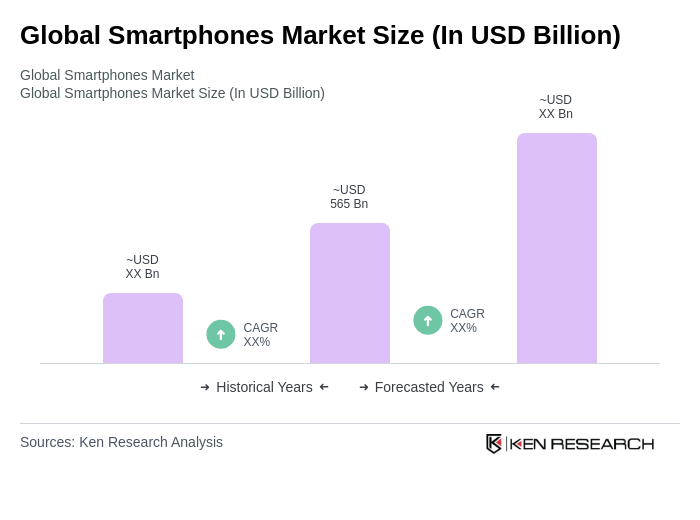
- The Global Smartphones Market is valued at USD 565 billion, based on a five-year historical analysis. This value aligns with industry tracking that places global smartphone revenues in the mid-hundreds of billions, with recent quarters surpassing USD 100 billion in revenue and average selling prices approaching USD 350, underscoring premiumization and sustained demand . This growth is primarily driven by the increasing demand for advanced mobile technology, the proliferation of internet connectivity, and the rising adoption of smartphones across various demographics. The market has seen a significant shift towards 5G-enabled devices, enhancing user experience and driving sales .
- Key players in this market include the United States, China, and India, which dominate due to their large consumer bases, rapid technological advancements, and strong manufacturing capabilities. The U.S. is known for its innovation and premium brands, while China leads in production and affordability, and India is witnessing a surge in smartphone adoption among its growing middle class .
- In 2023, the European Union implemented regulations mandating that all smartphones sold within its member states must be compatible with a common charging standard by 2024. This regulation aims to reduce electronic waste and improve consumer convenience, reflecting a growing trend towards sustainability in the technology sector .
Global Smartphones Market Segmentation
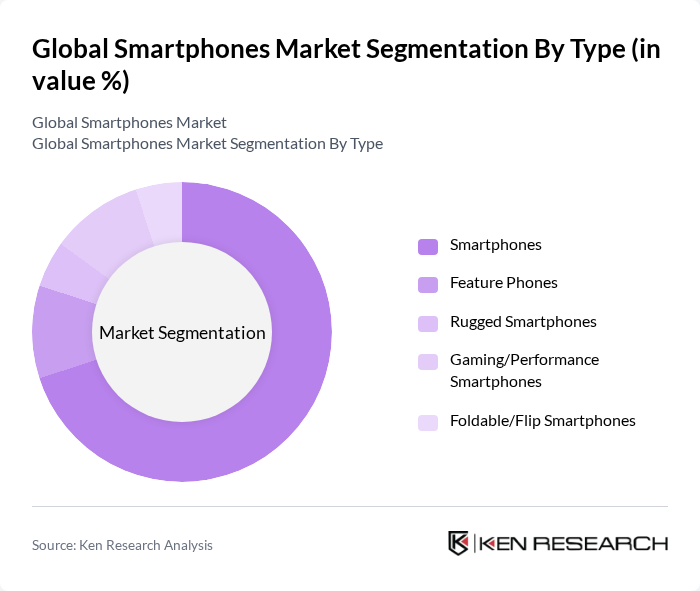
By Type:The market is segmented into various types, including smartphones, feature phones, rugged smartphones, gaming/performance smartphones, and foldable/flip smartphones. Among these, smartphones dominate the market due to their multifunctionality, integration of advanced technologies, and widespread consumer preference for devices that offer internet connectivity, social media access, and various applications. The trend towards high-performance and gaming smartphones is also gaining traction, driven by the increasing popularity of mobile gaming. Additionally, foldables are expanding from a niche into a fast-growing premium subsegment as OEMs broaden portfolios and carriers expand financing and trade-in programs, supporting ASP growth .
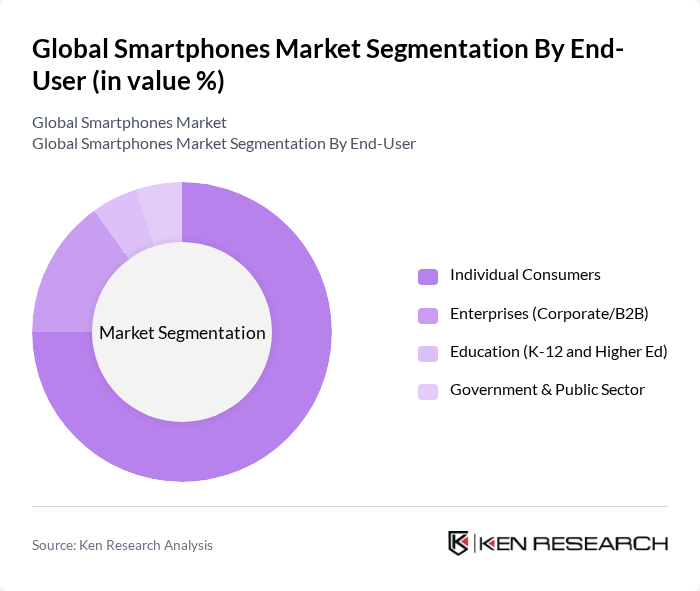
By End-User:The end-user segmentation includes individual consumers, enterprises (Corporate/B2B), education (K-12 and higher education), and government & public sector. Individual consumers represent the largest segment, driven by the increasing reliance on smartphones for daily activities, communication, and entertainment. The rise of remote work and online education has also boosted demand from enterprises and educational institutions, highlighting the versatility of smartphones in various sectors. Enterprise demand is also supported by device financing programs, trade-in initiatives, and security/management features embedded in modern OS and silicon, which have become priorities in corporate deployments .
Global Smartphones Market Competitive Landscape
The Global Smartphones Market is characterized by a dynamic mix of regional and international players. Leading participants such as Apple Inc., Samsung Electronics Co., Ltd., Xiaomi Corporation, vivo Mobile Communication Co., Ltd., OPPO Mobile Telecommunications Corp., Ltd., OnePlus Technology (Shenzhen) Co., Ltd., Transsion Holdings (TECNO, Infinix, itel), Motorola Mobility LLC (a Lenovo Company), Lenovo Group Limited, Huawei Technologies Co., Ltd., HONOR Device Co., Ltd., HMD Global Oy (Nokia-branded phones), Sony Corporation (Xperia), TCL Technology (TCL Communication/Alcatel), ZTE Corporation, ASUS (ASUSTeK Computer Inc.), Google LLC (Pixel), Nothing Technology Limited, Realme Mobile Telecommunications (India) Pvt. Ltd., Panasonic Holdings Corporation (Toughbook/Toughbook Smart Device lines) contribute to innovation, geographic expansion, and service delivery in this space .
Global Smartphones Market Industry Analysis
Growth Drivers
- Increasing Smartphone Penetration in Emerging Markets:The smartphone penetration rate in emerging markets is projected to reach 70% in the future, up from 55% in the past. Countries like India and Brazil are leading this growth, with smartphone users expected to increase by 200 million in India alone. This surge is driven by affordable devices and improved internet access, with mobile subscriptions in low-income regions expected to grow by 15% annually, according to the International Telecommunication Union (ITU).
- Advancements in Mobile Technology and Features:The global investment in mobile technology is anticipated to exceed one trillion dollars in the future, fostering innovations such as AI integration and enhanced camera capabilities. Notably, 5G technology is set to cover 40% of the global population, enabling faster data speeds and improved user experiences. This technological evolution is expected to drive smartphone upgrades, with consumers increasingly seeking devices that support advanced functionalities, as reported by the GSMA.
- Rising Demand for Mobile Applications and Services:The mobile application market is projected to generate over 407 billion dollars in revenue in the future, reflecting a significant increase from 300 billion dollars in the past. This growth is fueled by the increasing reliance on mobile apps for daily activities, including banking, shopping, and entertainment. The number of mobile app downloads is expected to surpass 250 billion globally, indicating a robust demand for smartphones that can support diverse applications, according to App Annie.
Market Challenges
- Intense Competition Among Manufacturers:The smartphone market is characterized by fierce competition, with over 1,500 brands vying for market share. Major players like Apple, Samsung, and Xiaomi dominate, but numerous low-cost manufacturers are emerging, driving prices down. This competitive landscape has led to a 10% decline in average selling prices (ASPs) over the past two years, impacting profit margins and forcing companies to innovate rapidly to maintain market relevance.
- Supply Chain Disruptions:The smartphone industry faces significant supply chain challenges, exacerbated by geopolitical tensions and the COVID-19 pandemic. In the recent past, semiconductor shortages led to a production decline of approximately 15%, affecting major manufacturers. Additionally, logistics costs have surged by 30% due to increased shipping rates and port congestion, complicating inventory management and leading to longer lead times for product launches, as reported by the Semiconductor Industry Association (SIA).
Global Smartphones Market Future Outlook
The future of the smartphone market appears promising, driven by technological advancements and evolving consumer preferences. As 5G technology becomes more widespread, it will enhance mobile connectivity and enable new applications, particularly in gaming and augmented reality. Additionally, the trend towards sustainable products is likely to shape manufacturing practices, with companies increasingly focusing on eco-friendly materials and recycling initiatives. This shift will not only meet consumer demand but also align with global sustainability goals.
Market Opportunities
- Expansion into Untapped Markets:Emerging markets present significant growth opportunities, with smartphone adoption rates expected to rise sharply. For instance, Africa's smartphone penetration is projected to reach 50% in the future, creating a potential user base of over 600 million. Companies that strategically enter these markets can capitalize on the growing demand for affordable smartphones and mobile services, enhancing their market presence.
- Development of 5G Technology:The rollout of 5G networks is anticipated to create new revenue streams, with an estimated two point seven trillion dollars economic impact in the future. This technology will enable enhanced mobile experiences, driving demand for compatible devices. Manufacturers that invest in 5G-capable smartphones can attract tech-savvy consumers and businesses, positioning themselves as leaders in the next generation of mobile technology.
Scope of the Report
| Segment | Sub-Segments |
|---|---|
| By Type | Smartphones Feature Phones Rugged Smartphones Gaming/Performance Smartphones Foldable/Flip Smartphones |
| By End-User | Individual Consumers Enterprises (Corporate/B2B) Education (K-12 and Higher Ed) Government & Public Sector |
| By Distribution Channel | Online (Direct-to-Consumer and E-commerce Marketplaces) Offline Retail (Brand Stores, Multi-brand Retailers) Carrier/Telco Channels Enterprise/Value-Added Resellers |
| By Price Range | Entry/Budget (<$200) Mid-Range ($200–$599) Premium ($600–$999) Ultra-Premium (?$1,000) |
| By Operating System | Android iOS HarmonyOS Others |
| By Brand | Apple (iPhone) Samsung (Galaxy) Xiaomi (Redmi, POCO) Transsion (TECNO, Infinix, itel) vivo OPPO (including OnePlus) |
| By Connectivity | G LTE G (Sub-6, mmWave) Wi?Fi Only/Cellular-disabled Devices Satellite-enabled/NTN-capable |
Key Target Audience
Investors and Venture Capitalist Firms
Government and Regulatory Bodies (e.g., Federal Communications Commission, European Commission)
Manufacturers and Producers
Distributors and Retailers
Telecommunications Service Providers
Mobile Application Developers
Industry Associations (e.g., GSMA, Consumer Technology Association)
Financial Institutions
Players Mentioned in the Report:
Apple Inc.
Samsung Electronics Co., Ltd.
Xiaomi Corporation
vivo Mobile Communication Co., Ltd.
OPPO Mobile Telecommunications Corp., Ltd.
OnePlus Technology (Shenzhen) Co., Ltd.
Transsion Holdings (TECNO, Infinix, itel)
Motorola Mobility LLC (a Lenovo Company)
Lenovo Group Limited
Huawei Technologies Co., Ltd.
HONOR Device Co., Ltd.
HMD Global Oy (Nokia-branded phones)
Sony Corporation (Xperia)
TCL Technology (TCL Communication/Alcatel)
ZTE Corporation
ASUS (ASUSTeK Computer Inc.)
Google LLC (Pixel)
Nothing Technology Limited
Realme Mobile Telecommunications (India) Pvt. Ltd.
Panasonic Holdings Corporation (Toughbook/Toughbook Smart Device lines)
Table of Contents
Market Assessment Phase
1. Executive Summary and Approach
2. Global Smartphones Market Overview
2.1 Key Insights and Strategic Recommendations
2.2 Global Smartphones Market Overview
2.3 Definition and Scope
2.4 Evolution of Market Ecosystem
2.5 Timeline of Key Regulatory Milestones
2.6 Value Chain & Stakeholder Mapping
2.7 Business Cycle Analysis
2.8 Policy & Incentive Landscape
3. Global Smartphones Market Analysis
3.1 Growth Drivers
3.1.1 Increasing smartphone penetration in emerging markets
3.1.2 Advancements in mobile technology and features
3.1.3 Rising demand for mobile applications and services
3.1.4 Growth of e-commerce and online shopping
3.2 Market Challenges
3.2.1 Intense competition among manufacturers
3.2.2 Rapid technological changes
3.2.3 Supply chain disruptions
3.2.4 Regulatory compliance and standards
3.3 Market Opportunities
3.3.1 Expansion into untapped markets
3.3.2 Development of 5G technology
3.3.3 Increasing demand for sustainable products
3.3.4 Growth in mobile gaming and entertainment
3.4 Market Trends
3.4.1 Shift towards foldable and flexible displays
3.4.2 Integration of AI and machine learning in smartphones
3.4.3 Rise of budget smartphones with premium features
3.4.4 Increased focus on cybersecurity and data privacy
3.5 Government Regulation
3.5.1 Data protection and privacy laws
3.5.2 Environmental regulations on electronic waste
3.5.3 Import tariffs and trade policies
3.5.4 Standards for wireless communication technologies
4. SWOT Analysis
5. Stakeholder Analysis
6. Porter's Five Forces Analysis
7. Global Smartphones Market Market Size, 2019-2024
7.1 By Value
7.2 By Volume
7.3 By Average Selling Price
8. Global Smartphones Market Segmentation
8.1 By Type
8.1.1 Smartphones
8.1.2 Feature Phones
8.1.3 Rugged Smartphones
8.1.4 Gaming/Performance Smartphones
8.1.5 Foldable/Flip Smartphones
8.2 By End-User
8.2.1 Individual Consumers
8.2.2 Enterprises (Corporate/B2B)
8.2.3 Education (K-12 and Higher Ed)
8.2.4 Government & Public Sector
8.3 By Distribution Channel
8.3.1 Online (Direct-to-Consumer and E-commerce Marketplaces)
8.3.2 Offline Retail (Brand Stores, Multi-brand Retailers)
8.3.3 Carrier/Telco Channels
8.3.4 Enterprise/Value-Added Resellers
8.4 By Price Range
8.4.1 Entry/Budget (<$200)
8.4.2 Mid-Range ($200–$599)
8.4.3 Premium ($600–$999)
8.4.4 Ultra-Premium (?$1,000)
8.5 By Operating System
8.5.1 Android
8.5.2 iOS
8.5.3 HarmonyOS
8.5.4 Others
8.6 By Brand
8.6.1 Apple (iPhone)
8.6.2 Samsung (Galaxy)
8.6.3 Xiaomi (Redmi, POCO)
8.6.4 Transsion (TECNO, Infinix, itel)
8.6.5 vivo
8.6.6 OPPO (including OnePlus)
8.7 By Connectivity
8.7.1 4G LTE
8.7.2 5G (Sub-6, mmWave)
8.7.3 Wi?Fi Only/Cellular-disabled Devices
8.7.4 Satellite-enabled/NTN-capable
9. Global Smartphones Market Competitive Analysis
9.1 Market Share of Key Players
9.2 Cross Comparison of Key Players
9.2.1 Company Name
9.2.2 Global Shipment Volume (Units, latest FY/TTM)
9.2.3 Revenue from Smartphones (USD, latest FY/TTM)
9.2.4 YoY Shipment Growth (%)
9.2.5 Global Market Share (%)
9.2.6 Average Selling Price (ASP, USD)
9.2.7 Gross Margin (Smartphone segment, %)
9.2.8 R&D Intensity (% of Revenue)
9.2.9 5G Mix (% of Shipments)
9.2.10 Geographic Mix (Top 3 Regions by Share)
9.2.11 Channel Mix (Carrier vs. Open Market, %)
9.2.12 Product Portfolio Breadth (Entry/Mid/Premium/Ultra-Premium coverage)
9.2.13 Replacement vs. New-to-Smartphone Demand Mix (est. %)
9.2.14 Inventory Turns/Days of Inventory
9.2.15 Brand Equity/Net Promoter Score (where disclosed)
9.3 SWOT Analysis of Top Players
9.4 Pricing Analysis
9.5 Detailed Profile of Major Companies
9.5.1 Apple Inc.
9.5.2 Samsung Electronics Co., Ltd.
9.5.3 Xiaomi Corporation
9.5.4 vivo Mobile Communication Co., Ltd.
9.5.5 OPPO Mobile Telecommunications Corp., Ltd.
9.5.6 OnePlus Technology (Shenzhen) Co., Ltd.
9.5.7 Transsion Holdings (TECNO, Infinix, itel)
9.5.8 Motorola Mobility LLC (a Lenovo Company)
9.5.9 Lenovo Group Limited
9.5.10 Huawei Technologies Co., Ltd.
9.5.11 HONOR Device Co., Ltd.
9.5.12 HMD Global Oy (Nokia-branded phones)
9.5.13 Sony Corporation (Xperia)
9.5.14 TCL Technology (TCL Communication/Alcatel)
9.5.15 ZTE Corporation
9.5.16 ASUS (ASUSTeK Computer Inc.)
9.5.17 Google LLC (Pixel)
9.5.18 Nothing Technology Limited
9.5.19 Realme Mobile Telecommunications (India) Pvt. Ltd.
9.5.20 Panasonic Holdings Corporation (Toughbook/Toughbook Smart Device lines)
10. Global Smartphones Market End-User Analysis
10.1 Procurement Behavior of Key Ministries
10.1.1 Government procurement policies
10.1.2 Budget allocation for technology
10.1.3 Evaluation criteria for smartphone purchases
10.2 Corporate Spend on Infrastructure & Energy
10.2.1 Investment in mobile technology
10.2.2 Budget for employee devices
10.2.3 Spending on mobile applications
10.3 Pain Point Analysis by End-User Category
10.3.1 Device compatibility issues
10.3.2 Security concerns
10.3.3 Performance limitations
10.4 User Readiness for Adoption
10.4.1 Awareness of new technologies
10.4.2 Training and support needs
10.4.3 Adoption barriers
10.5 Post-Deployment ROI and Use Case Expansion
10.5.1 Measurement of productivity gains
10.5.2 User satisfaction metrics
10.5.3 Opportunities for further integration
11. Global Smartphones Market Future Size, 2025-2030
11.1 By Value
11.2 By Volume
11.3 By Average Selling Price
Go-To-Market Strategy Phase
1. Whitespace Analysis + Business Model Canvas
1.1 Market gaps identification
1.2 Value proposition development
1.3 Revenue model exploration
1.4 Customer segments analysis
1.5 Key partnerships identification
1.6 Cost structure assessment
1.7 Channels for delivery
2. Marketing and Positioning Recommendations
2.1 Branding strategies
2.2 Product USPs
2.3 Target audience segmentation
2.4 Communication strategies
2.5 Digital marketing tactics
3. Distribution Plan
3.1 Urban retail strategies
3.2 Rural NGO tie-ups
3.3 E-commerce partnerships
3.4 Direct-to-consumer models
4. Channel & Pricing Gaps
4.1 Underserved routes
4.2 Pricing bands analysis
4.3 Competitor pricing strategies
5. Unmet Demand & Latent Needs
5.1 Category gaps identification
5.2 Consumer segments analysis
5.3 Emerging trends exploration
6. Customer Relationship
6.1 Loyalty programs
6.2 After-sales service enhancements
6.3 Customer feedback mechanisms
7. Value Proposition
7.1 Sustainability initiatives
7.2 Integrated supply chains
7.3 Unique selling points
8. Key Activities
8.1 Regulatory compliance
8.2 Branding efforts
8.3 Distribution setup
9. Entry Strategy Evaluation
9.1 Domestic Market Entry Strategy
9.1.1 Product mix considerations
9.1.2 Pricing band strategies
9.1.3 Packaging options
9.2 Export Entry Strategy
9.2.1 Target countries analysis
9.2.2 Compliance roadmap development
10. Entry Mode Assessment
10.1 Joint Ventures
10.2 Greenfield investments
10.3 Mergers & Acquisitions
10.4 Distributor Model
11. Capital and Timeline Estimation
11.1 Capital requirements
11.2 Timelines for execution
12. Control vs Risk Trade-Off
12.1 Ownership considerations
12.2 Partnerships evaluation
13. Profitability Outlook
13.1 Breakeven analysis
13.2 Long-term sustainability strategies
14. Potential Partner List
14.1 Distributors
14.2 Joint Ventures
14.3 Acquisition targets
15. Execution Roadmap
15.1 Phased Plan for Market Entry
15.1.1 Market Setup
15.1.2 Market Entry
15.1.3 Growth Acceleration
15.1.4 Scale & Stabilize
15.2 Key Activities and Milestones
15.2.1 Milestone tracking
15.2.2 Activity scheduling
Research Methodology
Phase 1: Approach1
Desk Research
- Analysis of market reports from industry associations and research firms
- Review of financial statements and annual reports from leading smartphone manufacturers
- Examination of consumer behavior studies and market trends published by technology analysts
Primary Research
- Interviews with product managers and marketing executives at smartphone companies
- Surveys conducted with consumers to understand preferences and purchasing behavior
- Focus groups with tech enthusiasts to gather insights on emerging trends and features
Validation & Triangulation
- Cross-validation of data from multiple sources including sales data and consumer surveys
- Triangulation of findings from industry experts and market analysts
- Sanity checks through expert panel discussions to ensure data reliability
Phase 2: Market Size Estimation1
Top-down Assessment
- Estimation of total smartphone market size based on global sales figures
- Segmentation by region, operating system, and price range
- Incorporation of growth rates from historical data and market forecasts
Bottom-up Modeling
- Collection of sales volume data from major retailers and e-commerce platforms
- Estimation of average selling prices across different smartphone categories
- Calculation of market size based on unit sales and revenue generation
Forecasting & Scenario Analysis
- Utilization of time-series analysis to project future market trends
- Scenario modeling based on technological advancements and consumer adoption rates
- Development of best-case, worst-case, and most-likely market scenarios through 2030
Phase 3: CATI Sample Composition1
| Scope Item/Segment | Sample Size | Target Respondent Profiles |
|---|---|---|
| Consumer Smartphone Preferences | 150 | Smartphone Users, Tech Enthusiasts |
| Retail Sales Insights | 100 | Retail Managers, Sales Associates |
| Market Trends Analysis | 80 | Market Analysts, Industry Experts |
| Brand Loyalty Studies | 120 | Brand Managers, Marketing Executives |
| Emerging Technology Adoption | 90 | Product Developers, R&D Managers |
Frequently Asked Questions
What is the current value of the global smartphones market?
The global smartphones market is valued at approximately USD 565 billion, reflecting a significant growth trend driven by increasing demand for advanced mobile technology and the proliferation of internet connectivity across various demographics.
Which countries dominate the global smartphones market?
What are the key growth drivers in the global smartphones market?
What challenges does the global smartphones market face?
Other Regional/Country Reports
Malaysia Smartphones Market
APAC Smartphones Market
SEA Smartphones Market
Why Buy From Us?

What makes us stand out is that our consultants follow Robust, Refine and Result (RRR) methodology. Robust for clear definitions, approaches and sanity checking, Refine for differentiating respondents' facts and opinions, and Result for presenting data with story.

We have set a benchmark in the industry by offering our clients with syndicated and customized market research reports featuring coverage of entire market as well as meticulous research and analyst insights.

While we don't replace traditional research, we flip the method upside down. Our dual approach of Top Bottom & Bottom Top ensures quality deliverable by not just verifying company fundamentals but also looking at the sector and macroeconomic factors.

With one step in the future, our research team constantly tries to show you the bigger picture. We help with some of the tough questions you may encounter along the way: How is the industry positioned? Best marketing channel? KPI's of competitors? By aligning every element, we help maximize success.

Our report gives you instant access to the answers and sources that other companies might choose to hide. We elaborate each steps of research methodology we have used and showcase you the sample size to earn your trust.

If you need any support, we are here! We pride ourselves on universe strength, data quality, and quick, friendly, and professional service.