About the Report
Base Year 2024Global Smokeless Tobacco Market Overview
- The Global Smokeless Tobacco Market is valued at approximately USD 21–22 billion, based on a five-year analysis. This growth is primarily driven by increasing consumer preference for smokeless alternatives due to health concerns associated with traditional smoking. Additionally, the rising awareness of the harmful effects of tobacco smoke has led to a shift towards smokeless products, which are perceived as less harmful.
- Key players in this market include the United States, India, and Sweden. Asia Pacific holds the largest regional share, Sweden maintains high per-capita consumption and category maturity via snus, and the U.S. remains a major revenue pool with established moist snuff and nicotine pouch brands; India has significant usage of chewing and regional forms.
- In 2023, the U.S. Food and Drug Administration (FDA) implemented regulations requiring all smokeless tobacco products to carry health warnings on packaging. This regulation aims to inform consumers about the risks associated with smokeless tobacco use, thereby promoting informed choices and reducing consumption among vulnerable populations.
Global Smokeless Tobacco Market Segmentation
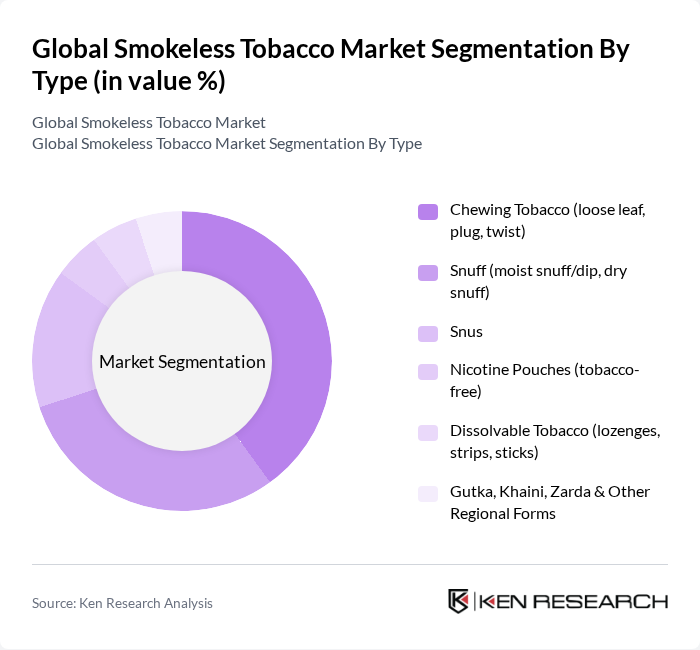
By Type:The smokeless tobacco market is segmented into various types, including Chewing Tobacco, Snuff, Snus, Nicotine Pouches, Dissolvable Tobacco, and regional forms like Gutka, Khaini, and Zarda. Among these, Chewing Tobacco and Snuff are the most popular due to their traditional use and cultural significance in many regions. Chewing Tobacco, particularly in loose leaf and plug forms, has a strong consumer base in countries like India and the U.S. Snuff, especially moist snuff, is gaining traction due to its convenience and discreet usage.
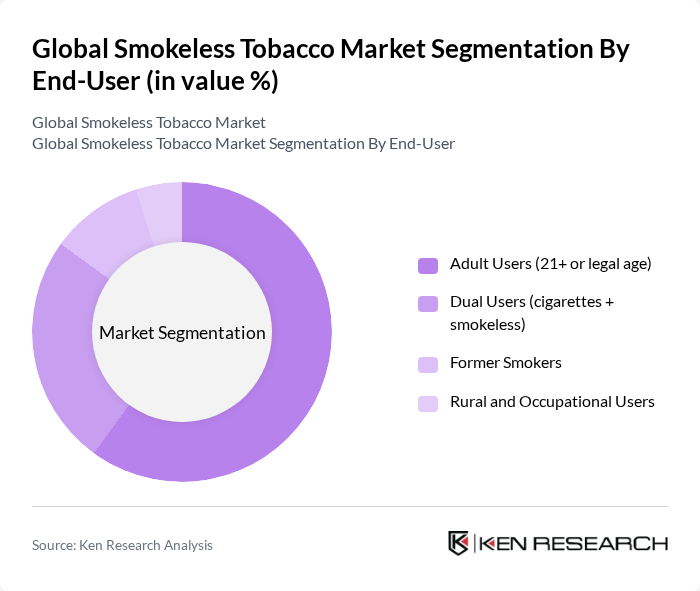
By End-User:The end-user segmentation includes Adult Users, Dual Users, Former Smokers, and Rural and Occupational Users. Adult Users represent the largest segment, driven by the cultural acceptance of smokeless tobacco in various regions. Dual Users, who consume both cigarettes and smokeless products, are also significant, as they often seek alternatives to reduce health risks. The Former Smokers segment is growing as individuals look for less harmful options to quit smoking.
Global Smokeless Tobacco Market Competitive Landscape
The Global Smokeless Tobacco Market is characterized by a dynamic mix of regional and international players. Leading participants such as Altria Group, Inc. (U.S.), British American Tobacco p.l.c. (UK), Philip Morris International Inc. (Switzerland), Imperial Brands PLC (UK), Japan Tobacco Inc. (Japan), Swedish Match AB (Sweden) — a Philip Morris International company, Reynolds American Inc. (U.S.) — a subsidiary of British American Tobacco, ITC Limited (India), Godfrey Phillips India Ltd. (India), DS Group (Dharampal Satyapal Ltd.) (India), Scandi Standard Snus/Swedish Match brands (General, ZYN) — see respective owners, Skruf Snus AB (Sweden) — a subsidiary of Imperial Brands, Scandinavian Tobacco Group A/S (Denmark), Swedish Match North America LLC (U.S.), National Tobacco Company, L.P. (U.S.), Turning Point Brands, Inc. (U.S.), Mac Baren Tobacco Company A/S (Denmark), Orkla ASA (Norway) — owner of Jordan snus (legacy/selected markets), GN Tobacco Sweden AB (Sweden), KT&G Corporation (South Korea) contribute to innovation, geographic expansion, and service delivery in this space.
Global Smokeless Tobacco Market Industry Analysis
Growth Drivers
- Increasing Health Awareness:The global shift towards health consciousness is driving the smokeless tobacco market. In future, approximately 60% of consumers in None are expected to prioritize health benefits when choosing tobacco products. This trend is supported by a 15% increase in health-related advertising expenditures, which reached $1.4 billion in future. As consumers become more informed about the risks of traditional smoking, the demand for smokeless alternatives is anticipated to rise significantly, fostering market growth.
- Shift Towards Reduced-Risk Products:The demand for reduced-risk tobacco products is surging, with sales of smokeless tobacco expected to reach 1.6 million tons in None by future. This shift is driven by a growing preference for products perceived as less harmful, supported by a 20% increase in product innovation investments, totaling $600 million in future. As consumers seek safer alternatives, manufacturers are responding with a wider range of smokeless options, further propelling market expansion.
- Expansion of Distribution Channels:The expansion of distribution channels is significantly enhancing market accessibility. In future, the number of retail outlets selling smokeless tobacco in None is projected to increase by 25%, reaching over 12,500 locations. This growth is supported by a 30% rise in e-commerce sales, which accounted for $400 million in future. Enhanced availability through diverse channels is expected to drive consumer adoption and increase overall market penetration.
Market Challenges
- Stringent Regulatory Frameworks:The smokeless tobacco market faces significant challenges due to stringent regulatory frameworks. In None, over 40% of local governments have implemented strict regulations on tobacco sales, including licensing requirements and product bans. These regulations have resulted in a 10% decline in market growth in future, as companies struggle to comply with varying laws. The evolving regulatory landscape poses ongoing challenges for market participants.
- Stigmatization of Tobacco Products:The stigmatization of tobacco products continues to hinder market growth. In None, surveys indicate that 55% of the population views smokeless tobacco negatively, impacting consumer willingness to purchase. This social stigma has led to a 15% decrease in sales in future, as public health campaigns increasingly target tobacco use. Overcoming this perception will be crucial for the market's recovery and future growth.
Global Smokeless Tobacco Market Future Outlook
The future of the smokeless tobacco market in None appears promising, driven by evolving consumer preferences and innovative product offerings. As health awareness continues to rise, the demand for reduced-risk products is expected to grow, with manufacturers focusing on developing safer alternatives. Additionally, the expansion of e-commerce and retail channels will enhance product accessibility, allowing for greater market penetration. Companies that adapt to these trends and invest in consumer education will likely thrive in this dynamic landscape.
Market Opportunities
- Emerging Markets Growth:Emerging markets present significant growth opportunities for smokeless tobacco. In None, the population is projected to increase by 6 million by future, with rising disposable incomes leading to greater tobacco consumption. This demographic shift is expected to create a demand for smokeless products, allowing companies to expand their market presence and capitalize on new consumer bases.
- Product Innovation and Diversification:There is a substantial opportunity for product innovation and diversification in the smokeless tobacco sector. In None, the introduction of flavored nicotine pouches and organic options is gaining traction, with sales expected to increase by 35% in future. Companies that invest in research and development to create unique offerings will likely capture a larger market share and meet evolving consumer preferences.
Scope of the Report
| Segment | Sub-Segments |
|---|---|
| By Type | Chewing Tobacco (loose leaf, plug, twist) Snuff (moist snuff/dip, dry snuff) Snus Nicotine Pouches (tobacco-free) Dissolvable Tobacco (lozenges, strips, sticks) Gutka, Khaini, Zarda & Other Regional Forms |
| By End-User | Adult Users (21+ or legal age) Dual Users (cigarettes + smokeless) Former Smokers Rural and Occupational Users |
| By Distribution Channel | Convenience Stores & Gas Stations Supermarkets/Hypermarkets Tobacconists & Specialty Stores Online (D2C brand sites, marketplaces, age-gated platforms) Duty-Free & Travel Retail |
| By Packaging Type | Pouches (snus/pouches, nicotine pouches) Tins/Cans Sachets Bulk & Refill Packs |
| By Flavor | Mint/Menthol Tobacco/Original Fruit & Confectionery Spices/Herbal (cardamom, clove, masala) Unflavored |
| By Price Range | Value/Low Mid Premium |
| By Region | North America Europe Asia-Pacific Latin America Middle East & Africa |
Key Target Audience
Investors and Venture Capitalist Firms
Government and Regulatory Bodies (e.g., Food and Drug Administration, World Health Organization)
Manufacturers and Producers
Distributors and Retailers
Health Organizations (e.g., Centers for Disease Control and Prevention)
Industry Associations (e.g., Tobacco Industry Association)
Financial Institutions
Market Analysts and Economic Research Firms
Players Mentioned in the Report:
Altria Group, Inc. (U.S.)
British American Tobacco p.l.c. (UK)
Philip Morris International Inc. (Switzerland)
Imperial Brands PLC (UK)
Japan Tobacco Inc. (Japan)
Swedish Match AB (Sweden) a Philip Morris International company
Reynolds American Inc. (U.S.) a subsidiary of British American Tobacco
ITC Limited (India)
Godfrey Phillips India Ltd. (India)
DS Group (Dharampal Satyapal Ltd.) (India)
Scandi Standard Snus/Swedish Match brands (General, ZYN) see respective owners
Skruf Snus AB (Sweden) a subsidiary of Imperial Brands
Scandinavian Tobacco Group A/S (Denmark)
Swedish Match North America LLC (U.S.)
National Tobacco Company, L.P. (U.S.)
Turning Point Brands, Inc. (U.S.)
Mac Baren Tobacco Company A/S (Denmark)
Orkla ASA (Norway) owner of Jordan snus (legacy/selected markets)
GN Tobacco Sweden AB (Sweden)
KT&G Corporation (South Korea)
Table of Contents
Market Assessment Phase
1. Executive Summary and Approach
2. Global Smokeless Tobacco Market Overview
2.1 Key Insights and Strategic Recommendations
2.2 Global Smokeless Tobacco Market Overview
2.3 Definition and Scope
2.4 Evolution of Market Ecosystem
2.5 Timeline of Key Regulatory Milestones
2.6 Value Chain & Stakeholder Mapping
2.7 Business Cycle Analysis
2.8 Policy & Incentive Landscape
3. Global Smokeless Tobacco Market Analysis
3.1 Growth Drivers
3.1.1 Increasing Health Awareness
3.1.2 Shift Towards Reduced-Risk Products
3.1.3 Rising Disposable Income
3.1.4 Expansion of Distribution Channels
3.2 Market Challenges
3.2.1 Stringent Regulatory Frameworks
3.2.2 Stigmatization of Tobacco Products
3.2.3 Competition from Alternative Products
3.2.4 Supply Chain Disruptions
3.3 Market Opportunities
3.3.1 Emerging Markets Growth
3.3.2 Product Innovation and Diversification
3.3.3 E-commerce Expansion
3.3.4 Strategic Partnerships and Collaborations
3.4 Market Trends
3.4.1 Increasing Popularity of Nicotine Pouches
3.4.2 Growth of Organic and Natural Products
3.4.3 Digital Marketing Strategies
3.4.4 Focus on Sustainability
3.5 Government Regulation
3.5.1 Taxation Policies on Tobacco Products
3.5.2 Advertising Restrictions
3.5.3 Health Warning Labels
3.5.4 Age Restrictions on Sales
4. SWOT Analysis
5. Stakeholder Analysis
6. Porter's Five Forces Analysis
7. Global Smokeless Tobacco Market Market Size, 2019-2024
7.1 By Value
7.2 By Volume
7.3 By Average Selling Price
8. Global Smokeless Tobacco Market Segmentation
8.1 By Type
8.1.1 Chewing Tobacco (loose leaf, plug, twist)
8.1.2 Snuff (moist snuff/dip, dry snuff)
8.1.3 Snus
8.1.4 Nicotine Pouches (tobacco-free)
8.1.5 Dissolvable Tobacco (lozenges, strips, sticks)
8.1.6 Gutka, Khaini, Zarda & Other Regional Forms
8.2 By End-User
8.2.1 Adult Users (21+ or legal age)
8.2.2 Dual Users (cigarettes + smokeless)
8.2.3 Former Smokers
8.2.4 Rural and Occupational Users
8.3 By Distribution Channel
8.3.1 Convenience Stores & Gas Stations
8.3.2 Supermarkets/Hypermarkets
8.3.3 Tobacconists & Specialty Stores
8.3.4 Online (D2C brand sites, marketplaces, age-gated platforms)
8.3.5 Duty-Free & Travel Retail
8.4 By Packaging Type
8.4.1 Pouches (snus/pouches, nicotine pouches)
8.4.2 Tins/Cans
8.4.3 Sachets
8.4.4 Bulk & Refill Packs
8.5 By Flavor
8.5.1 Mint/Menthol
8.5.2 Tobacco/Original
8.5.3 Fruit & Confectionery
8.5.4 Spices/Herbal (cardamom, clove, masala)
8.5.5 Unflavored
8.6 By Price Range
8.6.1 Value/Low
8.6.2 Mid
8.6.3 Premium
8.7 By Region
8.7.1 North America
8.7.2 Europe
8.7.3 Asia-Pacific
8.7.4 Latin America
8.7.5 Middle East & Africa
9. Global Smokeless Tobacco Market Competitive Analysis
9.1 Market Share of Key Players
9.2 Cross Comparison of Key Players
9.2.1 Company Name
9.2.2 Group Size (Global, Regional, or Local)
9.2.3 Smokeless/Nicotine Pouch Revenue (latest FY, USD)
9.2.4 Smokeless Volume Sold (million cans/pouches/packs)
9.2.5 Geographic Footprint (no. of countries/regions served)
9.2.6 Market Share in Core Category/Region (%)
9.2.7 Portfolio Breadth (snus, moist snuff, chewing, pouches, dissolvables)
9.2.8 Average Realized Price per Unit (by core category)
9.2.9 Distribution Reach (retail doors, e-commerce presence, duty-free)
9.2.10 Regulatory Status (MRTP/PMTA approvals, local bans/permissions)
9.2.11 Brand Equity/Awareness Index (core brands)
9.2.12 Innovation Velocity (new SKUs/claims launched in last 12–24 months)
9.2.13 Compliance & Age-Verification Effectiveness (online/offline)
9.2.14 Sustainability & ESG Disclosures (sourcing, packaging, targets)
9.3 SWOT Analysis of Top Players
9.4 Pricing Analysis
9.5 Detailed Profile of Major Companies
9.5.1 Altria Group, Inc. (U.S.)
9.5.2 British American Tobacco p.l.c. (UK)
9.5.3 Philip Morris International Inc. (Switzerland)
9.5.4 Imperial Brands PLC (UK)
9.5.5 Japan Tobacco Inc. (Japan)
9.5.6 Swedish Match AB (Sweden) — a Philip Morris International company
9.5.7 Reynolds American Inc. (U.S.) — a subsidiary of British American Tobacco
9.5.8 ITC Limited (India)
9.5.9 Godfrey Phillips India Ltd. (India)
9.5.10 DS Group (Dharampal Satyapal Ltd.) (India)
9.5.11 Scandi Standard Snus/Swedish Match brands (General, ZYN) — see respective owners
9.5.12 Skruf Snus AB (Sweden) — a subsidiary of Imperial Brands
9.5.13 Scandinavian Tobacco Group A/S (Denmark)
9.5.14 Swedish Match North America LLC (U.S.)
9.5.15 National Tobacco Company, L.P. (U.S.)
9.5.16 Turning Point Brands, Inc. (U.S.)
9.5.17 Mac Baren Tobacco Company A/S (Denmark)
9.5.18 Orkla ASA (Norway) — owner of Jordan snus (legacy/selected markets)
9.5.19 GN Tobacco Sweden AB (Sweden)
9.5.20 KT&G Corporation (South Korea)
10. Global Smokeless Tobacco Market End-User Analysis
10.1 Procurement Behavior of Key Ministries
10.1.1 Government Procurement Policies
10.1.2 Budget Allocations for Tobacco Control
10.1.3 Engagement with Tobacco Manufacturers
10.2 Corporate Spend on Infrastructure & Energy
10.2.1 Investment in Production Facilities
10.2.2 Expenditure on Marketing and Distribution
10.3 Pain Point Analysis by End-User Category
10.3.1 Regulatory Compliance Challenges
10.3.2 Supply Chain Issues
10.3.3 Consumer Preferences Shifts
10.4 User Readiness for Adoption
10.4.1 Awareness of Smokeless Tobacco Products
10.4.2 Acceptance of New Product Types
10.5 Post-Deployment ROI and Use Case Expansion
10.5.1 Evaluation of Product Performance
10.5.2 Customer Feedback Mechanisms
11. Global Smokeless Tobacco Market Future Size, 2025-2030
11.1 By Value
11.2 By Volume
11.3 By Average Selling Price
Go-To-Market Strategy Phase
1. Whitespace Analysis + Business Model Canvas
1.1 Market Gaps Identification
1.2 Business Model Framework
2. Marketing and Positioning Recommendations
2.1 Branding Strategies
2.2 Product USPs
3. Distribution Plan
3.1 Urban Retail Strategies
3.2 Rural NGO Tie-ups
4. Channel & Pricing Gaps
4.1 Underserved Routes
4.2 Pricing Bands
5. Unmet Demand & Latent Needs
5.1 Category Gaps
5.2 Consumer Segments
6. Customer Relationship
6.1 Loyalty Programs
6.2 After-sales Service
7. Value Proposition
7.1 Sustainability Initiatives
7.2 Integrated Supply Chains
8. Key Activities
8.1 Regulatory Compliance
8.2 Branding Efforts
8.3 Distribution Setup
9. Entry Strategy Evaluation
9.1 Domestic Market Entry Strategy
9.1.1 Product Mix Considerations
9.1.2 Pricing Band Strategy
9.1.3 Packaging Innovations
9.2 Export Entry Strategy
9.2.1 Target Countries Analysis
9.2.2 Compliance Roadmap Development
10. Entry Mode Assessment
10.1 Joint Ventures
10.2 Greenfield Investments
10.3 Mergers & Acquisitions
10.4 Distributor Model Evaluation
11. Capital and Timeline Estimation
11.1 Capital Requirements
11.2 Timelines for Implementation
12. Control vs Risk Trade-Off
12.1 Ownership vs Partnerships
13. Profitability Outlook
13.1 Breakeven Analysis
13.2 Long-term Sustainability
14. Potential Partner List
14.1 Distributors
14.2 Joint Ventures
14.3 Acquisition Targets
15. Execution Roadmap
15.1 Phased Plan for Market Entry
15.1.1 Market Setup
15.1.2 Market Entry
15.1.3 Growth Acceleration
15.1.4 Scale & Stabilize
15.2 Key Activities and Milestones
15.2.1 Milestone Planning
15.2.2 Activity Tracking
Research Methodology
Phase 1: Approach1
Desk Research
- Analysis of industry reports from global health organizations and tobacco regulatory bodies
- Review of market data from trade associations and government publications on smokeless tobacco
- Examination of academic journals and publications focusing on consumer behavior and health impacts
Primary Research
- Interviews with industry experts, including health professionals and market analysts
- Surveys conducted with consumers to understand preferences and usage patterns of smokeless tobacco
- Focus group discussions with retailers and distributors to gather insights on market dynamics
Validation & Triangulation
- Cross-validation of findings through multiple data sources, including sales data and consumer surveys
- Triangulation of insights from primary interviews with secondary research findings
- Sanity checks performed by a panel of experts in the tobacco industry
Phase 2: Market Size Estimation1
Top-down Assessment
- Estimation of market size based on national tobacco consumption statistics and trends
- Segmentation of the market by product type, region, and consumer demographics
- Incorporation of regulatory impacts and health campaigns on smokeless tobacco consumption
Bottom-up Modeling
- Collection of sales data from key manufacturers and distributors in the smokeless tobacco sector
- Estimation of market share based on product volume and pricing strategies
- Analysis of consumer purchasing behavior and frequency of use to derive volume estimates
Forecasting & Scenario Analysis
- Utilization of time-series analysis to project future market trends based on historical data
- Scenario modeling based on potential regulatory changes and shifts in consumer preferences
- Development of best-case, worst-case, and most-likely market scenarios through 2030
Phase 3: CATI Sample Composition1
| Scope Item/Segment | Sample Size | Target Respondent Profiles |
|---|---|---|
| Consumer Preferences for Smokeless Tobacco | 120 | Smokeless Tobacco Users, Health-Conscious Consumers |
| Retail Insights on Smokeless Tobacco Sales | 100 | Store Managers, Tobacco Product Distributors |
| Health Impact Perceptions | 80 | Healthcare Professionals, Public Health Advocates |
| Market Trends and Regulatory Impact | 70 | Industry Analysts, Regulatory Affairs Specialists |
| Consumer Awareness and Education | 90 | Community Leaders, Educational Program Coordinators |
Frequently Asked Questions
What is the current value of the Global Smokeless Tobacco Market?
The Global Smokeless Tobacco Market is valued at approximately USD 2122 billion. This valuation is based on a five-year analysis and reflects the increasing consumer preference for smokeless alternatives due to health concerns associated with traditional smoking.
Which regions are the largest markets for smokeless tobacco?
What types of smokeless tobacco products are available?
Who are the primary end-users of smokeless tobacco products?
Other Regional/Country Reports
Indonesia Smokeless Tobacco Market
Malaysia Smokeless Tobacco Market
APAC Smokeless Tobacco Market
SEA Smokeless Tobacco Market
Why Buy From Us?

What makes us stand out is that our consultants follow Robust, Refine and Result (RRR) methodology. Robust for clear definitions, approaches and sanity checking, Refine for differentiating respondents' facts and opinions, and Result for presenting data with story.

We have set a benchmark in the industry by offering our clients with syndicated and customized market research reports featuring coverage of entire market as well as meticulous research and analyst insights.

While we don't replace traditional research, we flip the method upside down. Our dual approach of Top Bottom & Bottom Top ensures quality deliverable by not just verifying company fundamentals but also looking at the sector and macroeconomic factors.

With one step in the future, our research team constantly tries to show you the bigger picture. We help with some of the tough questions you may encounter along the way: How is the industry positioned? Best marketing channel? KPI's of competitors? By aligning every element, we help maximize success.

Our report gives you instant access to the answers and sources that other companies might choose to hide. We elaborate each steps of research methodology we have used and showcase you the sample size to earn your trust.

If you need any support, we are here! We pride ourselves on universe strength, data quality, and quick, friendly, and professional service.