About the Report
Base Year 2024Global Sonobuoy Market Overview
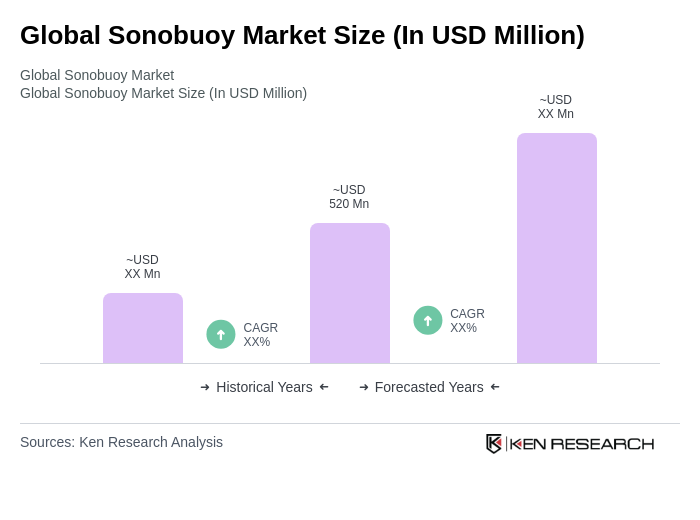
- The Global Sonobuoy Market is valued at USD 520 million, based on a five-year historical analysis. This growth is primarily driven by increasing defense budgets, advancements in underwater surveillance technology, and rising maritime security concerns. Rising global military expenditure and naval modernization programs are catalyzing demand for sonobuoys used in anti-submarine warfare and maritime domain awareness .
- Key players in this market include the United States, the United Kingdom, and China. The U.S. dominates due to sustained investment in naval aviation ASW capabilities and large-scale sonobuoy procurement for platforms such as P-8A Poseidon, while the U.K. benefits from its maritime posture and ASW revival, and China’s rapid fleet expansion supports growing indigenous ASW capability needs . Increased defense spending and fleet modernization initiatives underpin these countries’ positions in the market .
- In 2023, the U.S. government implemented new regulations to enhance the operational capabilities of sonobuoys, mandating that all military sonobuoys must comply with updated NATO standards. While interoperability with NATO Allied standards and STANAGs is a long-standing requirement in allied ASW operations, open-source market reports do not document a specific new U.S. regulation in that year uniquely mandating updated NATO compliance for all sonobuoys; however, ongoing adherence to NATO STANAGs and interoperability requirements remains a core driver for allied procurement and integration across ASW systems .
Global Sonobuoy Market Segmentation
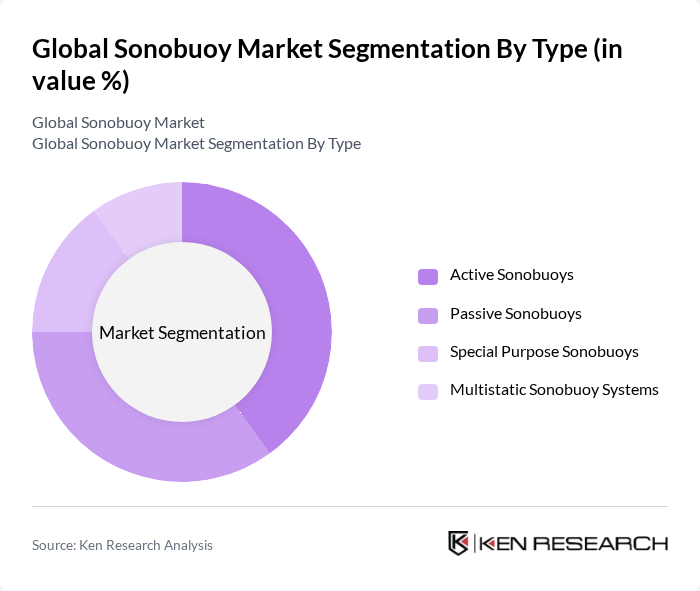
By Type:The sonobuoy market is segmented into Active Sonobuoys, Passive Sonobuoys, Special Purpose Sonobuoys, and Multistatic Sonobuoy Systems. Active Sonobuoys emit acoustic energy to detect and localize submarines, Passive Sonobuoys provide stealthy detection by listening for acoustic signatures, Special Purpose Sonobuoys address functions such as bathythermographic profiling and command/control relay, and Multistatic Sonobuoy Systems coordinate multiple source/receiver nodes to enhance detection performance against quiet submarines and in challenging acoustic conditions .
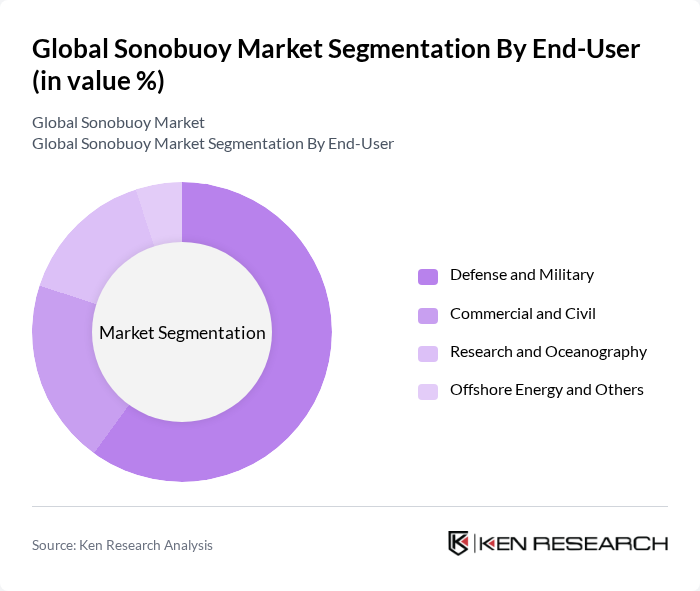
By End-User:The market is segmented into Defense and Military, Commercial and Civil, Research and Oceanography, and Offshore Energy and Others. The Defense and Military segment is the largest due to increased ASW activity, P-8A/P-3C and allied maritime patrol aircraft operations, and growing undersea threat perceptions. Commercial and Civil demand grows with environmental monitoring and maritime safety needs, while Research and Oceanography leverage sonobuoys for ocean profiling and acoustic research; offshore energy participants apply acoustic sensing for site assessment and environmental baselining .
Global Sonobuoy Market Competitive Landscape
The Global Sonobuoy Market is characterized by a dynamic mix of regional and international players. Leading participants such as Ultra Maritime (formerly Ultra Electronics Maritime), Sparton Corporation (Elbit Systems of America), ERAPSCO (Ultra Maritime and Sparton JV), Thales Group, L3Harris Technologies, Lockheed Martin Corporation, Leonardo S.p.A., Saab AB, Kongsberg Gruppen ASA, General Dynamics Corporation, Raytheon (RTX Corporation), Northrop Grumman Corporation, Naval Group, Bharat Electronics Limited (BEL), China State Shipbuilding Corporation (CSSC) contribute to innovation, geographic expansion, and service delivery in this space .
Global Sonobuoy Market Industry Analysis
Growth Drivers
- Increasing Demand for Maritime Surveillance:The global maritime surveillance market is projected to reach $25 billion in the future, driven by heightened security concerns and territorial disputes. Countries are investing heavily in surveillance technologies, with the U.S. allocating approximately $800 billion for defense in the future, which includes advanced maritime capabilities. This surge in investment is expected to boost the demand for sonobuoys, essential for effective underwater monitoring and threat detection.
- Advancements in Sonar Technology:The sonar technology sector is experiencing rapid innovation, with R&D spending expected to exceed $6 billion in the future. Enhanced sonar systems, including digital signal processing and machine learning algorithms, are improving detection capabilities. For instance, the introduction of multi-static sonar systems has increased detection ranges by up to 35%. These advancements are crucial for military and commercial applications, driving the sonobuoy market's growth.
- Rising Defense Budgets Globally:Global defense spending is projected to reach $2.5 trillion in the future, with significant increases in countries like India and China, which are expected to spend $80 billion and $300 billion, respectively. This increase in defense budgets is primarily aimed at enhancing naval capabilities, including anti-submarine warfare. Consequently, the demand for sonobuoys, which play a critical role in these operations, is anticipated to rise significantly.
Market Challenges
- High Initial Investment Costs:The development and deployment of sonobuoy systems require substantial capital investment, often exceeding $1.2 million per unit for advanced models. This high cost can deter potential buyers, particularly in emerging markets where budget constraints are prevalent. As a result, many defense organizations may delay or scale back their procurement plans, hindering market growth in the short term.
- Regulatory Compliance Complexities:The sonobuoy market faces stringent regulatory requirements, including export controls and environmental standards. Compliance with these regulations can incur additional costs, estimated at 20-25% of project budgets. For instance, the U.S. International Traffic in Arms Regulations (ITAR) complicate the export of defense-related technologies, limiting market access for manufacturers and potentially stifling innovation and growth.
Global Sonobuoy Market Future Outlook
The future of the sonobuoy market appears promising, driven by technological advancements and increasing defense expenditures. As nations prioritize maritime security, the integration of sonobuoys with unmanned systems is expected to enhance operational efficiency. Furthermore, the shift towards environmentally friendly technologies will likely spur innovation, leading to the development of sustainable sonobuoy solutions. These trends indicate a dynamic market landscape, with significant opportunities for growth and collaboration in the coming years.
Market Opportunities
- Expansion into Emerging Markets:Emerging economies, particularly in Southeast Asia and Africa, are increasing their defense budgets, with a combined growth rate of 10% expected in the future. This presents a significant opportunity for sonobuoy manufacturers to penetrate these markets, providing advanced maritime surveillance solutions tailored to local needs and budgets.
- Development of Next-Generation Sonobuoys:The demand for next-generation sonobuoys, equipped with AI and enhanced data analytics capabilities, is on the rise. With an estimated market potential of $2 billion in the future, companies that invest in R&D for innovative sonobuoy technologies can capture a significant share of this lucrative segment, meeting the evolving needs of military and commercial users.
Scope of the Report
| Segment | Sub-Segments |
|---|---|
| By Type | Active Sonobuoys Passive Sonobuoys Special Purpose Sonobuoys Multistatic Sonobuoy Systems |
| By End-User | Defense and Military Commercial and Civil Research and Oceanography Offshore Energy and Others |
| By Application | Anti-Submarine Warfare (ASW) Training and Exercise Oceanographic and Environmental Monitoring Search and Rescue (SAR) |
| By Deployment Method | Free-Fall Launch Cartridge/Pneumatic Launch Spring Launch Systems Unmanned Aerial Systems (UAS) Deployment |
| By Size Class | Size A Size B Size C Others |
| By Region | North America (U.S., Canada) Europe (U.K., France, Germany, Russia, Rest of Europe) Asia-Pacific (China, India, Japan, South Korea, Rest of APAC) Latin America Middle East & Africa |
| By Technology | Bathythermograph (BT) Directional Command Activated (DICASS) Directional Frequency Analysis and Recording (DIFAR) Low Frequency Analysis and Recording (LOFAR) Data Link Communications and Others |
Key Target Audience
Investors and Venture Capitalist Firms
Government and Regulatory Bodies (e.g., National Oceanic and Atmospheric Administration, U.S. Navy)
Manufacturers and Producers
Defense Contractors
Environmental Monitoring Agencies
Maritime Security Organizations
Research and Development Institutions
Military and Defense Agencies
Players Mentioned in the Report:
Ultra Maritime (formerly Ultra Electronics Maritime)
Sparton Corporation (Elbit Systems of America)
ERAPSCO (Ultra Maritime and Sparton JV)
Thales Group
L3Harris Technologies
Lockheed Martin Corporation
Leonardo S.p.A.
Saab AB
Kongsberg Gruppen ASA
General Dynamics Corporation
Raytheon (RTX Corporation)
Northrop Grumman Corporation
Naval Group
Bharat Electronics Limited (BEL)
China State Shipbuilding Corporation (CSSC)
Table of Contents
Market Assessment Phase
1. Executive Summary and Approach
2. Global Sonobuoy Market Overview
2.1 Key Insights and Strategic Recommendations
2.2 Global Sonobuoy Market Overview
2.3 Definition and Scope
2.4 Evolution of Market Ecosystem
2.5 Timeline of Key Regulatory Milestones
2.6 Value Chain & Stakeholder Mapping
2.7 Business Cycle Analysis
2.8 Policy & Incentive Landscape
3. Global Sonobuoy Market Analysis
3.1 Growth Drivers
3.1.1 Increasing demand for maritime surveillance
3.1.2 Advancements in sonar technology
3.1.3 Rising defense budgets globally
3.1.4 Growing need for anti-submarine warfare capabilities
3.2 Market Challenges
3.2.1 High initial investment costs
3.2.2 Regulatory compliance complexities
3.2.3 Limited awareness among potential users
3.2.4 Technological obsolescence
3.3 Market Opportunities
3.3.1 Expansion into emerging markets
3.3.2 Development of next-generation sonobuoys
3.3.3 Partnerships with defense contractors
3.3.4 Integration with unmanned systems
3.4 Market Trends
3.4.1 Increasing automation in maritime operations
3.4.2 Shift towards environmentally friendly technologies
3.4.3 Enhanced data analytics for sonar data
3.4.4 Growing collaboration between military and civilian sectors
3.5 Government Regulation
3.5.1 Export control regulations
3.5.2 Environmental compliance standards
3.5.3 Defense procurement policies
3.5.4 International maritime laws
4. SWOT Analysis
5. Stakeholder Analysis
6. Porter's Five Forces Analysis
7. Global Sonobuoy Market Market Size, 2019-2024
7.1 By Value
7.2 By Volume
7.3 By Average Selling Price
8. Global Sonobuoy Market Segmentation
8.1 By Type
8.1.1 Active Sonobuoys
8.1.2 Passive Sonobuoys
8.1.3 Special Purpose Sonobuoys
8.1.4 Multistatic Sonobuoy Systems
8.2 By End-User
8.2.1 Defense and Military
8.2.2 Commercial and Civil
8.2.3 Research and Oceanography
8.2.4 Offshore Energy and Others
8.3 By Application
8.3.1 Anti-Submarine Warfare (ASW)
8.3.2 Training and Exercise
8.3.3 Oceanographic and Environmental Monitoring
8.3.4 Search and Rescue (SAR)
8.4 By Deployment Method
8.4.1 Free-Fall Launch
8.4.2 Cartridge/Pneumatic Launch
8.4.3 Spring Launch Systems
8.4.4 Unmanned Aerial Systems (UAS) Deployment
8.5 By Size Class
8.5.1 Size A
8.5.2 Size B
8.5.3 Size C
8.5.4 Others
8.6 By Region
8.6.1 North America (U.S., Canada)
8.6.2 Europe (U.K., France, Germany, Russia, Rest of Europe)
8.6.3 Asia-Pacific (China, India, Japan, South Korea, Rest of APAC)
8.6.4 Latin America
8.6.5 Middle East & Africa
8.7 By Technology
8.7.1 Bathythermograph (BT)
8.7.2 Directional Command Activated (DICASS)
8.7.3 Directional Frequency Analysis and Recording (DIFAR)
8.7.4 Low Frequency Analysis and Recording (LOFAR)
8.7.5 Data Link Communications and Others
9. Global Sonobuoy Market Competitive Analysis
9.1 Market Share of Key Players
9.2 Cross Comparison of Key Players
9.2.1 Company Name
9.2.2 Product Portfolio Breadth (Active/Passive/Special Purpose, size class coverage)
9.2.3 Sonobuoy Segment Revenue (USD, latest fiscal year)
9.2.4 Order Backlog and Contract Wins (number/value over last 3 years)
9.2.5 Geographic Footprint (regions served; % revenue by region)
9.2.6 R&D Intensity (% of revenue; patents filed related to sonobuoys)
9.2.7 Production Capacity and Surge Capability (units/year)
9.2.8 Interoperability and Standards Compliance (NATO STANAGs, RF bands)
9.2.9 Delivery Performance (on-time delivery rate to MoDs/DoD)
9.2.10 Average Selling Price (ASP) Trend by Type
9.2.11 Aftermarket and Training Revenue Mix (%)
9.2.12 Strategic Partnerships/JVs (e.g., ERAPSCO participation)
9.3 SWOT Analysis of Top Players
9.4 Pricing Analysis
9.5 Detailed Profile of Major Companies
9.5.1 Ultra Maritime (formerly Ultra Electronics Maritime)
9.5.2 Sparton Corporation (Elbit Systems of America)
9.5.3 ERAPSCO (Ultra Maritime and Sparton JV)
9.5.4 Thales Group
9.5.5 L3Harris Technologies
9.5.6 Lockheed Martin Corporation
9.5.7 Leonardo S.p.A.
9.5.8 Saab AB
9.5.9 Kongsberg Gruppen ASA
9.5.10 General Dynamics Corporation
9.5.11 Raytheon (RTX Corporation)
9.5.12 Northrop Grumman Corporation
9.5.13 Naval Group
9.5.14 Bharat Electronics Limited (BEL)
9.5.15 China State Shipbuilding Corporation (CSSC)
10. Global Sonobuoy Market End-User Analysis
10.1 Procurement Behavior of Key Ministries
10.1.1 Defense Ministries
10.1.2 Environmental Agencies
10.1.3 Research Institutions
10.1.4 Others
10.2 Corporate Spend on Infrastructure & Energy
10.2.1 Defense Spending Trends
10.2.2 Research Funding Allocations
10.2.3 Environmental Monitoring Budgets
10.2.4 Others
10.3 Pain Point Analysis by End-User Category
10.3.1 Military
10.3.2 Commercial Shipping
10.3.3 Research Institutions
10.3.4 Others
10.4 User Readiness for Adoption
10.4.1 Awareness Levels
10.4.2 Training Requirements
10.4.3 Budget Allocations
10.4.4 Others
10.5 Post-Deployment ROI and Use Case Expansion
10.5.1 Performance Metrics
10.5.2 Cost Savings
10.5.3 Use Case Diversification
10.5.4 Others
11. Global Sonobuoy Market Future Size, 2025-2030
11.1 By Value
11.2 By Volume
11.3 By Average Selling Price
Go-To-Market Strategy Phase
1. Whitespace Analysis + Business Model Canvas
1.1 Market Gaps Identification
1.2 Business Model Framework
2. Marketing and Positioning Recommendations
2.1 Branding Strategies
2.2 Product USPs
3. Distribution Plan
3.1 Urban Retail Strategies
3.2 Rural NGO Tie-ups
4. Channel & Pricing Gaps
4.1 Underserved Routes
4.2 Pricing Bands
5. Unmet Demand & Latent Needs
5.1 Category Gaps
5.2 Consumer Segments
6. Customer Relationship
6.1 Loyalty Programs
6.2 After-sales Service
7. Value Proposition
7.1 Sustainability
7.2 Integrated Supply Chains
8. Key Activities
8.1 Regulatory Compliance
8.2 Branding
8.3 Distribution Setup
9. Entry Strategy Evaluation
9.1 Domestic Market Entry Strategy
9.1.1 Product Mix
9.1.2 Pricing Band
9.1.3 Packaging
9.2 Export Entry Strategy
9.2.1 Target Countries
9.2.2 Compliance Roadmap
10. Entry Mode Assessment
10.1 JV
10.2 Greenfield
10.3 M&A
10.4 Distributor Model
11. Capital and Timeline Estimation
11.1 Capital Requirements
11.2 Timelines
12. Control vs Risk Trade-Off
12.1 Ownership vs Partnerships
13. Profitability Outlook
13.1 Breakeven Analysis
13.2 Long-term Sustainability
14. Potential Partner List
14.1 Distributors
14.2 JVs
14.3 Acquisition Targets
15. Execution Roadmap
15.1 Phased Plan for Market Entry
15.1.1 Market Setup
15.1.2 Market Entry
15.1.3 Growth Acceleration
15.1.4 Scale & Stabilize
15.2 Key Activities and Milestones
15.2.1 Activity Timeline
15.2.2 Milestone Tracking
Research Methodology
Phase 1: Approach1
Desk Research
- Industry reports from maritime and defense organizations focusing on sonobuoy technology
- Market analysis publications from government agencies and defense contractors
- Academic journals and white papers on underwater acoustics and sonar systems
Primary Research
- Interviews with product managers at leading sonobuoy manufacturers
- Surveys with military procurement officers and defense analysts
- Field interviews with marine biologists and oceanographers utilizing sonobuoys
Validation & Triangulation
- Cross-validation of market data through multiple industry sources and expert opinions
- Triangulation of findings from primary interviews and secondary data sources
- Sanity checks through expert panel discussions and feedback sessions
Phase 2: Market Size Estimation1
Top-down Assessment
- Analysis of global defense budgets allocated to sonar and surveillance technologies
- Segmentation of the market by application areas such as military, commercial, and research
- Incorporation of trends in maritime security and environmental monitoring
Bottom-up Modeling
- Volume estimates based on production capacities of key sonobuoy manufacturers
- Cost analysis derived from pricing models of various sonobuoy types
- Estimation of market share based on sales data from industry players
Forecasting & Scenario Analysis
- Multi-variable regression analysis considering geopolitical factors and technological advancements
- Scenario modeling based on potential shifts in defense spending and environmental regulations
- Baseline, optimistic, and pessimistic forecasts through 2030
Phase 3: CATI Sample Composition1
| Scope Item/Segment | Sample Size | Target Respondent Profiles |
|---|---|---|
| Military Sonobuoy Applications | 100 | Defense Procurement Officers, Military Analysts |
| Commercial Marine Research | 75 | Marine Biologists, Oceanographic Researchers |
| Environmental Monitoring Initiatives | 60 | Environmental Scientists, Policy Makers |
| Sonobuoy Technology Development | 80 | R&D Managers, Product Development Engineers |
| Training and Simulation Programs | 50 | Training Coordinators, Simulation Specialists |
Frequently Asked Questions
What is the current value of the Global Sonobuoy Market?
The Global Sonobuoy Market is valued at approximately USD 520 million, driven by increased defense budgets, advancements in underwater surveillance technology, and rising maritime security concerns.
What are the main types of sonobuoys available in the market?
Which countries are the key players in the Global Sonobuoy Market?
What are the primary applications of sonobuoys?
Other Regional/Country Reports
Indonesia Sonobuoy Market
Malaysia Sonobuoy Market
APAC Sonobuoy Market
Why Buy From Us?

What makes us stand out is that our consultants follow Robust, Refine and Result (RRR) methodology. Robust for clear definitions, approaches and sanity checking, Refine for differentiating respondents' facts and opinions, and Result for presenting data with story.

We have set a benchmark in the industry by offering our clients with syndicated and customized market research reports featuring coverage of entire market as well as meticulous research and analyst insights.

While we don't replace traditional research, we flip the method upside down. Our dual approach of Top Bottom & Bottom Top ensures quality deliverable by not just verifying company fundamentals but also looking at the sector and macroeconomic factors.

With one step in the future, our research team constantly tries to show you the bigger picture. We help with some of the tough questions you may encounter along the way: How is the industry positioned? Best marketing channel? KPI's of competitors? By aligning every element, we help maximize success.

Our report gives you instant access to the answers and sources that other companies might choose to hide. We elaborate each steps of research methodology we have used and showcase you the sample size to earn your trust.

If you need any support, we are here! We pride ourselves on universe strength, data quality, and quick, friendly, and professional service.