Global Sorghum Seeds For Sowing Market

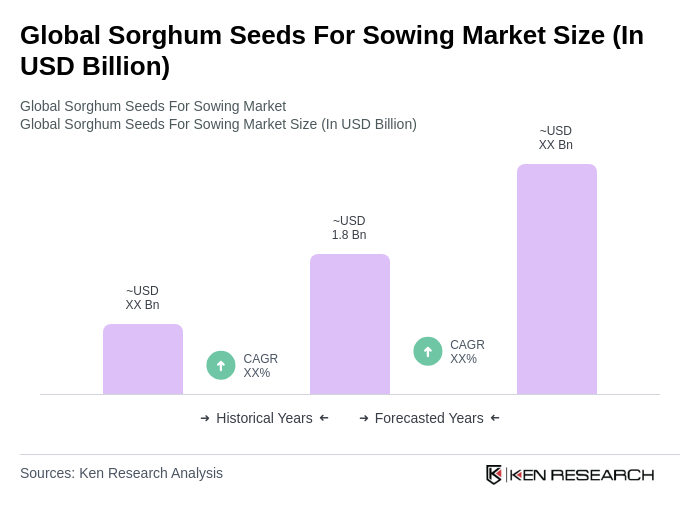
The Global Sorghum Seeds For Sowing Market, valued at USD 1.8 billion, grows due to sustainable agriculture, government support, and applications in gluten-free foods and biofuels.

Region:Global

Author(s):Dev

Product Code:KRAD0550

Pages:96

Published On:August 2025
About the Report

Base Year 2024

Global Sorghum Seeds For Sowing Market Overview

  • The Global Sorghum Seeds For Sowing Market is valued at USD 1.8 billion, based on a five-year historical analysis. This growth is driven by increasing adoption of sorghum in water-stressed regions due to its drought tolerance and heat resilience, along with agronomic traits like efficient water use and adaptability across marginal soils. Rising recognition of sorghum’s gluten-free nutrition profile and its expanding use in food, feed, and ethanol/biofuel value chains are reinforcing seed demand.
  • The United States, Brazil, and India are important players; however, North America (driven by the U.S.) is consistently cited as the largest regional market for sorghum seed, supported by advanced agronomy, hybrid adoption, and structured breeding programs. Brazil’s role is supported by large-scale grain and forage sorghum in rotation systems and ethanol-linked demand, while India’s prominence stems from dual uses in food (millets) and feed, with extensive smallholder adoption of hybrids and OPVs.
  • In India, public programs promoting nutri-cereals (including sorghum/jowar) have provided sustained support via the National Food Security Mission and millet initiatives, including continued state-level subsidies for certified seeds and demonstrations. While references often note ongoing support, specific new national policy rollouts tagged to a single year are typically framed within broader millet promotion and NFSM interventions rather than a one-off 2023-only policy; farmer support and subsidies for sorghum seed distribution and demonstrations remain part of these schemes and state programs.
Global Sorghum Seeds For Sowing Market Size

Global Sorghum Seeds For Sowing Market Segmentation

By Type:The sorghum seeds market is segmented into various types, including Hybrid Sorghum Seeds, Open-Pollinated Varieties, Grain Sorghum, Forage Sorghum, Sweet Sorghum, and Biomass/Energy Sorghum. Among these, Hybrid Sorghum Seeds are gaining traction due to their higher yield potential and resistance to pests and diseases; hybrids account for the largest share in most syndicated assessments, reflecting farmer preference for yield stability and stress tolerance. Open-Pollinated Varieties are also popular among smallholder farmers for their cost-effectiveness and seed-saving practices, particularly in developing regions. The demand for Grain Sorghum is driven by its use in food and feed chains, while Forage Sorghum is favored for livestock feed due to high biomass and drought resilience. Sweet Sorghum is increasingly recognized for its biofuel potential via fermentable sugars in stalks, and Biomass/Energy Sorghum is emerging as a sustainable energy feedstock for power and advanced fuels.
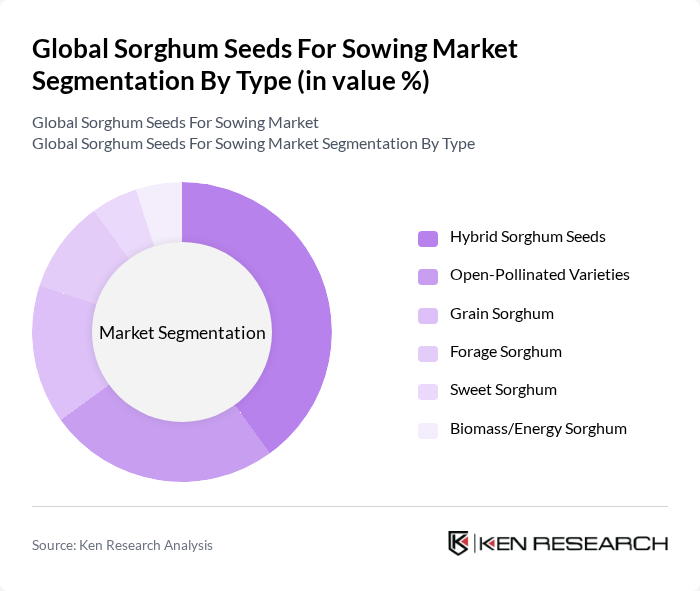
Global Sorghum Seeds For Sowing Market segmentation by Type.

By Application:The applications of sorghum seeds are diverse, including Food and Beverages, Animal Feed and Silage, Biofuel/Ethanol Production, Industrial Uses (Brewing/Distilling, Starch, Chemicals), and Seed Multiplication and Breeding. The Food and Beverages segment benefits from sorghum’s gluten-free and fiber-rich profile and rising use in traditional and value-added foods; Animal Feed and Silage is significant given demand for energy-dense forage and grain for rations; Biofuel/Ethanol Production is growing where sorghum grain and sweet sorghum feedstocks are integrated into renewable fuel programs; Industrial Uses span brewing/distilling and starch/biochemical inputs; Seed Multiplication and Breeding underpin variety pipeline development.
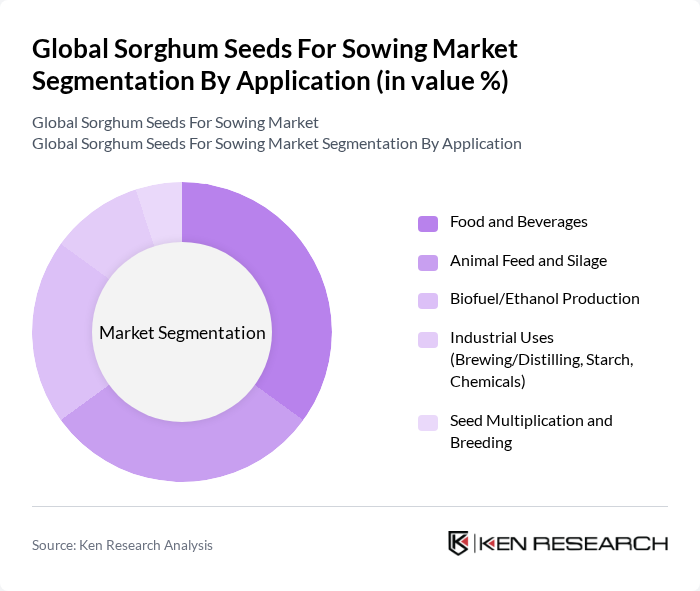
Global Sorghum Seeds For Sowing Market segmentation by Application.

Global Sorghum Seeds For Sowing Market Competitive Landscape

The Global Sorghum Seeds For Sowing Market is characterized by a dynamic mix of regional and international players. Leading participants such as Corteva Agriscience (Pioneer), Syngenta Seeds, Bayer Crop Science, Groupe Limagrain (Vilmorin & Cie), KWS SAAT SE & Co. KGaA, Advanta Seeds (UPL), Seed Co Limited, RAGT Semences, S&W Seed Company, Alta Seeds (Advanta), Dyna-Gro (Nutrien Ag Solutions), Pannar Seed (Corteva), Nuziveedu Seeds Ltd., Rasi Seeds (P) Ltd., Mahyco (Maharashtra Hybrid Seeds Co.) contribute to innovation, geographic expansion, and service delivery in this space.

Corteva Agriscience (Pioneer)

2019

Indianapolis, USA

Syngenta Seeds

2000

Basel, Switzerland

Bayer Crop Science

2002

Monheim am Rhein, Germany

Groupe Limagrain (Vilmorin & Cie)

1965

Saint-Beauzire, France

KWS SAAT SE & Co. KGaA

1856

Einbeck, Germany

Company

Establishment Year

Headquarters

Portfolio Breadth (Grain/Forage/Sweet/Biomass Coverage)

Geographic Footprint (Regions/Countries Served)

Sorghum Seed Revenue and Growth Rate

Market Penetration (Dealer Density/Channel Reach)

Trait/Technology Adoption (Hybridization, Drought Tolerance, Sugar Content)

Average Seed Price per Unit (by segment)

Global Sorghum Seeds For Sowing Market Industry Analysis

Growth Drivers

  • Increasing Demand for Gluten-Free Products:The global gluten-free food market is projected to reach $8.5 billion by 2025, driven by rising health consciousness. Sorghum, being naturally gluten-free, is increasingly favored by consumers seeking alternatives to wheat. In the U.S. alone, gluten-free product sales surged to $1.8 billion in the future, indicating a robust market for sorghum-based products. This trend is expected to bolster sorghum seed demand significantly, as manufacturers seek to incorporate gluten-free ingredients into their offerings.
  • Rising Awareness of Sustainable Agriculture:The global sustainable agriculture market is anticipated to grow to $21.5 billion by 2025, reflecting a shift towards eco-friendly farming practices. Sorghum, known for its drought resistance and low input requirements, aligns with these sustainable practices. In regions like Africa, where water scarcity is prevalent, sorghum cultivation has increased by 20% over the past five years, showcasing its potential as a sustainable crop that supports food security and environmental conservation.
  • Government Support for Sorghum Cultivation:In the future, the U.S. government allocated $1.5 billion to support sorghum farmers through subsidies and research initiatives. This financial backing aims to enhance sorghum production and promote its use in biofuels and livestock feed. Additionally, countries like India have introduced policies to increase sorghum acreage by 25% in the future, further driving the market. Such government initiatives are crucial in fostering a favorable environment for sorghum seed cultivation and adoption.

Market Challenges

  • Competition from Other Cereal Crops:The sorghum market faces stiff competition from other cereal crops, particularly maize and wheat, which dominate global production. In the future, global maize production reached 1.5 billion tons, while sorghum production was only 70 million tons. This disparity highlights the challenges sorghum faces in gaining market share. Farmers often prefer more established crops due to higher yields and better market access, which can hinder sorghum's growth potential.
  • Limited Awareness Among Farmers:Despite its benefits, many farmers remain unaware of sorghum's advantages, particularly in regions where it is not traditionally grown. In the future, surveys indicated that only 35% of farmers in the U.S. were familiar with sorghum's drought-resistant properties. This lack of awareness can lead to underutilization of sorghum seeds, limiting their adoption. Educational initiatives and outreach programs are essential to inform farmers about sorghum's potential and encourage its cultivation.

Global Sorghum Seeds For Sowing Market Future Outlook

The future of the sorghum seeds market appears promising, driven by increasing consumer demand for gluten-free products and sustainable agricultural practices. As governments worldwide continue to support sorghum cultivation through subsidies and research funding, the crop's adoption is likely to rise. Additionally, advancements in seed technology and precision agriculture will enhance yields and resilience, making sorghum a more attractive option for farmers. Overall, the market is poised for growth as awareness and demand for sorghum continue to expand.

Market Opportunities

  • Technological Advancements in Seed Production:Innovations in seed technology, such as genetic modification and hybridization, present significant opportunities for enhancing sorghum yields. In the future, investments in agricultural technology are expected to exceed $6 billion, facilitating the development of high-yield, disease-resistant sorghum varieties. This advancement can lead to increased adoption among farmers, boosting overall production and market growth.
  • Development of Value-Added Products:The growing trend towards health foods opens avenues for developing value-added sorghum products, such as flour and snacks. The global health food market is projected to reach $1.2 trillion by the future, creating a substantial opportunity for sorghum-based products. By capitalizing on this trend, manufacturers can diversify their offerings and increase demand for sorghum seeds, enhancing market potential.

Scope of the Report

SegmentSub-Segments
By Type

Hybrid Sorghum Seeds

Open-Pollinated Varieties

Grain Sorghum

Forage Sorghum

Sweet Sorghum

Biomass/Energy Sorghum

By Application

Food and Beverages

Animal Feed and Silage

Biofuel/Ethanol Production

Industrial Uses (Brewing/Distilling, Starch, Chemicals)

Seed Multiplication and Breeding

By End-User

Smallholder Farmers

Commercial Farms and Agribusinesses

Agricultural Cooperatives

Public and Private Research Institutions

Seed Producers and Contract Growers

By Distribution Channel

Direct Sales (Company/Dealer Networks)

Ag-Retailers and Cooperatives

Online and E-commerce

Government Input Schemes and Tender Programs

Agricultural Shows and Expos

By Region

North America

South America

Africa

Asia-Pacific

Europe

Middle East

By Price Range

Value Segment

Mid-Price Segment

Premium Segment

By Seed Treatment

Treated (Fungicide/Insecticide/Bio-stimulant Coated)

Untreated

Key Target Audience

Investors and Venture Capitalist Firms

Government and Regulatory Bodies (e.g., Food and Agriculture Organization, U.S. Department of Agriculture)

Seed Manufacturers and Producers

Agricultural Cooperatives

Distributors and Retailers of Agricultural Products

Agri-tech Companies

Industry Associations (e.g., International Sorghum Producers Association)

Financial Institutions and Banks specializing in Agriculture Financing

Players Mentioned in the Report:

Corteva Agriscience (Pioneer)

Syngenta Seeds

Bayer Crop Science

Groupe Limagrain (Vilmorin & Cie)

KWS SAAT SE & Co. KGaA

Advanta Seeds (UPL)

Seed Co Limited

RAGT Semences

S&W Seed Company

Alta Seeds (Advanta)

Dyna-Gro (Nutrien Ag Solutions)

Pannar Seed (Corteva)

Nuziveedu Seeds Ltd.

Rasi Seeds (P) Ltd.

Mahyco (Maharashtra Hybrid Seeds Co.)

Table of Contents

Market Assessment Phase

1. Executive Summary and Approach


2. Global Sorghum Seeds For Sowing Market Overview

2.1 Key Insights and Strategic Recommendations

2.2 Global Sorghum Seeds For Sowing Market Overview

2.3 Definition and Scope

2.4 Evolution of Market Ecosystem

2.5 Timeline of Key Regulatory Milestones

2.6 Value Chain & Stakeholder Mapping

2.7 Business Cycle Analysis

2.8 Policy & Incentive Landscape


3. Global Sorghum Seeds For Sowing Market Analysis

3.1 Growth Drivers

3.1.1 Increasing Demand for Gluten-Free Products
3.1.2 Rising Awareness of Sustainable Agriculture
3.1.3 Government Support for Sorghum Cultivation
3.1.4 Expansion of Sorghum in Livestock Feed

3.2 Market Challenges

3.2.1 Competition from Other Cereal Crops
3.2.2 Limited Awareness Among Farmers
3.2.3 Vulnerability to Climate Change
3.2.4 Supply Chain Disruptions

3.3 Market Opportunities

3.3.1 Technological Advancements in Seed Production
3.3.2 Growing Export Markets
3.3.3 Development of Value-Added Products
3.3.4 Increasing Investment in Agricultural Research

3.4 Market Trends

3.4.1 Shift Towards Organic Sorghum Seeds
3.4.2 Adoption of Precision Agriculture Techniques
3.4.3 Rising Popularity of Sorghum in Health Foods
3.4.4 Enhanced Focus on Crop Diversification

3.5 Government Regulation

3.5.1 Subsidies for Sorghum Seed Production
3.5.2 Quality Standards for Seed Certification
3.5.3 Environmental Regulations Impacting Cultivation
3.5.4 Trade Policies Affecting Sorghum Exports

4. SWOT Analysis


5. Stakeholder Analysis


6. Porter's Five Forces Analysis


7. Global Sorghum Seeds For Sowing Market Market Size, 2019-2024

7.1 By Value

7.2 By Volume

7.3 By Average Selling Price


8. Global Sorghum Seeds For Sowing Market Segmentation

8.1 By Type

8.1.1 Hybrid Sorghum Seeds
8.1.2 Open-Pollinated Varieties
8.1.3 Grain Sorghum
8.1.4 Forage Sorghum
8.1.5 Sweet Sorghum
8.1.6 Biomass/Energy Sorghum

8.2 By Application

8.2.1 Food and Beverages
8.2.2 Animal Feed and Silage
8.2.3 Biofuel/Ethanol Production
8.2.4 Industrial Uses (Brewing/Distilling, Starch, Chemicals)
8.2.5 Seed Multiplication and Breeding

8.3 By End-User

8.3.1 Smallholder Farmers
8.3.2 Commercial Farms and Agribusinesses
8.3.3 Agricultural Cooperatives
8.3.4 Public and Private Research Institutions
8.3.5 Seed Producers and Contract Growers

8.4 By Distribution Channel

8.4.1 Direct Sales (Company/Dealer Networks)
8.4.2 Ag-Retailers and Cooperatives
8.4.3 Online and E-commerce
8.4.4 Government Input Schemes and Tender Programs
8.4.5 Agricultural Shows and Expos

8.5 By Region

8.5.1 North America
8.5.2 South America
8.5.3 Africa
8.5.4 Asia-Pacific
8.5.5 Europe
8.5.6 Middle East

8.6 By Price Range

8.6.1 Value Segment
8.6.2 Mid-Price Segment
8.6.3 Premium Segment

8.7 By Seed Treatment

8.7.1 Treated (Fungicide/Insecticide/Bio-stimulant Coated)
8.7.2 Untreated

9. Global Sorghum Seeds For Sowing Market Competitive Analysis

9.1 Market Share of Key Players(Micro, Small, Medium, Large Enterprises)

9.2 Cross Comparison of Key Players

9.2.1 Company Name
9.2.2 Portfolio Breadth (Grain/Forage/Sweet/Biomass Coverage)
9.2.3 Geographic Footprint (Regions/Countries Served)
9.2.4 Sorghum Seed Revenue and Growth Rate
9.2.5 Market Penetration (Dealer Density/Channel Reach)
9.2.6 Trait/Technology Adoption (Hybridization, Drought Tolerance, Sugar Content)
9.2.7 Average Seed Price per Unit (by segment)
9.2.8 R&D Intensity (R&D spend %, breeding stations, trials)
9.2.9 Pipeline/Variety Launches (past 3–5 years)
9.2.10 Quality and Certification Compliance (ISTA/OECD/Local)
9.2.11 Farmer Satisfaction/Repeat Purchase Rate

9.3 SWOT Analysis of Top Players

9.4 Pricing Analysis(By Class and Payload)

9.5 Detailed Profile of Major Companies

9.5.1 Corteva Agriscience (Pioneer)
9.5.2 Syngenta Seeds
9.5.3 Bayer Crop Science
9.5.4 Groupe Limagrain (Vilmorin & Cie)
9.5.5 KWS SAAT SE & Co. KGaA
9.5.6 Advanta Seeds (UPL)
9.5.7 Seed Co Limited
9.5.8 RAGT Semences
9.5.9 S&W Seed Company
9.5.10 Alta Seeds (Advanta)
9.5.11 Dyna-Gro (Nutrien Ag Solutions)
9.5.12 Pannar Seed (Corteva)
9.5.13 Nuziveedu Seeds Ltd.
9.5.14 Rasi Seeds (P) Ltd.
9.5.15 Mahyco (Maharashtra Hybrid Seeds Co.)

10. Global Sorghum Seeds For Sowing Market End-User Analysis

10.1 Procurement Behavior of Key Ministries

10.1.1 Government Procurement Policies
10.1.2 Budget Allocations for Sorghum Seeds
10.1.3 Collaboration with Agricultural Agencies
10.1.4 Evaluation Criteria for Seed Selection

10.2 Corporate Spend on Infrastructure & Energy

10.2.1 Investment in Agricultural Infrastructure
10.2.2 Funding for Research and Development
10.2.3 Expenditure on Sustainable Practices

10.3 Pain Point Analysis by End-User Category

10.3.1 Access to Quality Seeds
10.3.2 Price Volatility of Sorghum Seeds
10.3.3 Availability of Technical Support

10.4 User Readiness for Adoption

10.4.1 Awareness of Sorghum Benefits
10.4.2 Training and Education Programs
10.4.3 Adoption of New Varieties

10.5 Post-Deployment ROI and Use Case Expansion

10.5.1 Measurement of Yield Improvements
10.5.2 Cost-Benefit Analysis of Sorghum Cultivation
10.5.3 Expansion into New Markets

11. Global Sorghum Seeds For Sowing Market Future Size, 2025-2030

11.1 By Value

11.2 By Volume

11.3 By Average Selling Price


Go-To-Market Strategy Phase

1. Whitespace Analysis + Business Model Canvas

1.1 Market Gaps Identification

1.2 Value Proposition Development

1.3 Revenue Streams Analysis

1.4 Key Partnerships Exploration

1.5 Cost Structure Assessment

1.6 Customer Segmentation

1.7 Channels of Distribution


2. Marketing and Positioning Recommendations

2.1 Branding Strategies

2.2 Product USPs

2.3 Target Market Identification

2.4 Communication Strategies

2.5 Digital Marketing Approaches


3. Distribution Plan

3.1 Urban Retail Strategies

3.2 Rural NGO Tie-Ups

3.3 E-commerce Integration

3.4 Logistics and Supply Chain Management


4. Channel & Pricing Gaps

4.1 Underserved Routes

4.2 Pricing Bands Analysis

4.3 Competitor Pricing Strategies


5. Unmet Demand & Latent Needs

5.1 Category Gaps Identification

5.2 Consumer Segments Analysis

5.3 Product Development Opportunities


6. Customer Relationship

6.1 Loyalty Programs

6.2 After-sales Service

6.3 Customer Feedback Mechanisms


7. Value Proposition

7.1 Sustainability Initiatives

7.2 Integrated Supply Chains

7.3 Community Engagement Strategies


8. Key Activities

8.1 Regulatory Compliance

8.2 Branding Initiatives

8.3 Distribution Setup


9. Entry Strategy Evaluation

9.1 Domestic Market Entry Strategy

9.1.1 Product Mix Considerations
9.1.2 Pricing Band Strategy
9.1.3 Packaging Innovations

9.2 Export Entry Strategy

9.2.1 Target Countries Identification
9.2.2 Compliance Roadmap Development

10. Entry Mode Assessment

10.1 Joint Ventures

10.2 Greenfield Investments

10.3 Mergers & Acquisitions

10.4 Distributor Model Evaluation


11. Capital and Timeline Estimation

11.1 Capital Requirements Analysis

11.2 Timelines for Market Entry


12. Control vs Risk Trade-Off

12.1 Ownership vs Partnerships

12.2 Risk Mitigation Strategies


13. Profitability Outlook

13.1 Breakeven Analysis

13.2 Long-term Sustainability Strategies


14. Potential Partner List

14.1 Distributors

14.2 Joint Ventures

14.3 Acquisition Targets


15. Execution Roadmap

15.1 Phased Plan for Market Entry

15.1.1 Market Setup
15.1.2 Market Entry
15.1.3 Growth Acceleration
15.1.4 Scale & Stabilize

15.2 Key Activities and Milestones

15.2.1 Milestone Planning
15.2.2 Activity Tracking

Research Methodology

ApproachModellingSample

Phase 1: Approach1

Desk Research

  • Analysis of global agricultural reports and sorghum seed market studies
  • Review of trade statistics from agricultural departments and international trade organizations
  • Examination of academic journals and publications focusing on sorghum cultivation and seed technology

Primary Research

  • Interviews with agronomists and seed production experts in the sorghum sector
  • Surveys with farmers and agricultural cooperatives involved in sorghum cultivation
  • Discussions with distributors and retailers specializing in sorghum seeds

Validation & Triangulation

  • Cross-validation of findings through multiple data sources including government reports and industry publications
  • Triangulation of insights from primary interviews with secondary data trends
  • Sanity checks conducted through expert panels comprising agribusiness analysts

Phase 2: Market Size Estimation1

Top-down Assessment

  • Estimation of the global sorghum seed market size based on agricultural output data
  • Segmentation analysis by geographic regions and end-use applications
  • Incorporation of trends in sorghum demand driven by food security and biofuel production

Bottom-up Modeling

  • Collection of sales data from leading sorghum seed producers and distributors
  • Estimation of market share based on production capacity and sales volume
  • Analysis of pricing strategies and cost structures of sorghum seed varieties

Forecasting & Scenario Analysis

  • Utilization of time-series analysis to project future market growth rates
  • Scenario modeling based on climatic changes and agricultural policy impacts
  • Development of baseline, optimistic, and pessimistic forecasts through 2030

Phase 3: CATI Sample Composition1

Scope Item/SegmentSample SizeTarget Respondent Profiles
Sorghum Seed Producers100Seed Company Executives, Production Managers
Agricultural Cooperatives80Cooperative Leaders, Agronomy Advisors
Farmers Cultivating Sorghum140Smallholder Farmers, Commercial Growers
Distributors and Retailers70Supply Chain Managers, Retail Buyers
Research Institutions60Agricultural Researchers, Policy Analysts

Frequently Asked Questions

What is the current value of the Global Sorghum Seeds For Sowing Market?

The Global Sorghum Seeds For Sowing Market is valued at approximately USD 1.8 billion, reflecting a significant growth trend driven by increasing adoption of sorghum in water-stressed regions and its nutritional benefits.

Which regions are the largest markets for sorghum seeds?

What types of sorghum seeds are available in the market?

What are the primary applications of sorghum seeds?

Other Regional/Country Reports

UAE Sorghum Seeds For Sowing MarketKSA Sorghum Seeds For Sowing Market

Indonesia Sorghum Seeds For Sowing Market

Malaysia Sorghum Seeds For Sowing Market

APAC Sorghum Seeds For Sowing Market

SEA Sorghum Seeds For Sowing Market

Why Buy From Us?

Refine Robust Result (RRR) Framework

What makes us stand out is that our consultants follow Robust, Refine and Result (RRR) methodology. Robust for clear definitions, approaches and sanity checking, Refine for differentiating respondents' facts and opinions, and Result for presenting data with story.

Our Reach Is Unmatched

We have set a benchmark in the industry by offering our clients with syndicated and customized market research reports featuring coverage of entire market as well as meticulous research and analyst insights.

Shifting the Research Paradigm

While we don't replace traditional research, we flip the method upside down. Our dual approach of Top Bottom & Bottom Top ensures quality deliverable by not just verifying company fundamentals but also looking at the sector and macroeconomic factors.

More Insights-Better Decisions

With one step in the future, our research team constantly tries to show you the bigger picture. We help with some of the tough questions you may encounter along the way: How is the industry positioned? Best marketing channel? KPI's of competitors? By aligning every element, we help maximize success.

Transparency and Trust

Our report gives you instant access to the answers and sources that other companies might choose to hide. We elaborate each steps of research methodology we have used and showcase you the sample size to earn your trust.

Round the Clock Support

If you need any support, we are here! We pride ourselves on universe strength, data quality, and quick, friendly, and professional service.

Why Clients Choose Us?

400000+
Reports in repository
150+
Consulting projects a year
100+
Analysts
8000+
Client Queries in 2022








