About the Report
Base Year 2024Listen to the audio summary
Global Soybean Meal Market Overview
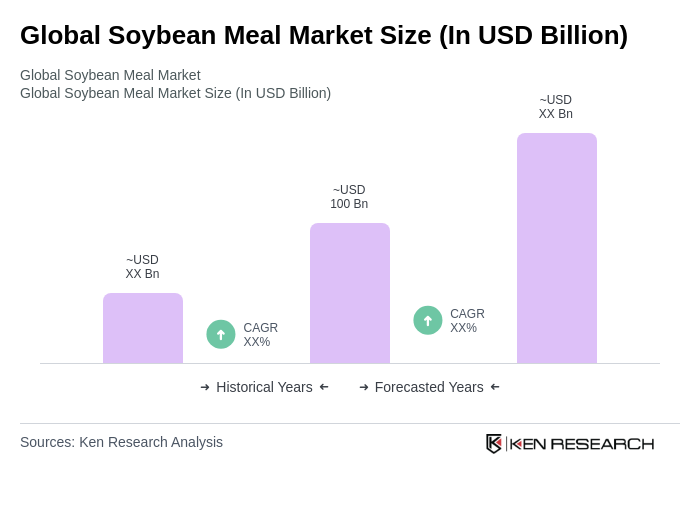
- The Global Soybean Meal Market is valued at approximately USD 100 billion, based on a five-year historical analysis. This value reflects sustained demand from protein-rich animal feed, notably poultry and aquaculture, and continued adoption of plant-based proteins; increased crushing capacity expansions tied to renewable diesel policies have also increased soybean meal output as a co-product.
- Key producing and exporting countries remain the United States, Brazil, and Argentina; these countries dominate soybean and soymeal trade due to large-scale acreage, favorable agro-climatic conditions, and advanced production systems, underpinning a robust global supply chain for feed uses.
- The U.S. “Agricultural Improvement Act” commonly refers to the Farm Bill; the most recent full Farm Bill before renewal extensions was enacted earlier and has since been extended, with federal support mechanisms (e.g., crop insurance, research via USDA/land-grant programs) continuing to support soybean producers. Specific new enactment attributed to 2023 requires clarification, as Congress operated under extensions while negotiating updates; however, the policy framework sustaining subsidies and research funding for soybeans remains in place.
Global Soybean Meal Market Segmentation
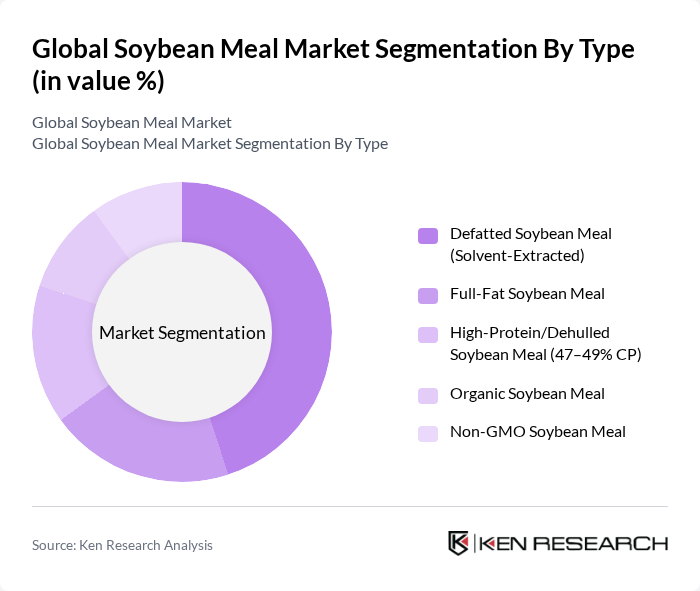
By Type:The market is segmented into various types of soybean meal, including Defatted Soybean Meal (Solvent-Extracted), Full-Fat Soybean Meal, High-Protein/Dehulled Soybean Meal (47–49% CP), Organic Soybean Meal, and Non-GMO Soybean Meal. Among these, Defatted Soybean Meal (Solvent-Extracted) is the leading subsegment due to its high protein content and cost-effectiveness, making it the preferred choice for animal feed manufacturers. The increasing focus on protein fortification in animal diets further drives the demand for this subsegment.
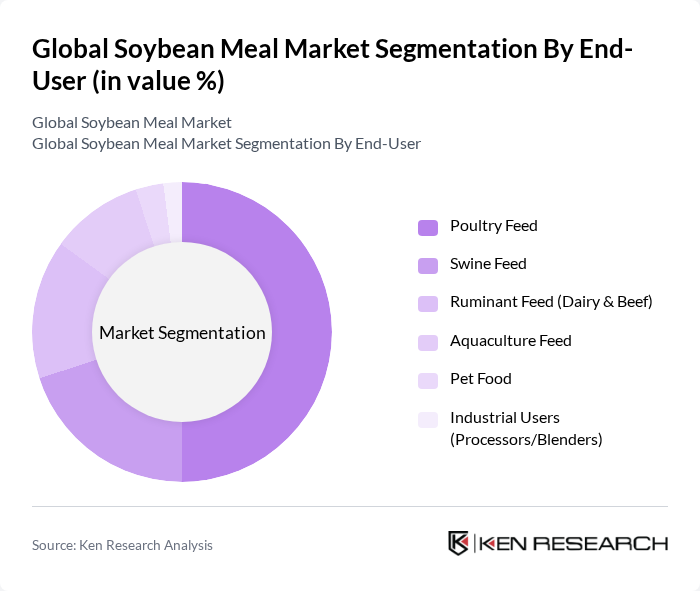
By End-User:The end-user segmentation includes Poultry Feed, Swine Feed, Ruminant Feed (Dairy & Beef), Aquaculture Feed, Pet Food, and Industrial Users (Processors/Blenders). Poultry Feed is the dominant subsegment, driven by the growing poultry industry and the increasing consumption of chicken and eggs globally. The rising awareness of the nutritional benefits of soybean meal in poultry diets has further solidified its position as the preferred feed ingredient.
Global Soybean Meal Market Competitive Landscape
The Global Soybean Meal Market is characterized by a dynamic mix of regional and international players. Leading participants such as Cargill, Incorporated, Archer Daniels Midland Company (ADM), Bunge Global SA, Louis Dreyfus Company B.V. (LDC), CHS Inc., Wilmar International Limited, COFCO Corporation, Ag Processing Inc (AGP), The Scoular Company, Marubeni Corporation, Perdue AgriBusiness, GrainCorp Limited, J.D. Heiskell & Co., Sodrugestvo Group S.A., The Andersons, Inc. contribute to innovation, geographic expansion, and service delivery in this space.
Global Soybean Meal Market Industry Analysis
Growth Drivers
- Increasing Demand for Animal Feed:The global demand for animal feed is projected to reach 1.3 billion metric tons in the near future, driven by the rising livestock population, which is expected to grow by 1.6% annually. This surge in demand is primarily attributed to the increasing meat consumption, particularly in developing regions. For instance, the FAO estimates that meat production will increase by 15% in the coming years, further propelling the need for high-protein feed ingredients like soybean meal.
- Rising Health Consciousness Among Consumers:As consumers become more health-conscious, the demand for protein-rich diets is increasing. The global protein market is anticipated to reach $55 billion in the near future, with plant-based proteins gaining significant traction. This trend is reflected in the growing preference for soybean meal, which is recognized for its high protein content (approximately 44-48% protein) and essential amino acids, making it a preferred choice for health-oriented consumers and animal nutritionists alike.
- Technological Advancements in Processing:Innovations in soybean processing technologies are enhancing the efficiency and quality of soybean meal production. For example, the introduction of enzyme-assisted extraction methods has improved oil yield by 6-11%, leading to higher protein concentration in the meal. The global investment in agricultural technology is projected to reach $12 billion in the near future, facilitating advancements that will further optimize soybean meal production and meet the growing market demand.
Market Challenges
- Price Volatility of Raw Materials:The soybean market is characterized by significant price fluctuations, influenced by factors such as weather conditions and global supply chain disruptions. For instance, soybean prices experienced a 22% increase recently due to adverse weather in key producing regions. This volatility poses a challenge for producers and consumers alike, as it complicates budgeting and long-term planning in the soybean meal market.
- Competition from Alternative Protein Sources:The rise of alternative protein sources, such as pea protein and insect meal, is intensifying competition in the animal feed market. The alternative protein market is projected to grow to $12 billion in the near future, attracting investments and consumer interest. This shift poses a challenge for soybean meal producers, as they must innovate and differentiate their products to maintain market share amidst growing competition.
Global Soybean Meal Market Future Outlook
The future of the soybean meal market appears promising, driven by increasing demand for sustainable and high-protein feed options. As consumers continue to prioritize health and sustainability, the market is likely to see a rise in organic and non-GMO soybean meal products. Additionally, advancements in processing technologies will enhance product quality and efficiency, enabling producers to meet the evolving needs of the aquaculture and livestock sectors, which are expected to expand significantly in the coming years.
Market Opportunities
- Growth in Aquaculture Sector:The aquaculture industry is projected to grow at a rate of 6% annually, reaching a market size of $220 billion in the near future. This growth presents a significant opportunity for soybean meal, as it is increasingly used in fish feed formulations due to its high protein content and digestibility, making it a vital ingredient for sustainable aquaculture practices.
- Development of Organic Soybean Meal:The organic food market is expected to reach $350 billion in the near future, with organic soybean meal gaining traction among health-conscious consumers. This trend offers a lucrative opportunity for producers to develop and market organic soybean meal, catering to the growing demand for clean-label and sustainably sourced animal feed products.
Scope of the Report
| Segment | Sub-Segments |
|---|---|
| By Type | Defatted Soybean Meal (Solvent-Extracted) Full-Fat Soybean Meal High-Protein/Dehulled Soybean Meal (47–49% CP) Organic Soybean Meal Non-GMO Soybean Meal |
| By End-User | Poultry Feed Swine Feed Ruminant Feed (Dairy & Beef) Aquaculture Feed Pet Food Industrial Users (Processors/Blenders) |
| By Application | Animal Feed Food and Beverage Processing (Protein Fortification) Fertilizer/Organic Amendments Industrial and Bio-based Products Others |
| By Distribution Channel | Direct Sales to Integrators/Feed Mills Traders and Distributors Online B2B Platforms Retail/Agri-Dealer Networks |
| By Region | North America Europe Asia-Pacific Latin America Middle East & Africa |
| By Price Range | Low Price Mid Price High Price |
| By Packaging Type | Bulk (Railcar, Barge, Vessel, Truck) Bagged (25–50 kg) Flexible Intermediate Bulk Containers (FIBC/Tote Bags) Custom/Contract Packaging |
Key Target Audience
Investors and Venture Capitalist Firms
Government and Regulatory Bodies (e.g., Food and Drug Administration, Environmental Protection Agency)
Manufacturers and Producers
Distributors and Retailers
Animal Feed Manufacturers
Food Processing Companies
Exporters and Importers
Commodity Traders
Players Mentioned in the Report:
Cargill, Incorporated
Archer Daniels Midland Company (ADM)
Bunge Global SA
Louis Dreyfus Company B.V. (LDC)
CHS Inc.
Wilmar International Limited
COFCO Corporation
Ag Processing Inc (AGP)
The Scoular Company
Marubeni Corporation
Perdue AgriBusiness
GrainCorp Limited
J.D. Heiskell & Co.
Sodrugestvo Group S.A.
The Andersons, Inc.
Table of Contents
Market Assessment Phase
1. Executive Summary and Approach
2. Global Soybean Meal Market Overview
2.1 Key Insights and Strategic Recommendations
2.2 Global Soybean Meal Market Overview
2.3 Definition and Scope
2.4 Evolution of Market Ecosystem
2.5 Timeline of Key Regulatory Milestones
2.6 Value Chain & Stakeholder Mapping
2.7 Business Cycle Analysis
2.8 Policy & Incentive Landscape
3. Global Soybean Meal Market Analysis
3.1 Growth Drivers
3.1.1 Increasing Demand for Animal Feed
3.1.2 Rising Health Consciousness Among Consumers
3.1.3 Expansion of Soybean Cultivation Areas
3.1.4 Technological Advancements in Processing
3.2 Market Challenges
3.2.1 Price Volatility of Raw Materials
3.2.2 Competition from Alternative Protein Sources
3.2.3 Regulatory Compliance Issues
3.2.4 Environmental Concerns Related to Soybean Farming
3.3 Market Opportunities
3.3.1 Growth in Aquaculture Sector
3.3.2 Development of Organic Soybean Meal
3.3.3 Expansion into Emerging Markets
3.3.4 Innovations in Product Formulation
3.4 Market Trends
3.4.1 Increasing Use of Soybean Meal in Plant-Based Diets
3.4.2 Shift Towards Sustainable Farming Practices
3.4.3 Rising Popularity of Non-GMO Products
3.4.4 Enhanced Focus on Supply Chain Transparency
3.5 Government Regulation
3.5.1 Import Tariffs on Soybean Products
3.5.2 Quality Standards for Animal Feed
3.5.3 Environmental Regulations on Soybean Cultivation
3.5.4 Subsidies for Sustainable Agriculture Practices
4. SWOT Analysis
5. Stakeholder Analysis
6. Porter's Five Forces Analysis
7. Global Soybean Meal Market Market Size, 2019-2024
7.1 By Value
7.2 By Volume
7.3 By Average Selling Price
8. Global Soybean Meal Market Segmentation
8.1 By Type
8.1.1 Defatted Soybean Meal (Solvent-Extracted)
8.1.2 Full-Fat Soybean Meal
8.1.3 High-Protein/Dehulled Soybean Meal (47–49% CP)
8.1.4 Organic Soybean Meal
8.1.5 Non-GMO Soybean Meal
8.2 By End-User
8.2.1 Poultry Feed
8.2.2 Swine Feed
8.2.3 Ruminant Feed (Dairy & Beef)
8.2.4 Aquaculture Feed
8.2.5 Pet Food
8.2.6 Industrial Users (Processors/Blenders)
8.3 By Application
8.3.1 Animal Feed
8.3.2 Food and Beverage Processing (Protein Fortification)
8.3.3 Fertilizer/Organic Amendments
8.3.4 Industrial and Bio-based Products
8.3.5 Others
8.4 By Distribution Channel
8.4.1 Direct Sales to Integrators/Feed Mills
8.4.2 Traders and Distributors
8.4.3 Online B2B Platforms
8.4.4 Retail/Agri-Dealer Networks
8.5 By Region
8.5.1 North America
8.5.2 Europe
8.5.3 Asia-Pacific
8.5.4 Latin America
8.5.5 Middle East & Africa
8.6 By Price Range
8.6.1 Low Price
8.6.2 Mid Price
8.6.3 High Price
8.7 By Packaging Type
8.7.1 Bulk (Railcar, Barge, Vessel, Truck)
8.7.2 Bagged (25–50 kg)
8.7.3 Flexible Intermediate Bulk Containers (FIBC/Tote Bags)
8.7.4 Custom/Contract Packaging
9. Global Soybean Meal Market Competitive Analysis
9.1 Market Share of Key Players
9.2 Cross Comparison of Key Players
9.2.1 Company Name
9.2.2 Scale Category (Global Major, Regional Major, Niche)
9.2.3 Soymeal Revenue (USD) and 3–5 Year CAGR
9.2.4 Production Capacity (MMT/year) and Utilization (%)
9.2.5 Geographic Footprint (Crush/Origination/Export Hubs)
9.2.6 Feed Segment Mix (% Poultry/Swine/Ruminant/Aqua)
9.2.7 Contracting Model (Spot vs. Hedged vs. Long-term)
9.2.8 Export Share (% of Sales) and Key Routes
9.2.9 Product Portfolio Breadth (Defatted, Full-fat, Hi-Pro, Organic, Non-GMO)
9.2.10 Quality/Compliance Certifications (GMP+, FAMI-QS, ISO, Non-GMO/Organic)
9.2.11 R&D/Innovation Pipeline (e.g., Enzyme-treated, Low-oligosaccharide)
9.2.12 Sustainability Metrics (Deforestation-free %, Scope 1–3, Traceability %)
9.2.13 Pricing Power Indicators (Basis vs. Futures, Premiums/Discounts)
9.2.14 Customer Retention/Top 10 Integrator Coverage
9.3 SWOT Analysis of Top Players
9.4 Pricing Analysis
9.5 Detailed Profile of Major Companies
9.5.1 Cargill, Incorporated
9.5.2 Archer Daniels Midland Company (ADM)
9.5.3 Bunge Global SA
9.5.4 Louis Dreyfus Company B.V. (LDC)
9.5.5 CHS Inc.
9.5.6 Wilmar International Limited
9.5.7 COFCO Corporation
9.5.8 Ag Processing Inc (AGP)
9.5.9 The Scoular Company
9.5.10 Marubeni Corporation
9.5.11 Perdue AgriBusiness
9.5.12 GrainCorp Limited
9.5.13 J.D. Heiskell & Co.
9.5.14 Sodrugestvo Group S.A.
9.5.15 The Andersons, Inc.
10. Global Soybean Meal Market End-User Analysis
10.1 Procurement Behavior of Key Ministries
10.1.1 Government Procurement Policies
10.1.2 Budget Allocations for Animal Feed
10.1.3 Compliance with Quality Standards
10.2 Corporate Spend on Infrastructure & Energy
10.2.1 Investment in Feed Production Facilities
10.2.2 Energy Consumption Patterns
10.2.3 Infrastructure Development Initiatives
10.3 Pain Point Analysis by End-User Category
10.3.1 Cost Management Challenges
10.3.2 Quality Assurance Issues
10.3.3 Supply Chain Disruptions
10.4 User Readiness for Adoption
10.4.1 Awareness of Soybean Meal Benefits
10.4.2 Training and Support Needs
10.4.3 Adoption Barriers
10.5 Post-Deployment ROI and Use Case Expansion
10.5.1 Measurement of Feed Efficiency
10.5.2 Long-term Cost Savings
10.5.3 Opportunities for Product Diversification
11. Global Soybean Meal Market Future Size, 2025-2030
11.1 By Value
11.2 By Volume
11.3 By Average Selling Price
Go-To-Market Strategy Phase
1. Whitespace Analysis + Business Model Canvas
1.1 Market Gaps Identification
1.2 Value Proposition Development
1.3 Revenue Streams Analysis
1.4 Customer Segmentation
1.5 Key Partnerships
1.6 Cost Structure Analysis
1.7 Competitive Advantage
2. Marketing and Positioning Recommendations
2.1 Branding Strategies
2.2 Product USPs
2.3 Target Market Identification
2.4 Communication Strategy
2.5 Digital Marketing Approaches
3. Distribution Plan
3.1 Urban Retail Strategies
3.2 Rural NGO Tie-ups
3.3 E-commerce Integration
3.4 Logistics Optimization
4. Channel & Pricing Gaps
4.1 Underserved Routes
4.2 Pricing Bands Analysis
4.3 Competitor Pricing Strategies
5. Unmet Demand & Latent Needs
5.1 Category Gaps
5.2 Consumer Segments
5.3 Product Development Opportunities
6. Customer Relationship
6.1 Loyalty Programs
6.2 After-sales Service
6.3 Customer Feedback Mechanisms
7. Value Proposition
7.1 Sustainability Initiatives
7.2 Integrated Supply Chains
7.3 Competitive Differentiation
8. Key Activities
8.1 Regulatory Compliance
8.2 Branding Efforts
8.3 Distribution Setup
9. Entry Strategy Evaluation
9.1 Domestic Market Entry Strategy
9.1.1 Product Mix Considerations
9.1.2 Pricing Band Strategy
9.1.3 Packaging Solutions
9.2 Export Entry Strategy
9.2.1 Target Countries
9.2.2 Compliance Roadmap
10. Entry Mode Assessment
10.1 Joint Ventures
10.2 Greenfield Investments
10.3 Mergers & Acquisitions
10.4 Distributor Model
11. Capital and Timeline Estimation
11.1 Capital Requirements
11.2 Timelines for Implementation
12. Control vs Risk Trade-Off
12.1 Ownership Considerations
12.2 Partnerships Evaluation
13. Profitability Outlook
13.1 Breakeven Analysis
13.2 Long-term Sustainability Strategies
14. Potential Partner List
14.1 Distributors
14.2 Joint Ventures
14.3 Acquisition Targets
15. Execution Roadmap
15.1 Phased Plan for Market Entry
15.1.1 Market Setup
15.1.2 Market Entry
15.1.3 Growth Acceleration
15.1.4 Scale & Stabilize
15.2 Key Activities and Milestones
15.2.1 Milestone Planning
15.2.2 Activity Tracking
Research Methodology
Phase 1: Approach1
Desk Research
- Analysis of global soybean meal production statistics from FAO and USDA reports
- Review of market trends and forecasts from industry publications and trade journals
- Examination of regulatory frameworks affecting soybean meal trade and usage
Primary Research
- Interviews with key stakeholders in the soybean supply chain, including farmers and processors
- Surveys targeting feed manufacturers and livestock producers to assess demand dynamics
- Field visits to processing plants to gather insights on operational practices and challenges
Validation & Triangulation
- Cross-validation of findings with multiple data sources, including trade associations and government agencies
- Triangulation of market data with insights from industry experts and academic research
- Sanity checks through expert panel discussions to ensure data reliability and relevance
Phase 2: Market Size Estimation1
Top-down Assessment
- Estimation of global soybean meal market size based on overall soybean production figures
- Segmentation of market by geographical regions and end-use applications
- Incorporation of macroeconomic indicators influencing soybean meal consumption
Bottom-up Modeling
- Collection of firm-level sales data from major soybean meal producers
- Estimation of average selling prices based on regional market conditions
- Volume calculations based on feed conversion ratios in livestock production
Forecasting & Scenario Analysis
- Development of predictive models using historical data and market trends
- Scenario analysis based on potential shifts in agricultural policies and trade agreements
- Projections of market growth under varying conditions of supply and demand
Phase 3: CATI Sample Composition1
| Scope Item/Segment | Sample Size | Target Respondent Profiles |
|---|---|---|
| Livestock Feed Manufacturers | 120 | Production Managers, Procurement Officers |
| Soybean Processors | 100 | Operations Managers, Quality Control Supervisors |
| Agricultural Cooperatives | 80 | Cooperative Managers, Member Farmers |
| Exporters and Importers | 70 | Trade Analysts, Logistics Coordinators |
| Research Institutions | 60 | Agricultural Researchers, Policy Analysts |
Frequently Asked Questions
What is the current value of the Global Soybean Meal Market?
The Global Soybean Meal Market is valued at approximately USD 100 billion, reflecting sustained demand from protein-rich animal feed, particularly in poultry and aquaculture, along with the adoption of plant-based proteins and increased soybean meal output due to crushing capacity expansions.
Which countries are the leading producers and exporters of soybean meal?
What are the main types of soybean meal available in the market?
What are the primary end-users of soybean meal?
Other Regional/Country Reports
Malaysia Soybean Meal Market
APAC Soybean Meal Market
SEA Soybean Meal Market
Why Buy From Us?

What makes us stand out is that our consultants follow Robust, Refine and Result (RRR) methodology. Robust for clear definitions, approaches and sanity checking, Refine for differentiating respondents' facts and opinions, and Result for presenting data with story.

We have set a benchmark in the industry by offering our clients with syndicated and customized market research reports featuring coverage of entire market as well as meticulous research and analyst insights.

While we don't replace traditional research, we flip the method upside down. Our dual approach of Top Bottom & Bottom Top ensures quality deliverable by not just verifying company fundamentals but also looking at the sector and macroeconomic factors.

With one step in the future, our research team constantly tries to show you the bigger picture. We help with some of the tough questions you may encounter along the way: How is the industry positioned? Best marketing channel? KPI's of competitors? By aligning every element, we help maximize success.

Our report gives you instant access to the answers and sources that other companies might choose to hide. We elaborate each steps of research methodology we have used and showcase you the sample size to earn your trust.

If you need any support, we are here! We pride ourselves on universe strength, data quality, and quick, friendly, and professional service.