About the Report
Base Year 2024Global Space Mining Market Overview
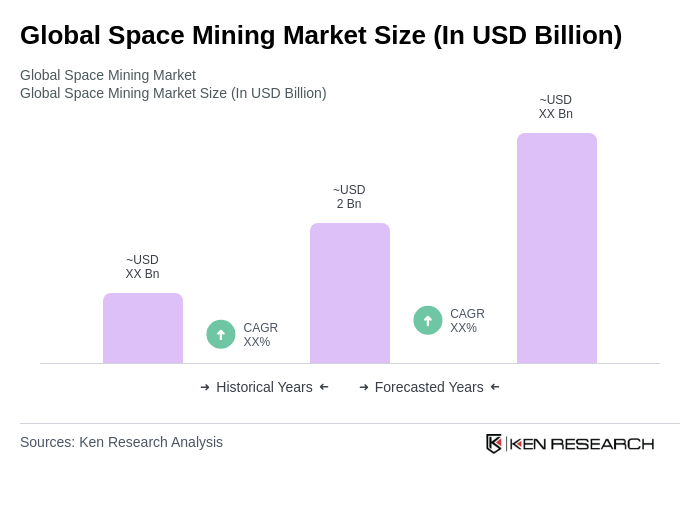
- The Global Space Mining Market is valued at USD 2 billion, based on a five-year historical analysis, reflecting published estimates that place the market around USD 1.99–2.05 billion in recent assessments . This growth is primarily driven by advancements in space exploration technologies, increasing investments from both government and private sectors, and the rising demand for rare minerals and in-situ resources (notably water/ice for propellant and life support). Agencies and commercial firms are advancing ISRU demonstrators, lunar payload contracts, and prospecting missions that underpin near-term revenue streams such as payload services, ISRU tech development, and regolith handling systems .
- Key players in this market include the United States, China, and the European Union, which dominate due to robust space programs, significant R&D funding, and public–private partnerships. The U.S. leads with NASA’s CLPS payload contracts and ISRU-focused collaborations; North America is repeatedly identified as a leading region given regulatory support and agency–startup partnerships. Europe advances via ESA and national initiatives (e.g., Luxembourg’s space resources framework) that catalyze private investment, while China accelerates lunar science, sample-return, and resource-utilization technology as part of its expanding deep-space program .
- In 2023, the U.S. did not enact a new “Space Resource Exploration and Utilization Act.” The operative U.S. framework recognizing private rights to space resources is the U.S. Commercial Space Launch Competitiveness Act of 2015 (Title IV—Space Resource Exploration and Utilization), and NASA has since reinforced practice through lunar regolith purchase contracts; internationally, Luxembourg’s 2017 law and the Artemis Accords support permissive resource utilization under international law .
Global Space Mining Market Segmentation
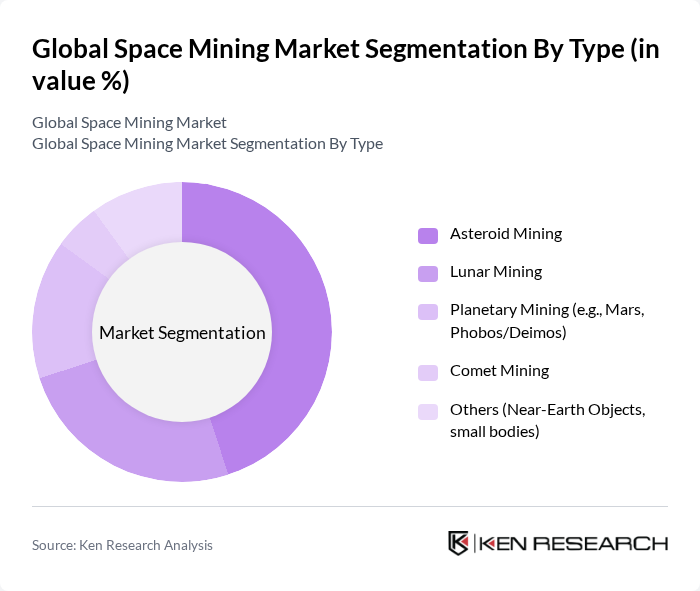
By Type:The space mining market is segmented into various types, including Asteroid Mining, Lunar Mining, Planetary Mining (e.g., Mars, Phobos/Deimos), Comet Mining, and Others (Near-Earth Objects, small bodies). Among these, Asteroid Mining is widely profiled as a leading strategic focus due to the abundance of valuable resources such as platinum group metals and water, alongside lower gravity wells that can reduce mission delta-v for certain targets; in parallel, Lunar Mining is gaining traction due to near-term ISRU prospects around polar volatiles and regolith-based materials for construction and propellant production .
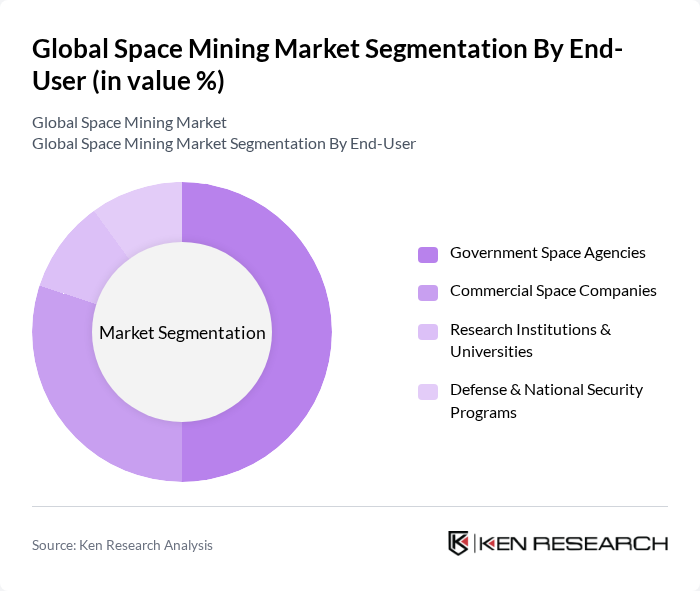
By End-User:The end-user segmentation includes Government Space Agencies, Commercial Space Companies, Research Institutions & Universities, and Defense & National Security Programs. Government Space Agencies are the leading segment, supported by substantial funding for lunar and asteroid prospecting, ISRU technology maturation, and payload delivery services that de-risk commercial participation; agency–startup partnerships and CLPS-style task orders are central to current market activity .
Global Space Mining Market Competitive Landscape
The Global Space Mining Market is characterized by a dynamic mix of regional and international players. Leading participants such as AstroForge, TransAstra Corporation, ispace, inc. (Japan), Lunar Outpost, OffWorld, Inc., Motiv Space Systems, Masten Space Systems, Honeybee Robotics, Asteroid Mining Corporation, Karman+ (Karman Plus), Planetary Resources, Inc. (legacy assets), Deep Space Industries (legacy, now part of Bradford Space), NASA (National Aeronautics and Space Administration), European Space Agency (ESA), Luxembourg Space Agency (LSA) contribute to innovation, geographic expansion, and service delivery in this space .
Global Space Mining Market Industry Analysis
Growth Drivers
- Increasing Demand for Rare Earth Elements:The global demand for rare earth elements (REEs) is projected to reach 350,000 metric tons, driven by their critical role in electronics, renewable energy, and defense technologies. The U.S. Geological Survey reported that the market for REEs is expected to grow significantly, with a compound annual growth rate (CAGR) of 8% from 2020 to 2024. This surge in demand is propelling interest in space mining as a viable source of these essential materials.
- Technological Advancements in Space Exploration:Investment in space exploration technologies is expected to exceed $120 billion, with advancements in propulsion systems, robotics, and AI enhancing the feasibility of space mining. NASA's Artemis program aims to establish a sustainable human presence on the Moon, which will facilitate the extraction of lunar resources. These technological innovations are crucial for reducing costs and increasing the efficiency of space mining operations.
- Government Investments in Space Programs:Governments worldwide are projected to allocate over $25 billion to space programs, reflecting a growing recognition of the strategic importance of space resources. The European Space Agency and NASA are leading initiatives to explore asteroids and the Moon for mining opportunities. This financial commitment is expected to stimulate research and development, paving the way for commercial space mining ventures and partnerships with private companies.
Market Challenges
- High Initial Investment Costs:The initial investment required for space mining operations is estimated to be around $1 billion per mission, which poses a significant barrier to entry for many companies. This high cost is primarily due to the need for advanced spacecraft, mining equipment, and the development of supporting infrastructure. As a result, only a few well-funded organizations can afford to undertake these ambitious projects, limiting market participation.
- Regulatory Uncertainties:The regulatory landscape for space mining remains ambiguous, with no comprehensive framework governing resource extraction in outer space. The Outer Space Treaty of 1967, which has been signed by over 100 countries, does not explicitly address commercial mining rights. This lack of clarity creates uncertainty for investors and companies, potentially hindering the growth of the space mining sector as stakeholders await clearer regulations.
Global Space Mining Market Future Outlook
The future of space mining appears promising, driven by technological advancements and increasing collaboration among nations. As countries invest in space exploration, the potential for resource extraction from asteroids and the Moon is becoming more viable. Innovations in robotics and automation are expected to enhance operational efficiency, while partnerships between private companies and government agencies will likely accelerate the development of sustainable mining practices, ensuring a balanced approach to resource utilization in space.
Market Opportunities
- Development of In-Situ Resource Utilization:The concept of in-situ resource utilization (ISRU) is gaining traction, with potential savings of up to 50% in mission costs by utilizing local resources. This approach allows for the extraction and processing of materials on-site, reducing the need for transporting resources from Earth. Companies focusing on ISRU technologies are well-positioned to capitalize on this emerging trend in space mining.
- Partnerships with Space Agencies:Collaborations between private companies and space agencies are expected to create significant opportunities in the space mining sector. For instance, partnerships with NASA and ESA can provide access to funding, technology, and expertise. Such alliances can facilitate the development of innovative mining technologies and enhance the overall success rate of space mining missions, making them more attractive to investors.
Scope of the Report
| Segment | Sub-Segments |
|---|---|
| By Type | Asteroid Mining Lunar Mining Planetary Mining (e.g., Mars, Phobos/Deimos) Comet Mining Others (Near-Earth Objects, small bodies) |
| By End-User | Government Space Agencies Commercial Space Companies Research Institutions & Universities Defense & National Security Programs |
| By Resource Type | Water/Ice (for propellant and life support) Platinum Group Metals (PGMs) Industrial Metals (Nickel, Iron, Cobalt) Silicates & Regolith (construction feedstock) Rare Earth Elements |
| By Mission Type | Prospecting/Reconnaissance Robotic Extraction & Processing Human-Assisted Operations Sample Return & Demonstration Missions |
| By Funding Source | Government Funding & Grants Venture Capital & Private Equity Public-Private Partnerships Strategic Corporate Investments |
| By Technology Used | Robotic Mining Systems & Manipulators Autonomous Navigation, AI & Machine Learning Remote Sensing & In-Situ Prospecting (ISR/ISRU) Drilling, Excavation & Material Processing Units Spacecraft, Landers & Transfer Vehicles |
| By Market Maturity | Concept/Demonstration Early Commercialization Growth Mature |
Key Target Audience
Investors and Venture Capitalist Firms
Government and Regulatory Bodies (e.g., NASA, European Space Agency)
Aerospace and Defense Contractors
Mining and Resource Extraction Companies
Space Technology Startups
Space Exploration Agencies (e.g., ISRO, Roscosmos)
Environmental and Sustainability Organizations
Insurance Companies Specializing in Space Ventures
Players Mentioned in the Report:
AstroForge
TransAstra Corporation
ispace, inc. (Japan)
Lunar Outpost
OffWorld, Inc.
Motiv Space Systems
Masten Space Systems
Honeybee Robotics
Asteroid Mining Corporation
Karman+ (Karman Plus)
Planetary Resources, Inc. (legacy assets)
Deep Space Industries (legacy, now part of Bradford Space)
NASA (National Aeronautics and Space Administration)
European Space Agency (ESA)
Luxembourg Space Agency (LSA)
Table of Contents
Market Assessment Phase
1. Executive Summary and Approach
2. Global Space Mining Market Overview
2.1 Key Insights and Strategic Recommendations
2.2 Global Space Mining Market Overview
2.3 Definition and Scope
2.4 Evolution of Market Ecosystem
2.5 Timeline of Key Regulatory Milestones
2.6 Value Chain & Stakeholder Mapping
2.7 Business Cycle Analysis
2.8 Policy & Incentive Landscape
3. Global Space Mining Market Analysis
3.1 Growth Drivers
3.1.1 Increasing Demand for Rare Earth Elements
3.1.2 Technological Advancements in Space Exploration
3.1.3 Government Investments in Space Programs
3.1.4 Rising Private Sector Participation
3.2 Market Challenges
3.2.1 High Initial Investment Costs
3.2.2 Regulatory Uncertainties
3.2.3 Technical Feasibility Issues
3.2.4 Environmental Concerns
3.3 Market Opportunities
3.3.1 Development of In-Situ Resource Utilization
3.3.2 Partnerships with Space Agencies
3.3.3 Expansion into Asteroid Mining
3.3.4 Innovations in Spacecraft Technology
3.4 Market Trends
3.4.1 Growth of Space Startups
3.4.2 Increased Collaboration between Nations
3.4.3 Focus on Sustainable Mining Practices
3.4.4 Advancements in Robotics and Automation
3.5 Government Regulation
3.5.1 Outer Space Treaty Compliance
3.5.2 National Space Policy Frameworks
3.5.3 Licensing Requirements for Space Mining
3.5.4 Environmental Protection Regulations
4. SWOT Analysis
5. Stakeholder Analysis
6. Porter's Five Forces Analysis
7. Global Space Mining Market Market Size, 2019-2024
7.1 By Value
7.2 By Volume
7.3 By Average Selling Price
8. Global Space Mining Market Segmentation
8.1 By Type
8.1.1 Asteroid Mining
8.1.2 Lunar Mining
8.1.3 Planetary Mining (e.g., Mars, Phobos/Deimos)
8.1.4 Comet Mining
8.1.5 Others (Near-Earth Objects, small bodies)
8.2 By End-User
8.2.1 Government Space Agencies
8.2.2 Commercial Space Companies
8.2.3 Research Institutions & Universities
8.2.4 Defense & National Security Programs
8.3 By Resource Type
8.3.1 Water/Ice (for propellant and life support)
8.3.2 Platinum Group Metals (PGMs)
8.3.3 Industrial Metals (Nickel, Iron, Cobalt)
8.3.4 Silicates & Regolith (construction feedstock)
8.3.5 Rare Earth Elements
8.4 By Mission Type
8.4.1 Prospecting/Reconnaissance
8.4.2 Robotic Extraction & Processing
8.4.3 Human-Assisted Operations
8.4.4 Sample Return & Demonstration Missions
8.5 By Funding Source
8.5.1 Government Funding & Grants
8.5.2 Venture Capital & Private Equity
8.5.3 Public-Private Partnerships
8.5.4 Strategic Corporate Investments
8.6 By Technology Used
8.6.1 Robotic Mining Systems & Manipulators
8.6.2 Autonomous Navigation, AI & Machine Learning
8.6.3 Remote Sensing & In-Situ Prospecting (ISR/ISRU)
8.6.4 Drilling, Excavation & Material Processing Units
8.6.5 Spacecraft, Landers & Transfer Vehicles
8.7 By Market Maturity
8.7.1 Concept/Demonstration
8.7.2 Early Commercialization
8.7.3 Growth
8.7.4 Mature
9. Global Space Mining Market Competitive Analysis
9.1 Market Share of Key Players
9.2 Cross Comparison of Key Players
9.2.1 Company Name
9.2.2 Stage of Development (Demo, Early Revenue, Growth)
9.2.3 Fundraising to Date (USD)
9.2.4 Contracted Backlog/LOIs (USD or count)
9.2.5 Demonstrated ISRU Capability (TRL level)
9.2.6 Mission Success Rate (% of attempts)
9.2.7 Partnerships with Agencies/Primes (count/quality)
9.2.8 Patents/Key IP Assets (count)
9.2.9 Unit Economics for Propellant/Resource ($/kg in space)
9.2.10 Cash Runway (months) & Burn Rate (USD/month)
9.2.11 Launch/Mission Cadence (per year)
9.2.12 Time-to-Resource Delivery (mission timeline, months)
9.3 SWOT Analysis of Top Players
9.4 Pricing Analysis
9.5 Detailed Profile of Major Companies
9.5.1 AstroForge
9.5.2 TransAstra Corporation
9.5.3 ispace, inc. (Japan)
9.5.4 Lunar Outpost
9.5.5 OffWorld, Inc.
9.5.6 Motiv Space Systems
9.5.7 Masten Space Systems
9.5.8 Honeybee Robotics
9.5.9 Asteroid Mining Corporation
9.5.10 Karman+ (Karman Plus)
9.5.11 Planetary Resources, Inc. (legacy assets)
9.5.12 Deep Space Industries (legacy, now part of Bradford Space)
9.5.13 NASA (National Aeronautics and Space Administration)
9.5.14 European Space Agency (ESA)
9.5.15 Luxembourg Space Agency (LSA)
10. Global Space Mining Market End-User Analysis
10.1 Procurement Behavior of Key Ministries
10.1.1 Government Space Agencies
10.1.2 Defense Ministries
10.1.3 Research Institutions
10.1.4 Private Sector Partnerships
10.2 Corporate Spend on Infrastructure & Energy
10.2.1 Investment in Space Infrastructure
10.2.2 Funding for Research and Development
10.2.3 Expenditure on Technology Acquisition
10.3 Pain Point Analysis by End-User Category
10.3.1 Budget Constraints
10.3.2 Technical Limitations
10.3.3 Regulatory Hurdles
10.4 User Readiness for Adoption
10.4.1 Awareness of Space Mining Benefits
10.4.2 Training and Skill Development Needs
10.4.3 Infrastructure Readiness
10.5 Post-Deployment ROI and Use Case Expansion
10.5.1 Measurement of ROI
10.5.2 Potential for Scaling Operations
10.5.3 Expansion into New Markets
11. Global Space Mining Market Future Size, 2025-2030
11.1 By Value
11.2 By Volume
11.3 By Average Selling Price
Go-To-Market Strategy Phase
1. Whitespace Analysis + Business Model Canvas
1.1 Market Gaps Identification
1.2 Business Model Development
1.3 Value Proposition Analysis
1.4 Competitive Landscape Overview
2. Marketing and Positioning Recommendations
2.1 Branding Strategies
2.2 Product USPs
2.3 Target Audience Identification
3. Distribution Plan
3.1 Urban Retail Strategies
3.2 Rural NGO Tie-ups
3.3 Online Distribution Channels
4. Channel & Pricing Gaps
4.1 Underserved Routes
4.2 Pricing Bands Analysis
4.3 Competitor Pricing Strategies
5. Unmet Demand & Latent Needs
5.1 Category Gaps
5.2 Consumer Segments Analysis
5.3 Emerging Trends Identification
6. Customer Relationship
6.1 Loyalty Programs
6.2 After-sales Service
6.3 Customer Feedback Mechanisms
7. Value Proposition
7.1 Sustainability Initiatives
7.2 Integrated Supply Chains
7.3 Competitive Advantages
8. Key Activities
8.1 Regulatory Compliance
8.2 Branding Efforts
8.3 Distribution Setup
9. Entry Strategy Evaluation
9.1 Domestic Market Entry Strategy
9.1.1 Product Mix Considerations
9.1.2 Pricing Band Strategy
9.1.3 Packaging Solutions
9.2 Export Entry Strategy
9.2.1 Target Countries Identification
9.2.2 Compliance Roadmap Development
10. Entry Mode Assessment
10.1 Joint Ventures
10.2 Greenfield Investments
10.3 Mergers & Acquisitions
10.4 Distributor Model Evaluation
11. Capital and Timeline Estimation
11.1 Capital Requirements Analysis
11.2 Timelines for Implementation
12. Control vs Risk Trade-Off
12.1 Ownership vs Partnerships
12.2 Risk Management Strategies
13. Profitability Outlook
13.1 Breakeven Analysis
13.2 Long-term Sustainability Strategies
14. Potential Partner List
14.1 Distributors
14.2 Joint Ventures
14.3 Acquisition Targets
15. Execution Roadmap
15.1 Phased Plan for Market Entry
15.1.1 Market Setup
15.1.2 Market Entry
15.1.3 Growth Acceleration
15.1.4 Scale & Stabilize
15.2 Key Activities and Milestones
15.2.1 Milestone Planning
15.2.2 Activity Tracking
Research Methodology
Phase 1: Approach1
Desk Research
- Analysis of existing market reports and white papers on space mining trends
- Review of scientific publications and journals focusing on asteroid mining technologies
- Examination of government and international space agency reports on space resource utilization
Primary Research
- Interviews with industry experts and thought leaders in space mining
- Surveys targeting executives from aerospace companies involved in space exploration
- Field interviews with researchers and engineers working on space mining projects
Validation & Triangulation
- Cross-validation of findings through multiple expert interviews and secondary data sources
- Triangulation of market data with technological advancements and investment trends
- Sanity checks through peer reviews and expert panel discussions
Phase 2: Market Size Estimation1
Top-down Assessment
- Estimation of total addressable market based on global space exploration budgets
- Segmentation by potential resource types (e.g., water, metals, rare minerals)
- Incorporation of projected growth rates from space industry forecasts
Bottom-up Modeling
- Volume estimates based on planned missions and payload capacities of spacecraft
- Cost analysis derived from historical data on space mission expenditures
- Revenue projections based on potential market prices for extracted resources
Forecasting & Scenario Analysis
- Multi-factor regression analysis incorporating technological advancements and investment trends
- Scenario modeling based on regulatory changes and international collaboration in space mining
- Baseline, optimistic, and pessimistic forecasts through 2035
Phase 3: CATI Sample Composition1
| Scope Item/Segment | Sample Size | Target Respondent Profiles |
|---|---|---|
| Asteroid Mining Initiatives | 120 | Space Engineers, Project Managers |
| Space Resource Utilization Technologies | 90 | Research Scientists, Technology Developers |
| Investment in Space Mining Startups | 60 | Venture Capitalists, Financial Analysts |
| Regulatory Frameworks for Space Mining | 50 | Policy Makers, Legal Experts in Space Law |
| International Collaboration in Space Exploration | 70 | Government Officials, Space Agency Representatives |
Frequently Asked Questions
What is the current value of the Global Space Mining Market?
The Global Space Mining Market is valued at approximately USD 2 billion, based on recent assessments and a five-year historical analysis. This valuation reflects the growing interest and investment in space exploration technologies and resource extraction.
What are the main drivers of growth in the space mining market?
Which countries are leading in the space mining sector?
What types of mining are included in the Global Space Mining Market?
Other Regional/Country Reports
Indonesia Space Mining Market
Malaysia Space Mining Market
APAC Space Mining Market
SEA Space Mining Market
Why Buy From Us?

What makes us stand out is that our consultants follow Robust, Refine and Result (RRR) methodology. Robust for clear definitions, approaches and sanity checking, Refine for differentiating respondents' facts and opinions, and Result for presenting data with story.

We have set a benchmark in the industry by offering our clients with syndicated and customized market research reports featuring coverage of entire market as well as meticulous research and analyst insights.

While we don't replace traditional research, we flip the method upside down. Our dual approach of Top Bottom & Bottom Top ensures quality deliverable by not just verifying company fundamentals but also looking at the sector and macroeconomic factors.

With one step in the future, our research team constantly tries to show you the bigger picture. We help with some of the tough questions you may encounter along the way: How is the industry positioned? Best marketing channel? KPI's of competitors? By aligning every element, we help maximize success.

Our report gives you instant access to the answers and sources that other companies might choose to hide. We elaborate each steps of research methodology we have used and showcase you the sample size to earn your trust.

If you need any support, we are here! We pride ourselves on universe strength, data quality, and quick, friendly, and professional service.