Region:Global
Author(s):Shubham
Product Code:KRAC0809
Pages:90
Published On:August 2025
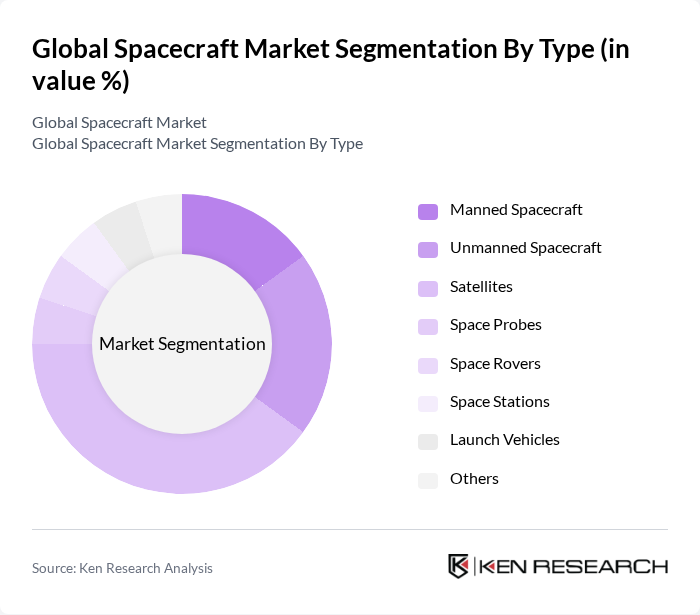
By Type:The spacecraft market is segmented into Manned Spacecraft, Unmanned Spacecraft, Satellites, Space Probes, Space Rovers, Space Stations, Launch Vehicles, and Others. Among these,Satellitesdominate the market due to their critical role in communication, navigation, and earth observation. The increasing reliance on satellite technology for applications such as telecommunications, internet connectivity, remote sensing, and weather forecasting has led to a significant rise in satellite launches and deployments, with the number of operational satellites increasing more than threefold in recent years.
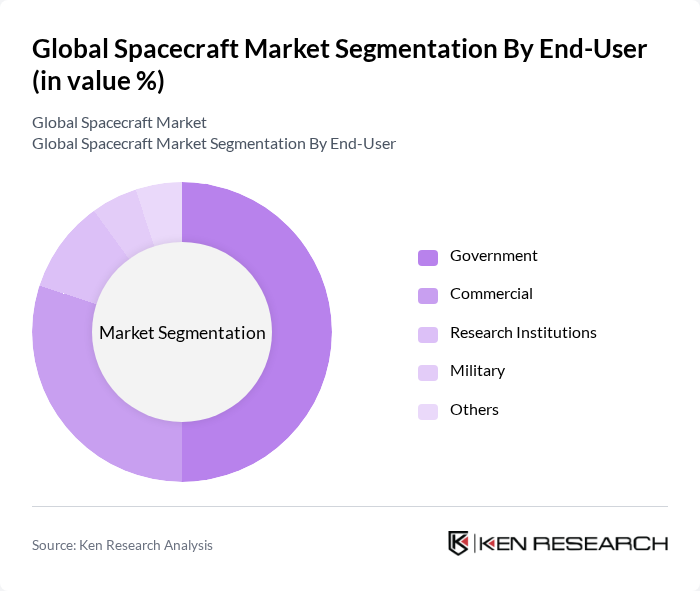
By End-User:The market is further segmented by end-user into Government, Commercial, Research Institutions, Military, and Others. TheGovernmentsegment holds a significant share, driven by national space programs, defense initiatives, and international collaborations. Governments worldwide are investing heavily in space technology for national security, scientific research, and global positioning systems, leading to increased demand for various spacecraft. The commercial segment is the fastest-growing, propelled by private sector innovation and new business models in satellite services, launch operations, and deep space exploration.
The Global Spacecraft Market is characterized by a dynamic mix of regional and international players. Leading participants such as Boeing, Lockheed Martin, Northrop Grumman, Airbus Defence and Space, SpaceX, Thales Alenia Space, Raytheon Technologies, Blue Origin, Rocket Lab, Maxar Technologies, Planet Labs, Arianespace, China Aerospace Science and Technology Corporation (CASC), Mitsubishi Heavy Industries, Indian Space Research Organisation (ISRO) / Antrix Corporation, Surrey Satellite Technology Limited (SSTL), OHB SE, Israel Aerospace Industries (IAI), JAXA (Japan Aerospace Exploration Agency), SES S.A., Iridium Communications, SSL (Space Systems Loral) contribute to innovation, geographic expansion, and service delivery in this space.
The future of the spacecraft market appears promising, driven by technological advancements and increasing investments. The shift towards reusable launch vehicles is expected to lower costs and enhance accessibility, while the integration of AI and machine learning will optimize spacecraft operations. Additionally, the focus on sustainability will lead to eco-friendly practices in spacecraft design and operation, ensuring compliance with environmental standards and attracting more stakeholders to the industry.
| Segment | Sub-Segments |
|---|---|
| By Type | Manned Spacecraft Unmanned Spacecraft Satellites Space Probes Space Rovers Space Stations Launch Vehicles Others |
| By End-User | Government Commercial Research Institutions Military Others |
| By Application | Communication Earth Observation Scientific Research Navigation Meteorology Space Exploration Transportation (Cargo & Crew) Others |
| By Component | Payloads Propulsion Systems Power Systems Communication Systems Attitude Control Modules Onboard Computers Thermal Control Systems Others |
| By Sales Channel | Direct Sales Distributors Online Sales Others |
| By Distribution Mode | Ground Launch Air Launch Sea Launch Others |
| By Price Range | Low-End Mid-Range High-End Others |
| By Geography | North America Europe Asia-Pacific Latin America Middle East and Africa |
| Scope Item/Segment | Sample Size | Target Respondent Profiles |
|---|---|---|
| Satellite Manufacturing | 100 | Production Managers, R&D Engineers |
| Space Exploration Programs | 80 | Project Directors, Mission Planners |
| Launch Services Providers | 60 | Operations Managers, Business Development Executives |
| Space Technology Innovations | 50 | Technology Officers, Research Scientists |
| Government Space Agencies | 70 | Policy Makers, Program Managers |
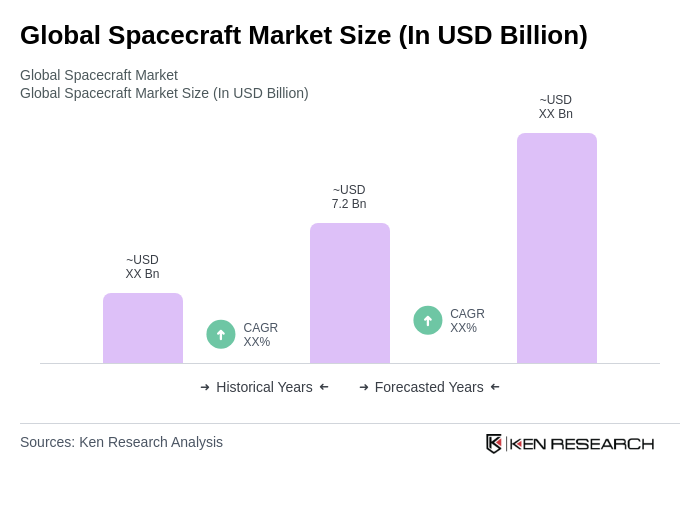
The Global Spacecraft Market is valued at approximately USD 7.2 billion, driven by advancements in satellite technology, reusable launch vehicles, and increasing demand for satellite-based services such as communications and earth observation.

What makes us stand out is that our consultants follow Robust, Refine and Result (RRR) methodology. Robust for clear definitions, approaches and sanity checking, Refine for differentiating respondents' facts and opinions, and Result for presenting data with story.

We have set a benchmark in the industry by offering our clients with syndicated and customized market research reports featuring coverage of entire market as well as meticulous research and analyst insights.

While we don't replace traditional research, we flip the method upside down. Our dual approach of Top Bottom & Bottom Top ensures quality deliverable by not just verifying company fundamentals but also looking at the sector and macroeconomic factors.

With one step in the future, our research team constantly tries to show you the bigger picture. We help with some of the tough questions you may encounter along the way: How is the industry positioned? Best marketing channel? KPI's of competitors? By aligning every element, we help maximize success.

Our report gives you instant access to the answers and sources that other companies might choose to hide. We elaborate each steps of research methodology we have used and showcase you the sample size to earn your trust.

If you need any support, we are here! We pride ourselves on universe strength, data quality, and quick, friendly, and professional service.













