About the Report
Base Year 2024Listen to the audio summary
Global Specialty Vehicle Market Overview
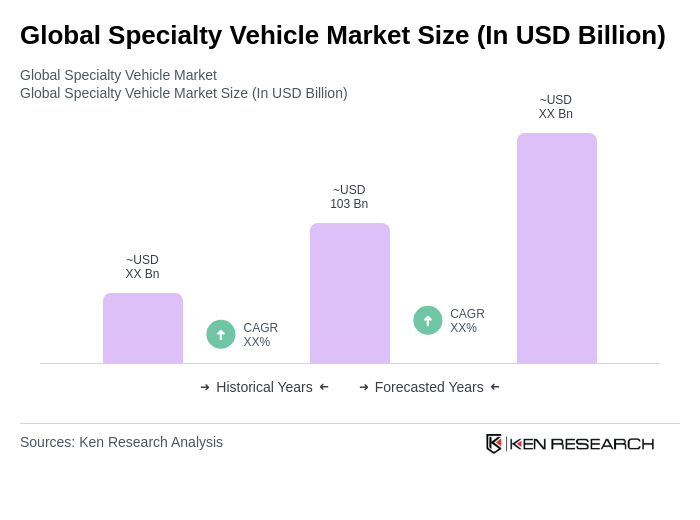
- The Global Specialty Vehicle Market is valued at USD 103 billion, based on a five-year historical analysis. This growth is primarily driven by increasing demand for specialized vehicles across various sectors, including emergency services, healthcare, construction, logistics, and public utilities. The rise in urbanization, infrastructure development, and the expansion of e-commerce have further fueled the need for utility and recreational vehicles, contributing to the market's expansion. Additionally, the integration of advanced technologies such as telematics, electric drivetrains, and automation is enhancing vehicle performance and operational efficiency, supporting sustained market growth .
- Key players in this market include the United States, Germany, and China, which dominate due to their advanced manufacturing capabilities, robust infrastructure, and significant investments in emergency, utility, and logistics services. The presence of major automotive manufacturers and a growing focus on innovation in vehicle technology, including alternative powertrains and intelligent connectivity, also play a crucial role in their market leadership .
- In recent years, the U.S. government and other major markets have implemented updated safety and environmental standards for emergency and specialty vehicles. These regulations aim to enhance public safety and reduce emissions, requiring manufacturers to invest in advanced technologies and sustainable practices in vehicle production, such as electrification and improved emission controls .
Global Specialty Vehicle Market Segmentation
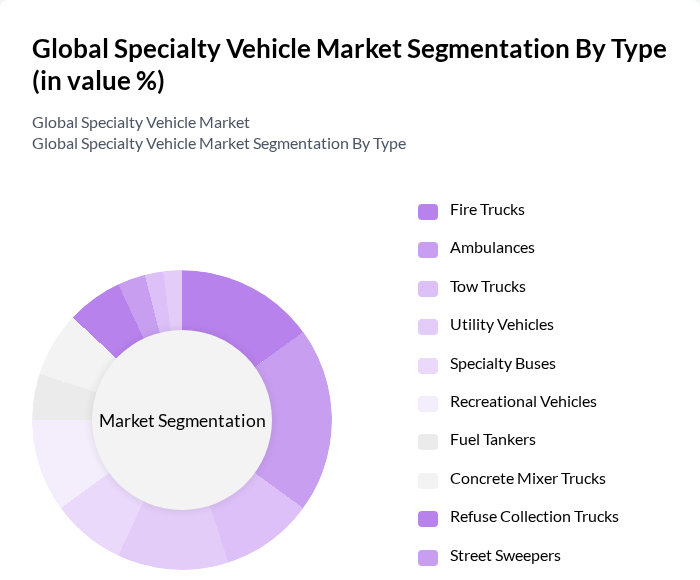
By Type:The market is segmented into various types of specialty vehicles, including Fire Trucks, Ambulances, Tow Trucks, Utility Vehicles, Specialty Buses, Recreational Vehicles, Fuel Tankers, Concrete Mixer Trucks, Refuse Collection Trucks, Street Sweepers, Winter Maintenance Vehicles, and Others. Each type serves specific functions and industries, contributing to the overall market dynamics. Fire Trucks and Ambulances are essential for emergency response, while Utility Vehicles and Specialty Buses support infrastructure and public transport. Recreational Vehicles address leisure and tourism needs, and vehicles like Fuel Tankers and Concrete Mixer Trucks are critical for industrial and construction operations .
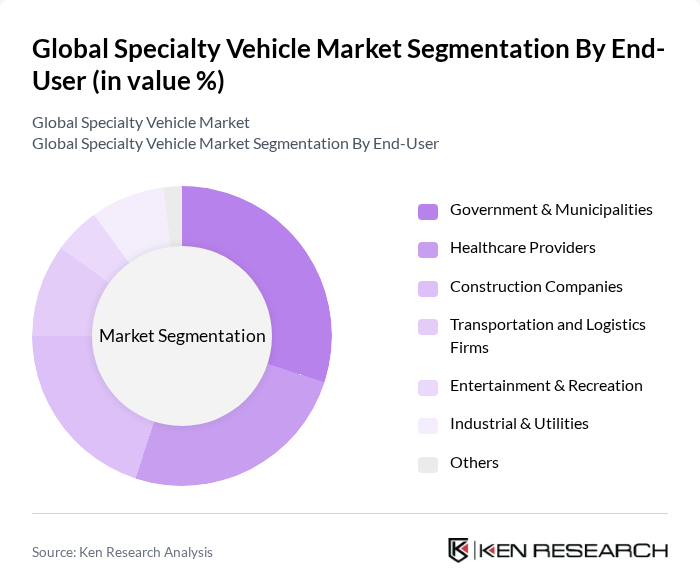
By End-User:The market is segmented by end-users, including Government & Municipalities, Healthcare Providers, Construction Companies, Transportation and Logistics Firms, Entertainment & Recreation, Industrial & Utilities, and Others. Each end-user category has distinct requirements and influences the demand for specialty vehicles. Government & Municipalities are primary buyers for emergency and utility vehicles, Healthcare Providers drive demand for ambulances and mobile clinics, while Construction Companies require a range of specialized vehicles for project execution. Transportation and Logistics Firms increasingly seek customized vehicles for last-mile delivery and freight, and Industrial & Utilities focus on vehicles for maintenance and operational support .
Global Specialty Vehicle Market Competitive Landscape
The Global Specialty Vehicle Market is characterized by a dynamic mix of regional and international players. Leading participants such as Daimler Truck AG, Volvo Group, Oshkosh Corporation, PACCAR Inc., Navistar International Corporation, Isuzu Motors Ltd., Hino Motors, Ltd., MAN Truck & Bus SE, Mitsubishi Fuso Truck and Bus Corporation, BYD Company Limited, Workhorse Group Inc., Altec Industries, Inc., Terex Corporation, Rosenbauer International AG, and REV Group, Inc. contribute to innovation, geographic expansion, and service delivery in this space .
Global Specialty Vehicle Market Industry Analysis
Growth Drivers
- Increasing Demand for Customization:The global specialty vehicle market is witnessing a surge in demand for customized vehicles, driven by consumer preferences for unique features. In future, the customization segment is projected to account for approximately $15 billion, reflecting a 10% increase from the previous period. This trend is supported by the rise of e-commerce, where businesses seek tailored delivery solutions. Additionally, 60% of consumers express a willingness to pay more for personalized vehicles, indicating a robust market potential for customization.
- Technological Advancements in Vehicle Design:Innovations in vehicle design are propelling the specialty vehicle market forward. In future, investments in advanced manufacturing technologies, such as 3D printing and AI-driven design, are expected to exceed $5 billion. These technologies enhance production efficiency and reduce lead times, allowing manufacturers to respond swiftly to market demands. Furthermore, 70% of industry leaders report that integrating smart technologies into vehicle design has improved operational efficiency, further driving market growth.
- Rising Environmental Regulations:Stricter environmental regulations are shaping the specialty vehicle market landscape. In future, compliance with emission standards is projected to cost manufacturers around $3 billion, prompting a shift towards eco-friendly vehicles. Governments worldwide are implementing policies that incentivize the production of low-emission vehicles, with 40% of new specialty vehicles expected to meet these standards. This regulatory push not only fosters innovation but also aligns with consumer preferences for sustainable transportation solutions.
Market Challenges
- High Manufacturing Costs:The specialty vehicle market faces significant challenges due to high manufacturing costs, which are projected to reach $20 billion in future. Factors contributing to these costs include the use of advanced materials and technologies, which, while enhancing vehicle performance, also inflate production expenses. Additionally, fluctuating raw material prices, particularly for aluminum and steel, further exacerbate cost pressures, making it difficult for manufacturers to maintain competitive pricing.
- Supply Chain Disruptions:Ongoing supply chain disruptions continue to pose a challenge for the specialty vehicle market. In future, it is estimated that supply chain issues could lead to a loss of $10 billion in potential revenue. Factors such as geopolitical tensions and the lingering effects of the COVID-19 pandemic have resulted in delays and increased costs for critical components. This instability hampers manufacturers' ability to meet growing demand and maintain production schedules.
Global Specialty Vehicle Market Future Outlook
The future of the specialty vehicle market appears promising, driven by technological advancements and a growing emphasis on sustainability. As manufacturers increasingly adopt electric and hybrid technologies, the market is expected to see a significant transformation. Additionally, the integration of smart technologies will enhance vehicle functionality and safety. With a projected increase in consumer demand for customized and eco-friendly vehicles, the market is poised for substantial growth, particularly in emerging economies where infrastructure development is accelerating.
Market Opportunities
- Expansion into Emerging Markets:Emerging markets present a lucrative opportunity for specialty vehicle manufacturers. In future, these regions are expected to contribute an additional $8 billion to the market, driven by urbanization and increasing disposable incomes. As infrastructure improves, demand for specialized vehicles in sectors like logistics and public transport will rise, creating new avenues for growth.
- Development of Electric Specialty Vehicles:The shift towards electric specialty vehicles is a significant opportunity for market players. With global electric vehicle sales projected to reach 10 million units in future, manufacturers can capitalize on this trend by developing electric variants of specialty vehicles. This transition not only aligns with regulatory requirements but also meets consumer demand for sustainable transportation options, potentially increasing market share.
Scope of the Report
| Segment | Sub-Segments |
|---|---|
| By Type | Fire Trucks Ambulances Tow Trucks Utility Vehicles Specialty Buses Recreational Vehicles Fuel Tankers Concrete Mixer Trucks Refuse Collection Trucks Street Sweepers Winter Maintenance Vehicles Others |
| By End-User | Government & Municipalities Healthcare Providers Construction Companies Transportation and Logistics Firms Entertainment & Recreation Industrial & Utilities Others |
| By Application | Emergency Services (Fire, Ambulance, Police) Construction and Maintenance Public Transport Waste Management Law Enforcement Fuel & Chemical Transport Others |
| By Fuel Type | Diesel Gasoline Electric Hybrid Hydrogen Fuel Cell Others |
| By Size | Light-Duty Vehicles Medium-Duty Vehicles Heavy-Duty Vehicles Others |
| By Customization Level | Fully Customized Semi-Customized Standard Models Others |
| By Region | North America Europe Asia-Pacific Latin America Middle East & Africa |
Key Target Audience
Investors and Venture Capitalist Firms
Government and Regulatory Bodies (e.g., National Highway Traffic Safety Administration, Environmental Protection Agency)
Manufacturers and Producers
Distributors and Retailers
Fleet Operators and Logistics Companies
Automotive Component Suppliers
Industry Associations (e.g., Specialty Equipment Market Association)
Financial Institutions
Players Mentioned in the Report:
Daimler Truck AG
Volvo Group
Oshkosh Corporation
PACCAR Inc.
Navistar International Corporation
Isuzu Motors Ltd.
Hino Motors, Ltd.
MAN Truck & Bus SE
Mitsubishi Fuso Truck and Bus Corporation
BYD Company Limited
Workhorse Group Inc.
Altec Industries, Inc.
Terex Corporation
Rosenbauer International AG
REV Group, Inc.
Table of Contents
Market Assessment Phase
1. Executive Summary and Approach
2. Global Specialty Vehicle Market Overview
2.1 Key Insights and Strategic Recommendations
2.2 Global Specialty Vehicle Market Overview
2.3 Definition and Scope
2.4 Evolution of Market Ecosystem
2.5 Timeline of Key Regulatory Milestones
2.6 Value Chain & Stakeholder Mapping
2.7 Business Cycle Analysis
2.8 Policy & Incentive Landscape
3. Global Specialty Vehicle Market Analysis
3.1 Growth Drivers
3.1.1 Increasing Demand for Customization
3.1.2 Technological Advancements in Vehicle Design
3.1.3 Rising Environmental Regulations
3.1.4 Growth in E-commerce and Delivery Services
3.2 Market Challenges
3.2.1 High Manufacturing Costs
3.2.2 Supply Chain Disruptions
3.2.3 Regulatory Compliance Issues
3.2.4 Limited Availability of Skilled Labor
3.3 Market Opportunities
3.3.1 Expansion into Emerging Markets
3.3.2 Development of Electric Specialty Vehicles
3.3.3 Partnerships with Technology Firms
3.3.4 Customization for Niche Markets
3.4 Market Trends
3.4.1 Shift Towards Sustainable Vehicles
3.4.2 Integration of Smart Technologies
3.4.3 Increasing Focus on Safety Features
3.4.4 Growth of Online Sales Channels
3.5 Government Regulation
3.5.1 Emission Standards Compliance
3.5.2 Safety Regulations for Specialty Vehicles
3.5.3 Incentives for Electric Vehicle Adoption
3.5.4 Import Tariffs on Specialty Vehicles
4. SWOT Analysis
5. Stakeholder Analysis
6. Porter's Five Forces Analysis
7. Global Specialty Vehicle Market Market Size, 2019-2024
7.1 By Value
7.2 By Volume
7.3 By Average Selling Price
8. Global Specialty Vehicle Market Segmentation
8.1 By Type
8.1.1 Fire Trucks
8.1.2 Ambulances
8.1.3 Tow Trucks
8.1.4 Utility Vehicles
8.1.5 Specialty Buses
8.1.6 Recreational Vehicles
8.1.7 Fuel Tankers
8.1.8 Concrete Mixer Trucks
8.1.9 Refuse Collection Trucks
8.1.10 Street Sweepers
8.1.11 Winter Maintenance Vehicles
8.1.12 Others
8.2 By End-User
8.2.1 Government & Municipalities
8.2.2 Healthcare Providers
8.2.3 Construction Companies
8.2.4 Transportation and Logistics Firms
8.2.5 Entertainment & Recreation
8.2.6 Industrial & Utilities
8.2.7 Others
8.3 By Application
8.3.1 Emergency Services (Fire, Ambulance, Police)
8.3.2 Construction and Maintenance
8.3.3 Public Transport
8.3.4 Waste Management
8.3.5 Law Enforcement
8.3.6 Fuel & Chemical Transport
8.3.7 Others
8.4 By Fuel Type
8.4.1 Diesel
8.4.2 Gasoline
8.4.3 Electric
8.4.4 Hybrid
8.4.5 Hydrogen Fuel Cell
8.4.6 Others
8.5 By Size
8.5.1 Light-Duty Vehicles
8.5.2 Medium-Duty Vehicles
8.5.3 Heavy-Duty Vehicles
8.5.4 Others
8.6 By Customization Level
8.6.1 Fully Customized
8.6.2 Semi-Customized
8.6.3 Standard Models
8.6.4 Others
8.7 By Region
8.7.1 North America
8.7.2 Europe
8.7.3 Asia-Pacific
8.7.4 Latin America
8.7.5 Middle East & Africa
9. Global Specialty Vehicle Market Competitive Analysis
9.1 Market Share of Key Players
9.2 KPIs for Cross Comparison of Key Players
9.2.1 Revenue (USD Million)
9.2.2 Production Volume (Units)
9.2.3 Market Share (%)
9.2.4 Geographic Presence (Number of Countries/Regions)
9.2.5 R&D Expenditure (% of Revenue)
9.2.6 Product Portfolio Breadth (Number of Specialty Vehicle Types)
9.2.7 Adoption Rate of Alternative Powertrains (Electric/Hybrid/Hydrogen)
9.2.8 Major End-User Segments Served
9.2.9 Strategic Partnerships & M&A Activity
9.2.10 Aftermarket & Service Revenue (%)
9.3 SWOT Analysis of Top Players
9.4 Pricing Analysis
9.5 Detailed Profile of Major Companies
9.5.1 Daimler Truck AG
9.5.2 Volvo Group
9.5.3 Oshkosh Corporation
9.5.4 PACCAR Inc.
9.5.5 Navistar International Corporation
9.5.6 Isuzu Motors Ltd.
9.5.7 Hino Motors, Ltd.
9.5.8 MAN Truck & Bus SE
9.5.9 Mitsubishi Fuso Truck and Bus Corporation
9.5.10 BYD Company Limited
9.5.11 Workhorse Group Inc.
9.5.12 Altec Industries, Inc.
9.5.13 Terex Corporation
9.5.14 Rosenbauer International AG
9.5.15 REV Group, Inc.
10. Global Specialty Vehicle Market End-User Analysis
10.1 Procurement Behavior of Key Ministries
10.1.1 Government Procurement Trends
10.1.2 Budget Allocations for Specialty Vehicles
10.1.3 Decision-Making Processes
10.1.4 Vendor Selection Criteria
10.2 Corporate Spend on Infrastructure & Energy
10.2.1 Investment Trends in Specialty Vehicles
10.2.2 Budgeting for Fleet Expansion
10.2.3 Cost-Benefit Analysis Practices
10.2.4 Long-term Financial Commitments
10.3 Pain Point Analysis by End-User Category
10.3.1 Challenges Faced by Government Users
10.3.2 Issues in Healthcare Sector
10.3.3 Construction Industry Pain Points
10.3.4 Logistics and Transportation Challenges
10.4 User Readiness for Adoption
10.4.1 Assessment of Current Fleet Capabilities
10.4.2 Willingness to Invest in New Technologies
10.4.3 Training and Support Needs
10.4.4 Feedback Mechanisms for User Experience
10.5 Post-Deployment ROI and Use Case Expansion
10.5.1 Measuring ROI for Specialty Vehicles
10.5.2 Case Studies of Successful Deployments
10.5.3 Expansion Opportunities Post-Deployment
10.5.4 Long-term Value Assessment
11. Global Specialty Vehicle Market Future Size, 2025-2030
11.1 By Value
11.2 By Volume
11.3 By Average Selling Price
Go-To-Market Strategy Phase
1. Whitespace Analysis + Business Model Canvas
1.1 Market Gaps Identification
1.2 Business Model Development
2. Marketing and Positioning Recommendations
2.1 Branding Strategies
2.2 Product USPs
3. Distribution Plan
3.1 Urban Retail Strategies
3.2 Rural NGO Tie-ups
4. Channel & Pricing Gaps
4.1 Underserved Routes
4.2 Pricing Bands Analysis
5. Unmet Demand & Latent Needs
5.1 Category Gaps
5.2 Consumer Segments
6. Customer Relationship
6.1 Loyalty Programs
6.2 After-sales Service
7. Value Proposition
7.1 Sustainability Initiatives
7.2 Integrated Supply Chains
8. Key Activities
8.1 Regulatory Compliance
8.2 Branding Efforts
8.3 Distribution Setup
9. Entry Strategy Evaluation
9.1 Domestic Market Entry Strategy
9.1.1 Product Mix Considerations
9.1.2 Pricing Band Strategy
9.1.3 Packaging Options
9.2 Export Entry Strategy
9.2.1 Target Countries Identification
9.2.2 Compliance Roadmap Development
10. Entry Mode Assessment
10.1 Joint Ventures
10.2 Greenfield Investments
10.3 Mergers & Acquisitions
10.4 Distributor Model Evaluation
11. Capital and Timeline Estimation
11.1 Capital Requirements
11.2 Timelines for Implementation
12. Control vs Risk Trade-Off
12.1 Ownership Considerations
12.2 Partnerships Evaluation
13. Profitability Outlook
13.1 Breakeven Analysis
13.2 Long-term Sustainability Strategies
14. Potential Partner List
14.1 Distributors
14.2 Joint Ventures
14.3 Acquisition Targets
15. Execution Roadmap
15.1 Phased Plan for Market Entry
15.1.1 Market Setup
15.1.2 Market Entry
15.1.3 Growth Acceleration
15.1.4 Scale & Stabilize
15.2 Key Activities and Milestones
15.2.1 Milestone Planning
15.2.2 Activity Tracking
Research Methodology
Phase 1: Approach1
Desk Research
- Industry reports from global automotive associations and specialty vehicle trade publications
- Market data from government transportation departments and regulatory bodies
- Analysis of historical sales data and trends from leading specialty vehicle manufacturers
Primary Research
- Interviews with fleet managers and procurement officers in various industries
- Surveys targeting specialty vehicle manufacturers and distributors
- Field interviews with end-users in sectors such as construction, agriculture, and emergency services
Validation & Triangulation
- Cross-validation of findings through multiple data sources including trade publications and expert insights
- Triangulation of market size estimates using sales data, production statistics, and regulatory frameworks
- Sanity checks conducted through expert panel reviews and feedback from industry stakeholders
Phase 2: Market Size Estimation1
Top-down Assessment
- Analysis of total vehicle sales data segmented by specialty vehicle categories
- Estimation of market share based on historical growth rates and industry forecasts
- Incorporation of macroeconomic indicators affecting specialty vehicle demand
Bottom-up Modeling
- Volume estimates derived from production data of specialty vehicle manufacturers
- Cost analysis based on pricing models of various specialty vehicle types
- Aggregation of data from regional markets to form a comprehensive global outlook
Forecasting & Scenario Analysis
- Multi-variable forecasting using economic growth, technological advancements, and regulatory changes
- Scenario analysis based on potential shifts in consumer preferences and environmental regulations
- Development of baseline, optimistic, and pessimistic market projections through 2030
Phase 3: CATI Sample Composition1
| Scope Item/Segment | Sample Size | Target Respondent Profiles |
|---|---|---|
| Construction Specialty Vehicles | 100 | Fleet Managers, Project Supervisors |
| Agricultural Specialty Vehicles | 60 | Farm Equipment Operators, Agricultural Engineers |
| Emergency Response Vehicles | 50 | Fire Chiefs, Emergency Services Coordinators |
| Recreational Specialty Vehicles | 70 | Dealership Managers, Product Development Teams |
| Utility Specialty Vehicles | 40 | Utility Managers, Maintenance Supervisors |
Frequently Asked Questions
What is the current value of the Global Specialty Vehicle Market?
The Global Specialty Vehicle Market is valued at approximately USD 103 billion, driven by increasing demand for specialized vehicles across sectors such as emergency services, healthcare, construction, and logistics, along with advancements in technology and urbanization.
What are the key drivers of growth in the specialty vehicle market?
Which regions dominate the Global Specialty Vehicle Market?
What types of vehicles are included in the specialty vehicle market?
Other Regional/Country Reports
Indonesia Specialty Vehicle Market
Malaysia Specialty Vehicle Market
APAC Specialty Vehicle Market
SEA Specialty Vehicle Market
Why Buy From Us?

What makes us stand out is that our consultants follow Robust, Refine and Result (RRR) methodology. Robust for clear definitions, approaches and sanity checking, Refine for differentiating respondents' facts and opinions, and Result for presenting data with story.

We have set a benchmark in the industry by offering our clients with syndicated and customized market research reports featuring coverage of entire market as well as meticulous research and analyst insights.

While we don't replace traditional research, we flip the method upside down. Our dual approach of Top Bottom & Bottom Top ensures quality deliverable by not just verifying company fundamentals but also looking at the sector and macroeconomic factors.

With one step in the future, our research team constantly tries to show you the bigger picture. We help with some of the tough questions you may encounter along the way: How is the industry positioned? Best marketing channel? KPI's of competitors? By aligning every element, we help maximize success.

Our report gives you instant access to the answers and sources that other companies might choose to hide. We elaborate each steps of research methodology we have used and showcase you the sample size to earn your trust.

If you need any support, we are here! We pride ourselves on universe strength, data quality, and quick, friendly, and professional service.