Region:Global
Author(s):Shubham
Product Code:KRAB0801
Pages:81
Published On:August 2025
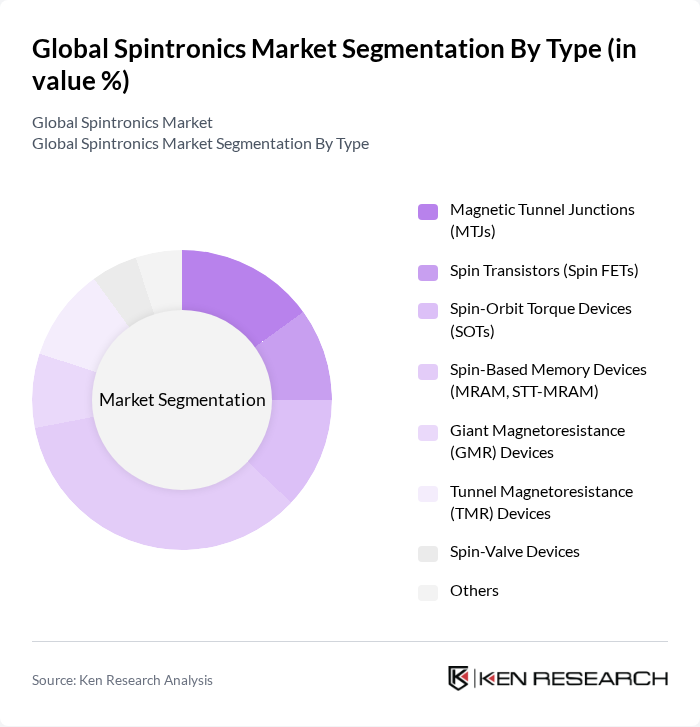
By Type:The spintronics market can be segmented into various types, including Magnetic Tunnel Junctions (MTJs), Spin Transistors (Spin FETs), Spin-Orbit Torque Devices (SOTs), Spin-Based Memory Devices (MRAM, STT-MRAM), Giant Magnetoresistance (GMR) Devices, Tunnel Magnetoresistance (TMR) Devices, Spin-Valve Devices, and Others. Among these, Spin-Based Memory Devices are currently leading the market due to their high efficiency and speed in data storage applications, which are increasingly critical in consumer electronics and data centers .
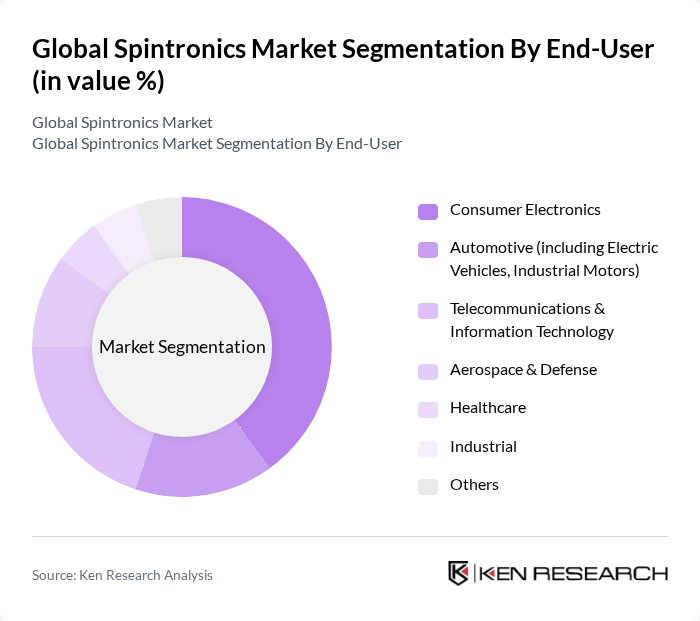
By End-User:The end-user segmentation of the spintronics market includes Consumer Electronics, Automotive (including Electric Vehicles, Industrial Motors), Telecommunications & Information Technology, Aerospace & Defense, Healthcare, Industrial, and Others. The Consumer Electronics segment is currently the most significant contributor to the market, driven by the increasing demand for high-performance devices such as smartphones, laptops, and gaming consoles that utilize advanced spintronic technologies for enhanced functionality .
The Global Spintronics Market is characterized by a dynamic mix of regional and international players. Leading participants such as Intel Corporation, IBM Corporation, NVE Corporation, Advanced Micro Devices, Inc., Toshiba Corporation, STMicroelectronics N.V., Micron Technology, Inc., Qualcomm Incorporated, Panasonic Corporation, Samsung Electronics Co., Ltd., Cypress Semiconductor Corporation, Renesas Electronics Corporation, Texas Instruments Incorporated, Infineon Technologies AG, Analog Devices, Inc., Spintronics Inc., Plures Technologies, Antaios SAS, Micromem Technologies Inc. contribute to innovation, geographic expansion, and service delivery in this space.
The future of the spintronics market appears promising, driven by technological advancements and increasing applications across various sectors. As industries prioritize energy efficiency and performance, spintronic devices are likely to gain traction in data storage and quantum computing. Furthermore, ongoing research and development efforts are expected to enhance device capabilities, making them more appealing to manufacturers and consumers alike. The integration of spintronics in emerging technologies will further solidify its position in the market landscape.
| Segment | Sub-Segments |
|---|---|
| By Type | Magnetic Tunnel Junctions (MTJs) Spin Transistors (Spin FETs) Spin-Orbit Torque Devices (SOTs) Spin-Based Memory Devices (MRAM, STT-MRAM) Giant Magnetoresistance (GMR) Devices Tunnel Magnetoresistance (TMR) Devices Spin-Valve Devices Others |
| By End-User | Consumer Electronics Automotive (including Electric Vehicles, Industrial Motors) Telecommunications & Information Technology Aerospace & Defense Healthcare Industrial Others |
| By Application | Data Storage (Hard Disks, MRAM) Magnetic Sensors Quantum Computing Energy Harvesting Spin Logic Devices Neuromorphic Computing Others |
| By Component | Hardware Software Services |
| By Sales Channel | Direct Sales Distributors Online Sales |
| By Distribution Mode | Retail Wholesale E-commerce |
| By Price Range | Low-End Mid-Range High-End |
| Scope Item/Segment | Sample Size | Target Respondent Profiles |
|---|---|---|
| Data Storage Applications | 100 | Product Managers, R&D Directors |
| Sensor Technologies | 80 | Application Engineers, Technical Sales Representatives |
| Quantum Computing Integration | 60 | Quantum Researchers, Hardware Developers |
| Telecommunications Sector | 50 | Network Engineers, Product Development Managers |
| Automotive Spintronics Applications | 70 | Automotive Engineers, Innovation Managers |
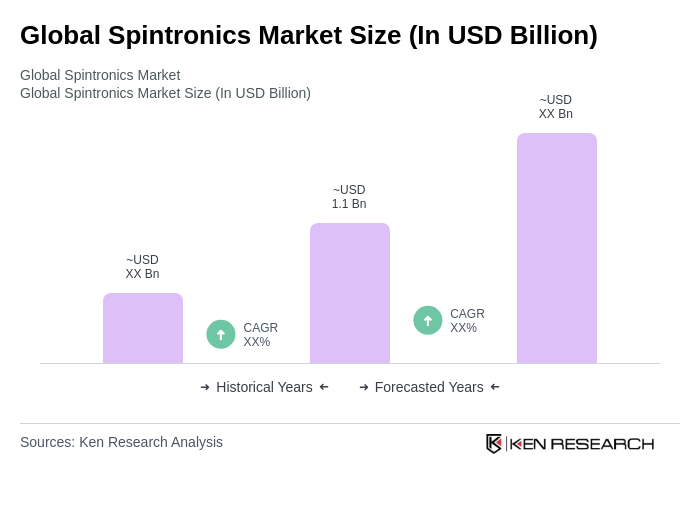
The Global Spintronics Market is valued at approximately USD 1.1 billion, driven by the demand for advanced electronic devices, data storage technologies, and quantum computing applications. This valuation is based on a five-year historical analysis of market trends.

What makes us stand out is that our consultants follow Robust, Refine and Result (RRR) methodology. Robust for clear definitions, approaches and sanity checking, Refine for differentiating respondents' facts and opinions, and Result for presenting data with story.

We have set a benchmark in the industry by offering our clients with syndicated and customized market research reports featuring coverage of entire market as well as meticulous research and analyst insights.

While we don't replace traditional research, we flip the method upside down. Our dual approach of Top Bottom & Bottom Top ensures quality deliverable by not just verifying company fundamentals but also looking at the sector and macroeconomic factors.

With one step in the future, our research team constantly tries to show you the bigger picture. We help with some of the tough questions you may encounter along the way: How is the industry positioned? Best marketing channel? KPI's of competitors? By aligning every element, we help maximize success.

Our report gives you instant access to the answers and sources that other companies might choose to hide. We elaborate each steps of research methodology we have used and showcase you the sample size to earn your trust.

If you need any support, we are here! We pride ourselves on universe strength, data quality, and quick, friendly, and professional service.













