Global Sports Sunglasses Market

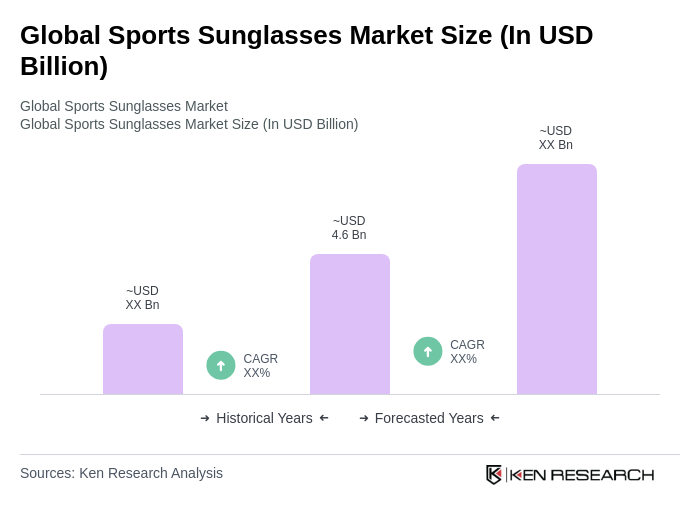
Global Sports Sunglasses Market, valued at USD 4.6 billion, is growing due to rising outdoor activities, UV protection needs, and innovations like polarized lenses, led by regions like US and Europe.

Region:Global

Author(s):Dev

Product Code:KRAA1664

Pages:96

Published On:August 2025
About the Report

Base Year 2024

Global Sports Sunglasses Market Overview

  • The Global Sports Sunglasses Market is valued at USD 4.6 billion, based on a five-year historical analysis. This value aligns with multiple industry trackers that place the market in the USD 4–5.5 billion range, supported by recent estimates around USD 4.5–5.4 billion, and reflects steady demand for performance eyewear. The market is primarily driven by increasing participation in outdoor sports, rising awareness of eye protection, and advancements in lens technology (polarized, photochromic, impact-resistant polycarbonate/nylon, hydrophobic/anti-scratch coatings). The market has seen a surge in demand for high-performance eyewear that offers UV protection, durability, and comfort, catering to both amateur and professional athletes.
  • Key players in this market include the United States, Germany, and Japan, which dominate due to their strong sports culture, high disposable incomes, and established retail networks. North America and Europe are leading revenue contributors in sports eyewear/sunglasses, with strong brand presence and innovation in the U.S., while Germany and Japan have recognized strengths in precision manufacturing and eyewear technology.
  • In 2023, the European Union implemented regulations mandating that all sports eyewear must meet specific safety and performance standards. EU eyewear placed on the market must comply with the Personal Protective Equipment Regulation (EU) 2016/425 and the harmonized eyewear safety standards framework (including UV protection and impact resistance for protective/sports eyewear), with CE marking requirements enforced by market surveillance authorities.
Global Sports Sunglasses Market Size

Global Sports Sunglasses Market Segmentation

By Type:The market is segmented into various types of sports sunglasses, including polarized, non-polarized, photochromic/transition, interchangeable lenses systems, prescription-ready sports sunglasses, performance wraparound, and others such as mirrored and gradient lenses. Among these, polarized sunglasses are leading the market due to their superior glare reduction and visual clarity, making them a preferred choice for outdoor sports enthusiasts. The demand for photochromic lenses is also rising as they offer versatility for both indoor and outdoor use.
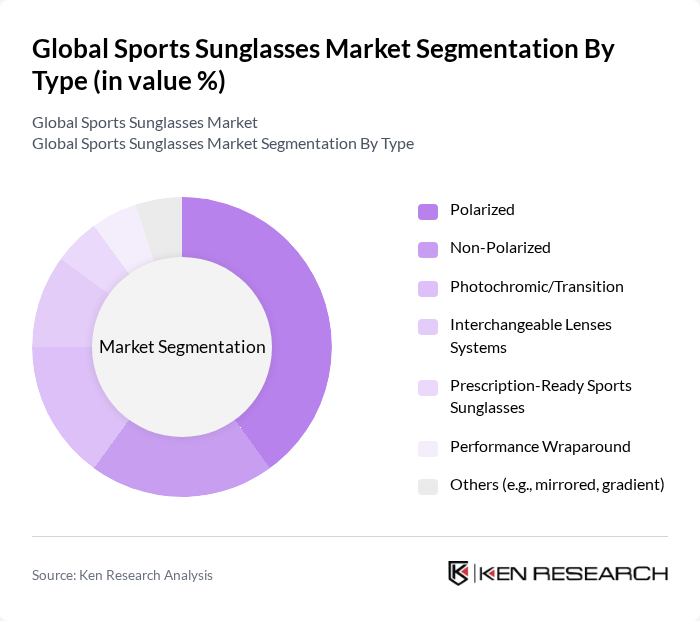
Global Sports Sunglasses Market segmentation by Type.

By End-User:The end-user segmentation includes adults (men, women, unisex), kids/children, amateur and professional athletes, and outdoor lifestyle/athleisure consumers. The adult segment dominates the market, driven by the increasing trend of outdoor activities and sports participation among adults. Additionally, the rise of athleisure fashion has led to a growing demand for stylish yet functional eyewear among casual consumers.
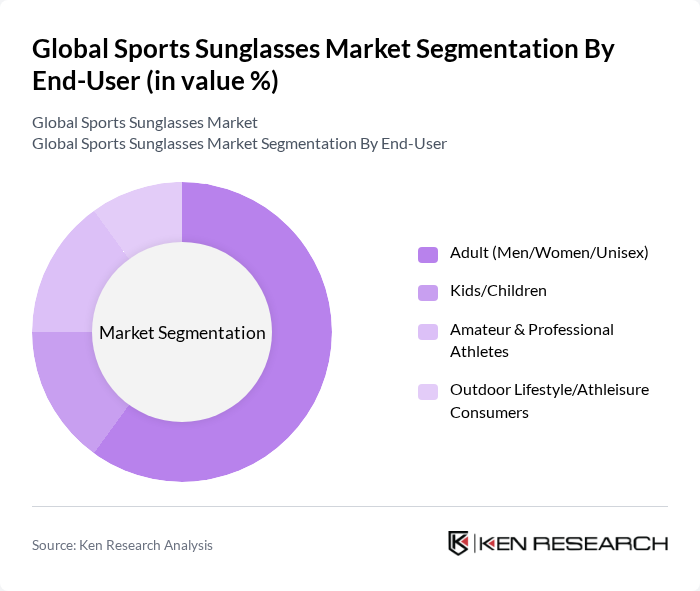
Global Sports Sunglasses Market segmentation by End-User.

Global Sports Sunglasses Market Competitive Landscape

The Global Sports Sunglasses Market is characterized by a dynamic mix of regional and international players. Leading participants such as Oakley (EssilorLuxottica), Ray-Ban (EssilorLuxottica), Nike Vision (Marchon/EssilorLuxottica licensed), Adidas Sport Eyewear (Marcolin licensed), Under Armour Eyewear (Safilo licensed), Smith Optics (Safilo Group), Bollé, Tifosi Optics, Maui Jim, Serengeti, Wiley X, Costa Del Mar (EssilorLuxottica), Spy Optic (Bollé Brands), Revo, Julbo contribute to innovation, geographic expansion, and service delivery in this space.

Oakley

1975

Foothill Ranch, California, USA

Ray-Ban

1937

Milan, Italy

Nike Vision

1998

Beaverton, Oregon, USA

Adidas Sport Eyewear

1991

Herzogenaurach, Germany

Smith Optics

1965

Sun Valley, Idaho, USA

Company

Establishment Year

Headquarters

Group Size (Global, Regional, Niche)

Sports Sunglasses Revenue (latest FY)

3-Year CAGR (Sports Sunglasses)

Market Penetration (countries/doors)

Average Selling Price (ASP) band

Product Innovation Rate (new SKUs/year)

Global Sports Sunglasses Market Industry Analysis

Growth Drivers

  • Increasing Participation in Outdoor Sports:The global outdoor sports participation rate has surged, with over 50% of adults engaging in activities like cycling, running, and hiking in future. This trend is supported by the World Health Organization's recommendation of at least 150 minutes of moderate-intensity exercise weekly. As more individuals prioritize fitness, the demand for sports sunglasses, which enhance performance and protect against UV rays, is expected to rise significantly, driving market growth.
  • Rising Awareness About UV Protection:A future survey indicated that 70% of consumers are now aware of the harmful effects of UV radiation on eye health. This awareness has led to increased sales of UV-protective eyewear, with the global market for UV-blocking sunglasses projected to reach $3.5 billion in future. As health consciousness grows, consumers are more inclined to invest in quality sports sunglasses that offer superior UV protection, further propelling market expansion.
  • Technological Advancements in Lens Materials:Innovations in lens technology, such as the introduction of lightweight, impact-resistant materials, have transformed sports sunglasses. For instance, polycarbonate lenses, which are 10 times more impact-resistant than standard glass, have gained popularity. The global market for advanced lens materials is expected to exceed $2 billion in future, as athletes seek durable and high-performance eyewear, thus driving demand in the sports sunglasses sector.

Market Challenges

  • Intense Competition Among Brands:The sports sunglasses market is characterized by fierce competition, with over 200 brands vying for market share. Major players like Oakley and Ray-Ban dominate, but numerous smaller brands are emerging, leading to price wars and reduced profit margins. In future, the average market share of the top five brands was approximately 40%, indicating a fragmented market that poses challenges for new entrants and established companies alike.
  • Counterfeit Products in the Market:The prevalence of counterfeit sports sunglasses has become a significant challenge, with estimates suggesting that counterfeit goods account for nearly 20% of the market. This not only undermines brand integrity but also poses safety risks to consumers. The global loss due to counterfeit products in the eyewear industry was estimated at $1.5 billion in future, prompting brands to invest heavily in anti-counterfeiting measures and consumer education.

Global Sports Sunglasses Market Future Outlook

The future of the sports sunglasses market appears promising, driven by increasing consumer awareness of eye health and the growing trend of outdoor activities. As technological advancements continue to enhance product offerings, brands are likely to focus on integrating smart technology into eyewear, catering to tech-savvy consumers. Additionally, sustainability will play a crucial role, with manufacturers prioritizing eco-friendly materials and practices to meet the demands of environmentally conscious buyers, ensuring long-term growth in the sector.

Market Opportunities

  • Expansion into Emerging Markets:Emerging markets, particularly in Asia-Pacific, are witnessing a rapid increase in disposable income, with a projected growth rate of 6.5% annually. This economic growth is driving demand for premium sports sunglasses, presenting a lucrative opportunity for brands to expand their presence and capture new customer segments in these regions.
  • Development of Eco-Friendly Products:The shift towards sustainability is creating opportunities for brands to innovate eco-friendly sports sunglasses. With 70% of consumers willing to pay more for sustainable products, companies that invest in biodegradable materials and sustainable manufacturing processes can differentiate themselves and attract environmentally conscious consumers, enhancing their market position.

Scope of the Report

SegmentSub-Segments
By Type

Polarized

Non-Polarized

Photochromic/Transition

Interchangeable Lenses Systems

Prescription-Ready Sports Sunglasses

Performance Wraparound

Others (e.g., mirrored, gradient)

By End-User

Adult (Men/Women/Unisex)

Kids/Children

Amateur & Professional Athletes

Outdoor Lifestyle/Athleisure Consumers

By Sales Channel

Online Stores

Specialty Sports Stores

Supermarkets/Hypermarkets

Brand-Owned Retail & Direct-to-Consumer

By Distribution Mode

Offline Stores

E-commerce Marketplaces

Wholesale/Distributors

By Price Range

Mass/Budget

Mid-Range

Premium/Performance

By Material

Polycarbonate

Trivex/nylon (e.g., NXT)

Glass (mineral)

Bio-based/eco materials (frames/lenses)

By Sport/Application

Cycling

Running/Trail

Golf

Water Sports & Fishing

Snow Sports (ski/snowboard)

Baseball/Field Sports

Motorsports

Multi-sport/Outdoor Recreation

Key Target Audience

Investors and Venture Capitalist Firms

Government and Regulatory Bodies (e.g., Federal Trade Commission, Consumer Product Safety Commission)

Manufacturers and Producers

Distributors and Retailers

Sports Organizations and Associations

Optical Lens Technology Developers

Marketing and Advertising Agencies

Health and Safety Regulatory Agencies (e.g., Occupational Safety and Health Administration)

Players Mentioned in the Report:

Oakley (EssilorLuxottica)

Ray-Ban (EssilorLuxottica)

Nike Vision (Marchon/EssilorLuxottica licensed)

Adidas Sport Eyewear (Marcolin licensed)

Under Armour Eyewear (Safilo licensed)

Smith Optics (Safilo Group)

Bolle

Tifosi Optics

Maui Jim

Serengeti

Wiley X

Costa Del Mar (EssilorLuxottica)

Spy Optic (Bolle Brands)

Revo

Julbo

Table of Contents

Market Assessment Phase

1. Executive Summary and Approach


2. Global Sports Sunglasses Market Overview

2.1 Key Insights and Strategic Recommendations

2.2 Global Sports Sunglasses Market Overview

2.3 Definition and Scope

2.4 Evolution of Market Ecosystem

2.5 Timeline of Key Regulatory Milestones

2.6 Value Chain & Stakeholder Mapping

2.7 Business Cycle Analysis

2.8 Policy & Incentive Landscape


3. Global Sports Sunglasses Market Analysis

3.1 Growth Drivers

3.1.1 Increasing participation in outdoor sports
3.1.2 Rising awareness about UV protection
3.1.3 Technological advancements in lens materials
3.1.4 Growth of the fitness and wellness industry

3.2 Market Challenges

3.2.1 Intense competition among brands
3.2.2 Price sensitivity among consumers
3.2.3 Counterfeit products in the market
3.2.4 Rapid changes in fashion trends

3.3 Market Opportunities

3.3.1 Expansion into emerging markets
3.3.2 Collaborations with sports events and athletes
3.3.3 Development of eco-friendly products
3.3.4 Customization and personalization trends

3.4 Market Trends

3.4.1 Increasing demand for polarized lenses
3.4.2 Growth of online retail channels
3.4.3 Integration of smart technology in eyewear
3.4.4 Focus on sustainable manufacturing practices

3.5 Government Regulation

3.5.1 Standards for UV protection in eyewear
3.5.2 Regulations on product labeling and safety
3.5.3 Import tariffs on sports eyewear
3.5.4 Environmental regulations for manufacturing

4. SWOT Analysis


5. Stakeholder Analysis


6. Porter's Five Forces Analysis


7. Global Sports Sunglasses Market Market Size, 2019-2024

7.1 By Value

7.2 By Volume

7.3 By Average Selling Price


8. Global Sports Sunglasses Market Segmentation

8.1 By Type

8.1.1 Polarized
8.1.2 Non-Polarized
8.1.3 Photochromic/Transition
8.1.4 Interchangeable Lenses Systems
8.1.5 Prescription-Ready Sports Sunglasses
8.1.6 Performance Wraparound
8.1.7 Others (e.g., mirrored, gradient)

8.2 By End-User

8.2.1 Adult (Men/Women/Unisex)
8.2.2 Kids/Children
8.2.3 Amateur & Professional Athletes
8.2.4 Outdoor Lifestyle/Athleisure Consumers

8.3 By Sales Channel

8.3.1 Online Stores
8.3.2 Specialty Sports Stores
8.3.3 Supermarkets/Hypermarkets
8.3.4 Brand-Owned Retail & Direct-to-Consumer

8.4 By Distribution Mode

8.4.1 Offline Stores
8.4.2 E-commerce Marketplaces
8.4.3 Wholesale/Distributors

8.5 By Price Range

8.5.1 Mass/Budget
8.5.2 Mid-Range
8.5.3 Premium/Performance

8.6 By Material

8.6.1 Polycarbonate
8.6.2 Trivex/nylon (e.g., NXT)
8.6.3 Glass (mineral)
8.6.4 Bio-based/eco materials (frames/lenses)

8.7 By Sport/Application

8.7.1 Cycling
8.7.2 Running/Trail
8.7.3 Golf
8.7.4 Water Sports & Fishing
8.7.5 Snow Sports (ski/snowboard)
8.7.6 Baseball/Field Sports
8.7.7 Motorsports
8.7.8 Multi-sport/Outdoor Recreation

9. Global Sports Sunglasses Market Competitive Analysis

9.1 Market Share of Key Players

9.2 Cross Comparison of Key Players

9.2.1 Company Name
9.2.2 Group Size (Global, Regional, Niche)
9.2.3 Sports Sunglasses Revenue (latest FY)
9.2.4 3-Year CAGR (Sports Sunglasses)
9.2.5 Market Penetration (countries/doors)
9.2.6 Average Selling Price (ASP) band
9.2.7 Product Innovation Rate (new SKUs/year)
9.2.8 Lens Technology Portfolio breadth
9.2.9 Sponsorship/Endorsement Index (teams/athletes/events)
9.2.10 DTC Mix (% of sales via own channels)
9.2.11 E-commerce Conversion/Traffic ratio
9.2.12 On-time Fill Rate (OTIF) / Supply reliability
9.2.13 Customer Ratings (avg. star rating/returns %)

9.3 SWOT Analysis of Top Players

9.4 Pricing Analysis

9.5 Detailed Profile of Major Companies

9.5.1 Oakley (EssilorLuxottica)
9.5.2 Ray-Ban (EssilorLuxottica)
9.5.3 Nike Vision (Marchon/EssilorLuxottica licensed)
9.5.4 Adidas Sport Eyewear (Marcolin licensed)
9.5.5 Under Armour Eyewear (Safilo licensed)
9.5.6 Smith Optics (Safilo Group)
9.5.7 Bollé
9.5.8 Tifosi Optics
9.5.9 Maui Jim
9.5.10 Serengeti
9.5.11 Wiley X
9.5.12 Costa Del Mar (EssilorLuxottica)
9.5.13 Spy Optic (Bollé Brands)
9.5.14 Revo
9.5.15 Julbo

10. Global Sports Sunglasses Market End-User Analysis

10.1 Procurement Behavior of Key Ministries

10.1.1 Government contracts for sports events
10.1.2 Bulk purchasing for public sports programs
10.1.3 Sponsorship deals with athletes

10.2 Corporate Spend on Infrastructure & Energy

10.2.1 Investment in sports facilities
10.2.2 Funding for athlete training programs

10.3 Pain Point Analysis by End-User Category

10.3.1 Quality vs. affordability concerns
10.3.2 Availability of specialized products

10.4 User Readiness for Adoption

10.4.1 Awareness of product benefits
10.4.2 Willingness to invest in quality

10.5 Post-Deployment ROI and Use Case Expansion

10.5.1 Performance improvement tracking
10.5.2 Brand loyalty development

11. Global Sports Sunglasses Market Future Size, 2025-2030

11.1 By Value

11.2 By Volume

11.3 By Average Selling Price


Go-To-Market Strategy Phase

1. Whitespace Analysis + Business Model Canvas

1.1 Market Gaps Identification

1.2 Value Proposition Development

1.3 Revenue Streams Analysis

1.4 Customer Segmentation

1.5 Key Partnerships

1.6 Cost Structure Analysis

1.7 Channels of Distribution


2. Marketing and Positioning Recommendations

2.1 Branding strategies

2.2 Product USPs


3. Distribution Plan

3.1 Urban retail vs rural NGO tie-ups


4. Channel & Pricing Gaps

4.1 Underserved routes

4.2 Pricing bands


5. Unmet Demand & Latent Needs

5.1 Category gaps

5.2 Consumer segments


6. Customer Relationship

6.1 Loyalty programs

6.2 After-sales service


7. Value Proposition

7.1 Sustainability

7.2 Integrated supply chains


8. Key Activities

8.1 Regulatory compliance

8.2 Branding

8.3 Distribution setup


9. Entry Strategy Evaluation

9.1 Domestic Market Entry Strategy

9.1.1 Product mix
9.1.2 Pricing band
9.1.3 Packaging

9.2 Export Entry Strategy

9.2.1 Target countries
9.2.2 Compliance roadmap

10. Entry Mode Assessment

10.1 JV

10.2 Greenfield

10.3 M&A

10.4 Distributor Model


11. Capital and Timeline Estimation

11.1 Capital requirements

11.2 Timelines


12. Control vs Risk Trade-Off

12.1 Ownership vs Partnerships


13. Profitability Outlook

13.1 Breakeven analysis

13.2 Long-term sustainability


14. Potential Partner List

14.1 Distributors

14.2 JVs

14.3 Acquisition targets


15. Execution Roadmap

15.1 Phased Plan for Market Entry

15.1.1 Market Setup
15.1.2 Market Entry
15.1.3 Growth Acceleration
15.1.4 Scale & Stabilize

15.2 Key Activities and Milestones

15.2.1 Activity Planning
15.2.2 Milestone Tracking

Research Methodology

ApproachModellingSample

Phase 1: Approach1

Desk Research

  • Industry reports from sports eyewear associations and market research firms
  • Sales data and trends from leading sports sunglasses manufacturers
  • Consumer behavior studies and market analysis from academic journals

Primary Research

  • Interviews with product managers at major sports sunglasses brands
  • Surveys targeting outdoor sports enthusiasts and athletes
  • Focus groups with retail staff from specialty sports eyewear stores

Validation & Triangulation

  • Cross-validation of findings with sales data from multiple distribution channels
  • Triangulation of consumer insights with expert opinions from industry veterans
  • Sanity checks through feedback from a panel of sports optometrists

Phase 2: Market Size Estimation1

Top-down Assessment

  • Analysis of global sports market growth rates and their impact on sunglasses sales
  • Segmentation of the market by sport type, including cycling, running, and water sports
  • Incorporation of demographic trends influencing sports participation rates

Bottom-up Modeling

  • Volume estimates based on sales data from leading retailers and e-commerce platforms
  • Cost analysis of production and pricing strategies from manufacturers
  • Estimation of market share based on product category and geographic distribution

Forecasting & Scenario Analysis

  • Multi-variable forecasting using trends in health and fitness awareness
  • Scenario modeling based on economic conditions and consumer spending patterns
  • Baseline, optimistic, and pessimistic forecasts through 2030

Phase 3: CATI Sample Composition1

Scope Item/SegmentSample SizeTarget Respondent Profiles
Retail Sales of Sports Sunglasses140Store Managers, Sales Associates
Consumer Preferences in Sports Eyewear150Athletes, Outdoor Enthusiasts
Market Trends in Sports Eyewear100Industry Analysts, Market Researchers
Product Development Insights80Product Designers, Brand Managers
Impact of Technology on Sports Sunglasses70Optometrists, Tech Innovators

Frequently Asked Questions

What is the current value of the Global Sports Sunglasses Market?

The Global Sports Sunglasses Market is valued at approximately USD 4.6 billion, based on a five-year historical analysis. This figure aligns with industry estimates that place the market within the USD 45.5 billion range, indicating steady demand for performance eyewear.

What factors are driving the growth of the sports sunglasses market?

Which regions are leading in the sports sunglasses market?

What types of sports sunglasses are available in the market?

Other Regional/Country Reports

Indonesia Global Sports Sunglasses Market

Malaysia Global Sports Sunglasses Market

KSA Global Sports Sunglasses Market

APAC Global Sports Sunglasses Market

SEA Global Sports Sunglasses Market

Vietnam Global Sports Sunglasses Market

Why Buy From Us?

Refine Robust Result (RRR) Framework

What makes us stand out is that our consultants follow Robust, Refine and Result (RRR) methodology. Robust for clear definitions, approaches and sanity checking, Refine for differentiating respondents' facts and opinions, and Result for presenting data with story.

Our Reach Is Unmatched

We have set a benchmark in the industry by offering our clients with syndicated and customized market research reports featuring coverage of entire market as well as meticulous research and analyst insights.

Shifting the Research Paradigm

While we don't replace traditional research, we flip the method upside down. Our dual approach of Top Bottom & Bottom Top ensures quality deliverable by not just verifying company fundamentals but also looking at the sector and macroeconomic factors.

More Insights-Better Decisions

With one step in the future, our research team constantly tries to show you the bigger picture. We help with some of the tough questions you may encounter along the way: How is the industry positioned? Best marketing channel? KPI's of competitors? By aligning every element, we help maximize success.

Transparency and Trust

Our report gives you instant access to the answers and sources that other companies might choose to hide. We elaborate each steps of research methodology we have used and showcase you the sample size to earn your trust.

Round the Clock Support

If you need any support, we are here! We pride ourselves on universe strength, data quality, and quick, friendly, and professional service.

Why Clients Choose Us?

400000+
Reports in repository
150+
Consulting projects a year
100+
Analysts
8000+
Client Queries in 2022








