About the Report
Base Year 2024Listen to the audio summary
Global Sternal Closure Systems Market Overview
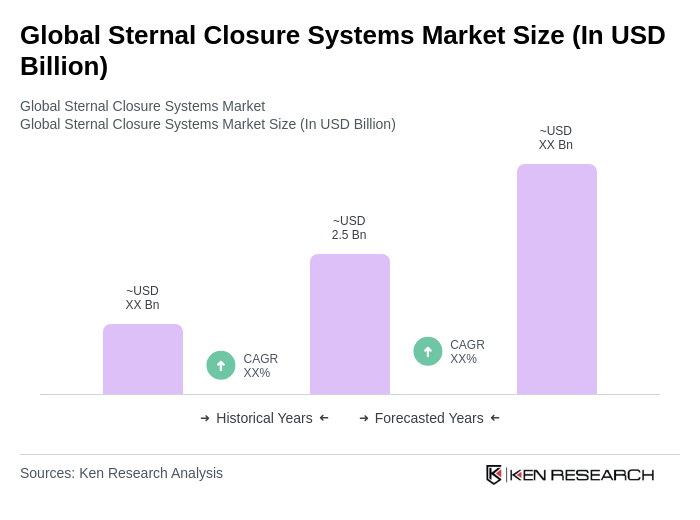
- The Global Sternal Closure Systems Market is valued at USD 2.5 billion, based on a five-year historical analysis. This growth is primarily driven by the increasing prevalence of cardiovascular diseases and the associated volume of open-heart procedures requiring median sternotomy, coupled with advancements in rigid fixation (plates/screws) and improved perioperative protocols that lower complications. The demand for effective sternal closure solutions is further fueled by clinical focus on reducing sternal wound infection, dehiscence, and improving patient recovery, with growing adoption of rigid fixation when clinically indicated.
- Key players in this market are concentrated in regions such as North America and Europe, supported by advanced cardiac surgery programs and high sternotomy volumes; North America has been identified as the largest regional market in recent assessments. The United States, Germany, and the United Kingdom exhibit robust demand aligned with high procedure throughput and strong investment in surgical technologies.
- In 2023, the U.S. Food and Drug Administration continued to regulate sternal closure devices as class II devices via the 510(k) pathway and relevant product codes (e.g., HRS for plate/screw systems), requiring substantial evidence of safety and effectiveness consistent with special controls; no discrete new across-the-board regulation specific only to sternal closure devices was issued that year.
Global Sternal Closure Systems Market Segmentation
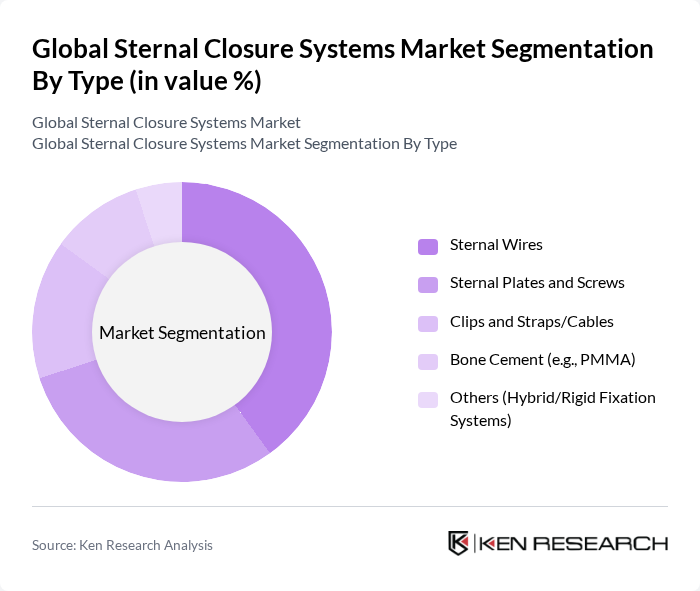
By Type:The market is segmented into various types, including Sternal Wires, Sternal Plates and Screws, Clips and Straps/Cables, Bone Cement (e.g., PMMA), and Others (Hybrid/Rigid Fixation Systems). Among these, Sternal Wires are the most widely used in routine sternotomy closure due to cost-effectiveness and familiarity in cardiac surgery workflows, while rigid fixation with Sternal Plates and Screws is gaining traction for high-risk patients and when greater stability is desired. Demand for Clips and Straps/Cables is supported by their utility as adjuncts or alternatives in specific clinical scenarios, aiming to simplify application and distribute forces across the sternum.
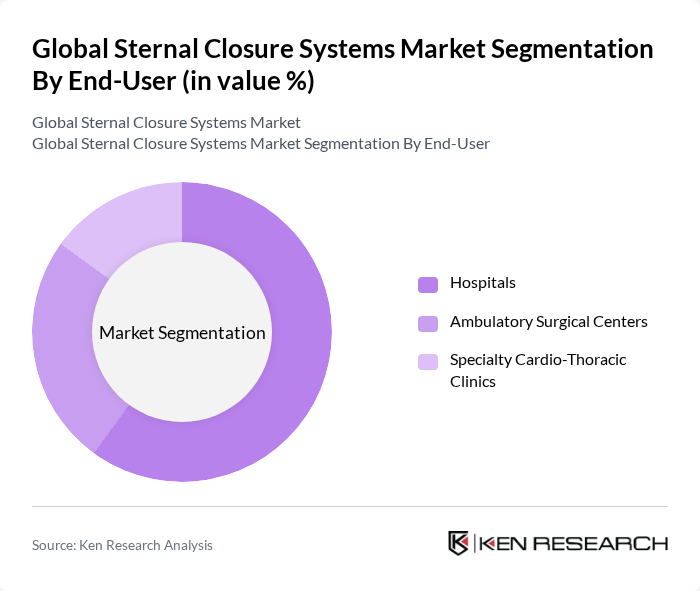
By End-User:The end-user segmentation includes Hospitals, Ambulatory Surgical Centers, and Specialty Cardio-Thoracic Clinics. Hospitals dominate due to concentration of cardiothoracic operating rooms, intensive care resources, and multi-disciplinary teams handling complex sternotomy cases. Ambulatory Surgical Centers are gaining attention for select thoracic procedures and enhanced efficiency where appropriate, while Specialty Cardio-Thoracic Clinics offer focused expertise and integrated perioperative pathways for sternotomy patients.
Global Sternal Closure Systems Market Competitive Landscape
The Global Sternal Closure Systems Market is characterized by a dynamic mix of regional and international players. Leading participants such as Zimmer Biomet, DePuy Synthes (Johnson & Johnson MedTech), Aesculap (B. Braun Melsungen AG), KLS Martin Group, SternaLock (Zimmer Biomet), Orthofix Medical Inc., Able Medical Devices, Kinamed Inc., Innovative Titanium Solutions (ITS) – Sternal Talon, IDEAR S.R.L., Jeil Medical Corporation, Praesidia S.r.l., Ossirius, MedXpert GmbH, Acumed LLC contribute to innovation, geographic expansion, and service delivery in this space.
Global Sternal Closure Systems Market Industry Analysis
Growth Drivers
- Increasing Prevalence of Cardiovascular Diseases:The World Health Organization reported that cardiovascular diseases (CVDs) are responsible for approximately17.9 milliondeaths annually, accounting forabout 32%of all global deaths. In future, the incidence of CVDs is projected to rise by5%, driven by lifestyle changes and an aging population. This surge necessitates effective surgical interventions, thereby increasing the demand for sternal closure systems, which are critical in cardiac surgeries.
- Advancements in Surgical Techniques:The integration of innovative surgical techniques, such as robotic-assisted surgeries, has transformed cardiac procedures. In future, the adoption of these advanced methods is expected to increase by15%, enhancing surgical precision and patient outcomes. These advancements necessitate the use of sophisticated sternal closure systems, which are designed to support these modern surgical practices, thereby driving market growth.
- Rising Geriatric Population:According to the United Nations, the global population aged 65 and older is projected to reachover 1.5 billion in future. In future, this demographic is expected to grow by20%, leading to a higher prevalence of age-related health issues, including cardiovascular diseases. This demographic shift will significantly increase the demand for sternal closure systems, as older patients often require surgical interventions for heart conditions.
Market Challenges
- High Cost of Sternal Closure Systems:The average cost of sternal closure systems can range from$1,500to$3,000per unit, which poses a significant financial burden on healthcare facilities, especially in future where budget constraints are prevalent. This high cost can limit access to advanced surgical options, potentially hindering market growth as hospitals may opt for less effective alternatives due to budgetary limitations.
- Stringent Regulatory Requirements:Regulatory bodies, such as the FDA and EMA, impose rigorous standards for medical devices, including sternal closure systems. In future, the approval process can take up to18 months, delaying product launches and increasing development costs. These stringent regulations can deter new entrants and slow innovation, posing a challenge to market expansion and the introduction of novel solutions.
Global Sternal Closure Systems Market Future Outlook
The future of the sternal closure systems market in future appears promising, driven by technological advancements and an increasing focus on patient-centric care. As healthcare providers prioritize minimally invasive techniques, the demand for innovative sternal closure solutions is expected to rise. Additionally, the growing investment in healthcare infrastructure will facilitate the adoption of advanced surgical technologies, further enhancing market dynamics and improving patient outcomes in the region.
Market Opportunities
- Expansion in Emerging Markets:Emerging markets in future present significant growth opportunities due to increasing healthcare expenditure, projected to reach$200 billion. This growth will drive demand for advanced sternal closure systems, as healthcare facilities seek to improve surgical outcomes and patient care standards.
- Development of Innovative Products:The market for sternal closure systems is ripe for innovation, particularly with the development of bioabsorbable materials. These materials are expected to reduce post-surgical complications significantly, with a projected reduction rate of30%, creating a substantial opportunity for manufacturers to capture market share through innovative product offerings.
Scope of the Report
| Segment | Sub-Segments |
|---|---|
| By Type | Sternal Wires Sternal Plates and Screws Clips and Straps/Cables Bone Cement (e.g., PMMA) Others (Hybrid/Rigid Fixation Systems) |
| By End-User | Hospitals Ambulatory Surgical Centers Specialty Cardio-Thoracic Clinics |
| By Material | Titanium Stainless Steel Polyether Ether Ketone (PEEK) and Other Polymers |
| By Procedure | Median Sternotomy Hemisternotomy Bilateral Thoracosternotomy Other Procedures |
| By Distribution Channel | Direct Sales Distributors Group Purchasing Organizations (GPOs) and Tenders |
| By Region | North America Europe Asia-Pacific Latin America Middle East & Africa |
| By Fixation Technique | Rigid Fixation (Plates/Screws) Wire/Cable Cerclage Hybrid Fixation |
Key Target Audience
Investors and Venture Capitalist Firms
Government and Regulatory Bodies (e.g., U.S. Food and Drug Administration, European Medicines Agency)
Manufacturers and Producers of Sternal Closure Systems
Distributors and Wholesalers of Medical Devices
Healthcare Providers and Hospitals
Medical Device Regulatory Consultants
Industry Associations (e.g., Medical Device Manufacturers Association)
Financial Institutions and Investment Banks
Players Mentioned in the Report:
Zimmer Biomet
DePuy Synthes (Johnson & Johnson MedTech)
Aesculap (B. Braun Melsungen AG)
KLS Martin Group
SternaLock (Zimmer Biomet)
Orthofix Medical Inc.
Able Medical Devices
Kinamed Inc.
Innovative Titanium Solutions (ITS) Sternal Talon
IDEAR S.R.L.
Jeil Medical Corporation
Praesidia S.r.l.
Ossirius
MedXpert GmbH
Acumed LLC
Table of Contents
Market Assessment Phase
1. Executive Summary and Approach
2. Global Sternal Closure Systems Market Overview
2.1 Key Insights and Strategic Recommendations
2.2 Global Sternal Closure Systems Market Overview
2.3 Definition and Scope
2.4 Evolution of Market Ecosystem
2.5 Timeline of Key Regulatory Milestones
2.6 Value Chain & Stakeholder Mapping
2.7 Business Cycle Analysis
2.8 Policy & Incentive Landscape
3. Global Sternal Closure Systems Market Analysis
3.1 Growth Drivers
3.1.1 Increasing prevalence of cardiovascular diseases
3.1.2 Advancements in surgical techniques
3.1.3 Rising geriatric population
3.1.4 Growing demand for minimally invasive surgeries
3.2 Market Challenges
3.2.1 High cost of sternal closure systems
3.2.2 Stringent regulatory requirements
3.2.3 Risk of post-surgical complications
3.2.4 Limited awareness in emerging markets
3.3 Market Opportunities
3.3.1 Expansion in emerging markets
3.3.2 Development of innovative products
3.3.3 Strategic partnerships and collaborations
3.3.4 Increasing investment in healthcare infrastructure
3.4 Market Trends
3.4.1 Shift towards bioabsorbable materials
3.4.2 Integration of technology in surgical procedures
3.4.3 Focus on patient-centric solutions
3.4.4 Rise in outpatient surgical procedures
3.5 Government Regulation
3.5.1 FDA regulations on medical devices
3.5.2 CE marking requirements in Europe
3.5.3 Guidelines for clinical trials
3.5.4 Reimbursement policies for surgical procedures
4. SWOT Analysis
5. Stakeholder Analysis
6. Porter's Five Forces Analysis
7. Global Sternal Closure Systems Market Market Size, 2019-2024
7.1 By Value
7.2 By Volume
7.3 By Average Selling Price
8. Global Sternal Closure Systems Market Segmentation
8.1 By Type
8.1.1 Sternal Wires
8.1.2 Sternal Plates and Screws
8.1.3 Clips and Straps/Cables
8.1.4 Bone Cement (e.g., PMMA)
8.1.5 Others (Hybrid/Rigid Fixation Systems)
8.2 By End-User
8.2.1 Hospitals
8.2.2 Ambulatory Surgical Centers
8.2.3 Specialty Cardio-Thoracic Clinics
8.3 By Material
8.3.1 Titanium
8.3.2 Stainless Steel
8.3.3 Polyether Ether Ketone (PEEK) and Other Polymers
8.4 By Procedure
8.4.1 Median Sternotomy
8.4.2 Hemisternotomy
8.4.3 Bilateral Thoracosternotomy
8.4.4 Other Procedures
8.5 By Distribution Channel
8.5.1 Direct Sales
8.5.2 Distributors
8.5.3 Group Purchasing Organizations (GPOs) and Tenders
8.6 By Region
8.6.1 North America
8.6.2 Europe
8.6.3 Asia-Pacific
8.6.4 Latin America
8.6.5 Middle East & Africa
8.7 By Fixation Technique
8.7.1 Rigid Fixation (Plates/Screws)
8.7.2 Wire/Cable Cerclage
8.7.3 Hybrid Fixation
9. Global Sternal Closure Systems Market Competitive Analysis
9.1 Market Share of Key Players
9.2 Cross Comparison of Key Players
9.2.1 Company Name
9.2.2 Core Product Portfolio Mix (Wires, Plates/Screws, Clips/Straps, Bone Cement)
9.2.3 Sternal Closure Revenue (USD) and CAGR
9.2.4 Geographic Footprint (No. of Countries/Regions Served)
9.2.5 Installed Base and Procedure Penetration (Cases Supported per Year)
9.2.6 Clinical Evidence Strength (No. of Trials/Peer-Reviewed Studies)
9.2.7 Infection and Complication Reduction Claims (DRG/SSI outcomes from studies)
9.2.8 Regulatory Approvals Portfolio (510(k)/CE marks)
9.2.9 Innovation Velocity (New SKUs/Design Iterations Past 3 Years)
9.2.10 Pricing and ASP Positioning (Value, Mid, Premium)
9.2.11 Channel Strength (Direct vs Distributor mix; GPO contracts)
9.2.12 Gross Margin and R&D Intensity (%)
9.2.13 Key Partnerships (Surgeon Societies, Hospital Systems)
9.3 SWOT Analysis of Top Players
9.4 Pricing Analysis
9.5 Detailed Profile of Major Companies
9.5.1 Zimmer Biomet
9.5.2 DePuy Synthes (Johnson & Johnson MedTech)
9.5.3 Aesculap (B. Braun Melsungen AG)
9.5.4 KLS Martin Group
9.5.5 SternaLock (Zimmer Biomet)
9.5.6 Orthofix Medical Inc.
9.5.7 Able Medical Devices
9.5.8 Kinamed Inc.
9.5.9 Innovative Titanium Solutions (ITS) – Sternal Talon
9.5.10 IDEAR S.R.L.
9.5.11 Jeil Medical Corporation
9.5.12 Praesidia S.r.l.
9.5.13 Ossirius
9.5.14 MedXpert GmbH
9.5.15 Acumed LLC
10. Global Sternal Closure Systems Market End-User Analysis
10.1 Procurement Behavior of Key Ministries
10.1.1 Government procurement policies
10.1.2 Budget allocation for healthcare
10.1.3 Evaluation criteria for suppliers
10.2 Corporate Spend on Infrastructure & Energy
10.2.1 Investment in healthcare facilities
10.2.2 Funding for surgical equipment
10.2.3 Trends in corporate healthcare spending
10.3 Pain Point Analysis by End-User Category
10.3.1 Challenges faced by hospitals
10.3.2 Issues in ambulatory surgical centers
10.3.3 Needs of specialty clinics
10.4 User Readiness for Adoption
10.4.1 Training requirements for staff
10.4.2 Infrastructure readiness
10.4.3 Financial readiness for new technologies
10.5 Post-Deployment ROI and Use Case Expansion
10.5.1 Measurement of surgical outcomes
10.5.2 Cost savings analysis
10.5.3 Expansion into new surgical applications
11. Global Sternal Closure Systems Market Future Size, 2025-2030
11.1 By Value
11.2 By Volume
11.3 By Average Selling Price
Go-To-Market Strategy Phase
1. Whitespace Analysis + Business Model Canvas
1.1 Market gaps identification
1.2 Value proposition development
1.3 Revenue model exploration
1.4 Customer segmentation analysis
1.5 Competitive landscape overview
2. Marketing and Positioning Recommendations
2.1 Branding strategies
2.2 Product USPs
2.3 Target audience identification
2.4 Communication strategies
3. Distribution Plan
3.1 Urban retail strategies
3.2 Rural NGO tie-ups
3.3 Online distribution channels
4. Channel & Pricing Gaps
4.1 Underserved routes
4.2 Pricing bands analysis
4.3 Competitor pricing strategies
5. Unmet Demand & Latent Needs
5.1 Category gaps identification
5.2 Consumer segments analysis
5.3 Emerging trends exploration
6. Customer Relationship
6.1 Loyalty programs
6.2 After-sales service
6.3 Customer feedback mechanisms
7. Value Proposition
7.1 Sustainability initiatives
7.2 Integrated supply chains
7.3 Cost-benefit analysis
8. Key Activities
8.1 Regulatory compliance
8.2 Branding efforts
8.3 Distribution setup
9. Entry Strategy Evaluation
9.1 Domestic Market Entry Strategy
9.1.1 Product mix considerations
9.1.2 Pricing band strategies
9.1.3 Packaging options
9.2 Export Entry Strategy
9.2.1 Target countries analysis
9.2.2 Compliance roadmap development
10. Entry Mode Assessment
10.1 Joint Ventures
10.2 Greenfield investments
10.3 Mergers & Acquisitions
10.4 Distributor Model evaluation
11. Capital and Timeline Estimation
11.1 Capital requirements analysis
11.2 Timelines for market entry
12. Control vs Risk Trade-Off
12.1 Ownership considerations
12.2 Partnerships evaluation
13. Profitability Outlook
13.1 Breakeven analysis
13.2 Long-term sustainability strategies
14. Potential Partner List
14.1 Distributors identification
14.2 Joint Ventures exploration
14.3 Acquisition targets
15. Execution Roadmap
15.1 Phased Plan for Market Entry
15.1.1 Market Setup
15.1.2 Market Entry
15.1.3 Growth Acceleration
15.1.4 Scale & Stabilize
15.2 Key Activities and Milestones
15.2.1 Milestone tracking
15.2.2 Activity scheduling
Research Methodology
Phase 1: Approach1
Desk Research
- Analysis of market reports from medical device regulatory bodies and industry associations
- Review of published articles in peer-reviewed journals focusing on sternal closure techniques
- Examination of sales data and product offerings from leading manufacturers in the sternal closure systems market
Primary Research
- Interviews with cardiac surgeons and thoracic specialists to understand clinical preferences
- Surveys with hospital procurement managers regarding purchasing decisions and budget allocations
- Field interviews with operating room staff to gather insights on product usability and performance
Validation & Triangulation
- Cross-validation of findings through multiple expert interviews and focus groups
- Triangulation of data from clinical studies, market reports, and expert opinions
- Sanity checks through feedback from a panel of industry experts and stakeholders
Phase 2: Market Size Estimation1
Top-down Assessment
- Estimation of total addressable market based on cardiac surgery volume statistics
- Segmentation of market size by product type, including sutures, staples, and adhesive systems
- Incorporation of trends in minimally invasive surgery and their impact on sternal closure systems
Bottom-up Modeling
- Collection of sales data from key manufacturers to establish baseline revenue figures
- Estimation of average selling prices for various sternal closure products
- Volume estimates based on surgical procedure frequencies and product usage rates
Forecasting & Scenario Analysis
- Multi-factor regression analysis incorporating demographic trends and healthcare expenditure growth
- Scenario modeling based on potential advancements in surgical techniques and materials
- Development of baseline, optimistic, and pessimistic forecasts through 2030
Phase 3: CATI Sample Composition1
| Scope Item/Segment | Sample Size | Target Respondent Profiles |
|---|---|---|
| Cardiac Surgeons | 100 | Cardiothoracic Surgeons, Surgical Directors |
| Hospital Procurement Managers | 80 | Procurement Officers, Supply Chain Managers |
| Operating Room Staff | 70 | Nurses, Surgical Technologists |
| Medical Device Distributors | 60 | Sales Representatives, Distribution Managers |
| Healthcare Policy Makers | 50 | Health Economists, Policy Analysts |
Frequently Asked Questions
What is the current value of the Global Sternal Closure Systems Market?
The Global Sternal Closure Systems Market is valued at approximately USD 2.5 billion, reflecting a significant growth driven by the rising prevalence of cardiovascular diseases and advancements in surgical techniques and protocols.
What factors are driving the growth of the Sternal Closure Systems Market?
Which regions dominate the Sternal Closure Systems Market?
What are the main types of sternal closure systems available?
Other Regional/Country Reports
Why Buy From Us?

What makes us stand out is that our consultants follow Robust, Refine and Result (RRR) methodology. Robust for clear definitions, approaches and sanity checking, Refine for differentiating respondents' facts and opinions, and Result for presenting data with story.

We have set a benchmark in the industry by offering our clients with syndicated and customized market research reports featuring coverage of entire market as well as meticulous research and analyst insights.

While we don't replace traditional research, we flip the method upside down. Our dual approach of Top Bottom & Bottom Top ensures quality deliverable by not just verifying company fundamentals but also looking at the sector and macroeconomic factors.

With one step in the future, our research team constantly tries to show you the bigger picture. We help with some of the tough questions you may encounter along the way: How is the industry positioned? Best marketing channel? KPI's of competitors? By aligning every element, we help maximize success.

Our report gives you instant access to the answers and sources that other companies might choose to hide. We elaborate each steps of research methodology we have used and showcase you the sample size to earn your trust.

If you need any support, we are here! We pride ourselves on universe strength, data quality, and quick, friendly, and professional service.