About the Report
Base Year 2024Global Submarine Cabling Systems Market Overview
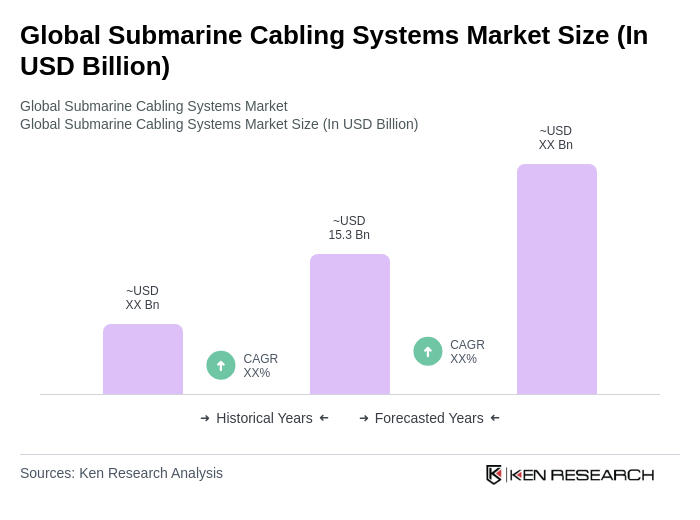
- The Global Submarine Cabling Systems Market is valued at approximately USD 15.3 billion, based on a five-year analysis. This level aligns with multiple industry trackers citing low-to-mid teens billions for the segment, with current drivers including surging international bandwidth demand, hyperscale data center expansion, and continued cloud migration supporting new transoceanic builds and upgrades .
- Key market activity is concentrated in countries such as the United States, China, and Japan, reflecting deep telecom capital formation, hyperscaler presence, and multiple new cable projects landing in these regions, which collectively underpin leadership in deployments and investment pipelines .
- In the United States, federal streamlining efforts for subsea infrastructure have focused on coordinated permitting across agencies and environmentally responsible deployment; trade sources highlight ongoing policy attention to accelerate subsea connectivity while balancing marine impact reviews .
Global Submarine Cabling Systems Market Segmentation
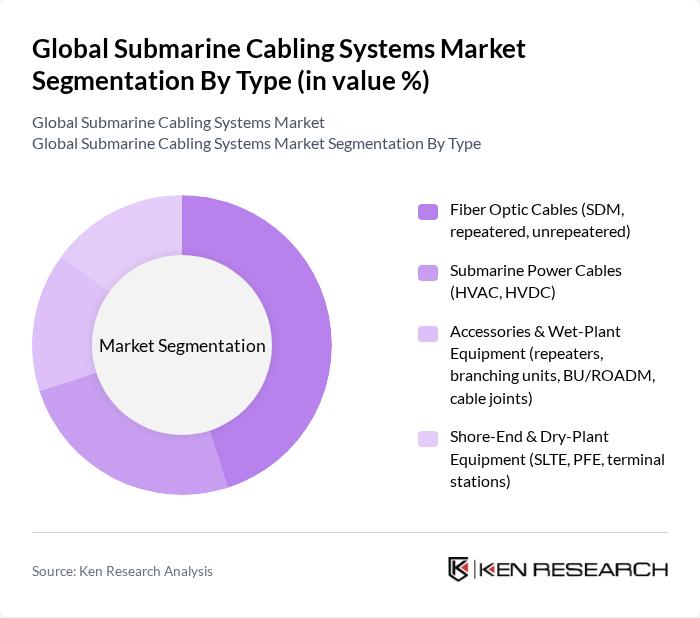
By Type:The market is segmented into various types, including Fiber Optic Cables, Submarine Power Cables, Accessories & Wet-Plant Equipment, and Shore-End & Dry-Plant Equipment. Among these, Fiber Optic Cables are the most dominant due to their high data transmission capacity and efficiency. The increasing demand for high-speed internet and data services has led to a surge in the deployment of fiber optic cables, making them a critical component of submarine cabling systems. Continued hyperscaler-led investment in high-fiber-count SDM systems and upgrades of repeatered routes further reinforce the dominance of fiber optic submarine telecom cables .
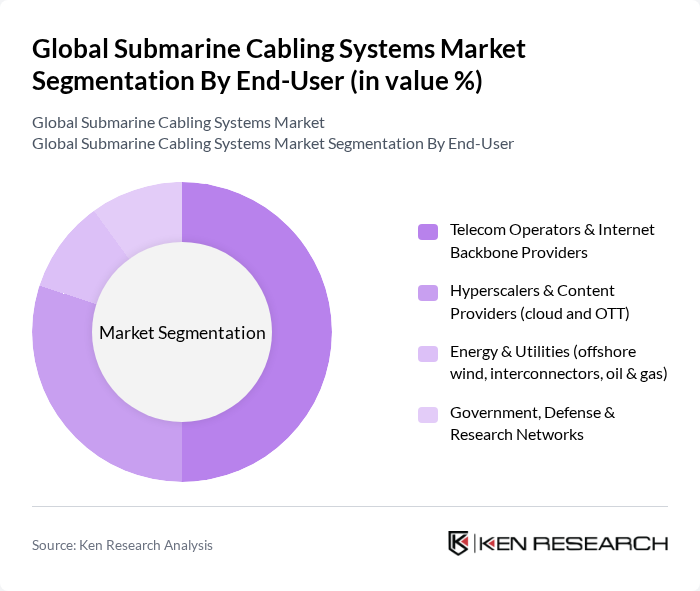
By End-User:The end-user segmentation includes Telecom Operators & Internet Backbone Providers, Hyperscalers & Content Providers, Energy & Utilities, and Government, Defense & Research Networks. Telecom Operators & Internet Backbone Providers dominate this segment due to the increasing demand for bandwidth and the need for reliable communication networks. The rapid growth of internet traffic and the expansion of digital services have made this segment crucial for the submarine cabling systems market. At the same time, hyperscalers have significantly increased direct participation and consortia leadership in transoceanic builds, accelerating capacity additions .
Global Submarine Cabling Systems Market Competitive Landscape
The Global Submarine Cabling Systems Market is characterized by a dynamic mix of regional and international players. Leading participants such as SubCom LLC, NEC Corporation, Alcatel Submarine Networks (ASN), a Nokia company, HMN Tech (formerly Huawei Marine Networks), NTT Ltd. (Submarine Cable and Global Networks), Orange Marine, Global Marine Group, Prysmian Group, Nexans S.A., ZTT Group (Jiangsu Zhongtian Technology), Hengtong Optic-Electric Co., Ltd., Telxius (Telefónica Group), Tata Communications (TGN), Google (Subsea Cable Investments), Meta (Facebook) Subsea Investments contribute to innovation, geographic expansion, and service delivery in this space. Ongoing demand drivers include record international bandwidth growth, European offshore wind interconnections stimulating power cable demand, and hyperscaler-led SDM deployments that increase fiber-pair counts and spectral efficiency across new builds .
Global Submarine Cabling Systems Market Industry Analysis
Growth Drivers
- Increasing Demand for High-Speed Internet Connectivity:The global demand for high-speed internet is projected to reach 5.3 billion users in future, driven by the proliferation of digital services. This surge necessitates robust submarine cabling systems to support data transmission. The International Telecommunication Union (ITU) reported that global internet traffic is expected to exceed 5.0 zettabytes annually, emphasizing the need for enhanced connectivity solutions. Such growth directly correlates with increased investments in submarine cabling infrastructure to meet user demands.
- Expansion of Data Centers and Cloud Services:The global data center market is anticipated to grow to $200 billion in future, with cloud services driving this expansion. According to Synergy Research Group, the cloud infrastructure market alone is expected to reach $100 billion, necessitating extensive submarine cabling to connect data centers across continents. This growth is fueled by the increasing reliance on cloud-based applications and services, which require high-capacity, low-latency connections to ensure optimal performance and user experience.
- Rising Investments in Renewable Energy Projects:The global investment in renewable energy is projected to reach $1.5 trillion in future, with offshore wind and solar projects gaining traction. These projects often require submarine cabling for energy transmission from remote locations to urban centers. The International Energy Agency (IEA) indicates that offshore wind capacity alone could reach 200 GW in future, further driving the demand for submarine cabling systems to facilitate efficient energy distribution and integration into existing grids.
Market Challenges
- High Installation and Maintenance Costs:The installation of submarine cabling systems can exceed $1 million per kilometer, significantly impacting project budgets. According to the World Bank, the high upfront costs associated with laying cables underwater, coupled with ongoing maintenance expenses, pose a substantial barrier to entry for new players. This financial burden can deter investment in necessary infrastructure upgrades, limiting the overall growth potential of the submarine cabling market.
- Environmental Concerns and Regulatory Hurdles:Environmental regulations can delay submarine cabling projects, with compliance costs reaching up to 20% of total project expenses. The International Maritime Organization (IMO) emphasizes the need for environmental impact assessments before project approval. These regulatory hurdles can lead to increased project timelines and costs, creating challenges for companies looking to expand their submarine cabling networks in ecologically sensitive areas.
Global Submarine Cabling Systems Market Future Outlook
The future of submarine cabling systems is poised for significant transformation, driven by technological advancements and increasing global connectivity needs. As countries invest in digital infrastructure, the integration of AI and IoT technologies will enhance operational efficiency and security. Furthermore, the growing emphasis on sustainability will lead to the development of eco-friendly cabling solutions. These trends indicate a robust demand for innovative submarine cabling systems that can support the evolving landscape of global communication and energy distribution.
Market Opportunities
- Development of Next-Generation Cabling Technologies:Innovations in cabling materials and designs are expected to enhance data transmission speeds and reduce latency. Companies investing in research and development can capitalize on this trend, potentially increasing market share and improving service offerings. The focus on next-generation technologies will likely attract significant investment, fostering a competitive landscape that drives further advancements in submarine cabling systems.
- Strategic Partnerships and Collaborations:Collaborations between telecommunications companies and technology providers can lead to enhanced service offerings and expanded market reach. By pooling resources and expertise, these partnerships can accelerate the deployment of submarine cabling systems, particularly in emerging markets. This strategic approach will enable companies to navigate regulatory challenges and optimize operational efficiencies, ultimately driving growth in the submarine cabling sector.
Scope of the Report
| Segment | Sub-Segments |
|---|---|
| By Type | Fiber Optic Cables (SDM, repeatered, unrepeatered) Submarine Power Cables (HVAC, HVDC) Accessories & Wet-Plant Equipment (repeaters, branching units, BU/ROADM, cable joints) Shore-End & Dry-Plant Equipment (SLTE, PFE, terminal stations) |
| By End-User | Telecom Operators & Internet Backbone Providers Hyperscalers & Content Providers (cloud and OTT) Energy & Utilities (offshore wind, interconnectors, oil & gas) Government, Defense & Research Networks |
| By Application | Data Communications (international and domestic subsea connectivity) Power Transmission (offshore wind export, grid interconnectors) Offshore Field Infrastructure (oil & gas, platform power/comm links) Environmental and SMART Sensing (seafloor monitoring, tsunami, seismic) |
| By Component | Wet Plant (cables, repeaters/amplifiers, branching units, cable protection) Dry Plant (SLTE, power feeding equipment, network management) Marine Services (survey, installation, ploughing, burial, repairs) Project & System Integration (route engineering, permitting, testing) |
| By Sales Channel | Direct EPC/System Turnkey Contracts Consortia & Club Deals Vendor Frameworks & Strategic Sourcing Integrators and Marine Service Providers |
| By Distribution Mode | Subsea (deepwater, shallow water) Shore-End & Terrestrial Backhaul Island and Interconnector Routes |
| By Investment Source | Private & Hyperscaler-Led Investments Public Funding & PPPs Carrier Consortia Multilateral & Development Finance |
Key Target Audience
Investors and Venture Capitalist Firms
Government and Regulatory Bodies (e.g., Federal Communications Commission, National Telecommunications and Information Administration)
Telecommunications Service Providers
Submarine Cable Manufacturers
Infrastructure Development Agencies
Marine Survey and Installation Companies
Telecom Equipment Suppliers
International Maritime Organizations
Players Mentioned in the Report:
SubCom LLC
NEC Corporation
Alcatel Submarine Networks (ASN), a Nokia company
HMN Tech (formerly Huawei Marine Networks)
NTT Ltd. (Submarine Cable and Global Networks)
Orange Marine
Global Marine Group
Prysmian Group
Nexans S.A.
ZTT Group (Jiangsu Zhongtian Technology)
Hengtong Optic-Electric Co., Ltd.
Telxius (Telefonica Group)
Tata Communications (TGN)
Google (Subsea Cable Investments)
Meta (Facebook) Subsea Investments
Table of Contents
Market Assessment Phase
1. Executive Summary and Approach
2. Global Submarine Cabling Systems Market Overview
2.1 Key Insights and Strategic Recommendations
2.2 Global Submarine Cabling Systems Market Overview
2.3 Definition and Scope
2.4 Evolution of Market Ecosystem
2.5 Timeline of Key Regulatory Milestones
2.6 Value Chain & Stakeholder Mapping
2.7 Business Cycle Analysis
2.8 Policy & Incentive Landscape
3. Global Submarine Cabling Systems Market Analysis
3.1 Growth Drivers
3.1.1 Increasing demand for high-speed internet connectivity
3.1.2 Expansion of data centers and cloud services
3.1.3 Rising investments in renewable energy projects
3.1.4 Growth in international trade and commerce
3.2 Market Challenges
3.2.1 High installation and maintenance costs
3.2.2 Environmental concerns and regulatory hurdles
3.2.3 Technological obsolescence
3.2.4 Competition from alternative communication technologies
3.3 Market Opportunities
3.3.1 Development of next-generation cabling technologies
3.3.2 Increasing government initiatives for digital infrastructure
3.3.3 Expansion into emerging markets
3.3.4 Strategic partnerships and collaborations
3.4 Market Trends
3.4.1 Growing focus on sustainability and eco-friendly solutions
3.4.2 Advancements in submarine cable manufacturing techniques
3.4.3 Increased demand for enhanced security features
3.4.4 Integration of AI and IoT in cabling systems
3.5 Government Regulation
3.5.1 Compliance with international maritime laws
3.5.2 Environmental impact assessments
3.5.3 Licensing and permitting requirements
3.5.4 Standards for cable performance and safety
4. SWOT Analysis
5. Stakeholder Analysis
6. Porter's Five Forces Analysis
7. Global Submarine Cabling Systems Market Market Size, 2019-2024
7.1 By Value
7.2 By Volume
7.3 By Average Selling Price
8. Global Submarine Cabling Systems Market Segmentation
8.1 By Type
8.1.1 Fiber Optic Cables (SDM, repeatered, unrepeatered)
8.1.2 Submarine Power Cables (HVAC, HVDC)
8.1.3 Accessories & Wet-Plant Equipment (repeaters, branching units, BU/ROADM, cable joints)
8.1.4 Shore-End & Dry-Plant Equipment (SLTE, PFE, terminal stations)
8.2 By End-User
8.2.1 Telecom Operators & Internet Backbone Providers
8.2.2 Hyperscalers & Content Providers (cloud and OTT)
8.2.3 Energy & Utilities (offshore wind, interconnectors, oil & gas)
8.2.4 Government, Defense & Research Networks
8.3 By Application
8.3.1 Data Communications (international and domestic subsea connectivity)
8.3.2 Power Transmission (offshore wind export, grid interconnectors)
8.3.3 Offshore Field Infrastructure (oil & gas, platform power/comm links)
8.3.4 Environmental and SMART Sensing (seafloor monitoring, tsunami, seismic)
8.4 By Component
8.4.1 Wet Plant (cables, repeaters/amplifiers, branching units, cable protection)
8.4.2 Dry Plant (SLTE, power feeding equipment, network management)
8.4.3 Marine Services (survey, installation, ploughing, burial, repairs)
8.4.4 Project & System Integration (route engineering, permitting, testing)
8.5 By Sales Channel
8.5.1 Direct EPC/System Turnkey Contracts
8.5.2 Consortia & Club Deals
8.5.3 Vendor Frameworks & Strategic Sourcing
8.5.4 Integrators and Marine Service Providers
8.6 By Distribution Mode
8.6.1 Subsea (deepwater, shallow water)
8.6.2 Shore-End & Terrestrial Backhaul
8.6.3 Island and Interconnector Routes
8.7 By Investment Source
8.7.1 Private & Hyperscaler-Led Investments
8.7.2 Public Funding & PPPs
8.7.3 Carrier Consortia
8.7.4 Multilateral & Development Finance
9. Global Submarine Cabling Systems Market Competitive Analysis
9.1 Market Share of Key Players(Micro, Small, Medium, Large Enterprises)
9.2 Cross Comparison of Key Players
9.2.1 Company Name
9.2.2 Group Size (Large, Medium, or Small as per industry convention)
9.2.3 Subsea Systems Revenue (USD, latest fiscal year)
9.2.4 Order Backlog / Book-to-Bill Ratio
9.2.5 Route Kilometers Delivered (12-month/TTM)
9.2.6 Installed Capacity per Fiber Pair (Tbps) and SDM readiness
9.2.7 Win Rate in Consortia/Turnkey Bids (%)
9.2.8 Marine Assets (cable ships, ROVs, ploughs)
9.2.9 Repair SLA/Mean Time to Repair (days)
9.2.10 Gross Margin on EPC/System Projects (%)
9.2.11 R&D Intensity (% of revenue; wet/dry plant)
9.2.12 Regional Footprint (landing countries, permits)
9.3 SWOT Analysis of Top Players
9.4 Pricing Analysis(By Class and Payload)
9.5 Detailed Profile of Major Companies
9.5.1 SubCom LLC
9.5.2 NEC Corporation
9.5.3 Alcatel Submarine Networks (ASN), a Nokia company
9.5.4 HMN Tech (formerly Huawei Marine Networks)
9.5.5 NTT Ltd. (Submarine Cable and Global Networks)
9.5.6 Orange Marine
9.5.7 Global Marine Group
9.5.8 Prysmian Group
9.5.9 Nexans S.A.
9.5.10 ZTT Group (Jiangsu Zhongtian Technology)
9.5.11 Hengtong Optic-Electric Co., Ltd.
9.5.12 Telxius (Telefónica Group)
9.5.13 Tata Communications (TGN)
9.5.14 Google (Subsea Cable Investments)
9.5.15 Meta (Facebook) Subsea Investments
10. Global Submarine Cabling Systems Market End-User Analysis
10.1 Procurement Behavior of Key Ministries
10.1.1 Government contracts and tenders
10.1.2 Budget allocation for infrastructure projects
10.1.3 Collaboration with private sector
10.2 Corporate Spend on Infrastructure & Energy
10.2.1 Investment trends in telecommunications
10.2.2 Funding for renewable energy projects
10.2.3 Infrastructure development budgets
10.3 Pain Point Analysis by End-User Category
10.3.1 Connectivity issues in remote areas
10.3.2 High operational costs
10.3.3 Regulatory compliance challenges
10.4 User Readiness for Adoption
10.4.1 Awareness of submarine cabling benefits
10.4.2 Training and skill development needs
10.4.3 Infrastructure readiness
10.5 Post-Deployment ROI and Use Case Expansion
10.5.1 Performance metrics evaluation
10.5.2 Expansion into new markets
10.5.3 Long-term maintenance strategies
11. Global Submarine Cabling Systems Market Future Size, 2025-2030
11.1 By Value
11.2 By Volume
11.3 By Average Selling Price
Go-To-Market Strategy Phase
1. Whitespace Analysis + Business Model Canvas
1.1 Market gaps identification
1.2 Value proposition development
1.3 Revenue model exploration
1.4 Customer segmentation analysis
1.5 Competitive landscape assessment
1.6 Key partnerships identification
1.7 Resource allocation strategy
2. Marketing and Positioning Recommendations
2.1 Branding strategies
2.2 Product USPs
2.3 Target audience identification
2.4 Communication strategy
2.5 Digital marketing initiatives
2.6 Event marketing opportunities
3. Distribution Plan
3.1 Urban retail strategies
3.2 Rural NGO tie-ups
3.3 Online distribution channels
3.4 Direct sales approach
3.5 Partnership with local distributors
4. Channel & Pricing Gaps
4.1 Underserved routes
4.2 Pricing bands analysis
4.3 Competitor pricing comparison
4.4 Value-based pricing strategies
5. Unmet Demand & Latent Needs
5.1 Category gaps identification
5.2 Consumer segments analysis
5.3 Emerging trends exploration
5.4 Customer feedback integration
6. Customer Relationship
6.1 Loyalty programs
6.2 After-sales service enhancements
6.3 Customer engagement strategies
6.4 Feedback and improvement loops
7. Value Proposition
7.1 Sustainability initiatives
7.2 Integrated supply chains
7.3 Cost-saving measures
7.4 Innovation in service delivery
8. Key Activities
8.1 Regulatory compliance
8.2 Branding efforts
8.3 Distribution setup
8.4 Training and development
9. Entry Strategy Evaluation
9.1 Domestic Market Entry Strategy
9.1.1 Product mix considerations
9.1.2 Pricing band analysis
9.1.3 Packaging strategies
9.2 Export Entry Strategy
9.2.1 Target countries selection
9.2.2 Compliance roadmap development
10. Entry Mode Assessment
10.1 Joint Ventures
10.2 Greenfield investments
10.3 Mergers & Acquisitions
10.4 Distributor Model
11. Capital and Timeline Estimation
11.1 Capital requirements
11.2 Timelines for implementation
12. Control vs Risk Trade-Off
12.1 Ownership considerations
12.2 Partnerships evaluation
13. Profitability Outlook
13.1 Breakeven analysis
13.2 Long-term sustainability strategies
14. Potential Partner List
14.1 Distributors
14.2 Joint Ventures
14.3 Acquisition targets
15. Execution Roadmap
15.1 Phased Plan for Market Entry
15.1.1 Market Setup
15.1.2 Market Entry
15.1.3 Growth Acceleration
15.1.4 Scale & Stabilize
15.2 Key Activities and Milestones
15.2.1 Milestone tracking
15.2.2 Activity scheduling
Research Methodology
Phase 1: Approach1
Desk Research
- Industry reports from telecommunications and maritime organizations
- Market analysis from government publications and international regulatory bodies
- Technical papers and white papers on submarine cabling technologies
Primary Research
- Interviews with project managers at leading submarine cable installation firms
- Surveys with network infrastructure planners and telecommunications engineers
- Field interviews with marine surveyors and cable maintenance experts
Validation & Triangulation
- Cross-validation of data from multiple industry sources and expert opinions
- Triangulation of market size estimates using historical growth rates
- Sanity checks through feedback from industry panels and focus groups
Phase 2: Market Size Estimation1
Top-down Assessment
- Analysis of global telecommunications spending trends and infrastructure investments
- Segmentation of market size by geographic regions and application sectors
- Incorporation of emerging technologies and their impact on cabling demand
Bottom-up Modeling
- Volume estimates based on the number of active submarine cables and their capacities
- Cost analysis derived from installation and maintenance expenditures
- Revenue projections based on service pricing and bandwidth demand
Forecasting & Scenario Analysis
- Multi-variable regression analysis incorporating internet traffic growth and data consumption trends
- Scenario modeling based on geopolitical factors and regulatory changes
- Baseline, optimistic, and pessimistic forecasts through 2035
Phase 3: CATI Sample Composition1
| Scope Item/Segment | Sample Size | Target Respondent Profiles |
|---|---|---|
| Telecommunications Infrastructure | 120 | Network Engineers, Infrastructure Managers |
| Marine Surveying Services | 90 | Marine Engineers, Survey Technicians |
| Cable Installation Projects | 80 | Project Managers, Operations Directors |
| Maintenance and Repair Services | 70 | Maintenance Supervisors, Technical Leads |
| Regulatory Compliance and Policy | 60 | Regulatory Affairs Specialists, Compliance Officers |
Frequently Asked Questions
What is the current value of the Global Submarine Cabling Systems Market?
The Global Submarine Cabling Systems Market is valued at approximately USD 15.3 billion, reflecting a significant demand driven by international bandwidth needs, hyperscale data center expansion, and cloud migration, according to multiple industry trackers.
Which countries are leading in submarine cabling system deployments?
What are the main types of submarine cabling systems?
Who are the primary end-users of submarine cabling systems?
Other Regional/Country Reports
Indonesia Submarine Cabling Systems Market
Malaysia Submarine Cabling Systems Market
APAC Submarine Cabling Systems Market
SEA Submarine Cabling Systems Market
Why Buy From Us?

What makes us stand out is that our consultants follow Robust, Refine and Result (RRR) methodology. Robust for clear definitions, approaches and sanity checking, Refine for differentiating respondents' facts and opinions, and Result for presenting data with story.

We have set a benchmark in the industry by offering our clients with syndicated and customized market research reports featuring coverage of entire market as well as meticulous research and analyst insights.

While we don't replace traditional research, we flip the method upside down. Our dual approach of Top Bottom & Bottom Top ensures quality deliverable by not just verifying company fundamentals but also looking at the sector and macroeconomic factors.

With one step in the future, our research team constantly tries to show you the bigger picture. We help with some of the tough questions you may encounter along the way: How is the industry positioned? Best marketing channel? KPI's of competitors? By aligning every element, we help maximize success.

Our report gives you instant access to the answers and sources that other companies might choose to hide. We elaborate each steps of research methodology we have used and showcase you the sample size to earn your trust.

If you need any support, we are here! We pride ourselves on universe strength, data quality, and quick, friendly, and professional service.