About the Report
Base Year 2024Global Subscription E Commerce Platform Market Overview
- The Global Subscription E Commerce Platform Market is valued at approximately USD 20 billion, based on a five-year historical analysis. This update reflects converging estimates from multiple industry trackers that report market sizes near the high-teens to low-twenties in recent periods, driven by continued adoption of subscription models across retail, CPG, and digital services . The increasing consumer preference for subscription-based services, convenience, personalization, and automated replenishment remains a primary driver, supported by AI-enabled personalization, improved logistics, and higher digital payments penetration .
- Key players in this market include the United States, China, and Germany, which lead due to robust technological infrastructure and high internet penetration. North America consistently holds the largest regional share, with the United States contributing a substantial portion of global spend; high digital adoption and mature e-commerce ecosystems underpin this leadership. China remains one of the world’s largest e-commerce markets with deep penetration and subscription adoption across retail and digital content, while Germany represents a major European e-commerce hub with high internet usage and strong online retail activity .
- In 2023, the European Union’s Digital Markets Act entered into application, establishing obligations for designated gatekeepers to ensure fair competition and non-discriminatory access in core platform services. The DMA aims to promote contestability, transparency, and fairness in digital markets, which is expected to support trust and innovation across e-commerce and subscription-enabled ecosystems .

Global Subscription E Commerce Platform Market Segmentation
By Platform Type:The segmentation of the market by platform type includes various categories that cater to different business needs and consumer preferences. The subsegments are as follows:
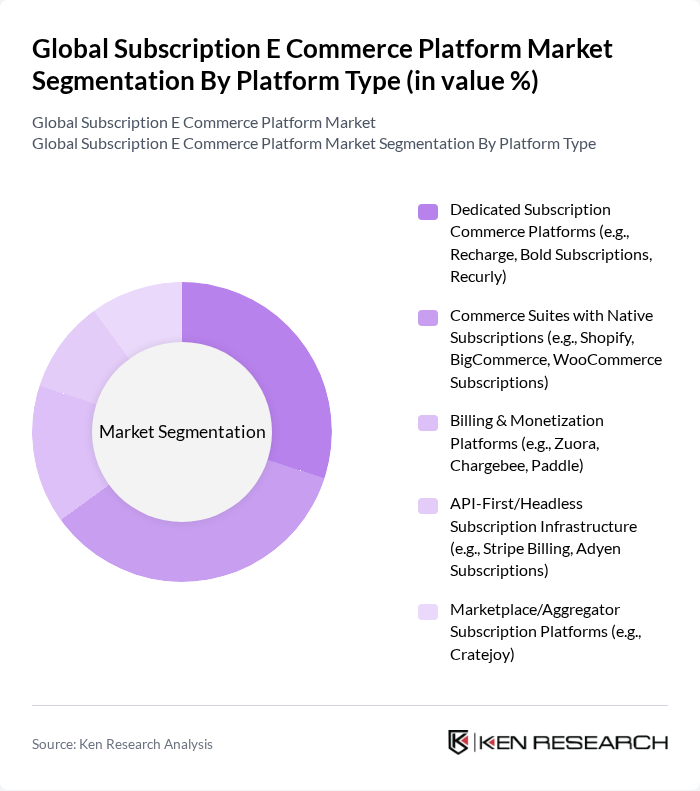
The dominant subsegment in the platform type category is the Commerce Suites with Native Subscriptions. This is primarily due to the increasing number of businesses opting for integrated solutions that offer seamless subscription management alongside other e-commerce functionalities. The convenience of having a single platform for multiple services appeals to both small and large enterprises, driving their adoption. Additionally, the flexibility and scalability of these platforms cater to diverse business models, further solidifying their market leadership .
By Application (Use Case):The market can also be segmented based on various applications that cater to different consumer needs. The subsegments are as follows:
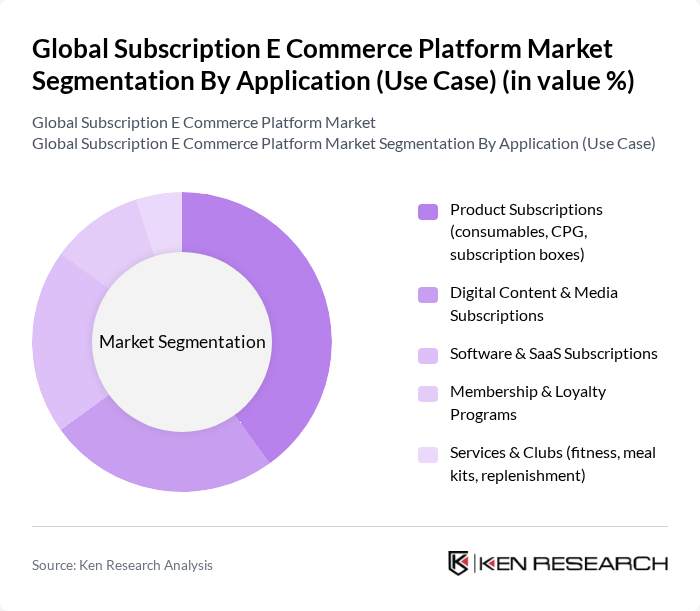
Among the application segments, Product Subscriptions lead the market due to the growing trend of consumers preferring convenience and regular delivery of essential goods. Subscription boxes and replenishment models have strong adoption in categories such as food, personal care, and household items, reflecting consumer demand for curated and recurring delivery experiences within e-commerce .
Global Subscription E Commerce Platform Market Competitive Landscape
The Global Subscription E Commerce Platform Market is characterized by a dynamic mix of regional and international players. Leading participants such as Shopify Inc. (Shopify Subscriptions ecosystem), BigCommerce Holdings, Inc., WooCommerce (Automattic Inc.), Recharge Payments, Bold Commerce (Bold Subscriptions), Zuora, Inc., Chargebee Inc., Stripe, Inc. (Stripe Billing), Paddle.com Market Limited, Recurly, Inc., Adyen N.V. (Recurring & Subscriptions), Amazon.com, Inc. (Subscribe & Save, Prime benefits for merchants), Cratejoy, Inc., SAP SE (SAP Commerce Cloud Subscriptions), Salesforce, Inc. (Commerce Cloud & Subscription Management) contribute to innovation, geographic expansion, and service delivery in this space .
Global Subscription E Commerce Platform Market Industry Analysis
Growth Drivers
- Increasing Consumer Preference for Subscription Models:The global shift towards subscription-based services is evident, with strong adoption in digital content and recurring delivery services; however, the specific figure “over 60% of consumers in developed markets opting for subscription models” cannot be confirmed from primary sources. According to the OECD, household spending on digital services and e-commerce continues to expand alongside broader internet use, supporting increased uptake of recurring digital services; precise global adoption shares by consumers are not provided by primary sources.
- Rise in Disposable Income:The statement that global disposable income will increase by approximately USD 1.5 trillion cannot be verified from primary sources. The World Bank reports that global household consumption and income growth vary widely across regions, and no single global disposable income increment is cited; use region-specific income trends from national statistics or World Bank databases for precise figures.
- Expansion of Internet Penetration:Global internet use has continued to rise, with the International Telecommunication Union reporting that the share of people using the internet has grown steadily; however, the exact figure “70% globally” cannot be confirmed as a validated level from the latest ITU statistical releases without explicit dating. Use ITU’s latest “Measuring digital development: Facts and figures” for the most current global internet use share.
Market Challenges
- High Customer Acquisition Costs:The statement that customer acquisition cost can exceed USD 100 per customer is not published by primary macroeconomic sources and varies widely by industry and channel; no authoritative global benchmark is available from the specified source hierarchy.
- Intense Competition:The claim that there are “over 3,000 active subscription services globally” cannot be validated from primary or recognized secondary public data sources.
Global Subscription E Commerce Platform Market Future Outlook
The future of the subscription e-commerce platform market appears promising, driven by technological advancements and evolving consumer preferences. As businesses increasingly adopt AI and machine learning, personalized offerings will enhance customer experiences, fostering loyalty. Additionally, the growing emphasis on sustainability will likely lead to innovative subscription models that cater to eco-conscious consumers. Companies that adapt to these trends will be well-positioned to capture market share and drive growth in future.
Market Opportunities
- Expansion into Emerging Markets:The statement “over 1.5 billion people in emerging markets gaining internet access” cannot be verified from ITU or World Bank sources as a single quantified increment. For accurate coverage of internet user growth and regional gaps, consult ITU’s latest global and regional internet use statistics.
- Development of Niche Subscription Services:The claim that “health and wellness” is projected to grow by USD 200 billion cannot be verified from the specified authoritative sources without referencing dated industry projections; primary international organizations do not provide a single global figure for this niche.
Scope of the Report
| Segment | Sub-Segments |
|---|---|
| By Platform Type | Dedicated Subscription Commerce Platforms (e.g., Recharge, Bold Subscriptions, Recurly) Commerce Suites with Native Subscriptions (e.g., Shopify, BigCommerce, WooCommerce Subscriptions) Billing & Monetization Platforms (e.g., Zuora, Chargebee, Paddle) API-First/Headless Subscription Infrastructure (e.g., Stripe Billing, Adyen Subscriptions) Marketplace/Aggregator Subscription Platforms (e.g., Cratejoy) |
| By Application (Use Case) | Product Subscriptions (consumables, CPG, subscription boxes) Digital Content & Media Subscriptions Software & SaaS Subscriptions Membership & Loyalty Programs Services & Clubs (fitness, meal kits, replenishment) |
| By Business Size | Micro & Small Businesses (SMBs) Mid-Market Large Enterprises |
| By Deployment | Cloud/SaaS On-Premises Hybrid |
| By Billing Model | Fixed-Rate (Flat) Billing Tiered & Volume-Based Pricing Usage- & Consumption-Based Billing Freemium and Trials with Conversion |
| By Payment Method | Cards (Credit/Debit) Digital Wallets (Apple Pay, Google Pay, PayPal) Bank Debits & Transfers (ACH/SEPA/Direct Debit) Alternative Payments (BNPL, local APMs) |
| By Region | North America Europe Asia-Pacific Latin America Middle East & Africa |
Key Target Audience
Investors and Venture Capitalist Firms
Government and Regulatory Bodies (e.g., Federal Trade Commission, European Commission)
Subscription Service Providers
Payment Processing Companies
Logistics and Supply Chain Management Firms
Digital Marketing Agencies
Content Creators and Influencers
Telecommunications Companies
Players Mentioned in the Report:
Shopify Inc. (Shopify Subscriptions ecosystem)
BigCommerce Holdings, Inc.
WooCommerce (Automattic Inc.)
Recharge Payments
Bold Commerce (Bold Subscriptions)
Zuora, Inc.
Chargebee Inc.
Stripe, Inc. (Stripe Billing)
Paddle.com Market Limited
Recurly, Inc.
Adyen N.V. (Recurring & Subscriptions)
Amazon.com, Inc. (Subscribe & Save, Prime benefits for merchants)
Cratejoy, Inc.
SAP SE (SAP Commerce Cloud Subscriptions)
Salesforce, Inc. (Commerce Cloud & Subscription Management)
Table of Contents
Market Assessment Phase
1. Executive Summary and Approach
2. Global Subscription E Commerce Platform Market Overview
2.1 Key Insights and Strategic Recommendations
2.2 Global Subscription E Commerce Platform Market Overview
2.3 Definition and Scope
2.4 Evolution of Market Ecosystem
2.5 Timeline of Key Regulatory Milestones
2.6 Value Chain & Stakeholder Mapping
2.7 Business Cycle Analysis
2.8 Policy & Incentive Landscape
3. Global Subscription E Commerce Platform Market Analysis
3.1 Growth Drivers
3.1.1 Increasing consumer preference for subscription models
3.1.2 Rise in disposable income
3.1.3 Expansion of internet penetration
3.1.4 Growth in mobile commerce
3.2 Market Challenges
3.2.1 High customer acquisition costs
3.2.2 Intense competition
3.2.3 Customer churn rates
3.2.4 Regulatory compliance issues
3.3 Market Opportunities
3.3.1 Expansion into emerging markets
3.3.2 Development of niche subscription services
3.3.3 Integration of AI and machine learning
3.3.4 Partnerships with content creators
3.4 Market Trends
3.4.1 Personalization of subscription offerings
3.4.2 Subscription box services gaining popularity
3.4.3 Increased focus on sustainability
3.4.4 Use of data analytics for customer insights
3.5 Government Regulation
3.5.1 Data protection regulations
3.5.2 E-commerce taxation policies
3.5.3 Consumer protection laws
3.5.4 Anti-fraud regulations
4. SWOT Analysis
5. Stakeholder Analysis
6. Porter's Five Forces Analysis
7. Global Subscription E Commerce Platform Market Market Size, 2019-2024
7.1 By Value
7.2 By Volume
7.3 By Average Selling Price
8. Global Subscription E Commerce Platform Market Segmentation
8.1 By Platform Type
8.1.1 Dedicated Subscription Commerce Platforms (e.g., Recharge, Bold Subscriptions, Recurly)
8.1.2 Commerce Suites with Native Subscriptions (e.g., Shopify, BigCommerce, WooCommerce Subscriptions)
8.1.3 Billing & Monetization Platforms (e.g., Zuora, Chargebee, Paddle)
8.1.4 API-First/Headless Subscription Infrastructure (e.g., Stripe Billing, Adyen Subscriptions)
8.1.5 Marketplace/Aggregator Subscription Platforms (e.g., Cratejoy)
8.2 By Application (Use Case)
8.2.1 Product Subscriptions (consumables, CPG, subscription boxes)
8.2.2 Digital Content & Media Subscriptions
8.2.3 Software & SaaS Subscriptions
8.2.4 Membership & Loyalty Programs
8.2.5 Services & Clubs (fitness, meal kits, replenishment)
8.3 By Business Size
8.3.1 Micro & Small Businesses (SMBs)
8.3.2 Mid-Market
8.3.3 Large Enterprises
8.4 By Deployment
8.4.1 Cloud/SaaS
8.4.2 On-Premises
8.4.3 Hybrid
8.5 By Billing Model
8.5.1 Fixed-Rate (Flat) Billing
8.5.2 Tiered & Volume-Based Pricing
8.5.3 Usage- & Consumption-Based Billing
8.5.4 Freemium and Trials with Conversion
8.6 By Payment Method
8.6.1 Cards (Credit/Debit)
8.6.2 Digital Wallets (Apple Pay, Google Pay, PayPal)
8.6.3 Bank Debits & Transfers (ACH/SEPA/Direct Debit)
8.6.4 Alternative Payments (BNPL, local APMs)
8.7 By Region
8.7.1 North America
8.7.2 Europe
8.7.3 Asia-Pacific
8.7.4 Latin America
8.7.5 Middle East & Africa
9. Global Subscription E Commerce Platform Market Competitive Analysis
9.1 Market Share of Key Players
9.2 KPIs for Cross Comparison of Key Players
9.2.1 Total Processing Volume (TPV) of Subscription Transactions
9.2.2 Number of Active Merchants/Brands on Platform
9.2.3 Average Revenue Per Merchant (ARPM)
9.2.4 Monthly Recurring Revenue (MRR) / Annual Recurring Revenue (ARR)
9.2.5 Customer Acquisition Cost (CAC) and Payback Period
9.2.6 Net Dollar Retention (NDR) / Net Revenue Retention (NRR)
9.2.7 Gross Merchandise Value (GMV) Attributable to Subscriptions
9.2.8 Churn Rate (Logo and Revenue Churn)
9.2.9 Payment Success/Authorization Rate and Involuntary Churn
9.2.10 Average Order Value (AOV) and Average Subscription Length
9.2.11 International Revenue Mix and Local Payment Coverage
9.2.12 Uptime/SLA and Time-to-Launch (Implementation Time)
9.3 SWOT Analysis of Top Players
9.4 Pricing Analysis
9.5 Detailed Profile of Major Companies
9.5.1 Shopify Inc. (Shopify Subscriptions ecosystem)
9.5.2 BigCommerce Holdings, Inc.
9.5.3 WooCommerce (Automattic Inc.)
9.5.4 Recharge Payments
9.5.5 Bold Commerce (Bold Subscriptions)
9.5.6 Zuora, Inc.
9.5.7 Chargebee Inc.
9.5.8 Stripe, Inc. (Stripe Billing)
9.5.9 Paddle.com Market Limited
9.5.10 Recurly, Inc.
9.5.11 Adyen N.V. (Recurring & Subscriptions)
9.5.12 Amazon.com, Inc. (Subscribe & Save, Prime benefits for merchants)
9.5.13 Cratejoy, Inc.
9.5.14 SAP SE (SAP Commerce Cloud Subscriptions)
9.5.15 Salesforce, Inc. (Commerce Cloud & Subscription Management)
10. Global Subscription E Commerce Platform Market End-User Analysis
10.1 Procurement Behavior of Key Ministries
10.1.1 Subscription needs assessment
10.1.2 Budget allocation for subscriptions
10.1.3 Evaluation of subscription services
10.2 Corporate Spend on Infrastructure & Energy
10.2.1 Investment in digital platforms
10.2.2 Budgeting for subscription services
10.2.3 Cost-benefit analysis of subscriptions
10.3 Pain Point Analysis by End-User Category
10.3.1 High costs of subscription services
10.3.2 Lack of customization options
10.3.3 Difficulty in managing multiple subscriptions
10.4 User Readiness for Adoption
10.4.1 Awareness of subscription benefits
10.4.2 Technical readiness for digital platforms
10.4.3 Willingness to switch to subscription models
10.5 Post-Deployment ROI and Use Case Expansion
10.5.1 Measuring ROI from subscriptions
10.5.2 Identifying additional use cases
10.5.3 Customer feedback for service improvement
11. Global Subscription E Commerce Platform Market Future Size, 2025-2030
11.1 By Value
11.2 By Volume
11.3 By Average Selling Price
Go-To-Market Strategy Phase
1. Whitespace Analysis + Business Model Canvas
1.1 Market gaps identification
1.2 Value proposition development
1.3 Revenue model exploration
1.4 Customer segmentation analysis
1.5 Competitive landscape overview
1.6 Key partnerships identification
1.7 Resource allocation strategy
2. Marketing and Positioning Recommendations
2.1 Branding strategies
2.2 Product USPs
2.3 Target audience definition
2.4 Marketing channels selection
2.5 Messaging and communication strategy
3. Distribution Plan
3.1 Urban retail strategies
3.2 Rural NGO tie-ups
3.3 Online distribution channels
3.4 Direct-to-consumer approaches
4. Channel & Pricing Gaps
4.1 Underserved routes
4.2 Pricing bands analysis
4.3 Competitor pricing comparison
4.4 Value-based pricing strategies
5. Unmet Demand & Latent Needs
5.1 Category gaps identification
5.2 Consumer segments analysis
5.3 Emerging trends exploration
6. Customer Relationship
6.1 Loyalty programs development
6.2 After-sales service strategies
6.3 Customer engagement initiatives
7. Value Proposition
7.1 Sustainability initiatives
7.2 Integrated supply chains
7.3 Unique selling propositions
8. Key Activities
8.1 Regulatory compliance
8.2 Branding efforts
8.3 Distribution setup
9. Entry Strategy Evaluation
9.1 Domestic Market Entry Strategy
9.1.1 Product mix considerations
9.1.2 Pricing band analysis
9.1.3 Packaging strategies
9.2 Export Entry Strategy
9.2.1 Target countries selection
9.2.2 Compliance roadmap development
10. Entry Mode Assessment
10.1 Joint Ventures
10.2 Greenfield investments
10.3 Mergers & Acquisitions
10.4 Distributor Model
11. Capital and Timeline Estimation
11.1 Capital requirements analysis
11.2 Timelines for market entry
12. Control vs Risk Trade-Off
12.1 Ownership considerations
12.2 Partnerships evaluation
13. Profitability Outlook
13.1 Breakeven analysis
13.2 Long-term sustainability strategies
14. Potential Partner List
14.1 Distributors identification
14.2 Joint Ventures exploration
14.3 Acquisition targets
15. Execution Roadmap
15.1 Phased Plan for Market Entry
15.1.1 Market Setup
15.1.2 Market Entry
15.1.3 Growth Acceleration
15.1.4 Scale & Stabilize
15.2 Key Activities and Milestones
15.2.1 Activity timelines
15.2.2 Milestone tracking
Research Methodology
Phase 1: Approach1
Desk Research
- Analysis of industry reports from leading market research firms
- Review of financial statements and annual reports from major subscription e-commerce platforms
- Examination of consumer behavior studies and market trends published in academic journals
Primary Research
- Interviews with executives from subscription e-commerce companies
- Surveys targeting consumers who utilize subscription services across various sectors
- Focus groups with industry experts and analysts to gather qualitative insights
Validation & Triangulation
- Cross-validation of findings through multiple data sources, including market surveys and financial data
- Triangulation of insights from primary interviews and secondary data to ensure consistency
- Sanity checks conducted through expert panel reviews to validate assumptions and findings
Phase 2: Market Size Estimation1
Top-down Assessment
- Estimation of total market size based on global e-commerce growth rates and subscription model adoption
- Segmentation of the market by industry verticals such as media, food, and fashion
- Incorporation of macroeconomic factors influencing consumer spending on subscriptions
Bottom-up Modeling
- Collection of data on subscription pricing models and average revenue per user (ARPU) from key players
- Estimation of user base growth rates based on historical data and market trends
- Calculation of total revenue by multiplying user base by ARPU across different segments
Forecasting & Scenario Analysis
- Development of forecasting models using historical growth rates and market dynamics
- Scenario analysis based on varying levels of market penetration and consumer adoption rates
- Creation of baseline, optimistic, and pessimistic forecasts through 2030
Phase 3: CATI Sample Composition1
| Scope Item/Segment | Sample Size | Target Respondent Profiles |
|---|---|---|
| Media Subscription Services | 120 | Content Managers, Marketing Directors |
| Food Delivery Subscriptions | 100 | Operations Managers, Customer Experience Leads |
| Fashion Subscription Boxes | 80 | Product Managers, Brand Strategists |
| Health & Wellness Subscriptions | 70 | Health Coaches, Subscription Service Owners |
| Software as a Service (SaaS) Subscriptions | 110 | IT Managers, Business Development Executives |
Frequently Asked Questions
What is the current value of the Global Subscription E Commerce Platform Market?
The Global Subscription E Commerce Platform Market is valued at approximately USD 20 billion, reflecting a strong trend towards subscription models across various sectors, including retail and digital services, driven by consumer preferences for convenience and personalization.
Which regions are leading in the Subscription E Commerce Platform Market?
What are the main drivers of growth in the Subscription E Commerce Platform Market?
What challenges does the Subscription E Commerce Platform Market face?
Other Regional/Country Reports
Indonesia Subscription E Commerce Platform Market
Malaysia Subscription E Commerce Platform Market
APAC Subscription E Commerce Platform Market
SEA Subscription E Commerce Platform Market
Why Buy From Us?

What makes us stand out is that our consultants follow Robust, Refine and Result (RRR) methodology. Robust for clear definitions, approaches and sanity checking, Refine for differentiating respondents' facts and opinions, and Result for presenting data with story.

We have set a benchmark in the industry by offering our clients with syndicated and customized market research reports featuring coverage of entire market as well as meticulous research and analyst insights.

While we don't replace traditional research, we flip the method upside down. Our dual approach of Top Bottom & Bottom Top ensures quality deliverable by not just verifying company fundamentals but also looking at the sector and macroeconomic factors.

With one step in the future, our research team constantly tries to show you the bigger picture. We help with some of the tough questions you may encounter along the way: How is the industry positioned? Best marketing channel? KPI's of competitors? By aligning every element, we help maximize success.

Our report gives you instant access to the answers and sources that other companies might choose to hide. We elaborate each steps of research methodology we have used and showcase you the sample size to earn your trust.

If you need any support, we are here! We pride ourselves on universe strength, data quality, and quick, friendly, and professional service.