Region:Global
Author(s):Rebecca
Product Code:KRAD0216
Pages:94
Published On:August 2025
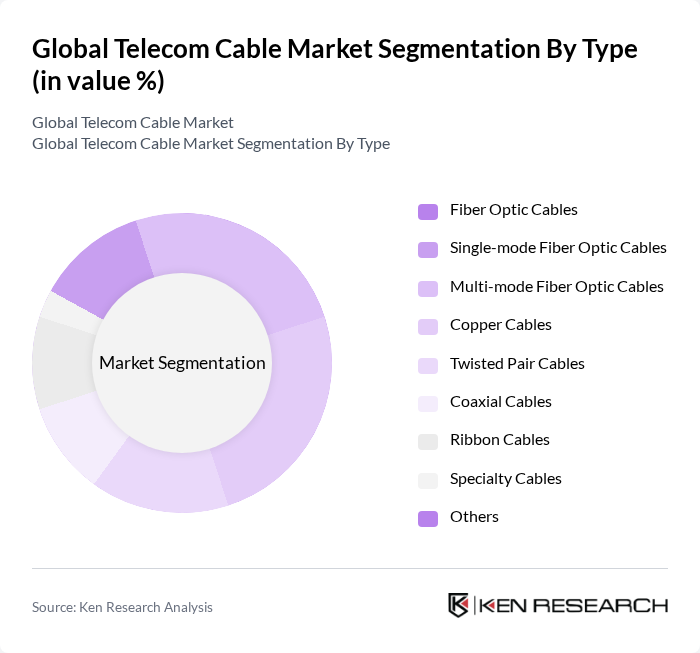
By Type:The telecom cable market is segmented into Fiber Optic Cables, Copper Cables, Ribbon Cables, Specialty Cables, and Others. Among these, Fiber Optic Cables are the most dominant due to their superior bandwidth, low latency, and high efficiency in data transmission. The increasing adoption of fiber optics is driven by the need for higher internet speeds and the expansion of 5G networks. Within Fiber Optic Cables, Single-mode and Multi-mode Fiber Optic Cables are the primary sub-segments. Single-mode cables lead the market due to their efficiency and suitability for long-distance, high-capacity transmission, while multi-mode cables are preferred for shorter distances and local area networks .
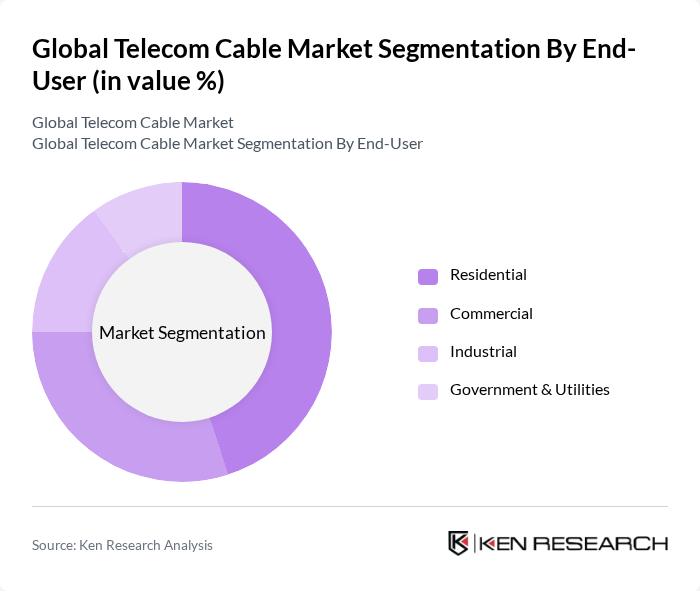
By End-User:The telecom cable market is segmented by end-user into Residential, Commercial, Industrial, and Government & Utilities. The Residential segment is currently the largest, driven by the increasing demand for high-speed internet, streaming services, and smart home technologies. The Commercial sector is also expanding rapidly due to the growing need for enhanced connectivity, data management, and the adoption of remote work and digital services. Industrial and Government & Utilities segments are experiencing growth as they modernize infrastructure and invest in digital transformation .
The Global Telecom Cable Market is characterized by a dynamic mix of regional and international players. Leading participants such as Prysmian Group, Nexans S.A., Corning Incorporated, Southwire Company, LLC, OFS Fitel, LLC, Belden Inc., General Cable Technologies Corporation, Sumitomo Electric Industries, Ltd., Leoni AG, CommScope Holding Company, Inc., TE Connectivity Ltd., Amphenol Corporation, Sterlite Technologies Limited, Rosenberger Hochfrequenztechnik GmbH & Co. KG, Lapp Group, Fujikura Ltd., Furukawa Electric Co., Ltd., LS Cable & System Ltd., Hengtong Group Co., Ltd., ZTT Group (Jiangsu Zhongtian Technology Co., Ltd.), NKT A/S, Taihan Electric Wire Co., Ltd., Tongding Group Co., Ltd., Hexatronic Group AB contribute to innovation, geographic expansion, and service delivery in this space.
The future of the telecom cable market is poised for significant transformation, driven by technological advancements and increasing demand for connectivity. As 5G networks roll out, telecom companies will prioritize upgrading their infrastructure to support higher data speeds and lower latency. Additionally, the integration of AI in network management will enhance operational efficiency, allowing for better resource allocation and improved service delivery. These trends will shape the market landscape, fostering innovation and competition among providers.
| Segment | Sub-Segments |
|---|---|
| By Type | Fiber Optic Cables Single-mode Fiber Optic Cables Multi-mode Fiber Optic Cables Copper Cables Twisted Pair Cables Coaxial Cables Ribbon Cables Specialty Cables Others |
| By End-User | Residential Commercial Industrial Government & Utilities |
| By Application | Telecommunications Data Centers Broadcasting Internet Connectivity Others |
| By Installation Type | Indoor Outdoor Underground Aerial |
| By Component | Cables Connectors Accessories |
| By Price Range | Low Medium High |
| By Policy Support | Subsidies Tax Exemptions Grants Others |
| Scope Item/Segment | Sample Size | Target Respondent Profiles |
|---|---|---|
| Telecom Infrastructure Providers | 100 | Network Engineers, Operations Managers |
| Service Provider Customer Insights | 80 | Customer Experience Managers, Product Development Leads |
| Regulatory Impact Assessment | 60 | Policy Analysts, Compliance Officers |
| End-User Satisfaction Surveys | 90 | Residential Customers, Business Account Managers |
| Market Trend Analysis | 70 | Market Analysts, Strategic Planners |
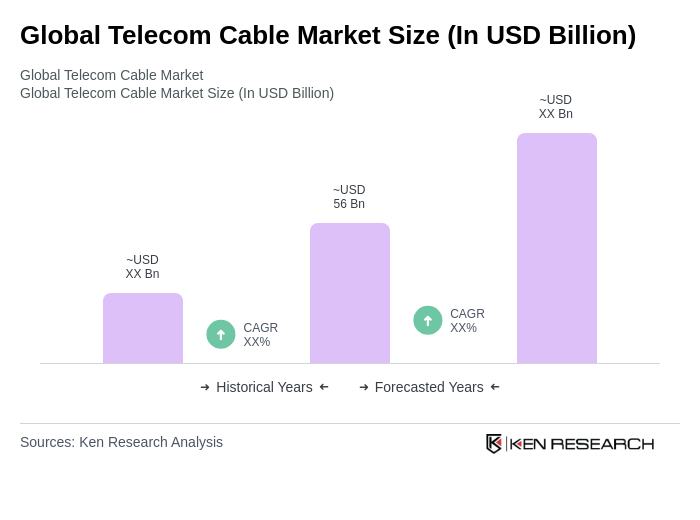
The Global Telecom Cable Market is valued at approximately USD 56 billion, driven by the increasing demand for high-speed connectivity, rapid telecommunications infrastructure expansion, and the widespread adoption of fiber optic technology across various sectors.

What makes us stand out is that our consultants follow Robust, Refine and Result (RRR) methodology. Robust for clear definitions, approaches and sanity checking, Refine for differentiating respondents' facts and opinions, and Result for presenting data with story.

We have set a benchmark in the industry by offering our clients with syndicated and customized market research reports featuring coverage of entire market as well as meticulous research and analyst insights.

While we don't replace traditional research, we flip the method upside down. Our dual approach of Top Bottom & Bottom Top ensures quality deliverable by not just verifying company fundamentals but also looking at the sector and macroeconomic factors.

With one step in the future, our research team constantly tries to show you the bigger picture. We help with some of the tough questions you may encounter along the way: How is the industry positioned? Best marketing channel? KPI's of competitors? By aligning every element, we help maximize success.

Our report gives you instant access to the answers and sources that other companies might choose to hide. We elaborate each steps of research methodology we have used and showcase you the sample size to earn your trust.

If you need any support, we are here! We pride ourselves on universe strength, data quality, and quick, friendly, and professional service.













