About the Report
Base Year 2024Listen to the audio summary
Global Telematics Control Unit Market Overview
- The Global Telematics Control Unit Market is valued at USD 15 billion, based on a five-year historical analysis. Recent analyst baselines place the market around USD 15.04 billion, aligning with broader connected-vehicle adoption and OEM integration trends .
- Key players in this market include the United States, Germany, and China, reflecting leadership in automotive production, connected-car penetration, and sustained R&D investment; Europe held a leading share recently, supported by strong OEMs and connectivity mandates, while North America and Asia Pacific (notably China) remain pivotal to scale and innovation .
- The European Union’s safety framework includes the eCall mandate requiring in-vehicle emergency call capability in new cars, which continues to bolster TCU fitment; this policy is cited by market sources as a key demand driver for compliant telematics systems under the EU’s General Safety Regulation package .

Global Telematics Control Unit Market Segmentation
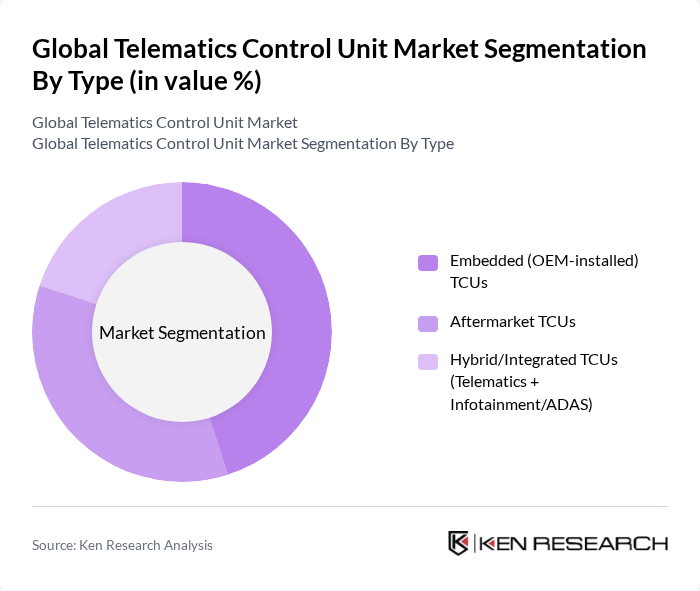
By Type:The telematics control unit market is segmented into three main types: Embedded (OEM-installed) TCUs, Aftermarket TCUs, and Hybrid/Integrated TCUs (Telematics + Infotainment/ADAS). Embedded TCUs are increasingly favored by OEMs due to mandated safety/connectivity features and seamless in-vehicle integration, while aftermarket TCUs serve retrofit needs across fleets and consumer vehicles. Hybrid/Integrated TCUs are gaining traction as OEMs converge telematics with infotainment head units and ADAS domain controllers, leveraging 4G/5G and C-V2X to support diagnostics, OTA updates, and safety services .
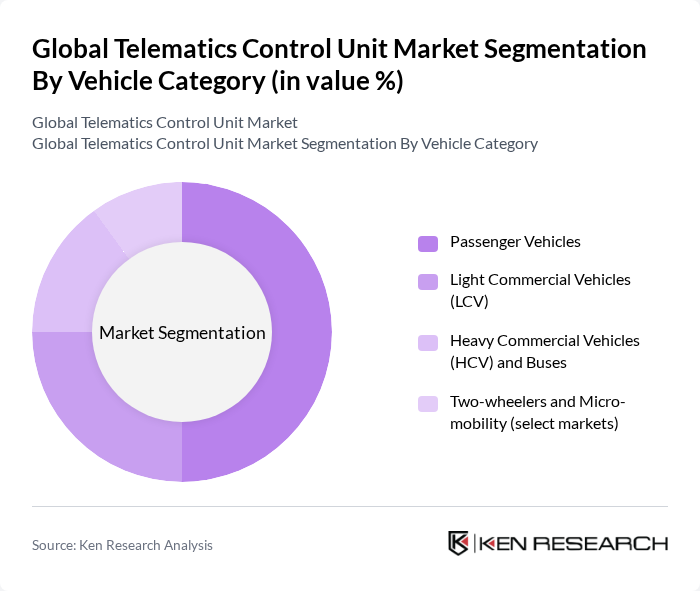
By Vehicle Category:The market is further segmented by vehicle category, including Passenger Vehicles, Light Commercial Vehicles (LCV), Heavy Commercial Vehicles (HCV) and Buses, and Two-wheelers and Micro-mobility (select markets). Passenger vehicles dominate on the back of OEM-installed connectivity, safety mandates (e.g., eCall), and consumer demand for connected services; LCVs and HCVs benefit from fleet management, remote diagnostics, and compliance use cases; two-wheelers and micro-mobility remain emerging niches in select markets as connectivity modules become more cost-efficient .
Global Telematics Control Unit Market Competitive Landscape
The Global Telematics Control Unit Market is characterized by a dynamic mix of regional and international players. Leading participants such as LG Electronics, Samsung Electronics (HARMAN International), Continental AG, Robert Bosch GmbH (Bosch Mobility), Denso Corporation, Marelli, Aptiv PLC, Panasonic Holdings Corporation, Valeo, Visteon Corporation, Qualcomm Technologies, Inc., Autotalks Ltd., Sierra Wireless (Semtech), Telit Cinterion, CalAmp Corp., Marelli Automotive Lighting and Electronics, Aisin Corporation, Fibocom Wireless Inc., Quectel Wireless Solutions, PATEO CONNECT+ contribute to innovation, geographic expansion, and service delivery in this space .
Global Telematics Control Unit Market Industry Analysis
Growth Drivers
- Increasing Demand for Connected Vehicles:The global connected vehicle market is projected to reach 50 million units in future, driven by consumer preferences for advanced features. In future, approximately 30% of new vehicles sold were equipped with telematics systems, reflecting a significant shift towards connectivity. This trend is supported by the rising number of smartphone users, which is expected to surpass 7.1 billion globally, enhancing the demand for integrated vehicle technologies.
- Rising Focus on Fleet Management Solutions:The fleet management market is anticipated to grow to $36 billion in future, with telematics playing a crucial role in optimizing operations. Companies are increasingly adopting telematics to monitor vehicle performance, reduce operational costs, and improve efficiency. In future, over 65% of fleet operators reported using telematics solutions, highlighting the growing reliance on data-driven decision-making in logistics and transportation sectors.
- Growing Emphasis on Vehicle Safety and Security:In future, the global automotive safety market is expected to reach $130 billion, with telematics contributing significantly to enhancing vehicle safety features. The implementation of advanced driver-assistance systems (ADAS) is projected to increase by 30% annually, driven by regulatory requirements and consumer demand for safer vehicles. This trend underscores the importance of telematics in providing real-time data for accident prevention and emergency response.
Market Challenges
- High Initial Investment Costs:The upfront costs associated with telematics systems can be a barrier for many businesses, particularly small and medium enterprises. In future, the average cost of implementing a telematics solution was estimated at $1,600 per vehicle, which can deter adoption. This challenge is compounded by the need for ongoing maintenance and updates, which can further strain budgets, especially in economically volatile regions.
- Data Privacy and Security Concerns:With the increasing amount of data collected by telematics systems, concerns regarding data privacy and security are paramount. In future, 75% of consumers expressed worries about how their data is used, leading to hesitance in adopting telematics solutions. Regulatory frameworks, such as GDPR, impose strict compliance requirements, which can complicate implementation and increase operational costs for telematics providers.
Global Telematics Control Unit Market Future Outlook
The telematics control unit market is poised for significant evolution, driven by technological advancements and changing consumer preferences. The integration of AI and machine learning is expected to enhance predictive analytics capabilities, allowing for more efficient fleet management and improved vehicle safety. Additionally, the expansion of 5G networks will facilitate faster data transmission, enabling real-time monitoring and analytics, which are crucial for the development of smart transportation systems and connected vehicles.
Market Opportunities
- Integration of AI and Machine Learning:The incorporation of AI in telematics systems can lead to enhanced predictive maintenance and operational efficiency. By future, AI-driven telematics solutions are expected to reduce maintenance costs by up to 25%, providing a compelling opportunity for businesses to leverage technology for improved performance and cost savings.
- Expansion into Emerging Markets:Emerging markets present a significant growth opportunity for telematics providers, with vehicle ownership projected to increase by 18% annually. As infrastructure improves and connectivity expands, the demand for telematics solutions in these regions is expected to rise, offering new avenues for revenue generation and market penetration.
Scope of the Report
| Segment | Sub-Segments |
|---|---|
| By Type | Embedded (OEM-installed) TCUs Aftermarket TCUs Hybrid/Integrated TCUs (Telematics + Infotainment/ADAS) |
| By Vehicle Category | Passenger Vehicles Light Commercial Vehicles (LCV) Heavy Commercial Vehicles (HCV) and Buses Two-wheelers and Micro-mobility (select markets) |
| By Connectivity Technology | G LTE/LTE Advanced G NR DSRC/C-V2X Satellite (backup/remote coverage) |
| By Function | Vehicle Diagnostics & Prognostics eCall/Crash Notification & Emergency Assistance Fleet Management & UBI Infotainment, Navigation & OTA Updates Driver Assistance & Safety (ADAS enablement) |
| By Deployment | OEM-Installed Aftermarket Installed |
| By Sales Channel | Direct to OEM Tier-1/Tier-2 Supplier Networks Aftermarket Distributors/Online |
| By Region | North America Europe Asia-Pacific Middle East & Africa South America |
Key Target Audience
Investors and Venture Capitalist Firms
Government and Regulatory Bodies (e.g., National Highway Traffic Safety Administration, Federal Communications Commission)
Automotive Manufacturers
Telematics Service Providers
Insurance Companies
Fleet Management Companies
Telecommunications Companies
Logistics and Transportation Companies
Players Mentioned in the Report:
LG Electronics
Samsung Electronics (HARMAN International)
Continental AG
Robert Bosch GmbH (Bosch Mobility)
Denso Corporation
Marelli
Aptiv PLC
Panasonic Holdings Corporation
Valeo
Visteon Corporation
Qualcomm Technologies, Inc.
Autotalks Ltd.
Sierra Wireless (Semtech)
Telit Cinterion
CalAmp Corp.
Marelli Automotive Lighting and Electronics
Aisin Corporation
Fibocom Wireless Inc.
Quectel Wireless Solutions
PATEO CONNECT+
Table of Contents
Market Assessment Phase
1. Executive Summary and Approach
2. Global Telematics Control Unit Market Overview
2.1 Key Insights and Strategic Recommendations
2.2 Global Telematics Control Unit Market Overview
2.3 Definition and Scope
2.4 Evolution of Market Ecosystem
2.5 Timeline of Key Regulatory Milestones
2.6 Value Chain & Stakeholder Mapping
2.7 Business Cycle Analysis
2.8 Policy & Incentive Landscape
3. Global Telematics Control Unit Market Analysis
3.1 Growth Drivers
3.1.1 Increasing demand for connected vehicles
3.1.2 Rising focus on fleet management solutions
3.1.3 Growing emphasis on vehicle safety and security
3.1.4 Expansion of IoT and smart city initiatives
3.2 Market Challenges
3.2.1 High initial investment costs
3.2.2 Data privacy and security concerns
3.2.3 Lack of standardization across platforms
3.2.4 Limited awareness among end-users
3.3 Market Opportunities
3.3.1 Integration of AI and machine learning
3.3.2 Development of advanced analytics solutions
3.3.3 Expansion into emerging markets
3.3.4 Partnerships with telecom providers
3.4 Market Trends
3.4.1 Shift towards subscription-based models
3.4.2 Increasing adoption of 5G technology
3.4.3 Growth of telematics in insurance applications
3.4.4 Rising demand for real-time data analytics
3.5 Government Regulation
3.5.1 Emission regulations for vehicles
3.5.2 Data protection laws impacting telematics
3.5.3 Safety standards for connected vehicles
3.5.4 Incentives for electric vehicle adoption
4. SWOT Analysis
5. Stakeholder Analysis
6. Porter's Five Forces Analysis
7. Global Telematics Control Unit Market Market Size, 2019-2024
7.1 By Value
7.2 By Volume
7.3 By Average Selling Price
8. Global Telematics Control Unit Market Segmentation
8.1 By Type
8.1.1 Embedded (OEM-installed) TCUs
8.1.2 Aftermarket TCUs
8.1.3 Hybrid/Integrated TCUs (Telematics + Infotainment/ADAS)
8.2 By Vehicle Category
8.2.1 Passenger Vehicles
8.2.2 Light Commercial Vehicles (LCV)
8.2.3 Heavy Commercial Vehicles (HCV) and Buses
8.2.4 Two-wheelers and Micro-mobility (select markets)
8.3 By Connectivity Technology
8.3.1 4G LTE/LTE Advanced
8.3.2 5G NR
8.3.3 DSRC/C-V2X
8.3.4 Satellite (backup/remote coverage)
8.4 By Function
8.4.1 Vehicle Diagnostics & Prognostics
8.4.2 eCall/Crash Notification & Emergency Assistance
8.4.3 Fleet Management & UBI
8.4.4 Infotainment, Navigation & OTA Updates
8.4.5 Driver Assistance & Safety (ADAS enablement)
8.5 By Deployment
8.5.1 OEM-Installed
8.5.2 Aftermarket Installed
8.6 By Sales Channel
8.6.1 Direct to OEM
8.6.2 Tier-1/Tier-2 Supplier Networks
8.6.3 Aftermarket Distributors/Online
8.7 By Region
8.7.1 North America
8.7.2 Europe
8.7.3 Asia-Pacific
8.7.4 Middle East & Africa
8.7.5 South America
9. Global Telematics Control Unit Market Competitive Analysis
9.1 Market Share of Key Players
9.2 Cross Comparison of Key Players
9.2.1 Company Name
9.2.2 Segment Focus (OEM TCU, Aftermarket TCU, or Both)
9.2.3 TCU Shipments (Annual Units)
9.2.4 Automotive Revenue from TCUs (USD)
9.2.5 Geographic Footprint (Regions Served/OEM Programs)
9.2.6 Connectivity Portfolio (4G, 5G, C-V2X, DSRC, Satellite)
9.2.7 Design Wins with Major OEMs (Count)
9.2.8 Compliance & Certifications (e.g., eCall, cybersecurity, UNECE R155/R156)
9.2.9 OTA Capability & Software Update Coverage
9.2.10 ASP Trend (Average Selling Price per TCU)
9.2.11 Gross Margin Range
9.2.12 R&D Intensity (% of Revenue)
9.2.13 Product Innovation Velocity (New Platforms/Year)
9.2.14 Strategic Partnerships (OEMs, Chipsets, MNOs, Cloud)
9.2.15 Supply Chain Resilience (Multi-sourcing/Localization)
9.2.16 Warranty/Field Failure Rate (PPM)
9.2.17 Cybersecurity Posture (Certifications/Incidents)
9.2.18 Time-to-SOP (Program Win to Start of Production)
9.3 SWOT Analysis of Top Players
9.4 Pricing Analysis
9.5 Detailed Profile of Major Companies
9.5.1 LG Electronics
9.5.2 Samsung Electronics (HARMAN International)
9.5.3 Continental AG
9.5.4 Robert Bosch GmbH (Bosch Mobility)
9.5.5 Denso Corporation
9.5.6 Marelli
9.5.7 Aptiv PLC
9.5.8 Panasonic Holdings Corporation
9.5.9 Valeo
9.5.10 Visteon Corporation
9.5.11 Qualcomm Technologies, Inc.
9.5.12 Autotalks Ltd.
9.5.13 Sierra Wireless (Semtech)
9.5.14 Telit Cinterion
9.5.15 CalAmp Corp.
9.5.16 Marelli Automotive Lighting and Electronics
9.5.17 Aisin Corporation
9.5.18 Fibocom Wireless Inc.
9.5.19 Quectel Wireless Solutions
9.5.20 PATEO CONNECT+
10. Global Telematics Control Unit Market End-User Analysis
10.1 Procurement Behavior of Key Ministries
10.1.1 Government Fleet Management
10.1.2 Public Safety Initiatives
10.1.3 Infrastructure Development Projects
10.2 Corporate Spend on Infrastructure & Energy
10.2.1 Investment in Smart Transportation
10.2.2 Budget Allocation for Telematics Solutions
10.2.3 Funding for Research and Development
10.3 Pain Point Analysis by End-User Category
10.3.1 Cost Management in Fleet Operations
10.3.2 Data Security Concerns
10.3.3 Integration with Existing Systems
10.4 User Readiness for Adoption
10.4.1 Awareness of Telematics Benefits
10.4.2 Training and Support Needs
10.4.3 Technology Acceptance Levels
10.5 Post-Deployment ROI and Use Case Expansion
10.5.1 Measurement of Cost Savings
10.5.2 Expansion of Use Cases in Operations
10.5.3 Long-term Value Realization
11. Global Telematics Control Unit Market Future Size, 2025-2030
11.1 By Value
11.2 By Volume
11.3 By Average Selling Price
Go-To-Market Strategy Phase
1. Whitespace Analysis + Business Model Canvas
1.1 Market Gaps Identification
1.2 Business Model Development
2. Marketing and Positioning Recommendations
2.1 Branding Strategies
2.2 Product USPs
3. Distribution Plan
3.1 Urban Retail Strategies
3.2 Rural NGO Tie-ups
4. Channel & Pricing Gaps
4.1 Underserved Routes
4.2 Pricing Bands Analysis
5. Unmet Demand & Latent Needs
5.1 Category Gaps
5.2 Consumer Segments
6. Customer Relationship
6.1 Loyalty Programs
6.2 After-sales Service
7. Value Proposition
7.1 Sustainability Initiatives
7.2 Integrated Supply Chains
8. Key Activities
8.1 Regulatory Compliance
8.2 Branding Efforts
8.3 Distribution Setup
9. Entry Strategy Evaluation
9.1 Domestic Market Entry Strategy
9.1.1 Product Mix Considerations
9.1.2 Pricing Band Strategy
9.1.3 Packaging Approaches
9.2 Export Entry Strategy
9.2.1 Target Countries Identification
9.2.2 Compliance Roadmap Development
10. Entry Mode Assessment
10.1 Joint Ventures
10.2 Greenfield Investments
10.3 Mergers & Acquisitions
10.4 Distributor Model Evaluation
11. Capital and Timeline Estimation
11.1 Capital Requirements
11.2 Timelines for Implementation
12. Control vs Risk Trade-Off
12.1 Ownership Considerations
12.2 Partnerships Evaluation
13. Profitability Outlook
13.1 Breakeven Analysis
13.2 Long-term Sustainability Strategies
14. Potential Partner List
14.1 Distributors
14.2 Joint Ventures
14.3 Acquisition Targets
15. Execution Roadmap
15.1 Phased Plan for Market Entry
15.1.1 Market Setup
15.1.2 Market Entry
15.1.3 Growth Acceleration
15.1.4 Scale & Stabilize
15.2 Key Activities and Milestones
15.2.1 Milestone Planning
15.2.2 Activity Tracking
Research Methodology
Phase 1: Approach1
Desk Research
- Industry reports from telematics associations and market research firms
- Government publications on transportation and automotive regulations
- Academic journals focusing on telematics technology advancements
Primary Research
- Interviews with telematics solution providers and technology developers
- Surveys with fleet management companies and logistics operators
- Field interviews with automotive manufacturers and OEMs
Validation & Triangulation
- Cross-validation of data from multiple industry sources and reports
- Triangulation of insights from primary interviews and secondary data
- Sanity checks through expert panels comprising industry veterans
Phase 2: Market Size Estimation1
Top-down Assessment
- Analysis of global automotive market size and telematics penetration rates
- Segmentation by application areas such as fleet management and insurance
- Incorporation of regional growth trends and technological adoption rates
Bottom-up Modeling
- Estimation of unit sales from leading telematics device manufacturers
- Operational cost analysis based on service pricing models
- Volume x average revenue per unit for various telematics solutions
Forecasting & Scenario Analysis
- Multi-factor regression analysis considering vehicle sales and telematics adoption
- Scenario modeling based on regulatory changes and market dynamics
- Baseline, optimistic, and pessimistic forecasts through 2030
Phase 3: CATI Sample Composition1
| Scope Item/Segment | Sample Size | Target Respondent Profiles |
|---|---|---|
| Fleet Management Solutions | 140 | Fleet Managers, Operations Directors |
| Insurance Telematics | 100 | Insurance Underwriters, Risk Assessment Analysts |
| Automotive OEM Integration | 80 | Product Managers, R&D Engineers |
| Telematics Device Manufacturing | 70 | Manufacturing Engineers, Supply Chain Managers |
| Consumer Telematics Applications | 90 | Product Development Managers, Marketing Executives |
Frequently Asked Questions
What is the current value of the Global Telematics Control Unit Market?
The Global Telematics Control Unit Market is valued at approximately USD 15.04 billion, reflecting a five-year historical analysis and aligning with trends in connected vehicle adoption and OEM integration.
Which regions are leading in the Telematics Control Unit Market?
What are the main types of telematics control units?
How does the European Union influence the telematics market?
Other Regional/Country Reports
Indonesia Telematics Control Unit Market
Malaysia Telematics Control Unit Market
APAC Telematics Control Unit Market
SEA Telematics Control Unit Market
Why Buy From Us?

What makes us stand out is that our consultants follow Robust, Refine and Result (RRR) methodology. Robust for clear definitions, approaches and sanity checking, Refine for differentiating respondents' facts and opinions, and Result for presenting data with story.

We have set a benchmark in the industry by offering our clients with syndicated and customized market research reports featuring coverage of entire market as well as meticulous research and analyst insights.

While we don't replace traditional research, we flip the method upside down. Our dual approach of Top Bottom & Bottom Top ensures quality deliverable by not just verifying company fundamentals but also looking at the sector and macroeconomic factors.

With one step in the future, our research team constantly tries to show you the bigger picture. We help with some of the tough questions you may encounter along the way: How is the industry positioned? Best marketing channel? KPI's of competitors? By aligning every element, we help maximize success.

Our report gives you instant access to the answers and sources that other companies might choose to hide. We elaborate each steps of research methodology we have used and showcase you the sample size to earn your trust.

If you need any support, we are here! We pride ourselves on universe strength, data quality, and quick, friendly, and professional service.