Ken Research Logo

Global Tidal Power Market

The global tidal power market, valued at USD 1.4 billion, is growing due to renewable energy shifts, technological innovations, and supportive policies, targeting 42.5% renewable share by 2030.

Region:Global

Author(s):Dev

Product Code:KRAC0403

Pages:95

Published On:August 2025

About the Report

Base Year 2024

Global Tidal Power Market Overview

  • The Global Tidal Power Market is valued at USD 1.4 billion, based on a five-year historical analysis, reflecting recent consolidated estimates for tidal energy market value driven by deployments and pilot-to-commercial transitions . This growth is primarily driven by the increasing demand for renewable energy sources, technological advancements in tidal energy systems, and supportive government policies aimed at reducing carbon emissions . The market is witnessing a shift towards sustainable energy solutions, with tidal power recognized for its reliable and predictable generation profile versus variable renewables .
  • Countries such as the United Kingdom, France, and South Korea dominate the Global Tidal Power Market due to their extensive coastlines, strong resources, and active project pipelines and demonstrations . The UK has made significant investments and hosts leading arrays and test centers (e.g., EMEC, MeyGen via SIMEC Atlantis; Orbital’s O2 platform), while France builds on long-standing marine energy capabilities and test sites; South Korea has deployed notable tidal range assets and continues to support marine energy initiatives .
  • In 2023, the European Union updated the Renewable Energy Directive (RED III), raising the binding renewable energy share target to at least 42.5% by 2030 (with an additional 2.5% indicative top?up), superseding the earlier 32% target under RED II . This framework accelerates the low?carbon transition and supports investment signals for ocean energy, including tidal projects across Europe .
Global Tidal Power Market Size

Global Tidal Power Market Segmentation

By Type:The tidal power market can be segmented into four main types: Tidal Stream (In-stream) Systems, Tidal Range (Barrage & Lagoon) Systems, Hybrid/Integrated Tidal Systems, and Emerging Concepts (e.g., Dynamic Tidal Power). Each of these types has unique characteristics and applications, catering to different energy needs and geographical conditions.
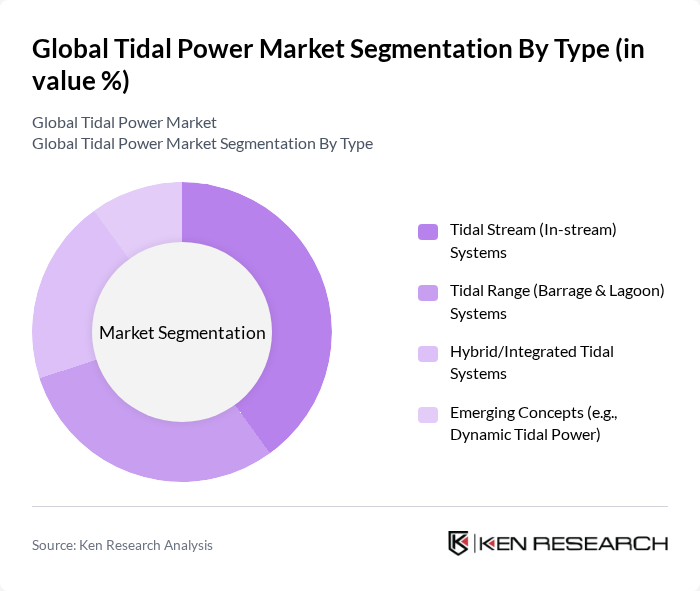
Global Tidal Power Market segmentation by Type.

The Tidal Stream (In-stream) Systems segment is currently leading the market due to its ability to harness the kinetic energy of tidal currents without the need for large infrastructure like barrages. This technology is increasingly favored for its lower environmental impact and cost-effectiveness. The growing interest in renewable energy sources and advancements in turbine technology are further propelling the adoption of tidal stream systems, making them a preferred choice for new projects.

By End-User:The tidal power market can be segmented by end-user into Utilities & Independent Power Producers (IPPs), Commercial & Industrial (C&I), Remote & Island Communities, and Defense & Research Facilities. Each end-user category has distinct energy requirements and operational frameworks, influencing their engagement with tidal energy solutions.
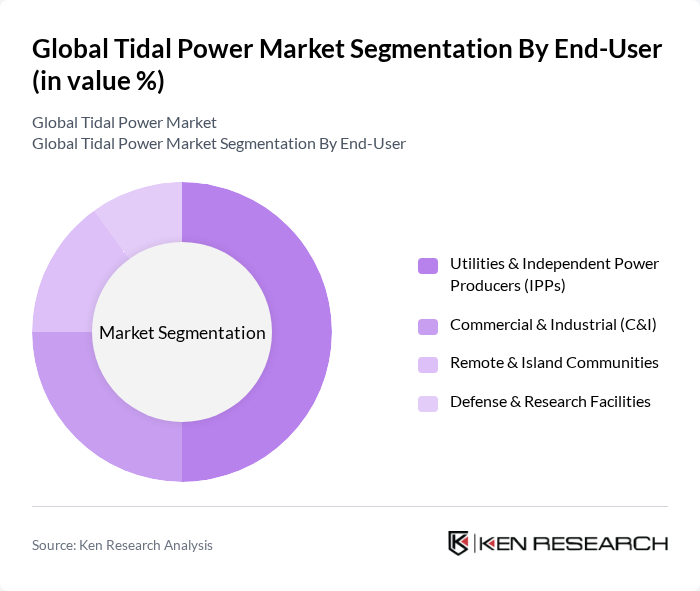
Global Tidal Power Market segmentation by End-User.

The Utilities & Independent Power Producers (IPPs) segment dominates the market as they are primarily responsible for large-scale energy generation and distribution. Their established infrastructure and investment capabilities allow them to capitalize on tidal energy projects, which are increasingly seen as viable alternatives to traditional energy sources. The push for renewable energy integration into national grids further solidifies their leadership in the tidal power market.

Global Tidal Power Market Competitive Landscape

The Global Tidal Power Market is characterized by a dynamic mix of regional and international players. Leading participants such as SIMEC Atlantis Energy (formerly Atlantis Resources), Orbital Marine Power Ltd. (formerly Scotrenewables), Verdant Power, Inc., Nova Innovation Ltd., Minesto AB, HydroQuest, Ocean Renewable Power Company (ORPC), Sabella SAS, Magallanes Renovables SL, Tocardo Tidal Power, Tidal Lagoon Power Ltd., Andritz Hydro (tidal turbines), Kawasaki Heavy Industries (tidal turbines), EDF Renewables (marine energy projects), DP Energy (tidal development) contribute to innovation, geographic expansion, and service delivery in this space.

SIMEC Atlantis Energy

2005

Edinburgh, Scotland

Orbital Marine Power Ltd.

2002

Orkney, Scotland

Verdant Power, Inc.

2000

New York, USA

Nova Innovation Ltd.

2010

Edinburgh, Scotland

Minesto AB

2007

Gothenburg, Sweden

Company

Establishment Year

Headquarters

Number of Operational Devices and Arrays

Levelized Cost of Energy (LCOE) for Tidal Projects

Capacity Factor and Availability (%)

Pipeline Backlog (MW) and Permitted Sites

Capital Efficiency ($/kW deployed)

Demonstration-to-Commercial Conversion Rate

Global Tidal Power Market Industry Analysis

Growth Drivers

  • Increasing Demand for Renewable Energy:The global shift towards renewable energy sources is evident, with investments in renewables reaching five hundred billion dollars in the future. This trend is driven by the need to reduce greenhouse gas emissions, as countries aim to meet the Paris Agreement targets. In None, the government has set a target to increase renewable energy's share to fifty percent by 2025, further fueling the demand for tidal power solutions as a sustainable energy source.
  • Technological Advancements in Tidal Energy Conversion:Recent innovations in tidal energy technology have significantly improved energy conversion efficiency. For instance, the latest tidal turbines can achieve efficiencies of up to forty-five percent, compared to earlier models that averaged around thirty percent. This technological progress is supported by a two hundred million dollar investment in R&D in None, aimed at enhancing tidal energy systems, making them more viable and attractive to investors and energy producers.
  • Government Support and Incentives for Clean Energy:Governments worldwide are increasingly providing financial incentives for renewable energy projects. In None, the government allocated one hundred fifty million dollars in subsidies for tidal energy projects in the future. This includes tax credits and grants that lower the financial burden on developers, encouraging the establishment of new tidal energy facilities and fostering a favorable environment for investment in clean energy technologies.

Market Challenges

  • High Initial Capital Investment:The capital required to establish tidal energy projects is substantial, often exceeding one billion dollars for large-scale installations. This high upfront cost poses a significant barrier to entry for many potential investors. In None, the average cost of tidal energy projects has increased by fifteen percent over the past three years, primarily due to rising material costs and technological complexities, making financing a critical challenge for developers.
  • Environmental and Ecological Concerns:Tidal energy projects can have significant ecological impacts, including alterations to marine habitats. In None, environmental assessments have shown that thirty percent of proposed tidal sites could disrupt local ecosystems. This has led to increased scrutiny from regulatory bodies, resulting in delays and additional costs for project approvals. Addressing these concerns is essential for the sustainable development of tidal energy resources.

Global Tidal Power Market Future Outlook

The future of the tidal power market appears promising, driven by increasing investments in sustainable energy and technological advancements. As countries strive to meet their renewable energy targets, tidal power is expected to play a crucial role in diversifying energy portfolios. The integration of tidal energy with smart grid technologies will enhance energy management, while ongoing research will likely lead to more efficient energy conversion systems, making tidal power a more attractive option for energy producers and investors alike.

Market Opportunities

  • Expansion into Emerging Markets:Emerging markets present significant opportunities for tidal energy development. Countries like India and Brazil are investing heavily in renewable energy, with tidal energy projects projected to attract three hundred million dollars in investments by 2025. This expansion can lead to job creation and energy security, making it a strategic focus for developers looking to capitalize on new markets.
  • Development of Hybrid Energy Systems:The integration of tidal power with other renewable sources, such as wind and solar, offers a unique opportunity to enhance energy reliability. Hybrid systems can provide a more stable energy supply, reducing dependence on fossil fuels. In None, pilot projects are underway, with an estimated investment of one hundred million dollars aimed at developing these hybrid systems, showcasing the potential for innovative energy solutions.

Scope of the Report

SegmentSub-Segments
By Type

Tidal Stream (In-stream) Systems

Tidal Range (Barrage & Lagoon) Systems

Hybrid/Integrated Tidal Systems

Emerging Concepts (e.g., Dynamic Tidal Power)

By End-User

Utilities & Independent Power Producers (IPPs)

Commercial & Industrial (C&I)

Remote & Island Communities

Defense & Research Facilities

By Region

North America

Europe

Asia-Pacific

Latin America

By Technology

Horizontal Axis Tidal Turbines (HATT)

Vertical Axis Tidal Turbines (VATT)

Oscillating Hydrofoils

Submerged Pressure Differential & Other Novel Devices

By Application

Grid-Connected Projects

Off-Grid/Microgrid Systems

Utility-Scale Arrays

Demonstration & Pilot Projects

By Investment Source

Private Equity & Venture Capital

Public Funding & Grants

Strategic Corporate Investment

Multilateral & International Financing

By Policy Support

Contracts for Difference (CfDs) / Feed-in Tariffs

Tax Credits & Accelerated Depreciation

Renewable Energy Certificates (RECs) / Guarantees of Origin

Permitting Streamlining & Environmental Consents

Key Target Audience

Investors and Venture Capitalist Firms

Government and Regulatory Bodies (e.g., U.S. Department of Energy, European Commission)

Manufacturers and Producers of Tidal Energy Equipment

Utility Companies and Energy Providers

Environmental Agencies (e.g., Environmental Protection Agency)

Project Developers and Operators

Energy Policy Makers and Advisors

International Renewable Energy Organizations (e.g., International Renewable Energy Agency)

Players Mentioned in the Report:

SIMEC Atlantis Energy (formerly Atlantis Resources)

Orbital Marine Power Ltd. (formerly Scotrenewables)

Verdant Power, Inc.

Nova Innovation Ltd.

Minesto AB

HydroQuest

Ocean Renewable Power Company (ORPC)

Sabella SAS

Magallanes Renovables SL

Tocardo Tidal Power

Tidal Lagoon Power Ltd.

Andritz Hydro (tidal turbines)

Kawasaki Heavy Industries (tidal turbines)

EDF Renewables (marine energy projects)

DP Energy (tidal development)

Table of Contents

Market Assessment Phase

1. Executive Summary and Approach


2. Global Tidal Power Market Overview

2.1 Key Insights and Strategic Recommendations

2.2 Global Tidal Power Market Overview

2.3 Definition and Scope

2.4 Evolution of Market Ecosystem

2.5 Timeline of Key Regulatory Milestones

2.6 Value Chain & Stakeholder Mapping

2.7 Business Cycle Analysis

2.8 Policy & Incentive Landscape


3. Global Tidal Power Market Analysis

3.1 Growth Drivers

3.1.1 Increasing Demand for Renewable Energy
3.1.2 Technological Advancements in Tidal Energy Conversion
3.1.3 Government Support and Incentives for Clean Energy
3.1.4 Rising Awareness of Climate Change and Environmental Impact

3.2 Market Challenges

3.2.1 High Initial Capital Investment
3.2.2 Environmental and Ecological Concerns
3.2.3 Limited Infrastructure for Tidal Energy
3.2.4 Regulatory Hurdles and Permitting Issues

3.3 Market Opportunities

3.3.1 Expansion into Emerging Markets
3.3.2 Development of Hybrid Energy Systems
3.3.3 Investment in Research and Development
3.3.4 Collaboration with Technology Providers

3.4 Market Trends

3.4.1 Increasing Investment in Sustainable Energy Projects
3.4.2 Growth of Smart Grid Technologies
3.4.3 Integration of Tidal Power with Other Renewable Sources
3.4.4 Focus on Energy Storage Solutions

3.5 Government Regulation

3.5.1 Renewable Energy Standards and Mandates
3.5.2 Feed-in Tariffs for Tidal Energy
3.5.3 Environmental Impact Assessments Requirements
3.5.4 International Agreements on Climate Change

4. SWOT Analysis


5. Stakeholder Analysis


6. Porter's Five Forces Analysis


7. Global Tidal Power Market Market Size, 2019-2024

7.1 By Value

7.2 By Volume

7.3 By Average Selling Price


8. Global Tidal Power Market Segmentation

8.1 By Type

8.1.1 Tidal Stream (In-stream) Systems
8.1.2 Tidal Range (Barrage & Lagoon) Systems
8.1.3 Hybrid/Integrated Tidal Systems
8.1.4 Emerging Concepts (e.g., Dynamic Tidal Power)

8.2 By End-User

8.2.1 Utilities & Independent Power Producers (IPPs)
8.2.2 Commercial & Industrial (C&I)
8.2.3 Remote & Island Communities
8.2.4 Defense & Research Facilities

8.3 By Region

8.3.1 North America
8.3.2 Europe
8.3.3 Asia-Pacific
8.3.4 Latin America

8.4 By Technology

8.4.1 Horizontal Axis Tidal Turbines (HATT)
8.4.2 Vertical Axis Tidal Turbines (VATT)
8.4.3 Oscillating Hydrofoils
8.4.4 Submerged Pressure Differential & Other Novel Devices

8.5 By Application

8.5.1 Grid-Connected Projects
8.5.2 Off-Grid/Microgrid Systems
8.5.3 Utility-Scale Arrays
8.5.4 Demonstration & Pilot Projects

8.6 By Investment Source

8.6.1 Private Equity & Venture Capital
8.6.2 Public Funding & Grants
8.6.3 Strategic Corporate Investment
8.6.4 Multilateral & International Financing

8.7 By Policy Support

8.7.1 Contracts for Difference (CfDs) / Feed-in Tariffs
8.7.2 Tax Credits & Accelerated Depreciation
8.7.3 Renewable Energy Certificates (RECs) / Guarantees of Origin
8.7.4 Permitting Streamlining & Environmental Consents

9. Global Tidal Power Market Competitive Analysis

9.1 Market Share of Key Players

9.2 KPIs for Cross Comparison of Key Players

9.2.1 Installed and Contracted Capacity (MW)
9.2.2 Number of Operational Devices and Arrays
9.2.3 Levelized Cost of Energy (LCOE) for Tidal Projects
9.2.4 Capacity Factor and Availability (%)
9.2.5 Pipeline Backlog (MW) and Permitted Sites
9.2.6 Capital Efficiency ($/kW deployed)
9.2.7 Demonstration-to-Commercial Conversion Rate
9.2.8 Grid Connection Success Rate and Time-to-Interconnect
9.2.9 O&M Cost per MWh and Mean Time Between Failures (MTBF)
9.2.10 Secured Revenues: PPAs/CfDs/Grants ($) and Duration

9.3 SWOT Analysis of Top Players

9.4 Pricing Analysis

9.5 Detailed Profile of Major Companies

9.5.1 SIMEC Atlantis Energy (formerly Atlantis Resources)
9.5.2 Orbital Marine Power Ltd. (formerly Scotrenewables)
9.5.3 Verdant Power, Inc.
9.5.4 Nova Innovation Ltd.
9.5.5 Minesto AB
9.5.6 HydroQuest
9.5.7 Ocean Renewable Power Company (ORPC)
9.5.8 Sabella SAS
9.5.9 Magallanes Renovables SL
9.5.10 Tocardo Tidal Power
9.5.11 Tidal Lagoon Power Ltd.
9.5.12 Andritz Hydro (tidal turbines)
9.5.13 Kawasaki Heavy Industries (tidal turbines)
9.5.14 EDF Renewables (marine energy projects)
9.5.15 DP Energy (tidal development)

10. Global Tidal Power Market End-User Analysis

10.1 Procurement Behavior of Key Ministries

10.1.1 Government Procurement Policies
10.1.2 Budget Allocations for Renewable Energy
10.1.3 Collaboration with Private Sector

10.2 Corporate Spend on Infrastructure & Energy

10.2.1 Investment Trends in Renewable Energy
10.2.2 Budgeting for Tidal Energy Projects
10.2.3 Long-term Energy Contracts

10.3 Pain Point Analysis by End-User Category

10.3.1 Cost of Implementation
10.3.2 Reliability of Energy Supply
10.3.3 Environmental Concerns

10.4 User Readiness for Adoption

10.4.1 Awareness of Tidal Energy Benefits
10.4.2 Technical Readiness of Infrastructure
10.4.3 Financial Readiness for Investment

10.5 Post-Deployment ROI and Use Case Expansion

10.5.1 Performance Metrics Post-Deployment
10.5.2 Expansion Opportunities in Other Regions
10.5.3 Long-term Sustainability of Projects

11. Global Tidal Power Market Future Size, 2025-2030

11.1 By Value

11.2 By Volume

11.3 By Average Selling Price


Go-To-Market Strategy Phase

1. Whitespace Analysis + Business Model Canvas

1.1 Market Gaps Identification

1.2 Value Proposition Development

1.3 Revenue Streams Analysis

1.4 Key Partnerships

1.5 Cost Structure Analysis

1.6 Customer Segments

1.7 Channels


2. Marketing and Positioning Recommendations

2.1 Branding Strategies

2.2 Product USPs


3. Distribution Plan

3.1 Urban Retail Strategies

3.2 Rural NGO Tie-ups


4. Channel & Pricing Gaps

4.1 Underserved Routes

4.2 Pricing Bands


5. Unmet Demand & Latent Needs

5.1 Category Gaps

5.2 Consumer Segments


6. Customer Relationship

6.1 Loyalty Programs

6.2 After-sales Service


7. Value Proposition

7.1 Sustainability

7.2 Integrated Supply Chains


8. Key Activities

8.1 Regulatory Compliance

8.2 Branding

8.3 Distribution Setup


9. Entry Strategy Evaluation

9.1 Domestic Market Entry Strategy

9.1.1 Product Mix
9.1.2 Pricing Band
9.1.3 Packaging

9.2 Export Entry Strategy

9.2.1 Target Countries
9.2.2 Compliance Roadmap

10. Entry Mode Assessment

10.1 Joint Ventures

10.2 Greenfield Investments

10.3 Mergers & Acquisitions

10.4 Distributor Model


11. Capital and Timeline Estimation

11.1 Capital Requirements

11.2 Timelines


12. Control vs Risk Trade-Off

12.1 Ownership vs Partnerships


13. Profitability Outlook

13.1 Breakeven Analysis

13.2 Long-term Sustainability


14. Potential Partner List

14.1 Distributors

14.2 Joint Ventures

14.3 Acquisition Targets


15. Execution Roadmap

15.1 Phased Plan for Market Entry

15.1.1 Market Setup
15.1.2 Market Entry
15.1.3 Growth Acceleration
15.1.4 Scale & Stabilize

15.2 Key Activities and Milestones

15.2.1 Milestone Planning
15.2.2 Activity Tracking

Research Methodology

ApproachModellingSample

Phase 1: Approach1

Desk Research

  • Analysis of global tidal power market reports from industry associations and governmental bodies
  • Review of academic journals and publications focusing on tidal energy technologies and innovations
  • Examination of market trends and forecasts from renewable energy think tanks and consultancy firms

Primary Research

  • Interviews with engineers and project managers involved in tidal power installations
  • Surveys with energy policy experts and regulatory authorities in key markets
  • Field interviews with stakeholders from tidal energy project financing and investment firms

Validation & Triangulation

  • Cross-validation of findings through multiple data sources including market reports and expert opinions
  • Triangulation of data from industry publications, government reports, and primary interviews
  • Sanity checks conducted through expert panel reviews and feedback sessions

Phase 2: Market Size Estimation1

Top-down Assessment

  • Estimation of global tidal power capacity based on installed megawatts and projected growth rates
  • Segmentation of market size by region, technology type, and application (e.g., grid-connected vs. off-grid)
  • Incorporation of government incentives and policies promoting tidal energy adoption

Bottom-up Modeling

  • Collection of data on project costs and operational expenses from existing tidal power plants
  • Estimation of revenue generation based on energy pricing and demand forecasts
  • Volume x cost analysis for different tidal energy technologies (e.g., tidal stream vs. tidal range)

Forecasting & Scenario Analysis

  • Multi-factor regression analysis incorporating variables such as technological advancements and regulatory changes
  • Scenario modeling based on varying levels of investment and public acceptance of tidal energy
  • Development of baseline, optimistic, and pessimistic forecasts through 2030

Phase 3: CATI Sample Composition1

Scope Item/SegmentSample SizeTarget Respondent Profiles
Tidal Energy Project Developers90Project Managers, Technical Directors
Government Energy Regulators70Policy Analysts, Regulatory Affairs Managers
Investment Firms in Renewable Energy50Investment Analysts, Portfolio Managers
Environmental NGOs Focused on Marine Energy40Research Coordinators, Advocacy Directors
Utility Companies Engaged in Tidal Power60Energy Managers, Operations Supervisors

Frequently Asked Questions

What is the current value of the Global Tidal Power Market?

The Global Tidal Power Market is valued at approximately USD 1.4 billion, reflecting a significant growth trend driven by increasing demand for renewable energy, technological advancements, and supportive government policies aimed at reducing carbon emissions.

Which countries are leading in the Global Tidal Power Market?

What are the main types of tidal power systems?

What drives the growth of the tidal power market?

Other Regional/Country Reports

Indonesia Global Tidal Power Market

Malaysia Global Tidal Power Market

KSA Global Tidal Power Market

APAC Global Tidal Power Market

SEA Global Tidal Power Market

Vietnam Global Tidal Power Market

Why Buy From Us?

Refine Robust Result (RRR) Framework

What makes us stand out is that our consultants follow Robust, Refine and Result (RRR) methodology. Robust for clear definitions, approaches and sanity checking, Refine for differentiating respondents' facts and opinions, and Result for presenting data with story.

Our Reach Is Unmatched

We have set a benchmark in the industry by offering our clients with syndicated and customized market research reports featuring coverage of entire market as well as meticulous research and analyst insights.

Shifting the Research Paradigm

While we don't replace traditional research, we flip the method upside down. Our dual approach of Top Bottom & Bottom Top ensures quality deliverable by not just verifying company fundamentals but also looking at the sector and macroeconomic factors.

More Insights-Better Decisions

With one step in the future, our research team constantly tries to show you the bigger picture. We help with some of the tough questions you may encounter along the way: How is the industry positioned? Best marketing channel? KPI's of competitors? By aligning every element, we help maximize success.

Transparency and Trust

Our report gives you instant access to the answers and sources that other companies might choose to hide. We elaborate each steps of research methodology we have used and showcase you the sample size to earn your trust.

Round the Clock Support

If you need any support, we are here! We pride ourselves on universe strength, data quality, and quick, friendly, and professional service.

Why Clients Choose Us?

400000+
Reports in repository
150+
Consulting projects a year
100+
Analysts
8000+
Client Queries in 2022








