About the Report
Base Year 2024Global Tomato Seeds Market Overview
- The Global Tomato Seeds Market is valued at USD 1.5 billion, based on a five-year historical analysis. This growth is primarily driven by increasing demand for tomatoes in both fresh and processed forms, advances in hybrid breeding and disease-resistance traits (e.g., resistance to ToBRFV), and rising adoption of protected cultivation for consistency and yield. The rising popularity of organic and specialty tomatoes (high-brix, cherry, grape) and expanding home/urban gardening are also contributing, as consumers seek quality, flavor, and traceability.
- Countries such as the United States, China, and India are among the leading tomato producers and key seed demand centers, supported by large cultivation areas and strong processing sectors; the U.S. benefits from advanced breeding and protected-culture adoption, while China and India leverage scale and expanding commercial hybrids. Investments in R&D by global seed majors and regional breeders continue to enhance yield, shelf life, flavor, and multi-disease resistance lines tailored to local agro-climates.
- In 2023, the European Union advanced its seed law reform and retained strict rules on varietal certification, labeling, and plant health for seed marketing under the existing EU seed marketing and plant health frameworks; commercial tomato seed lots must meet quality standards and be appropriately labeled, including any GMO status when applicable. These measures aim to safeguard plant health, ensure traceability and information to buyers, and support sustainable farming practices.

Global Tomato Seeds Market Segmentation
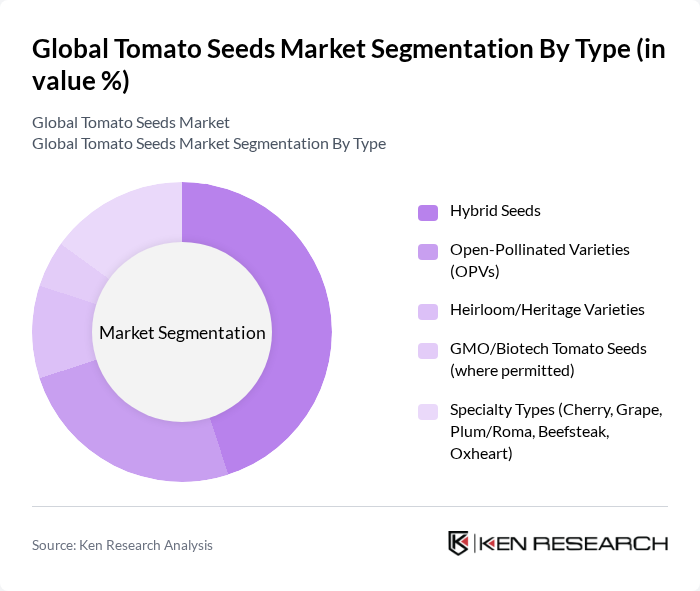
By Type:The tomato seeds market can be segmented into various types, including Hybrid Seeds, Open-Pollinated Varieties (OPVs), Heirloom/Heritage Varieties, GMO/Biotech Tomato Seeds (where permitted), and Specialty Types (Cherry, Grape, Plum/Roma, Beefsteak, Oxheart). Among these, Hybrid Seeds are leading the market due to higher yield potential, uniformity, and stacked resistance to key pathogens such as Fusarium, Verticillium, and ToBRFV—attributes critical for commercial profitability. Demand for specialty types continues to rise with premium pricing for cherry and high-brix segments in fresh retail and greenhouse channels.
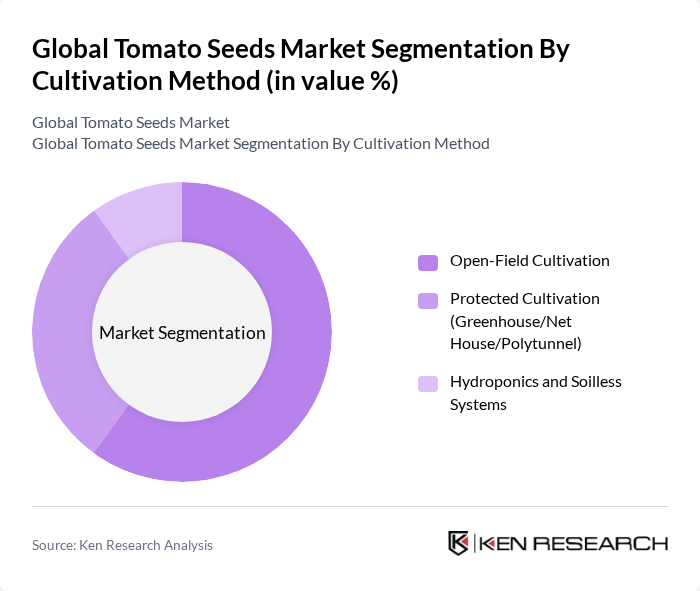
By Cultivation Method:The cultivation methods for tomato seeds include Open-Field Cultivation, Protected Cultivation (Greenhouse/Net House/Polytunnel), and Hydroponics and Soilless Systems. Open-Field Cultivation remains the most widely used method due to cost-effectiveness and scalability in major producing countries. Protected Cultivation is gaining traction for year-round supply, water-use efficiency, and improved pest/disease management, especially in Europe, North America, and parts of APAC; hydroponics is expanding within high-tech greenhouses for premium truss and cherry tomatoes.
Global Tomato Seeds Market Competitive Landscape
The Global Tomato Seeds Market is characterized by a dynamic mix of regional and international players. Leading participants such as Bayer Crop Science (Seminis Vegetable Seeds), Syngenta Seeds, Corteva Agriscience (Pioneer, Brevant), Groupe Limagrain (Vilmorin-Mikado, HM.CLAUSE), Rijk Zwaan, Sakata Seed Corporation, East-West Seed, Enza Zaden, Bejo Zaden, Nunhems (BASF Vegetable Seeds), Takii & Co., Ltd., Clause Vegetable Seeds (HM.CLAUSE), Known-You Seed Co., Ltd., Asia Seed Co., Ltd., Mahindra Agri Solutions Ltd. (Seeds Division) contribute to innovation, geographic expansion, and service delivery in this space.
Global Tomato Seeds Market Industry Analysis
Growth Drivers
- Increasing Demand for Organic Produce:The global organic food market is projected to reach $320 billion in future, driven by consumer preferences for healthier options. In future, organic tomato sales alone accounted for approximately $1.5 billion in the U.S. This surge in demand for organic produce is pushing farmers to seek high-quality organic tomato seeds, thereby stimulating growth in the tomato seeds market. The trend is further supported by the increasing number of certified organic farms, which reached over 3 million globally in future.
- Advancements in Seed Technology:The global investment in agricultural technology is expected to exceed $10 billion in future, with a significant portion directed towards seed innovation. Technologies such as CRISPR and gene editing are enhancing seed traits, leading to higher yields and disease resistance. For instance, the introduction of genetically modified tomato seeds has resulted in yield increases of up to 30% in various regions. These advancements are crucial for meeting the growing food demand and improving agricultural efficiency.
- Rising Global Population and Food Security Concerns:The world population is projected to reach 8.5 billion in future, intensifying the need for sustainable food production. According to the FAO, food production must increase by 70% to meet this demand. This urgency is driving investments in tomato seed development, as tomatoes are a staple crop. Countries like India and China are focusing on enhancing their agricultural output, leading to increased demand for high-yield tomato seeds to ensure food security.
Market Challenges
- Climate Change Impact on Crop Yields:Climate change is projected to reduce global agricultural yields by up to 25% in future, according to the IPCC. Extreme weather events, such as droughts and floods, are increasingly affecting tomato production, leading to inconsistent supply and quality. For instance, the recent drought in California resulted in a 15% decrease in tomato yields, highlighting the vulnerability of the sector. This unpredictability poses a significant challenge for seed producers and farmers alike.
- High Initial Investment for Seed Development:The development of new tomato seed varieties requires substantial financial investment, often exceeding $5 million per project. This high cost is a barrier for many small and medium-sized enterprises in the seed industry. Additionally, the lengthy research and development process, which can take up to 10 years, further complicates the situation. As a result, many companies may struggle to bring innovative products to market, limiting competition and growth in the sector.
Global Tomato Seeds Market Future Outlook
The future of the tomato seeds market is poised for significant transformation, driven by technological advancements and changing consumer preferences. As sustainable agriculture practices gain traction, the demand for climate-resilient seed varieties will likely increase. Furthermore, the rise of e-commerce platforms is expected to enhance seed distribution efficiency, making high-quality seeds more accessible to farmers. These trends indicate a dynamic market landscape, where innovation and adaptability will be key to success in meeting the evolving needs of the agricultural sector.
Market Opportunities
- Growth in Sustainable Agriculture Practices:The global market for sustainable agriculture is projected to reach $200 billion in future. This growth presents a significant opportunity for tomato seed producers to develop and market seeds that align with eco-friendly practices. By focusing on organic and sustainable seed varieties, companies can tap into a growing consumer base that prioritizes environmental responsibility and health.
- Technological Innovations in Seed Production:The integration of AI and machine learning in agriculture is expected to revolutionize seed production processes. In future, investments in agri-tech are anticipated to surpass $15 billion. This technological shift will enable more efficient breeding techniques and better crop management, creating opportunities for seed companies to enhance their product offerings and improve yield outcomes for farmers.
Scope of the Report
| Segment | Sub-Segments |
|---|---|
| By Type | Hybrid Seeds Open-Pollinated Varieties (OPVs) Heirloom/Heritage Varieties GMO/Biotech Tomato Seeds (where permitted) Specialty Types (Cherry, Grape, Plum/Roma, Beefsteak, Oxheart) |
| By Cultivation Method | Open-Field Cultivation Protected Cultivation (Greenhouse/Net House/Polytunnel) Hydroponics and Soilless Systems |
| By Application | Fresh Market (Table Tomatoes) Processing (Sauce, Paste, Canning, Ketchup) Specialty/High-Flavor Segments (Premium & Organic) Seed Production & Breeding Programs |
| By End-User | Commercial Growers and Agribusinesses Smallholder and Subsistence Farmers Home Gardeners/Hobbyists Research Institutions and Extension Bodies |
| By Trait | Disease Resistance Packages (e.g., ToMV, TSWV, Fusarium, Verticillium) Yield and Earliness Fruit Quality Traits (Size, Shelf-life, Firmness, Brix/Flavor) Growth Habit (Determinate, Semi-determinate, Indeterminate) |
| By Distribution Channel | Direct-to-Farm (Company/Dealer Networks) Agri-Retailers and Cooperatives Online and E-commerce Platforms Government/NGO Procurement Programs |
| By Region | North America Europe Asia-Pacific Latin America Middle East & Africa |
| By Price Tier | Premium (High-Density Trait/Greenhouse Hybrids) Mid-Range Value/Budget |
| By Packaging | Bulk/Commercial Packs Retail/Home Garden Packs Custom/Contract Packs |
Key Target Audience
Investors and Venture Capitalist Firms
Government and Regulatory Bodies (e.g., Food and Agriculture Organization, U.S. Department of Agriculture)
Seed Manufacturers and Producers
Distributors and Retailers of Agricultural Products
Agri-tech Companies
Industry Associations (e.g., International Seed Federation)
Financial Institutions and Banks
Biotechnology Firms
Players Mentioned in the Report:
Bayer Crop Science (Seminis Vegetable Seeds)
Syngenta Seeds
Corteva Agriscience (Pioneer, Brevant)
Groupe Limagrain (Vilmorin-Mikado, HM.CLAUSE)
Rijk Zwaan
Sakata Seed Corporation
East-West Seed
Enza Zaden
Bejo Zaden
Nunhems (BASF Vegetable Seeds)
Takii & Co., Ltd.
Clause Vegetable Seeds (HM.CLAUSE)
Known-You Seed Co., Ltd.
Asia Seed Co., Ltd.
Mahindra Agri Solutions Ltd. (Seeds Division)
Table of Contents
Market Assessment Phase
1. Executive Summary and Approach
2. Global Tomato Seeds Market Overview
2.1 Key Insights and Strategic Recommendations
2.2 Global Tomato Seeds Market Overview
2.3 Definition and Scope
2.4 Evolution of Market Ecosystem
2.5 Timeline of Key Regulatory Milestones
2.6 Value Chain & Stakeholder Mapping
2.7 Business Cycle Analysis
2.8 Policy & Incentive Landscape
3. Global Tomato Seeds Market Analysis
3.1 Growth Drivers
3.1.1 Increasing Demand for Organic Produce
3.1.2 Advancements in Seed Technology
3.1.3 Rising Global Population and Food Security Concerns
3.1.4 Expansion of Agricultural Land
3.2 Market Challenges
3.2.1 Climate Change Impact on Crop Yields
3.2.2 High Initial Investment for Seed Development
3.2.3 Regulatory Hurdles in Seed Approval
3.2.4 Competition from Alternative Crops
3.3 Market Opportunities
3.3.1 Growth in Sustainable Agriculture Practices
3.3.2 Technological Innovations in Seed Production
3.3.3 Expansion into Emerging Markets
3.3.4 Increasing Investment in Agricultural R&D
3.4 Market Trends
3.4.1 Shift Towards Hybrid and Genetically Modified Seeds
3.4.2 Rise of E-commerce in Seed Distribution
3.4.3 Focus on Climate-Resilient Varieties
3.4.4 Growing Consumer Awareness of Seed Quality
3.5 Government Regulation
3.5.1 Seed Certification Standards
3.5.2 Import and Export Regulations
3.5.3 Subsidies for Seed Development
3.5.4 Environmental Protection Laws
4. SWOT Analysis
5. Stakeholder Analysis
6. Porter's Five Forces Analysis
7. Global Tomato Seeds Market Market Size, 2019-2024
7.1 By Value
7.2 By Volume
7.3 By Average Selling Price
8. Global Tomato Seeds Market Segmentation
8.1 By Type
8.1.1 Hybrid Seeds
8.1.2 Open-Pollinated Varieties (OPVs)
8.1.3 Heirloom/Heritage Varieties
8.1.4 GMO/Biotech Tomato Seeds (where permitted)
8.1.5 Specialty Types (Cherry, Grape, Plum/Roma, Beefsteak, Oxheart)
8.2 By Cultivation Method
8.2.1 Open-Field Cultivation
8.2.2 Protected Cultivation (Greenhouse/Net House/Polytunnel)
8.2.3 Hydroponics and Soilless Systems
8.3 By Application
8.3.1 Fresh Market (Table Tomatoes)
8.3.2 Processing (Sauce, Paste, Canning, Ketchup)
8.3.3 Specialty/High-Flavor Segments (Premium & Organic)
8.3.4 Seed Production & Breeding Programs
8.4 By End-User
8.4.1 Commercial Growers and Agribusinesses
8.4.2 Smallholder and Subsistence Farmers
8.4.3 Home Gardeners/Hobbyists
8.4.4 Research Institutions and Extension Bodies
8.5 By Trait
8.5.1 Disease Resistance Packages (e.g., ToMV, TSWV, Fusarium, Verticillium)
8.5.2 Yield and Earliness
8.5.3 Fruit Quality Traits (Size, Shelf-life, Firmness, Brix/Flavor)
8.5.4 Growth Habit (Determinate, Semi-determinate, Indeterminate)
8.6 By Distribution Channel
8.6.1 Direct-to-Farm (Company/Dealer Networks)
8.6.2 Agri-Retailers and Cooperatives
8.6.3 Online and E-commerce Platforms
8.6.4 Government/NGO Procurement Programs
8.7 By Region
8.7.1 North America
8.7.2 Europe
8.7.3 Asia-Pacific
8.7.4 Latin America
8.7.5 Middle East & Africa
8.8 By Price Tier
8.8.1 Premium (High-Density Trait/Greenhouse Hybrids)
8.8.2 Mid-Range
8.8.3 Value/Budget
8.9 By Packaging
8.9.1 Bulk/Commercial Packs
8.9.2 Retail/Home Garden Packs
8.9.3 Custom/Contract Packs
9. Global Tomato Seeds Market Competitive Analysis
9.1 Market Share of Key Players
9.2 Cross Comparison of Key Players
9.2.1 Company Name
9.2.2 Segment Focus (Hybrid, OPV, Protected-culture, Processing)
9.2.3 Tomato Seed Revenue and Growth Rate (3–5 years)
9.2.4 Regional Footprint (APAC, Europe, Americas, MEA)
9.2.5 Portfolio Breadth (Cherry/Plum/Beefsteak/High-Brix/Resistant Lines)
9.2.6 Market Penetration (Dealer coverage, countries served)
9.2.7 R&D Intensity (R&D spend as % of sales; breeding stations count)
9.2.8 Trait Leadership (disease resistance stack coverage, ToBRFV resistance)
9.2.9 Distribution Efficiency (fill rate, time-to-delivery SLAs)
9.2.10 Pricing Positioning (premium vs value tiers)
9.2.11 Quality/Performance KPIs (germination %, uniformity, yield/ha benchmarks)
9.2.12 Brand Equity and Grower Loyalty (NPS/satisfaction indices)
9.3 SWOT Analysis of Top Players
9.4 Pricing Analysis
9.5 Detailed Profile of Major Companies
9.5.1 Bayer Crop Science (Seminis Vegetable Seeds)
9.5.2 Syngenta Seeds
9.5.3 Corteva Agriscience (Pioneer, Brevant)
9.5.4 Groupe Limagrain (Vilmorin-Mikado, HM.CLAUSE)
9.5.5 Rijk Zwaan
9.5.6 Sakata Seed Corporation
9.5.7 East-West Seed
9.5.8 Enza Zaden
9.5.9 Bejo Zaden
9.5.10 Nunhems (BASF Vegetable Seeds)
9.5.11 Takii & Co., Ltd.
9.5.12 Clause Vegetable Seeds (HM.CLAUSE)
9.5.13 Known-You Seed Co., Ltd.
9.5.14 Asia Seed Co., Ltd.
9.5.15 Mahindra Agri Solutions Ltd. (Seeds Division)
10. Global Tomato Seeds Market End-User Analysis
10.1 Procurement Behavior of Key Ministries
10.1.1 Government Procurement Policies
10.1.2 Budget Allocations for Agriculture
10.1.3 Collaboration with Seed Companies
10.1.4 Evaluation Criteria for Seed Selection
10.2 Corporate Spend on Infrastructure & Energy
10.2.1 Investment in Agricultural Infrastructure
10.2.2 Funding for Research and Development
10.2.3 Expenditure on Sustainable Practices
10.3 Pain Point Analysis by End-User Category
10.3.1 Quality Assurance Issues
10.3.2 Supply Chain Disruptions
10.3.3 Access to Advanced Seed Varieties
10.4 User Readiness for Adoption
10.4.1 Awareness of New Technologies
10.4.2 Training and Support Needs
10.4.3 Financial Readiness for Investment
10.5 Post-Deployment ROI and Use Case Expansion
10.5.1 Measurement of Yield Improvements
10.5.2 Long-term Cost Savings
10.5.3 Expansion into New Markets
11. Global Tomato Seeds Market Future Size, 2025-2030
11.1 By Value
11.2 By Volume
11.3 By Average Selling Price
Go-To-Market Strategy Phase
1. Whitespace Analysis + Business Model Canvas
1.1 Market Gaps Identification
1.2 Value Proposition Development
1.3 Revenue Streams Analysis
1.4 Key Partnerships Exploration
1.5 Cost Structure Assessment
1.6 Customer Segmentation
1.7 Competitive Advantage Analysis
2. Marketing and Positioning Recommendations
2.1 Branding Strategies
2.2 Product USPs
2.3 Target Market Identification
2.4 Communication Strategy
2.5 Digital Marketing Approaches
3. Distribution Plan
3.1 Urban Retail Strategies
3.2 Rural NGO Tie-ups
3.3 Direct-to-Consumer Channels
3.4 Partnership with Agricultural Cooperatives
4. Channel & Pricing Gaps
4.1 Underserved Routes
4.2 Pricing Bands Analysis
4.3 Competitor Pricing Comparison
5. Unmet Demand & Latent Needs
5.1 Category Gaps Identification
5.2 Consumer Segments Analysis
5.3 Emerging Trends Exploration
6. Customer Relationship
6.1 Loyalty Programs Development
6.2 After-sales Service Strategies
6.3 Customer Feedback Mechanisms
7. Value Proposition
7.1 Sustainability Initiatives
7.2 Integrated Supply Chains
7.3 Community Engagement Strategies
8. Key Activities
8.1 Regulatory Compliance
8.2 Branding Initiatives
8.3 Distribution Setup
9. Entry Strategy Evaluation
9.1 Domestic Market Entry Strategy
9.1.1 Product Mix Considerations
9.1.2 Pricing Band Strategy
9.1.3 Packaging Innovations
9.2 Export Entry Strategy
9.2.1 Target Countries Identification
9.2.2 Compliance Roadmap Development
10. Entry Mode Assessment
10.1 Joint Ventures
10.2 Greenfield Investments
10.3 Mergers & Acquisitions
10.4 Distributor Model Evaluation
11. Capital and Timeline Estimation
11.1 Capital Requirements Analysis
11.2 Timelines for Market Entry
12. Control vs Risk Trade-Off
12.1 Ownership vs Partnerships
13. Profitability Outlook
13.1 Breakeven Analysis
13.2 Long-term Sustainability Strategies
14. Potential Partner List
14.1 Distributors Identification
14.2 Joint Ventures Opportunities
14.3 Acquisition Targets
15. Execution Roadmap
15.1 Phased Plan for Market Entry
15.1.1 Market Setup
15.1.2 Market Entry
15.1.3 Growth Acceleration
15.1.4 Scale & Stabilize
15.2 Key Activities and Milestones
15.2.1 Milestone Planning
15.2.2 Activity Tracking
Research Methodology
Phase 1: Approach1
Desk Research
- Analysis of global agricultural reports from FAO and USDA
- Review of market studies and white papers from agricultural research institutions
- Examination of trade statistics and import/export data from national agricultural departments
Primary Research
- Interviews with seed distributors and retailers in key markets
- Surveys with agronomists and horticulturists specializing in tomato cultivation
- Field visits to tomato farms to gather insights on seed preferences and performance
Validation & Triangulation
- Cross-validation of findings with industry reports and expert opinions
- Triangulation of data from different geographical regions and market segments
- Sanity checks through feedback from a panel of agricultural experts
Phase 2: Market Size Estimation1
Top-down Assessment
- Estimation of market size based on global tomato production statistics
- Segmentation by seed type (hybrid, heirloom, organic) and geographical region
- Incorporation of trends in consumer preferences and organic farming practices
Bottom-up Modeling
- Volume estimates based on seed sales data from major suppliers
- Cost analysis of seed production and distribution channels
- Calculation of market size based on average price per seed type and total volume sold
Forecasting & Scenario Analysis
- Multi-variable forecasting using factors such as climate change impact and technological advancements
- Scenario analysis based on regulatory changes affecting seed patents and biodiversity
- Development of baseline, optimistic, and pessimistic market growth projections through 2030
Phase 3: CATI Sample Composition1
| Scope Item/Segment | Sample Size | Target Respondent Profiles |
|---|---|---|
| Commercial Tomato Growers | 140 | Farm Owners, Agricultural Managers |
| Seed Distributors and Retailers | 100 | Sales Managers, Product Line Managers |
| Agricultural Research Institutions | 80 | Research Scientists, Agronomy Experts |
| Organic Farming Advocates | 70 | Organic Farmers, Sustainability Coordinators |
| Government Agricultural Departments | 60 | Policy Makers, Agricultural Extension Officers |
Frequently Asked Questions
What is the current value of the Global Tomato Seeds Market?
The Global Tomato Seeds Market is valued at approximately USD 1.5 billion, driven by increasing demand for both fresh and processed tomatoes, advancements in hybrid breeding, and the rising popularity of organic and specialty tomatoes.
What factors are driving the growth of the tomato seeds market?
Which countries are the leading producers of tomatoes?
What types of tomato seeds are available in the market?
Other Regional/Country Reports
Indonesia Tomato Seeds Market
Malaysia Tomato Seeds Market
APAC Tomato Seeds Market
SEA Tomato Seeds Market
Why Buy From Us?

What makes us stand out is that our consultants follow Robust, Refine and Result (RRR) methodology. Robust for clear definitions, approaches and sanity checking, Refine for differentiating respondents' facts and opinions, and Result for presenting data with story.

We have set a benchmark in the industry by offering our clients with syndicated and customized market research reports featuring coverage of entire market as well as meticulous research and analyst insights.

While we don't replace traditional research, we flip the method upside down. Our dual approach of Top Bottom & Bottom Top ensures quality deliverable by not just verifying company fundamentals but also looking at the sector and macroeconomic factors.

With one step in the future, our research team constantly tries to show you the bigger picture. We help with some of the tough questions you may encounter along the way: How is the industry positioned? Best marketing channel? KPI's of competitors? By aligning every element, we help maximize success.

Our report gives you instant access to the answers and sources that other companies might choose to hide. We elaborate each steps of research methodology we have used and showcase you the sample size to earn your trust.

If you need any support, we are here! We pride ourselves on universe strength, data quality, and quick, friendly, and professional service.