About the Report
Base Year 2024Listen to the audio summary
Global Tractors Market Overview
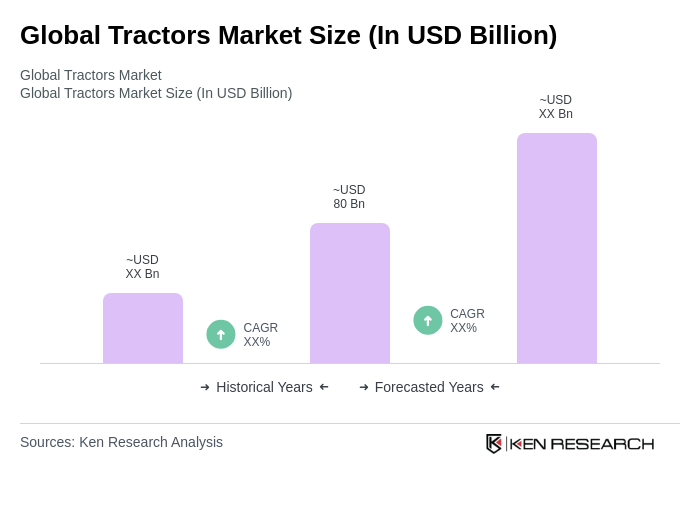
- The Global Tractors Market is valued at USD 80 billion, based on a five-year historical analysis. This value aligns with multiple industry sources reporting global agricultural/farm tractor market sizes in the high USD 70 billions range in the latest year, supported by ongoing mechanization, rising labor costs, and precision-agriculture adoption that boosts productivity and efficiency .
- Key players in this market include the United States, China, and India, which dominate due to their large agricultural sectors and sustained investments in farm mechanization and rural infrastructure. Asia Pacific is identified as the largest regional market by share, reflecting China and India’s scale and mechanization needs, while the U.S. benefits from advanced technology, higher adoption of precision farming, and strong OEM and dealer networks .
- In 2023, the U.S. advanced emissions and sustainability standards affecting off-road equipment, including agricultural tractors, through ongoing implementation of EPA Tier 4 final requirements and state-level initiatives (notably California) on off?road diesel and low?emission equipment; however, there was no single new nationwide federal rule mandating stricter standards for all new tractors issued uniquely in that year. Compliance with Tier 4 standards and growing moves toward lower-emission and alternative?power tractors underpin sustainability efforts in the sector .
Global Tractors Market Segmentation
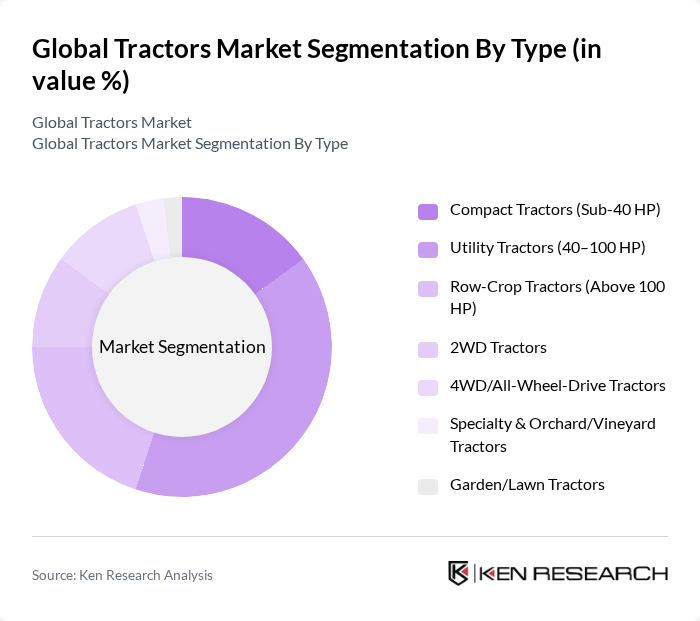
By Type:The market is segmented into various types of tractors, including Compact Tractors (Sub-40 HP), Utility Tractors (40–100 HP), Row-Crop Tractors (Above 100 HP), 2WD Tractors, 4WD/All-Wheel-Drive Tractors, Specialty & Orchard/Vineyard Tractors, and Garden/Lawn Tractors. Among these, Utility Tractors are dominant in many markets due to their versatility across field preparation, planting, and haulage, aligning with farmer preference for multi-function machines that optimize cost of ownership. Broad industry coverage also distinguishes 2WD units as volume-heavy in emerging markets, while 4WD and >100 HP categories see higher penetration in large-scale commercial farming and precision applications .
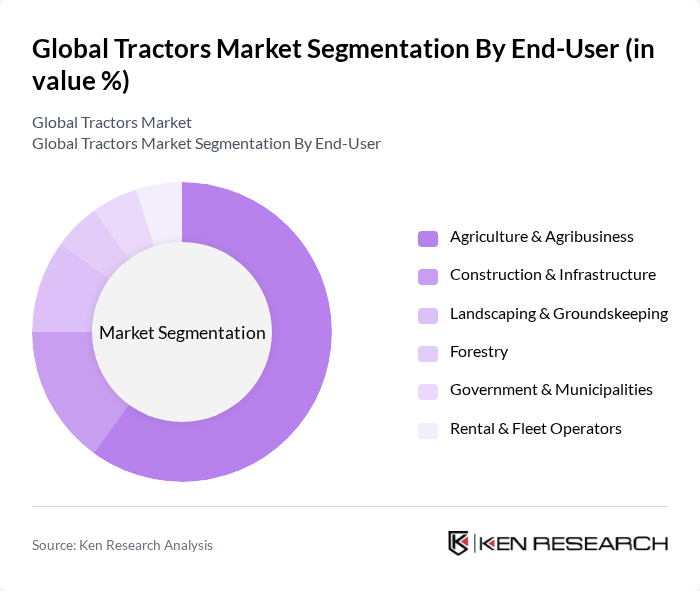
By End-User:The end-user segmentation includes Agriculture & Agribusiness, Construction & Infrastructure, Landscaping & Groundskeeping, Forestry, Government & Municipalities, and Rental & Fleet Operators. Agriculture & Agribusiness remains the largest end-user due to the central role of tractors in crop production, increased adoption of precision agriculture, and supportive policies/subsidies that encourage mechanization to meet food demand .
Global Tractors Market Competitive Landscape
The Global Tractors Market is characterized by a dynamic mix of regional and international players. Leading participants such as Deere & Company (John Deere), CNH Industrial N.V. (Case IH & New Holland), AGCO Corporation (Massey Ferguson, Fendt, Valtra), Kubota Corporation, Mahindra & Mahindra Ltd. (Mahindra Tractors), TAFE – Tractors and Farm Equipment Limited (Massey Ferguson India, Eicher), CLAAS KGaA mbH, Yanmar Co., Ltd., SDF Group (Same Deutz-Fahr), Escorts Kubota Limited, Argo Tractors S.p.A. (Landini, McCormick), JCB (Agricultural telehandlers and Fastrac tractors), Fendt (AGCO brand), Zetor Tractors a.s., LS Mtron Co., Ltd. (LS Tractor) contribute to innovation, geographic expansion, and service delivery in this space .
Global Tractors Market Industry Analysis
Growth Drivers
- Increasing Demand for Agricultural Productivity:The global agricultural sector is projected to require an increase in food production by aboutby mid?century to meet population and dietary changes, not 70%. The world population is projected to approach aroundby mid?century, consistent with UN population projections.
- Technological Advancements in Tractor Design:Innovations such as GPS-guided systems and automated controls are revolutionizing tractor efficiency. The global precision agriculture market is expected to reachin future, with tractors equipped with advanced technology accounting for a substantial share. These advancements not only improve operational efficiency but also reduce labor costs, making tractors more appealing to farmers seeking to optimize their operations.
- Government Subsidies for Agricultural Mechanization:Many governments are implementing subsidy programs to encourage the adoption of modern agricultural equipment. For instance, the U.S. Department of Agriculture allocatedin future for grants and loans to support farmers in purchasing advanced machinery. Such financial incentives significantly lower the barriers to entry for farmers, promoting tractor sales and enhancing overall agricultural productivity.
Market Challenges
- High Initial Investment Costs:The average cost of a new tractor can range fromto over, depending on the model and features. This high initial investment poses a significant barrier for smallholder farmers, particularly in developing regions where average annual incomes are below. Consequently, many farmers are unable to invest in modern tractors, limiting market growth and technological adoption.
- Fluctuating Raw Material Prices:The agricultural machinery industry is heavily reliant on raw materials such as steel and aluminum, which have seen price volatility. In future, steel prices are projected to fluctuate betweenandper ton, impacting production costs for tractor manufacturers. This unpredictability can lead to increased prices for consumers, further complicating purchasing decisions and potentially stalling market growth.
Global Tractors Market Future Outlook
The future of the tractors market is poised for significant transformation, driven by technological advancements and changing consumer preferences. As farmers increasingly adopt precision agriculture techniques, the demand for smart tractors equipped with IoT capabilities will rise. Additionally, the shift towards sustainable farming practices will encourage the development of electric and hybrid tractors, aligning with global environmental goals. These trends indicate a dynamic market landscape that will evolve to meet the needs of modern agriculture.
Market Opportunities
- Expansion into Emerging Markets:Emerging economies, particularly in Asia and Africa, are experiencing rapid urbanization and agricultural development. In future, these regions are expected to see aincrease in tractor demand as farmers seek to modernize their operations. This presents a lucrative opportunity for manufacturers to penetrate these markets with tailored solutions that address local needs.
- Development of Electric and Hybrid Tractors:With increasing environmental concerns, the demand for electric and hybrid tractors is on the rise. The global electric tractor market is projected to reachin future, driven by advancements in battery technology and government incentives. This shift not only aligns with sustainability goals but also offers manufacturers a chance to innovate and capture a growing segment of eco-conscious consumers.
Scope of the Report
| Segment | Sub-Segments |
|---|---|
| By Type | Compact Tractors (Sub-40 HP) Utility Tractors (40–100 HP) Row-Crop Tractors (Above 100 HP) WD Tractors WD/All-Wheel-Drive Tractors Specialty & Orchard/Vineyard Tractors Garden/Lawn Tractors |
| By End-User | Agriculture & Agribusiness Construction & Infrastructure Landscaping & Groundskeeping Forestry Government & Municipalities Rental & Fleet Operators |
| By Application | Tillage & Soil Preparation Planting & Seeding Harvesting & Haulage Crop Care (Spraying, Weeding) Material Handling & Transportation Landscaping & Municipal Services |
| By Sales Channel | OEM/Direct Sales Authorized Dealers/Distributors Online/Direct Digital Retail & Farm Equipment Stores Auction & Secondary Market |
| By Driveline | Two-Wheel Drive (2WD) Four-Wheel/All-Wheel Drive (4WD/AWD) |
| By Horsepower | Below 40 HP –100 HP Above 100 HP |
| By Operation | Manual/Conventional Precision-Enabled (GPS/Autosteer) Autonomous/Semi-autonomous |
Key Target Audience
Investors and Venture Capitalist Firms
Government and Regulatory Bodies (e.g., U.S. Department of Agriculture, European Commission)
Manufacturers and Producers
Distributors and Retailers
Farm Equipment Dealers
Industry Associations (e.g., Association of Equipment Manufacturers)
Financial Institutions
Logistics and Supply Chain Companies
Players Mentioned in the Report:
Deere & Company (John Deere)
CNH Industrial N.V. (Case IH & New Holland)
AGCO Corporation (Massey Ferguson, Fendt, Valtra)
Kubota Corporation
Mahindra & Mahindra Ltd. (Mahindra Tractors)
TAFE Tractors and Farm Equipment Limited (Massey Ferguson India, Eicher)
CLAAS KGaA mbH
Yanmar Co., Ltd.
SDF Group (Same Deutz-Fahr)
Escorts Kubota Limited
Argo Tractors S.p.A. (Landini, McCormick)
JCB (Agricultural telehandlers and Fastrac tractors)
Fendt (AGCO brand)
Zetor Tractors a.s.
LS Mtron Co., Ltd. (LS Tractor)
Table of Contents
Market Assessment Phase
1. Executive Summary and Approach
2. Global Tractors Market Overview
2.1 Key Insights and Strategic Recommendations
2.2 Global Tractors Market Overview
2.3 Definition and Scope
2.4 Evolution of Market Ecosystem
2.5 Timeline of Key Regulatory Milestones
2.6 Value Chain & Stakeholder Mapping
2.7 Business Cycle Analysis
2.8 Policy & Incentive Landscape
3. Global Tractors Market Analysis
3.1 Growth Drivers
3.1.1 Increasing demand for agricultural productivity
3.1.2 Technological advancements in tractor design
3.1.3 Government subsidies for agricultural mechanization
3.1.4 Rising global population and food demand
3.2 Market Challenges
3.2.1 High initial investment costs
3.2.2 Fluctuating raw material prices
3.2.3 Environmental regulations and compliance
3.2.4 Limited access to financing in developing regions
3.3 Market Opportunities
3.3.1 Expansion into emerging markets
3.3.2 Development of electric and hybrid tractors
3.3.3 Integration of IoT and smart farming technologies
3.3.4 Partnerships with agricultural cooperatives
3.4 Market Trends
3.4.1 Increasing adoption of precision agriculture
3.4.2 Growth of rental and leasing models
3.4.3 Focus on sustainability and eco-friendly practices
3.4.4 Rise of autonomous tractors
3.5 Government Regulation
3.5.1 Emission standards for agricultural machinery
3.5.2 Safety regulations for tractor operation
3.5.3 Subsidy programs for tractor purchases
3.5.4 Import tariffs on agricultural equipment
4. SWOT Analysis
5. Stakeholder Analysis
6. Porter's Five Forces Analysis
7. Global Tractors Market Market Size, 2019-2024
7.1 By Value
7.2 By Volume
7.3 By Average Selling Price
8. Global Tractors Market Segmentation
8.1 By Type
8.1.1 Compact Tractors (Sub-40 HP)
8.1.2 Utility Tractors (40–100 HP)
8.1.3 Row-Crop Tractors (Above 100 HP)
8.1.4 2WD Tractors
8.1.5 4WD/All-Wheel-Drive Tractors
8.1.6 Specialty & Orchard/Vineyard Tractors
8.1.7 Garden/Lawn Tractors
8.2 By End-User
8.2.1 Agriculture & Agribusiness
8.2.2 Construction & Infrastructure
8.2.3 Landscaping & Groundskeeping
8.2.4 Forestry
8.2.5 Government & Municipalities
8.2.6 Rental & Fleet Operators
8.3 By Application
8.3.1 Tillage & Soil Preparation
8.3.2 Planting & Seeding
8.3.3 Harvesting & Haulage
8.3.4 Crop Care (Spraying, Weeding)
8.3.5 Material Handling & Transportation
8.3.6 Landscaping & Municipal Services
8.4 By Sales Channel
8.4.1 OEM/Direct Sales
8.4.2 Authorized Dealers/Distributors
8.4.3 Online/Direct Digital
8.4.4 Retail & Farm Equipment Stores
8.4.5 Auction & Secondary Market
8.5 By Driveline
8.5.1 Two-Wheel Drive (2WD)
8.5.2 Four-Wheel/All-Wheel Drive (4WD/AWD)
8.6 By Horsepower
8.6.1 Below 40 HP
8.6.2 40–100 HP
8.6.3 Above 100 HP
8.7 By Operation
8.7.1 Manual/Conventional
8.7.2 Precision-Enabled (GPS/Autosteer)
8.7.3 Autonomous/Semi-autonomous
9. Global Tractors Market Competitive Analysis
9.1 Market Share of Key Players
9.2 Cross Comparison of Key Players
9.2.1 Company Name
9.2.2 Group Size (Global footprint, production capacity, dealer network)
9.2.3 Revenue Growth Rate (YoY tractor revenue/units)
9.2.4 Market Share by Horsepower Band (sub-40 HP, 40–100 HP, >100 HP)
9.2.5 Geographic Mix (APAC/NA/EU/LatAm/MEA % of sales)
9.2.6 Dealer Network Density (dealers per 1,000 tractors in service)
9.2.7 Installed Base & Customer Retention (repeat purchase rate)
9.2.8 Pricing Realization (avg. ASP by HP band vs market)
9.2.9 Product Breadth (2WD/4WD, compact, utility, row-crop, specialty)
9.2.10 Technology & Precision Features Penetration (telemetry, GPS, autonomy)
9.2.11 After-sales Coverage (parts fill rate, uptime SLA)
9.2.12 Supply Chain Resilience (lead times, localization %)
9.2.13 R&D Intensity (% of sales on R&D)
9.3 SWOT Analysis of Top Players
9.4 Pricing Analysis
9.5 Detailed Profile of Major Companies
9.5.1 Deere & Company (John Deere)
9.5.2 CNH Industrial N.V. (Case IH & New Holland)
9.5.3 AGCO Corporation (Massey Ferguson, Fendt, Valtra)
9.5.4 Kubota Corporation
9.5.5 Mahindra & Mahindra Ltd. (Mahindra Tractors)
9.5.6 TAFE – Tractors and Farm Equipment Limited (Massey Ferguson India, Eicher)
9.5.7 CLAAS KGaA mbH
9.5.8 Yanmar Co., Ltd.
9.5.9 SDF Group (Same Deutz-Fahr)
9.5.10 Escorts Kubota Limited
9.5.11 Argo Tractors S.p.A. (Landini, McCormick)
9.5.12 JCB (Agricultural telehandlers and Fastrac tractors)
9.5.13 Fendt (AGCO brand)
9.5.14 Zetor Tractors a.s.
9.5.15 LS Mtron Co., Ltd. (LS Tractor)
10. Global Tractors Market End-User Analysis
10.1 Procurement Behavior of Key Ministries
10.1.1 Budget Allocation for Agricultural Equipment
10.1.2 Procurement Processes and Regulations
10.1.3 Key Decision-Makers in Procurement
10.1.4 Trends in Government Purchases
10.2 Corporate Spend on Infrastructure & Energy
10.2.1 Investment in Agricultural Infrastructure
10.2.2 Spending on Modernization of Equipment
10.2.3 Budget Trends in Corporate Farming
10.3 Pain Point Analysis by End-User Category
10.3.1 Challenges Faced by Farmers
10.3.2 Issues in Equipment Maintenance
10.3.3 Accessibility of Financing Options
10.4 User Readiness for Adoption
10.4.1 Awareness of New Technologies
10.4.2 Training and Support Needs
10.4.3 Adoption Barriers
10.5 Post-Deployment ROI and Use Case Expansion
10.5.1 Measurement of ROI in Agricultural Operations
10.5.2 Expansion of Use Cases for Tractors
10.5.3 Long-term Benefits of Tractor Adoption
11. Global Tractors Market Future Size, 2025-2030
11.1 By Value
11.2 By Volume
11.3 By Average Selling Price
Go-To-Market Strategy Phase
1. Whitespace Analysis + Business Model Canvas
1.1 Market Gaps Identification
1.2 Business Model Development
1.3 Value Proposition Analysis
1.4 Competitive Landscape Overview
2. Marketing and Positioning Recommendations
2.1 Branding Strategies
2.2 Product USPs
2.3 Target Audience Identification
2.4 Communication Strategies
3. Distribution Plan
3.1 Urban Retail Strategies
3.2 Rural NGO Tie-ups
3.3 Distribution Channel Optimization
4. Channel & Pricing Gaps
4.1 Underserved Routes
4.2 Pricing Bands Analysis
4.3 Competitive Pricing Strategies
5. Unmet Demand & Latent Needs
5.1 Category Gaps Identification
5.2 Consumer Segments Analysis
5.3 Future Demand Projections
6. Customer Relationship
6.1 Loyalty Programs
6.2 After-sales Service Strategies
6.3 Customer Feedback Mechanisms
7. Value Proposition
7.1 Sustainability Initiatives
7.2 Integrated Supply Chains
7.3 Customer-Centric Innovations
8. Key Activities
8.1 Regulatory Compliance
8.2 Branding Initiatives
8.3 Distribution Setup
9. Entry Strategy Evaluation
9.1 Domestic Market Entry Strategy
9.1.1 Product Mix Considerations
9.1.2 Pricing Band Analysis
9.1.3 Packaging Strategies
9.2 Export Entry Strategy
9.2.1 Target Countries Identification
9.2.2 Compliance Roadmap Development
10. Entry Mode Assessment
10.1 Joint Ventures
10.2 Greenfield Investments
10.3 Mergers & Acquisitions
10.4 Distributor Model Evaluation
11. Capital and Timeline Estimation
11.1 Capital Requirements Analysis
11.2 Timelines for Market Entry
12. Control vs Risk Trade-Off
12.1 Ownership vs Partnerships
12.2 Risk Management Strategies
13. Profitability Outlook
13.1 Breakeven Analysis
13.2 Long-term Sustainability Strategies
14. Potential Partner List
14.1 Distributors
14.2 Joint Ventures
14.3 Acquisition Targets
15. Execution Roadmap
15.1 Phased Plan for Market Entry
15.1.1 Market Setup
15.1.2 Market Entry
15.1.3 Growth Acceleration
15.1.4 Scale & Stabilize
15.2 Key Activities and Milestones
15.2.1 Milestone Planning
15.2.2 Activity Tracking
Research Methodology
Phase 1: Approach1
Desk Research
- Analysis of industry reports from agricultural machinery associations and market research firms
- Review of government publications and agricultural census data for tractor usage statistics
- Examination of trade journals and publications for insights on technological advancements in tractors
Primary Research
- Interviews with key stakeholders in the tractor manufacturing sector, including CEOs and product managers
- Surveys with farmers and agricultural cooperatives to understand purchasing behavior and preferences
- Field visits to dealerships and agricultural expos to gather firsthand insights on market trends
Validation & Triangulation
- Cross-validation of data through multiple sources, including sales data and market forecasts
- Triangulation of findings from primary interviews with secondary data to ensure consistency
- Sanity checks through expert panels comprising industry veterans and market analysts
Phase 2: Market Size Estimation1
Top-down Assessment
- Estimation of total addressable market based on agricultural output and tractor penetration rates
- Segmentation of market size by region, tractor type, and end-user applications
- Incorporation of macroeconomic indicators such as GDP growth and agricultural investment trends
Bottom-up Modeling
- Collection of sales data from major tractor manufacturers to establish baseline volumes
- Analysis of pricing strategies across different tractor segments to estimate revenue potential
- Volume projections based on historical sales trends and anticipated market growth rates
Forecasting & Scenario Analysis
- Development of forecasting models using historical data and market drivers such as technology adoption
- Scenario analysis based on varying levels of agricultural policy support and environmental regulations
- Creation of multiple growth scenarios (baseline, optimistic, and pessimistic) through 2030
Phase 3: CATI Sample Composition1
| Scope Item/Segment | Sample Size | Target Respondent Profiles |
|---|---|---|
| Smallholder Farmers | 150 | Farm Owners, Agricultural Workers |
| Large Agricultural Enterprises | 100 | Farm Managers, Operations Directors |
| Tractor Dealerships | 80 | Sales Representatives, Store Managers |
| Agricultural Equipment Rental Services | 70 | Rental Managers, Business Development Executives |
| Government Agricultural Departments | 50 | Policy Makers, Agricultural Advisors |
Frequently Asked Questions
What is the current value of the Global Tractors Market?
The Global Tractors Market is valued at approximately USD 80 billion, reflecting a five-year historical analysis. This valuation is supported by ongoing mechanization, rising labor costs, and the adoption of precision agriculture, which enhances productivity and efficiency in the agricultural sector.
Which regions dominate the Global Tractors Market?
What are the main types of tractors in the market?
Who are the major players in the Global Tractors Market?
Other Regional/Country Reports
Indonesia Tractors Market
Malaysia Tractors Market
APAC Tractors Market
SEA Tractors Market
Why Buy From Us?

What makes us stand out is that our consultants follow Robust, Refine and Result (RRR) methodology. Robust for clear definitions, approaches and sanity checking, Refine for differentiating respondents' facts and opinions, and Result for presenting data with story.

We have set a benchmark in the industry by offering our clients with syndicated and customized market research reports featuring coverage of entire market as well as meticulous research and analyst insights.

While we don't replace traditional research, we flip the method upside down. Our dual approach of Top Bottom & Bottom Top ensures quality deliverable by not just verifying company fundamentals but also looking at the sector and macroeconomic factors.

With one step in the future, our research team constantly tries to show you the bigger picture. We help with some of the tough questions you may encounter along the way: How is the industry positioned? Best marketing channel? KPI's of competitors? By aligning every element, we help maximize success.

Our report gives you instant access to the answers and sources that other companies might choose to hide. We elaborate each steps of research methodology we have used and showcase you the sample size to earn your trust.

If you need any support, we are here! We pride ourselves on universe strength, data quality, and quick, friendly, and professional service.