About the Report
Base Year 2024Listen to the audio summary
Global Transcriptomics Market Overview
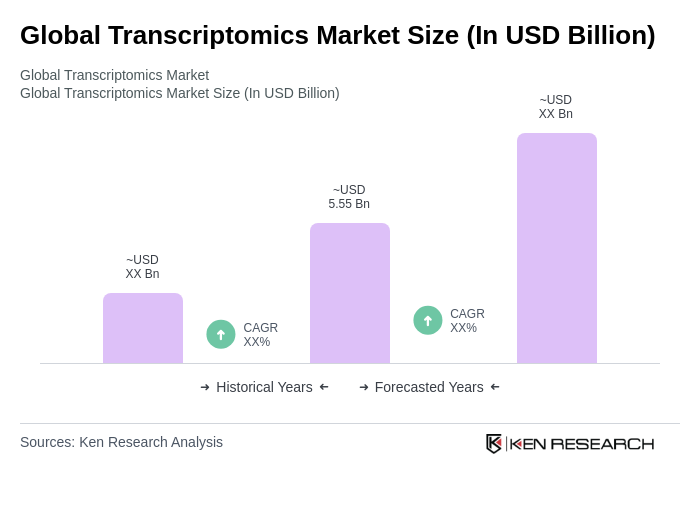
- The Global Transcriptomics Market is valued at USD 5.55 billion, based on a five-year historical analysis. This growth is primarily driven by advancements in genomic technologies such as next-generation sequencing, increasing demand for personalized medicine, and the rising prevalence of chronic diseases. Recent trends highlight the integration of artificial intelligence and machine learning in transcriptomic data analysis, which further accelerates drug discovery and development processes. Researchers are leveraging transcriptomics to understand gene expression patterns, identify novel biomarkers, and optimize therapeutic strategies for cancer, neurological, and rare diseases .
- Key players in this market include the United States, Germany, and China, which dominate due to their robust research infrastructure, significant investments in biotechnology, and a high concentration of leading pharmaceutical companies. The United States leads with the largest market share, driven by strong federal funding, advanced healthcare systems, and a high volume of transcriptomics-related patents and clinical trials. Germany and China have seen rapid growth due to increased government support for biotechnology and expanding clinical research networks .
- The U.S. government continues to enforce the Genomic Data Sharing Policy, which mandates that all genomic data generated from federally funded research be made publicly available. This policy enhances transparency and collaboration in genomic research, accelerating advancements in transcriptomics and related fields. The policy has contributed to an increase in publicly accessible transcriptomic datasets, supporting innovation in precision medicine and biomarker discovery .
Global Transcriptomics Market Segmentation
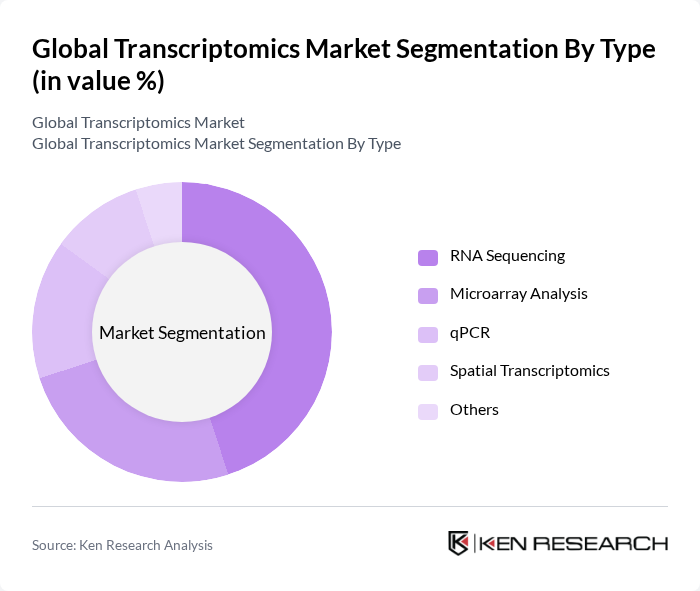
By Type:The market is segmented into RNA Sequencing, Microarray Analysis, qPCR, Spatial Transcriptomics, and Others. Among these, RNA Sequencing is the leading sub-segment due to its high sensitivity, ability to provide comprehensive insights into gene expression profiles, and scalability for large cohort studies. The demand for RNA Sequencing is driven by its applications in cancer research, drug development, rare disease profiling, and personalized medicine. Spatial Transcriptomics is emerging rapidly, enabling researchers to map gene expression within tissue architecture, which is critical for understanding tumor heterogeneity and tissue-specific disease mechanisms .
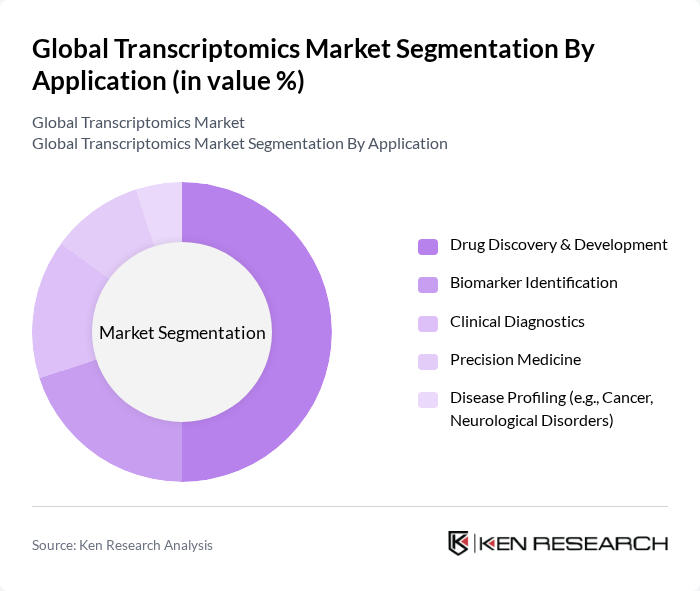
By Application:The applications of transcriptomics include Drug Discovery & Development, Biomarker Identification, Clinical Diagnostics, Precision Medicine, Disease Profiling (e.g., Cancer, Neurological Disorders), and Others. Drug Discovery & Development remains the dominant application area, as transcriptomics is essential for understanding disease mechanisms, identifying therapeutic targets, and validating drug efficacy. Biomarker Identification is increasingly important for early disease detection and patient stratification. Precision medicine and disease profiling are rapidly growing segments, reflecting the shift towards individualized treatment approaches and the need for molecular diagnostics in oncology and neurology .
Global Transcriptomics Market Competitive Landscape
The Global Transcriptomics Market is characterized by a dynamic mix of regional and international players. Leading participants such as Thermo Fisher Scientific Inc., Illumina, Inc., QIAGEN N.V., Agilent Technologies, Inc., Bio-Rad Laboratories, Inc., F. Hoffmann-La Roche AG, PerkinElmer, Inc., BGI Genomics Co., Ltd., Pacific Biosciences of California, Inc., 10x Genomics, Inc., Oxford Nanopore Technologies Ltd., Merck KGaA, New England Biolabs, Inc., Takara Bio Inc., Genomatix Software GmbH, Fluidigm Corporation, NanoString Technologies, Inc., Bruker Corporation, Affymetrix (now part of Thermo Fisher Scientific), GeneTech Inc. contribute to innovation, geographic expansion, and service delivery in this space.
Global Transcriptomics Market Industry Analysis
Growth Drivers
- Increasing Demand for Personalized Medicine:The global personalized medicine market is projected to reach $2.4 trillion in future, driven by the need for tailored therapies. This surge is fueled by advancements in transcriptomics, which enable precise patient stratification and targeted treatments. The World Health Organization reported that personalized medicine can reduce adverse drug reactions by 30%, highlighting its potential to improve patient outcomes and drive demand for transcriptomic technologies in clinical settings.
- Advancements in Sequencing Technologies:The cost of sequencing a human genome has plummeted from approximately $100 million in the early 2000s to around $1,000 in future, according to the National Human Genome Research Institute. This dramatic reduction has made transcriptomics more accessible, facilitating widespread adoption in research and clinical applications. Enhanced sequencing technologies, such as next-generation sequencing (NGS), are expected to increase throughput and accuracy, further propelling market growth as researchers seek to leverage these innovations for comprehensive gene expression analysis.
- Rising Prevalence of Chronic Diseases:The World Health Organization estimates that chronic diseases account for approximately 71% of all deaths globally, with conditions like cancer and diabetes on the rise. This alarming trend is driving the need for advanced diagnostic and therapeutic solutions, including transcriptomics. As healthcare systems increasingly focus on early detection and personalized treatment strategies, the demand for transcriptomic technologies is expected to grow significantly, providing critical insights into disease mechanisms and treatment responses.
Market Challenges
- High Costs of Transcriptomics Technologies:The initial investment required for transcriptomics technologies can be substantial, with costs for high-throughput sequencing platforms exceeding $500,000. This financial barrier limits access for smaller laboratories and research institutions, hindering widespread adoption. Additionally, ongoing operational costs, including reagents and data analysis software, can further strain budgets, making it challenging for many organizations to integrate these technologies into their workflows effectively.
- Data Management and Analysis Complexities:The volume of data generated by transcriptomics studies is immense, often reaching terabytes per experiment. Managing, storing, and analyzing this data presents significant challenges, particularly for organizations lacking robust bioinformatics capabilities. According to a report by the National Institutes of Health, approximately 60% of researchers cite data analysis as a major bottleneck in their projects, underscoring the need for improved tools and expertise in the field to facilitate effective data utilization.
Global Transcriptomics Market Future Outlook
The future of the transcriptomics market appears promising, driven by technological advancements and increasing applications in various fields. The integration of artificial intelligence and machine learning is expected to enhance data analysis capabilities, enabling more accurate interpretations of complex datasets. Furthermore, the expansion of transcriptomics applications in drug discovery and development will likely accelerate innovation, fostering collaborations between academia and industry. As emerging markets continue to invest in healthcare infrastructure, the global landscape for transcriptomics will evolve, presenting new opportunities for growth and development.
Market Opportunities
- Expansion of Applications in Drug Discovery:The drug discovery market is projected to reach $2.4 trillion in future, with transcriptomics playing a crucial role in identifying novel drug targets. By leveraging gene expression data, researchers can better understand disease mechanisms, leading to more effective therapies. This growing focus on precision medicine will create significant opportunities for transcriptomics technologies in pharmaceutical research and development.
- Integration of AI and Machine Learning:The global AI in healthcare market is expected to reach $45.2 billion in future, driven by the need for advanced data analysis. Integrating AI with transcriptomics can enhance predictive modeling and biomarker discovery, streamlining research processes. This synergy will not only improve the efficiency of data analysis but also facilitate the development of personalized treatment strategies, creating a robust opportunity for innovation in the field.
Scope of the Report
| Segment | Sub-Segments |
|---|---|
| By Type | RNA Sequencing Microarray Analysis qPCR Spatial Transcriptomics Others |
| By Application | Drug Discovery & Development Biomarker Identification Clinical Diagnostics Precision Medicine Disease Profiling (e.g., Cancer, Neurological Disorders) Others |
| By End-User | Academic & Research Institutes Pharmaceutical Companies Biotechnology Firms Contract Research Organizations (CROs) Hospitals & Clinical Laboratories Others |
| By Region | North America Europe Asia-Pacific Latin America Middle East & Africa |
| By Technology | Next-Generation Sequencing (NGS) Digital PCR RNA-Seq Microarrays Single-Cell Transcriptomics Others |
| By Product | Instruments Reagents & Consumables Software & Services Others |
| By Research Type | Basic Research Applied Research Clinical Research Others |
| By Funding Source | Government Grants Private Investments Academic Funding Others |
Key Target Audience
Investors and Venture Capitalist Firms
Government and Regulatory Bodies (e.g., U.S. Food and Drug Administration, European Medicines Agency)
Biotechnology and Pharmaceutical Companies
Clinical Research Organizations
Healthcare Providers and Hospitals
Diagnostic Laboratories
Biomarker Discovery Companies
Health Insurance Companies
Players Mentioned in the Report:
Thermo Fisher Scientific Inc.
Illumina, Inc.
QIAGEN N.V.
Agilent Technologies, Inc.
Bio-Rad Laboratories, Inc.
F. Hoffmann-La Roche AG
PerkinElmer, Inc.
BGI Genomics Co., Ltd.
Pacific Biosciences of California, Inc.
10x Genomics, Inc.
Oxford Nanopore Technologies Ltd.
Merck KGaA
New England Biolabs, Inc.
Takara Bio Inc.
Genomatix Software GmbH
Fluidigm Corporation
NanoString Technologies, Inc.
Bruker Corporation
Affymetrix (now part of Thermo Fisher Scientific)
GeneTech Inc.
Table of Contents
Market Assessment Phase
1. Executive Summary and Approach
2. Global Transcriptomics Market Overview
2.1 Key Insights and Strategic Recommendations
2.2 Global Transcriptomics Market Overview
2.3 Definition and Scope
2.4 Evolution of Market Ecosystem
2.5 Timeline of Key Regulatory Milestones
2.6 Value Chain & Stakeholder Mapping
2.7 Business Cycle Analysis
2.8 Policy & Incentive Landscape
3. Global Transcriptomics Market Analysis
3.1 Growth Drivers
3.1.1 Increasing demand for personalized medicine
3.1.2 Advancements in sequencing technologies
3.1.3 Rising prevalence of chronic diseases
3.1.4 Growth in research funding and investments
3.2 Market Challenges
3.2.1 High costs of transcriptomics technologies
3.2.2 Data management and analysis complexities
3.2.3 Regulatory hurdles in clinical applications
3.2.4 Limited skilled workforce in the field
3.3 Market Opportunities
3.3.1 Expansion of applications in drug discovery
3.3.2 Integration of AI and machine learning
3.3.3 Collaborations between academia and industry
3.3.4 Growth in emerging markets
3.4 Market Trends
3.4.1 Shift towards single-cell transcriptomics
3.4.2 Increasing focus on non-coding RNAs
3.4.3 Development of portable sequencing devices
3.4.4 Rise of cloud-based data analysis platforms
3.5 Government Regulation
3.5.1 Guidelines for genomic data sharing
3.5.2 Regulations on clinical trial transparency
3.5.3 Policies promoting research and innovation
3.5.4 Compliance requirements for laboratory practices
4. SWOT Analysis
5. Stakeholder Analysis
6. Porter's Five Forces Analysis
7. Global Transcriptomics Market Market Size, 2019-2024
7.1 By Value
7.2 By Volume
7.3 By Average Selling Price
8. Global Transcriptomics Market Segmentation
8.1 By Type
8.1.1 RNA Sequencing
8.1.2 Microarray Analysis
8.1.3 qPCR
8.1.4 Spatial Transcriptomics
8.1.5 Others
8.2 By Application
8.2.1 Drug Discovery & Development
8.2.2 Biomarker Identification
8.2.3 Clinical Diagnostics
8.2.4 Precision Medicine
8.2.5 Disease Profiling (e.g., Cancer, Neurological Disorders)
8.2.6 Others
8.3 By End-User
8.3.1 Academic & Research Institutes
8.3.2 Pharmaceutical Companies
8.3.3 Biotechnology Firms
8.3.4 Contract Research Organizations (CROs)
8.3.5 Hospitals & Clinical Laboratories
8.3.6 Others
8.4 By Region
8.4.1 North America
8.4.2 Europe
8.4.3 Asia-Pacific
8.4.4 Latin America
8.4.5 Middle East & Africa
8.5 By Technology
8.5.1 Next-Generation Sequencing (NGS)
8.5.2 Digital PCR
8.5.3 RNA-Seq
8.5.4 Microarrays
8.5.5 Single-Cell Transcriptomics
8.5.6 Others
8.6 By Product
8.6.1 Instruments
8.6.2 Reagents & Consumables
8.6.3 Software & Services
8.6.4 Others
8.7 By Research Type
8.7.1 Basic Research
8.7.2 Applied Research
8.7.3 Clinical Research
8.7.4 Others
8.8 By Funding Source
8.8.1 Government Grants
8.8.2 Private Investments
8.8.3 Academic Funding
8.8.4 Others
9. Global Transcriptomics Market Competitive Analysis
9.1 Market Share of Key Players
9.2 Cross Comparison of Key Players
9.2.1 Company Name
9.2.2 Group Size (Large, Medium, or Small as per industry convention)
9.2.3 Revenue Growth Rate (YoY %)
9.2.4 Market Share (%)
9.2.5 Geographic Presence (Number of Countries/Regions)
9.2.6 R&D Expenditure (% of Revenue)
9.2.7 Product Portfolio Breadth (Number of Transcriptomics Products)
9.2.8 Patent Portfolio (Number of Relevant Patents)
9.2.9 Strategic Partnerships & Collaborations (Number per Year)
9.2.10 Regulatory Approvals (Number of FDA/EMA Approvals)
9.2.11 Customer Segmentation (Academic, Pharma, Clinical, etc.)
9.2.12 Pricing Strategy
9.2.13 Product Development Cycle Time
9.2.14 Sales Conversion Rate
9.2.15 Average Deal Size
9.2.16 Customer Acquisition Cost
9.3 SWOT Analysis of Top Players
9.4 Pricing Analysis
9.5 Detailed Profile of Major Companies
9.5.1 Thermo Fisher Scientific Inc.
9.5.2 Illumina, Inc.
9.5.3 QIAGEN N.V.
9.5.4 Agilent Technologies, Inc.
9.5.5 Bio-Rad Laboratories, Inc.
9.5.6 F. Hoffmann-La Roche AG
9.5.7 PerkinElmer, Inc.
9.5.8 BGI Genomics Co., Ltd.
9.5.9 Pacific Biosciences of California, Inc.
9.5.10 10x Genomics, Inc.
9.5.11 Oxford Nanopore Technologies Ltd.
9.5.12 Merck KGaA
9.5.13 New England Biolabs, Inc.
9.5.14 Takara Bio Inc.
9.5.15 Genomatix Software GmbH
9.5.16 Fluidigm Corporation
9.5.17 NanoString Technologies, Inc.
9.5.18 Bruker Corporation
9.5.19 Affymetrix (now part of Thermo Fisher Scientific)
9.5.20 GeneTech Inc.
10. Global Transcriptomics Market End-User Analysis
10.1 Procurement Behavior of Key Ministries
10.1.1 Government funding for research initiatives
10.1.2 Collaboration with academic institutions
10.1.3 Adoption of innovative technologies
10.2 Corporate Spend on Infrastructure & Energy
10.2.1 Investment in laboratory infrastructure
10.2.2 Budget allocation for R&D
10.2.3 Expenditure on technology upgrades
10.3 Pain Point Analysis by End-User Category
10.3.1 Need for cost-effective solutions
10.3.2 Demand for high-throughput capabilities
10.3.3 Challenges in data interpretation
10.4 User Readiness for Adoption
10.4.1 Awareness of transcriptomics benefits
10.4.2 Training and skill development needs
10.4.3 Infrastructure readiness
10.5 Post-Deployment ROI and Use Case Expansion
10.5.1 Measurement of cost savings
10.5.2 Evaluation of research outcomes
10.5.3 Potential for scaling applications
11. Global Transcriptomics Market Future Size, 2025-2030
11.1 By Value
11.2 By Volume
11.3 By Average Selling Price
Go-To-Market Strategy Phase
1. Whitespace Analysis + Business Model Canvas
1.1 Market Gaps Identification
1.2 Value Proposition Development
1.3 Revenue Streams Analysis
1.4 Key Partnerships Exploration
1.5 Customer Segmentation
1.6 Cost Structure Assessment
1.7 Channels of Distribution
2. Marketing and Positioning Recommendations
2.1 Branding Strategies
2.2 Product USPs
3. Distribution Plan
3.1 Urban Retail vs Rural NGO Tie-ups
4. Channel & Pricing Gaps
4.1 Underserved Routes
4.2 Pricing Bands
5. Unmet Demand & Latent Needs
5.1 Category Gaps
5.2 Consumer Segments
6. Customer Relationship
6.1 Loyalty Programs
6.2 After-sales Service
7. Value Proposition
7.1 Sustainability
7.2 Integrated Supply Chains
8. Key Activities
8.1 Regulatory Compliance
8.2 Branding
8.3 Distribution Setup
9. Entry Strategy Evaluation
9.1 Domestic Market Entry Strategy
9.1.1 Product Mix
9.1.2 Pricing Band
9.1.3 Packaging
9.2 Export Entry Strategy
9.2.1 Target Countries
9.2.2 Compliance Roadmap
10. Entry Mode Assessment
10.1 JV
10.2 Greenfield
10.3 M&A
10.4 Distributor Model
11. Capital and Timeline Estimation
11.1 Capital Requirements
11.2 Timelines
12. Control vs Risk Trade-Off
12.1 Ownership vs Partnerships
13. Profitability Outlook
13.1 Breakeven Analysis
13.2 Long-term Sustainability
14. Potential Partner List
14.1 Distributors
14.2 JVs
14.3 Acquisition Targets
15. Execution Roadmap
15.1 Phased Plan for Market Entry
15.1.1 Market Setup
15.1.2 Market Entry
15.1.3 Growth Acceleration
15.1.4 Scale & Stabilize
15.2 Key Activities and Milestones
15.2.1 Activity Planning
15.2.2 Milestone Tracking
Research Methodology
Phase 1: Approach1
Desk Research
- Analysis of industry reports from leading market research firms focusing on transcriptomics
- Review of scientific publications and journals detailing advancements in transcriptomic technologies
- Examination of regulatory frameworks and guidelines from health authorities impacting transcriptomics
Primary Research
- Interviews with key opinion leaders in genomics and transcriptomics research
- Surveys targeting laboratory managers and researchers in biotech firms
- Field interviews with clinical researchers involved in transcriptomic studies
Validation & Triangulation
- Cross-validation of findings through multiple data sources including academic and industry insights
- Triangulation of market data with expert opinions to ensure accuracy
- Sanity checks conducted through feedback from a panel of industry experts
Phase 2: Market Size Estimation1
Top-down Assessment
- Estimation of global market size based on healthcare expenditure and R&D investments in genomics
- Segmentation of the market by application areas such as drug discovery, diagnostics, and personalized medicine
- Incorporation of trends in funding for transcriptomics research from government and private sectors
Bottom-up Modeling
- Collection of sales data from leading transcriptomics technology providers
- Estimation of market share based on product offerings and geographic presence
- Volume and pricing analysis of key transcriptomic products and services
Forecasting & Scenario Analysis
- Multi-factor regression analysis incorporating technological advancements and market adoption rates
- Scenario modeling based on potential regulatory changes and funding shifts in research
- Development of baseline, optimistic, and pessimistic forecasts through 2030
Phase 3: CATI Sample Composition1
| Scope Item/Segment | Sample Size | Target Respondent Profiles |
|---|---|---|
| Biotech Research Institutions | 100 | Research Scientists, Lab Directors |
| Pharmaceutical Companies | 80 | Clinical Research Managers, Product Development Leads |
| Academic Institutions | 70 | Professors, Graduate Researchers |
| Healthcare Providers | 60 | Pathologists, Genomic Medicine Specialists |
| Regulatory Bodies | 40 | Policy Makers, Compliance Officers |
Frequently Asked Questions
What is the current value of the Global Transcriptomics Market?
The Global Transcriptomics Market is valued at approximately USD 5.55 billion, reflecting significant growth driven by advancements in genomic technologies, personalized medicine demand, and the rising prevalence of chronic diseases.
What are the key drivers of growth in the Transcriptomics Market?
Which countries dominate the Global Transcriptomics Market?
How does the U.S. government support transcriptomics research?
Other Regional/Country Reports
Indonesia Transcriptomics Market
Malaysia Transcriptomics Market
APAC Transcriptomics Market
SEA Transcriptomics Market
Why Buy From Us?

What makes us stand out is that our consultants follow Robust, Refine and Result (RRR) methodology. Robust for clear definitions, approaches and sanity checking, Refine for differentiating respondents' facts and opinions, and Result for presenting data with story.

We have set a benchmark in the industry by offering our clients with syndicated and customized market research reports featuring coverage of entire market as well as meticulous research and analyst insights.

While we don't replace traditional research, we flip the method upside down. Our dual approach of Top Bottom & Bottom Top ensures quality deliverable by not just verifying company fundamentals but also looking at the sector and macroeconomic factors.

With one step in the future, our research team constantly tries to show you the bigger picture. We help with some of the tough questions you may encounter along the way: How is the industry positioned? Best marketing channel? KPI's of competitors? By aligning every element, we help maximize success.

Our report gives you instant access to the answers and sources that other companies might choose to hide. We elaborate each steps of research methodology we have used and showcase you the sample size to earn your trust.

If you need any support, we are here! We pride ourselves on universe strength, data quality, and quick, friendly, and professional service.