Region:Global
Author(s):Dev
Product Code:KRAD1619
Pages:94
Published On:November 2025
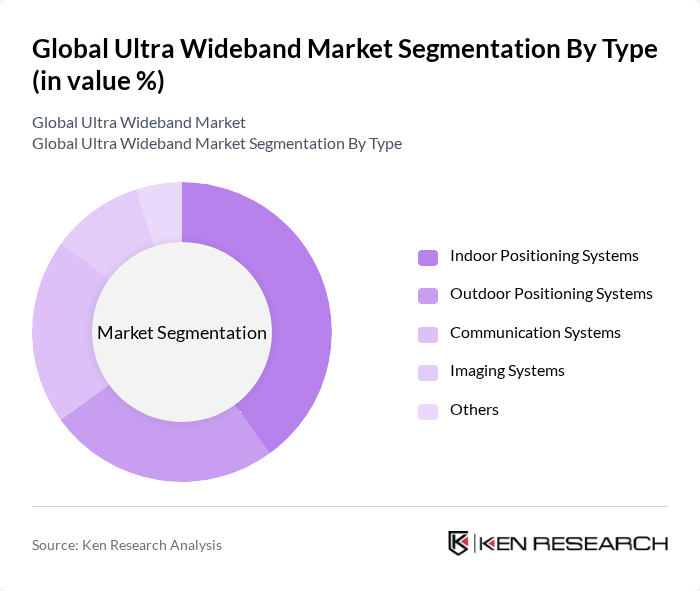
By Type:The segmentation by type includes Indoor Positioning Systems, Outdoor Positioning Systems, Communication Systems, Imaging Systems, and Others. Among these, Indoor Positioning Systems are currently leading the market due to their extensive application in retail, healthcare, logistics, and smart buildings, where precise location tracking is essential for enhancing customer experience, safety, and operational efficiency. The growing trend of smart cities, Industry 4.0, and IoT integration further propels the demand for these systems .
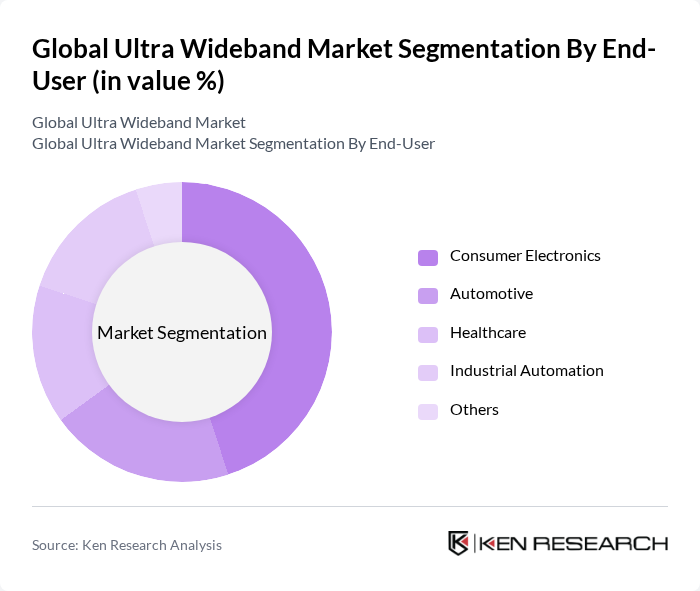
By End-User:The end-user segmentation includes Consumer Electronics, Automotive, Healthcare, Industrial Automation, and Others. The Consumer Electronics segment is currently the dominant force in the market, driven by the increasing integration of ultra-wideband technology in smartphones, wearables, and smart home devices. The demand for enhanced connectivity, secure device-to-device communication, and location-based services in consumer products is significantly boosting this segment's growth. Automotive and healthcare sectors are also rapidly adopting UWB for secure access, advanced driver assistance, and real-time patient and asset tracking .
The Global Ultra Wideband Market is characterized by a dynamic mix of regional and international players. Leading participants such as Decawave (now part of Qorvo), NXP Semiconductors, Texas Instruments, Qorvo, STMicroelectronics, Zebra Technologies, Apple Inc., Samsung Electronics, Qualcomm, Intel Corporation, Broadcom Inc., LitePoint (a Teradyne company), Impinj, NTT DOCOMO, Bosch Sensortec, Infineon Technologies, Huawei Technologies, Xiaomi Corporation, Sony Semiconductor Solutions, Murata Manufacturing contribute to innovation, geographic expansion, and service delivery in this space.
The future of the UWB market appears promising, driven by technological advancements and increasing integration with 5G networks. As industries seek more efficient and precise solutions, UWB is likely to gain traction in various applications, including smart homes and healthcare. The focus on energy-efficient technologies will further enhance UWB's appeal, as companies aim to reduce operational costs while improving performance. Overall, the market is poised for significant growth, with innovative applications emerging across multiple sectors.
| Segment | Sub-Segments |
|---|---|
| By Type | Indoor Positioning Systems Outdoor Positioning Systems Communication Systems Imaging Systems Others |
| By End-User | Consumer Electronics Automotive Healthcare Industrial Automation Others |
| By Application | Real-Time Locating Systems (RTLS) Asset Tracking Smart Home Devices Wearable Technology Security Systems Imaging and Sensing Others |
| By Component | Transmitters Receivers Antennas Integrated Circuits Software Others |
| By Region | North America Europe Asia-Pacific Latin America Middle East & Africa |
| By Technology | Time of Flight (ToF) Direct Sequence Spread Spectrum (DSSS) Frequency Hopping Spread Spectrum (FHSS) Others |
| By Market Segment | Consumer Market Commercial Market Government Market Industrial Market Others |
| Scope Item/Segment | Sample Size | Target Respondent Profiles |
|---|---|---|
| Healthcare Applications | 100 | Medical Device Manufacturers, Healthcare IT Managers |
| Automotive Safety Systems | 75 | Automotive Engineers, Safety Compliance Officers |
| Consumer Electronics | 90 | Product Managers, R&D Directors |
| Industrial Automation | 60 | Operations Managers, Automation Engineers |
| Smart Home Technologies | 80 | IoT Developers, Home Automation Specialists |
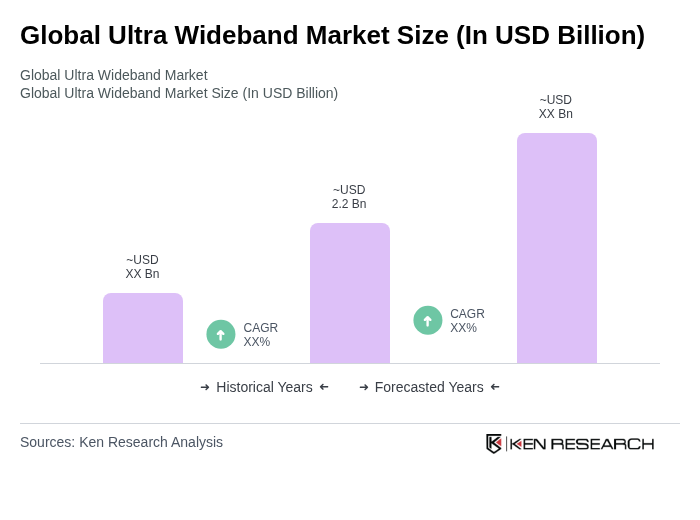
The Global Ultra Wideband Market is valued at approximately USD 2.2 billion, driven by the increasing demand for high-precision location tracking, real-time asset tracking, and secure wireless communication systems across various industries, including automotive, healthcare, and consumer electronics.

What makes us stand out is that our consultants follow Robust, Refine and Result (RRR) methodology. Robust for clear definitions, approaches and sanity checking, Refine for differentiating respondents' facts and opinions, and Result for presenting data with story.

We have set a benchmark in the industry by offering our clients with syndicated and customized market research reports featuring coverage of entire market as well as meticulous research and analyst insights.

While we don't replace traditional research, we flip the method upside down. Our dual approach of Top Bottom & Bottom Top ensures quality deliverable by not just verifying company fundamentals but also looking at the sector and macroeconomic factors.

With one step in the future, our research team constantly tries to show you the bigger picture. We help with some of the tough questions you may encounter along the way: How is the industry positioned? Best marketing channel? KPI's of competitors? By aligning every element, we help maximize success.

Our report gives you instant access to the answers and sources that other companies might choose to hide. We elaborate each steps of research methodology we have used and showcase you the sample size to earn your trust.

If you need any support, we are here! We pride ourselves on universe strength, data quality, and quick, friendly, and professional service.













