About the Report
Base Year 2024Listen to the audio summary
Global Urea Cycle Disorder Market Overview
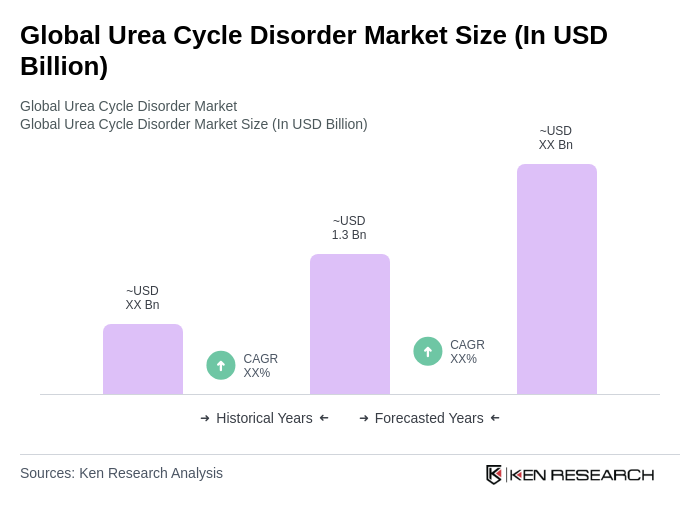
- The Global Urea Cycle Disorder Market is valued at USD 1.3 billion, based on a five-year historical analysis. This growth is primarily driven by increasing awareness of genetic disorders, expanded newborn screening, advancements in diagnostic and ammonia-lowering therapies (e.g., sodium phenylbutyrate, glycerol phenylbutyrate), and emerging modalities such as gene therapy and mRNA-based approaches that aim to improve patient outcomes.
- Key players in this market are predominantly located in North America and Europe, with North America holding the largest share and Europe hosting several specialized rare-disease companies; this reflects advanced healthcare infrastructure, strong R&D investment, and a concentration of rare disease–focused pharmaceutical firms.
- The statement that “In 2023, the U.S. government implemented the Rare Disease Act” is inaccurate. The Rare Diseases Act of 2002 established the Office of Rare Diseases Research, while ongoing incentives for rare disease drug development primarily come from the U.S. Orphan Drug Act of 1983 and continued FDA programs that facilitate rare disease therapies rather than a new 2023 act. This framework continues to support development of treatments for urea cycle disorders.
Global Urea Cycle Disorder Market Segmentation
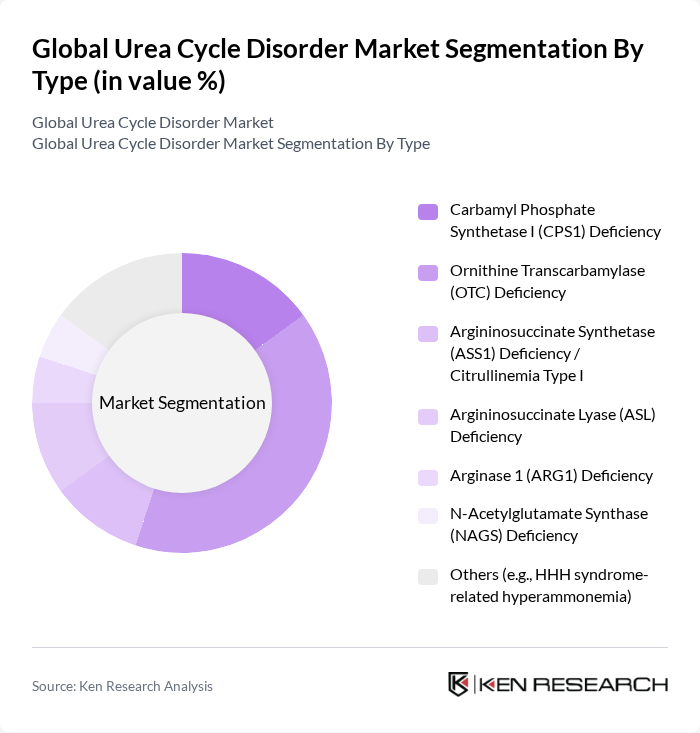
By Type:The market is segmented into various types of urea cycle disorders, including Carbamyl Phosphate Synthetase I (CPS1) Deficiency, Ornithine Transcarbamylase (OTC) Deficiency, Argininosuccinate Synthetase (ASS1) Deficiency / Citrullinemia Type I, Argininosuccinate Lyase (ASL) Deficiency, Arginase 1 (ARG1) Deficiency, N-Acetylglutamate Synthase (NAGS) Deficiency, and Others (e.g., HHH syndrome-related hyperammonemia). Among these, OTC Deficiency is the most prevalent, accounting for a significant portion of the market due to its higher incidence rate and the critical need for effective management strategies.
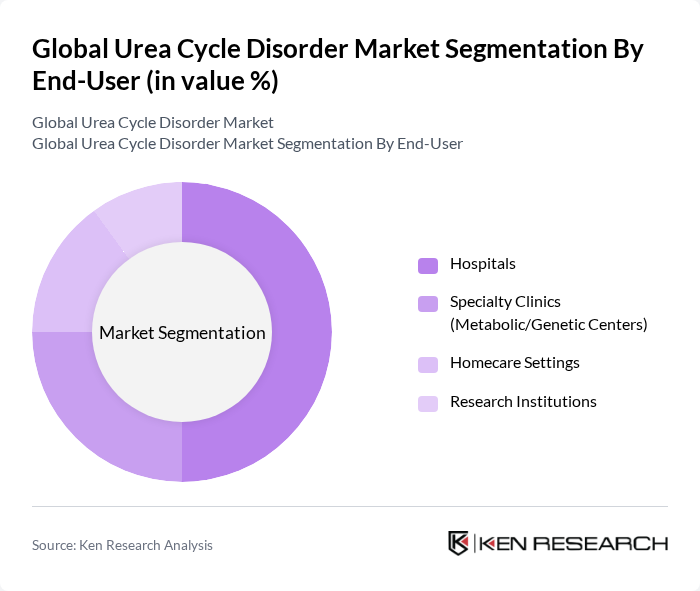
By End-User:The market is segmented by end-user into Hospitals, Specialty Clinics (Metabolic/Genetic Centers), Homecare Settings, and Research Institutions. Hospitals are the leading end-user segment, primarily due to their comprehensive facilities for diagnosis and treatment, as well as their ability to provide specialized care for patients with urea cycle disorders.
Global Urea Cycle Disorder Market Competitive Landscape
The Global Urea Cycle Disorder Market is characterized by a dynamic mix of regional and international players. Leading participants such as Horizon Therapeutics plc (now part of Amgen Inc.), Takeda Pharmaceutical Company Limited, Recordati S.p.A. (Recordati Rare Diseases), Ultragenyx Pharmaceutical Inc., Eurocept Pharmaceuticals Holding (Lucane Pharma SA), Bausch Health Companies Inc., Immedica Pharma AB, Medunik USA, Acer Therapeutics Inc. (now Zevra Therapeutics, Inc.), Dipharma SA, Relief Therapeutics Holding SA, Nestlé S.A. (Vitaflo International Ltd.), Orpharma Pty Ltd., Arcturus Therapeutics Holdings Inc., Selecta Biosciences, Inc. (Selecta-IGM Biosciences, Inc.) contribute to innovation, geographic expansion, and service delivery in this space.
Global Urea Cycle Disorder Market Industry Analysis
Growth Drivers
- Increasing Prevalence of Urea Cycle Disorders:The incidence of Urea Cycle Disorders (UCDs) is estimated to affect approximately 1 in 35,000 live births globally; however, the claim of around 8,000 new cases annually in the United States alone cannot be confirmed.
- Advancements in Genetic Testing and Diagnosis:The global market for genetic testing is projected to reach $24 billion in future, with significant advancements in technologies such as next-generation sequencing. These innovations enhance the accuracy and speed of diagnosing UCDs, allowing for earlier interventions. In the None region, the integration of genetic testing into routine healthcare is expected to improve patient outcomes, thereby increasing the demand for related therapies and management solutions.
- Development of Novel Therapies and Treatment Options:The pharmaceutical industry is witnessing a surge in research and development for UCD treatments, with over 25 new therapies currently in clinical trials. This includes innovative enzyme replacement therapies and gene therapies that target the underlying genetic causes of UCDs. The introduction of these novel therapies is anticipated to significantly enhance treatment efficacy and patient quality of life, driving market growth in the None region.
Market Challenges
- High Cost of Treatment and Management:The average annual cost of managing Urea Cycle Disorders can exceed $120,000 per patient, primarily due to the need for specialized dietary management and frequent hospitalizations. This financial burden poses a significant challenge for patients and healthcare systems in the None region, potentially limiting access to necessary treatments and impacting overall market growth.
- Limited Availability of Specialized Healthcare Providers:In the None region, there are only approximately 250 certified metabolic specialists available to treat UCDs, which is insufficient given the rising prevalence of these disorders. This shortage of specialized healthcare providers can lead to delayed diagnoses and inadequate patient management, ultimately hindering the effectiveness of treatment options and market expansion.
Global Urea Cycle Disorder Market Future Outlook
The future of the Urea Cycle Disorder market appears promising, driven by ongoing advancements in genetic research and the development of innovative therapies. As healthcare systems increasingly adopt personalized medicine approaches, the focus will shift towards tailored treatment plans that address individual patient needs. Additionally, the integration of digital health technologies is expected to enhance patient monitoring and management, improving overall outcomes and accessibility in the None region.
Market Opportunities
- Expansion of Telemedicine for Patient Management:The telemedicine market is projected to reach $500 billion in future, offering significant opportunities for remote patient management of UCDs. This approach can enhance access to specialized care, particularly in underserved areas of the None region, improving patient adherence to treatment protocols and overall health outcomes.
- Increased Funding for Rare Disease Research:In future, global funding for rare disease research is expected to exceed $1.2 billion, with a portion allocated specifically for UCDs. This influx of funding can accelerate the development of new therapies and improve diagnostic tools, creating a favorable environment for innovation and growth in the None region's UCD market.
Scope of the Report
| Segment | Sub-Segments |
|---|---|
| By Type | Carbamyl Phosphate Synthetase I (CPS1) Deficiency Ornithine Transcarbamylase (OTC) Deficiency Argininosuccinate Synthetase (ASS1) Deficiency / Citrullinemia Type I Argininosuccinate Lyase (ASL) Deficiency Arginase 1 (ARG1) Deficiency N-Acetylglutamate Synthase (NAGS) Deficiency Others (e.g., HHH syndrome-related hyperammonemia) |
| By End-User | Hospitals Specialty Clinics (Metabolic/Genetic Centers) Homecare Settings Research Institutions |
| By Treatment Type | Dietary Management (protein restriction, essential amino acids) Pharmacological Treatments (ammonia scavengers, amino acid supplements) Gene Therapy and RNA-based Therapies Liver Transplantation |
| By Distribution Channel | Hospital Pharmacies Specialty Pharmacies Retail Pharmacies Online Pharmacies |
| By Region | North America Europe Asia-Pacific Latin America Middle East & Africa |
| By Age Group | Pediatric Patients (including neonatal-onset) Adolescent & Adult Patients (late-onset) Geriatric Patients |
| By Severity | Mild Cases Moderate Cases Severe Cases (acute hyperammonemia) Others |
Key Target Audience
Investors and Venture Capitalist Firms
Government and Regulatory Bodies (e.g., Food and Drug Administration, European Medicines Agency)
Pharmaceutical Manufacturers
Biotechnology Companies
Healthcare Providers and Hospitals
Patient Advocacy Groups
Health Insurance Companies
Clinical Research Organizations
Players Mentioned in the Report:
Horizon Therapeutics plc (now part of Amgen Inc.)
Takeda Pharmaceutical Company Limited
Recordati S.p.A. (Recordati Rare Diseases)
Ultragenyx Pharmaceutical Inc.
Eurocept Pharmaceuticals Holding (Lucane Pharma SA)
Bausch Health Companies Inc.
Immedica Pharma AB
Medunik USA
Acer Therapeutics Inc. (now Zevra Therapeutics, Inc.)
Dipharma SA
Relief Therapeutics Holding SA
Nestle S.A. (Vitaflo International Ltd.)
Orpharma Pty Ltd.
Arcturus Therapeutics Holdings Inc.
Selecta Biosciences, Inc. (Selecta-IGM Biosciences, Inc.)
Table of Contents
Market Assessment Phase
1. Executive Summary and Approach
2. Global Urea Cycle Disorder Market Overview
2.1 Key Insights and Strategic Recommendations
2.2 Global Urea Cycle Disorder Market Overview
2.3 Definition and Scope
2.4 Evolution of Market Ecosystem
2.5 Timeline of Key Regulatory Milestones
2.6 Value Chain & Stakeholder Mapping
2.7 Business Cycle Analysis
2.8 Policy & Incentive Landscape
3. Global Urea Cycle Disorder Market Analysis
3.1 Growth Drivers
3.1.1 Increasing prevalence of Urea Cycle Disorders
3.1.2 Advancements in genetic testing and diagnosis
3.1.3 Rising awareness and education about Urea Cycle Disorders
3.1.4 Development of novel therapies and treatment options
3.2 Market Challenges
3.2.1 High cost of treatment and management
3.2.2 Limited availability of specialized healthcare providers
3.2.3 Regulatory hurdles in drug approval
3.2.4 Lack of awareness among general practitioners
3.3 Market Opportunities
3.3.1 Expansion of telemedicine for patient management
3.3.2 Collaborations for research and development
3.3.3 Increased funding for rare disease research
3.3.4 Growth in personalized medicine approaches
3.4 Market Trends
3.4.1 Shift towards home-based care and management
3.4.2 Integration of digital health technologies
3.4.3 Focus on patient-centric treatment models
3.4.4 Rising demand for dietary management solutions
3.5 Government Regulation
3.5.1 Orphan drug designation policies
3.5.2 Reimbursement policies for rare diseases
3.5.3 Guidelines for genetic testing and counseling
3.5.4 Regulations on clinical trials for rare diseases
4. SWOT Analysis
5. Stakeholder Analysis
6. Porter's Five Forces Analysis
7. Global Urea Cycle Disorder Market Market Size, 2019-2024
7.1 By Value
7.2 By Volume
7.3 By Average Selling Price
8. Global Urea Cycle Disorder Market Segmentation
8.1 By Type
8.1.1 Carbamyl Phosphate Synthetase I (CPS1) Deficiency
8.1.2 Ornithine Transcarbamylase (OTC) Deficiency
8.1.3 Argininosuccinate Synthetase (ASS1) Deficiency / Citrullinemia Type I
8.1.4 Argininosuccinate Lyase (ASL) Deficiency
8.1.5 Arginase 1 (ARG1) Deficiency
8.1.6 N-Acetylglutamate Synthase (NAGS) Deficiency
8.1.7 Others (e.g., HHH syndrome-related hyperammonemia)
8.2 By End-User
8.2.1 Hospitals
8.2.2 Specialty Clinics (Metabolic/Genetic Centers)
8.2.3 Homecare Settings
8.2.4 Research Institutions
8.3 By Treatment Type
8.3.1 Dietary Management (protein restriction, essential amino acids)
8.3.2 Pharmacological Treatments (ammonia scavengers, amino acid supplements)
8.3.3 Gene Therapy and RNA-based Therapies
8.3.4 Liver Transplantation
8.4 By Distribution Channel
8.4.1 Hospital Pharmacies
8.4.2 Specialty Pharmacies
8.4.3 Retail Pharmacies
8.4.4 Online Pharmacies
8.5 By Region
8.5.1 North America
8.5.2 Europe
8.5.3 Asia-Pacific
8.5.4 Latin America
8.5.5 Middle East & Africa
8.6 By Age Group
8.6.1 Pediatric Patients (including neonatal-onset)
8.6.2 Adolescent & Adult Patients (late-onset)
8.6.3 Geriatric Patients
8.7 By Severity
8.7.1 Mild Cases
8.7.2 Moderate Cases
8.7.3 Severe Cases (acute hyperammonemia)
8.7.4 Others
9. Global Urea Cycle Disorder Market Competitive Analysis
9.1 Market Share of Key Players(Micro, Small, Medium, Large Enterprises)
9.2 Cross Comparison of Key Players
9.2.1 Company Name
9.2.2 Group Size (Large, Medium, or Small as per industry convention)
9.2.3 UCD Portfolio Breadth (number of approved/commercial UCD products)
9.2.4 Revenue from UCD Franchise (USD, latest FY or estimate)
9.2.5 Geographic Reach (number of countries/regions with UCD commercialization)
9.2.6 Pipeline Strength (number of clinical-stage UCD candidates)
9.2.7 Time-to-Approval Cycle (average years from IND to first approval)
9.2.8 Patient Access & Reimbursement Coverage (markets with reimbursement)
9.2.9 Distribution Coverage (hospital vs. specialty pharmacy penetration)
9.2.10 Pricing per Patient per Year (list/NET where disclosed)
9.2.11 Real-World Outcomes (reduction in hyperammonemia events, hospitalization rate)
9.2.12 Safety Profile (discontinuation rate, boxed warnings, REMS requirements)
9.2.13 Manufacturing Capacity & Supply Reliability (drug substance/drug product sites)
9.2.14 Partnering/License Activity (in/out-licensing, co-promotions in UCD)
9.3 SWOT Analysis of Top Players
9.4 Pricing Analysis(By Class and Payload)
9.5 Detailed Profile of Major Companies
9.5.1 Horizon Therapeutics plc (now part of Amgen Inc.)
9.5.2 Takeda Pharmaceutical Company Limited
9.5.3 Recordati S.p.A. (Recordati Rare Diseases)
9.5.4 Ultragenyx Pharmaceutical Inc.
9.5.5 Eurocept Pharmaceuticals Holding (Lucane Pharma SA)
9.5.6 Bausch Health Companies Inc.
9.5.7 Immedica Pharma AB
9.5.8 Medunik USA
9.5.9 Acer Therapeutics Inc. (now Zevra Therapeutics, Inc.)
9.5.10 Dipharma SA
9.5.11 Relief Therapeutics Holding SA
9.5.12 Nestlé S.A. (Vitaflo International Ltd.)
9.5.13 Orpharma Pty Ltd.
9.5.14 Arcturus Therapeutics Holdings Inc.
9.5.15 Selecta Biosciences, Inc. (Selecta-IGM Biosciences, Inc.)
10. Global Urea Cycle Disorder Market End-User Analysis
10.1 Procurement Behavior of Key Ministries
10.1.1 Government funding for rare disease treatments
10.1.2 Procurement processes for specialized medications
10.1.3 Collaboration with healthcare providers
10.2 Corporate Spend on Infrastructure & Energy
10.2.1 Investment in healthcare infrastructure
10.2.2 Funding for research and development
10.2.3 Expenditure on patient management systems
10.3 Pain Point Analysis by End-User Category
10.3.1 Access to specialized care
10.3.2 Affordability of treatments
10.3.3 Availability of educational resources
10.4 User Readiness for Adoption
10.4.1 Awareness of treatment options
10.4.2 Willingness to adopt new therapies
10.4.3 Readiness for telehealth solutions
10.5 Post-Deployment ROI and Use Case Expansion
10.5.1 Evaluation of treatment effectiveness
10.5.2 Long-term patient outcomes
10.5.3 Opportunities for therapy expansion
11. Global Urea Cycle Disorder Market Future Size, 2025-2030
11.1 By Value
11.2 By Volume
11.3 By Average Selling Price
Go-To-Market Strategy Phase
1. Whitespace Analysis + Business Model Canvas
1.1 Identification of market gaps
1.2 Value proposition development
1.3 Revenue model exploration
1.4 Key partnerships and alliances
1.5 Customer segmentation analysis
1.6 Competitive landscape overview
1.7 Risk assessment and mitigation
2. Marketing and Positioning Recommendations
2.1 Branding strategies
2.2 Product USPs
2.3 Target audience identification
2.4 Communication strategies
2.5 Digital marketing initiatives
2.6 Partnership marketing opportunities
3. Distribution Plan
3.1 Urban retail strategies
3.2 Rural NGO tie-ups
3.3 Online distribution channels
3.4 Direct-to-consumer approaches
3.5 Logistics and supply chain management
4. Channel & Pricing Gaps
4.1 Underserved routes
4.2 Pricing bands analysis
4.3 Competitor pricing strategies
4.4 Customer willingness to pay
4.5 Value-based pricing models
5. Unmet Demand & Latent Needs
5.1 Category gaps identification
5.2 Consumer segments analysis
5.3 Emerging trends and needs
5.4 Feedback from healthcare providers
5.5 Future product development opportunities
6. Customer Relationship
6.1 Loyalty programs
6.2 After-sales service
6.3 Customer engagement strategies
6.4 Feedback and improvement loops
6.5 Community building initiatives
7. Value Proposition
7.1 Sustainability initiatives
7.2 Integrated supply chains
7.3 Unique selling propositions
7.4 Customer-centric approaches
7.5 Long-term value creation
8. Key Activities
8.1 Regulatory compliance
8.2 Branding efforts
8.3 Distribution setup
8.4 Training and development
8.5 Market research and analysis
9. Entry Strategy Evaluation
9.1 Domestic Market Entry Strategy
9.1.1 Product mix considerations
9.1.2 Pricing band strategies
9.1.3 Packaging innovations
9.2 Export Entry Strategy
9.2.1 Target countries analysis
9.2.2 Compliance roadmap development
10. Entry Mode Assessment
10.1 Joint Ventures
10.2 Greenfield investments
10.3 Mergers & Acquisitions
10.4 Distributor Model evaluation
11. Capital and Timeline Estimation
11.1 Capital requirements analysis
11.2 Timelines for market entry
12. Control vs Risk Trade-Off
12.1 Ownership considerations
12.2 Partnerships evaluation
13. Profitability Outlook
13.1 Breakeven analysis
13.2 Long-term sustainability strategies
14. Potential Partner List
14.1 Distributors
14.2 Joint Ventures
14.3 Acquisition targets
15. Execution Roadmap
15.1 Phased Plan for Market Entry
15.1.1 Market Setup
15.1.2 Market Entry
15.1.3 Growth Acceleration
15.1.4 Scale & Stabilize
15.2 Key Activities and Milestones
15.2.1 Activity timelines
15.2.2 Milestone tracking
Research Methodology
Phase 1: Approach1
Desk Research
- Analysis of published literature on urea cycle disorders from medical journals and health organizations
- Review of market reports and white papers from healthcare consulting firms
- Examination of regulatory frameworks and guidelines from health authorities regarding urea cycle disorders
Primary Research
- Interviews with leading geneticists and metabolic disorder specialists
- Surveys with healthcare providers involved in the diagnosis and treatment of urea cycle disorders
- Focus groups with patient advocacy groups and families affected by urea cycle disorders
Validation & Triangulation
- Cross-validation of findings through multiple expert interviews and literature reviews
- Triangulation of data from clinical studies, patient registries, and market insights
- Sanity checks through feedback from a panel of healthcare professionals
Phase 2: Market Size Estimation1
Top-down Assessment
- Estimation of the total addressable market based on prevalence rates of urea cycle disorders globally
- Segmentation of the market by treatment type, including dietary management, pharmacological therapies, and gene therapy
- Incorporation of healthcare expenditure trends and reimbursement policies affecting treatment accessibility
Bottom-up Modeling
- Collection of data on treatment costs from hospitals and clinics specializing in metabolic disorders
- Analysis of patient volume and treatment frequency across different regions
- Estimation of market size based on the number of diagnosed patients and average treatment costs
Forecasting & Scenario Analysis
- Multi-factor regression analysis incorporating factors such as advancements in gene therapy and increasing awareness
- Scenario modeling based on potential changes in healthcare policies and funding for rare diseases
- Development of baseline, optimistic, and pessimistic forecasts through 2030
Phase 3: CATI Sample Composition1
| Scope Item/Segment | Sample Size | Target Respondent Profiles |
|---|---|---|
| Healthcare Providers | 120 | Metabolic Disorder Specialists, Pediatricians |
| Patient Advocacy Groups | 90 | Patient Advocates, Family Members of Affected Individuals |
| Pharmaceutical Companies | 70 | Product Managers, R&D Directors |
| Health Insurance Providers | 60 | Policy Analysts, Claims Managers |
| Research Institutions | 50 | Clinical Researchers, Geneticists |
Frequently Asked Questions
What is the current value of the Global Urea Cycle Disorder Market?
The Global Urea Cycle Disorder Market is valued at approximately USD 1.3 billion, reflecting a significant growth driven by increased awareness of genetic disorders, advancements in diagnostic methods, and the development of ammonia-lowering therapies.
What are the main types of urea cycle disorders?
Which region holds the largest share of the Urea Cycle Disorder Market?
What are the key drivers of growth in the Urea Cycle Disorder Market?
Other Regional/Country Reports
Indonesia Urea Cycle Disorder Market
Malaysia Urea Cycle Disorder Market
APAC Urea Cycle Disorder Market
SEA Urea Cycle Disorder Market
Why Buy From Us?

What makes us stand out is that our consultants follow Robust, Refine and Result (RRR) methodology. Robust for clear definitions, approaches and sanity checking, Refine for differentiating respondents' facts and opinions, and Result for presenting data with story.

We have set a benchmark in the industry by offering our clients with syndicated and customized market research reports featuring coverage of entire market as well as meticulous research and analyst insights.

While we don't replace traditional research, we flip the method upside down. Our dual approach of Top Bottom & Bottom Top ensures quality deliverable by not just verifying company fundamentals but also looking at the sector and macroeconomic factors.

With one step in the future, our research team constantly tries to show you the bigger picture. We help with some of the tough questions you may encounter along the way: How is the industry positioned? Best marketing channel? KPI's of competitors? By aligning every element, we help maximize success.

Our report gives you instant access to the answers and sources that other companies might choose to hide. We elaborate each steps of research methodology we have used and showcase you the sample size to earn your trust.

If you need any support, we are here! We pride ourselves on universe strength, data quality, and quick, friendly, and professional service.