About the Report
Base Year 2024Listen to the audio summary
Global Used Car Market Overview
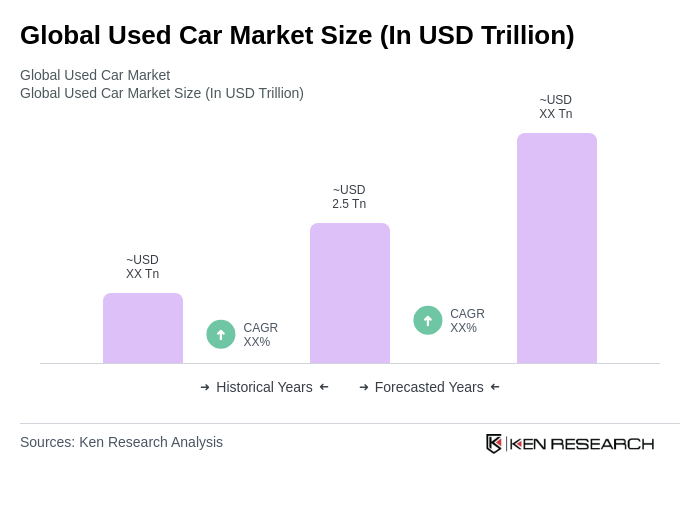
- The Global Used Car Market is valued at USD 2.5 trillion, based on a five-year historical analysis and recent industry reporting indicating around USD 2.5 trillion valuation, with growth underpinned by affordability-led demand, improved access to financing, and the rapid expansion of digital retailing and inspection tools that enhance transparency .
- Key players in this market include the United States, Germany, and Japan, supported by large automotive bases, high car parc/ownership rates, and mature retail and wholesale channels; the U.S. benefits from deep dealer networks and vehicle financing infrastructure, along with strong digital marketplaces that facilitate supply, discovery, and lending .
- In 2023, the U.S. strengthened used-car consumer protections through the Federal Trade Commission’s revised CARS Rule framework and ongoing federal-state enforcement emphasis on truthful advertising, fees disclosure, and vehicle history transparency; while comprehensive vehicle history reports are widely encouraged and used in industry practice, federal rules do not mandate a specific report, and safety/emissions standards continue to be governed by federal and state law at point of sale and registration .
Global Used Car Market Segmentation
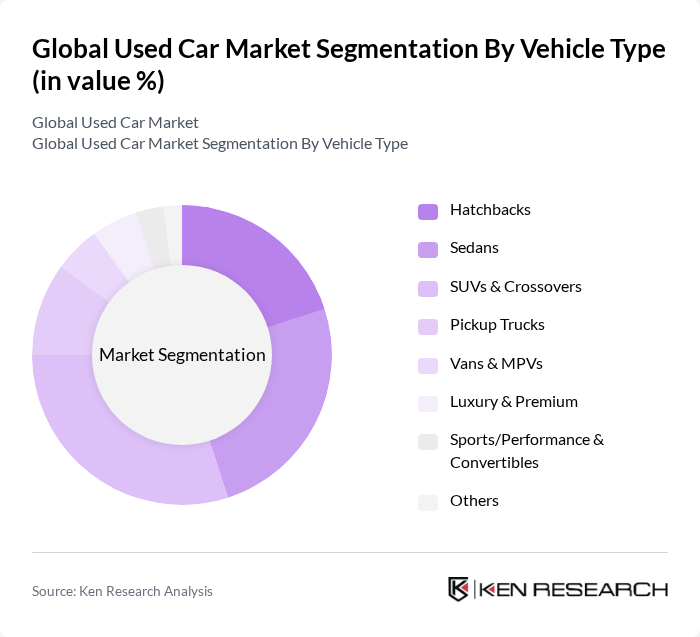
By Vehicle Type:The used car market is segmented by vehicle type, including hatchbacks, sedans, SUVs & crossovers, pickup trucks, vans & MPVs, luxury & premium vehicles, sports/performance & convertibles, and others. SUVs & crossovers have seen sustained popularity due to practicality and perceived safety, while sedans and hatchbacks remain attractive for value and fuel efficiency. Rising digital retailing and certification programs have supported consumer confidence across segments, with organized players emphasizing transparent pricing and warranties that particularly bolster SUV and mainstream passenger categories .
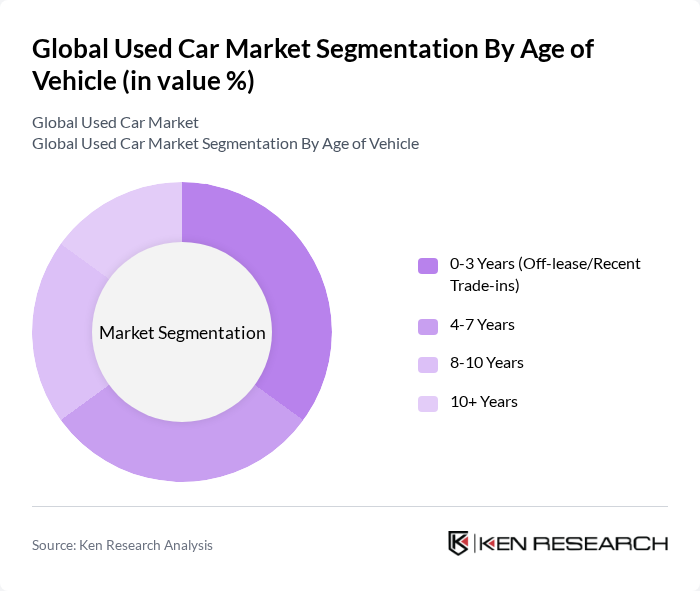
By Age of Vehicle:The segmentation by age of vehicle includes 0-3 years (off-lease/recent trade-ins), 4-7 years, 8-10 years, and 10+ years. The 0-3 years cohort is buoyed by certified pre-owned availability, recent technology/content, and lower perceived risk; strong demand also persists in the 4-7 years band as depreciation advantages meet affordability and wider model choice. Organized players’ inspection standards and warranties underpin buyer trust across these age bands in both offline and online channels .
Global Used Car Market Competitive Landscape
The Global Used Car Market is characterized by a dynamic mix of regional and international players. Leading participants such as CarMax, Inc., AutoNation, Inc., Carvana Co., Lithia Motors, Inc. (Driveway), Penske Automotive Group, Inc. (CarShop), Sonic Automotive, Inc. (EchoPark Automotive), Asbury Automotive Group, Inc. (Clicklane), Group 1 Automotive, Inc., Lookers plc, Pendragon plc (Evans Halshaw; CarStore), Auto Trader Group plc, Cazoo Group Ltd., AutoScout24 GmbH, Mobile.de GmbH, Cars.com Inc., TrueCar, Inc., Edmunds.com, Inc., eBay Inc. (Motors), Alibaba Group Holding Ltd. (Tmall Auto; Taobao Used Cars), Copart, Inc., KAR Global (ADESA; OPENLANE), BCA Marketplace Limited (British Car Auctions), Inchcape plc, Maruti Suzuki India Ltd. (True Value), Mahindra First Choice Wheels Ltd., OLX Group (OLX Autos), Droom Technology Pvt. Ltd., Cars24 Services Private Limited, Toyota Motor Corporation (Toyota Certified Used Vehicles), Volkswagen AG (Das WeltAuto) contribute to innovation, geographic expansion, and service delivery in this space.
Global Used Car Market Industry Analysis
Growth Drivers
- Increasing Demand for Affordable Transportation:The global used car market is experiencing a surge in demand, driven by the need for affordable transportation options. In future, the average price of a used car is projected to be around $28,000, making it a more accessible choice for consumers compared to new vehicles, which average $47,000. This price gap is significant, especially in regions where disposable income growth is slow, leading to increased sales of used vehicles.
- Rising Urbanization and Population Growth:Urbanization is a key driver of the used car market, with the United Nations estimating that by future, 57% of the global population will reside in urban areas. This trend is particularly pronounced in developing countries, where urban centers are expanding rapidly. As more people move to cities, the demand for personal vehicles, including used cars, is expected to rise, as public transportation may not meet the growing needs of urban dwellers.
- Expansion of Online Used Car Marketplaces:The rise of digital platforms has transformed the used car buying experience. In future, online sales of used cars are expected to account for approximately 31% of total sales, up from 21% in 2020. This shift is facilitated by the convenience of online shopping, allowing consumers to compare prices and access a wider range of vehicles. Major players like Carvana and Vroom are leading this trend, enhancing market accessibility and transparency.
Market Challenges
- Fluctuating Used Car Prices:The used car market faces significant challenges due to price volatility. In future, used car prices saw a dramatic increase of 16% year-over-year, driven by supply chain disruptions and semiconductor shortages. However, as supply stabilizes, prices are expected to fluctuate, creating uncertainty for both buyers and sellers. This unpredictability can deter potential buyers, impacting overall market growth and consumer confidence.
- Consumer Trust and Vehicle History Concerns:A major challenge in the used car market is consumer trust, particularly regarding vehicle history. According to a future survey, 41% of potential buyers expressed concerns about undisclosed accidents or title issues. The lack of transparency can lead to hesitance in purchasing used vehicles, as consumers seek assurance about the quality and reliability of their investment. This challenge necessitates improved vehicle history reporting and consumer education.
Global Used Car Market Future Outlook
The future of the used car market appears promising, driven by technological advancements and changing consumer preferences. As online purchasing continues to gain traction, more consumers will likely opt for digital platforms, enhancing convenience and accessibility. Additionally, the growing interest in electric and hybrid vehicles will create new segments within the used car market, appealing to environmentally conscious consumers. These trends indicate a dynamic market landscape, with opportunities for innovation and growth in the coming years.
Market Opportunities
- Growth of Electric and Hybrid Used Cars:The increasing adoption of electric and hybrid vehicles presents a significant opportunity in the used car market. In future, sales of used electric vehicles are expected to reach 1.6 million units globally, driven by rising environmental awareness and government incentives. This trend will cater to a growing segment of eco-conscious consumers seeking sustainable transportation options.
- Development of Subscription-Based Models:Subscription services for used cars are gaining traction, offering consumers flexibility and convenience. By future, it is estimated that subscription models could account for 6% of the used car market. This approach allows consumers to access vehicles without long-term commitments, appealing to younger demographics who prioritize flexibility and lower upfront costs in their transportation choices.
Scope of the Report
| Segment | Sub-Segments |
|---|---|
| By Vehicle Type | Hatchbacks Sedans SUVs & Crossovers Pickup Trucks Vans & MPVs Luxury & Premium Sports/Performance & Convertibles Others |
| By Age of Vehicle | 3 Years (Off-lease/Recent Trade-ins) 7 Years 10 Years + Years |
| By Condition/Certification | Certified Pre-Owned (CPO) Non-Certified |
| By Sales Channel | Franchised Dealerships Independent Dealers Online-first Platforms (e-commerce) Auctions (Wholesale & Retail) Private Party Sales |
| By Powertrain/Fuel Type | Gasoline Diesel Hybrid (HEV/PHEV) Battery Electric Vehicles (BEV) Others (CNG/LPG/Flex-fuel) |
| By Buyer Type | Personal/Individual Commercial & Fleet (including rental, ride-hailing, corporate) |
| By Financing Method | Cash Purchases Dealer-arranged Loans Bank/Credit Union Loans Buy-Here-Pay-Here (BHPH) Subscription/Other |
| By Geographic Region | North America Europe Asia Pacific Latin America Middle East & Africa |
| By Price Band (USD) | Under $10,000 $10,000 - $20,000 $20,000 - $30,000 $30,000 - $50,000 Over $50,000 |
Key Target Audience
Investors and Venture Capitalist Firms
Government and Regulatory Bodies (e.g., National Highway Traffic Safety Administration, Environmental Protection Agency)
Automobile Manufacturers
Used Car Dealerships
Automotive Auction Houses
Insurance Companies
Financial Institutions
Fleet Management Companies
Players Mentioned in the Report:
CarMax, Inc.
AutoNation, Inc.
Carvana Co.
Lithia Motors, Inc. (Driveway)
Penske Automotive Group, Inc. (CarShop)
Sonic Automotive, Inc. (EchoPark Automotive)
Asbury Automotive Group, Inc. (Clicklane)
Group 1 Automotive, Inc.
Lookers plc
Pendragon plc (Evans Halshaw; CarStore)
Auto Trader Group plc
Cazoo Group Ltd.
AutoScout24 GmbH
Mobile.de GmbH
Cars.com Inc.
TrueCar, Inc.
Edmunds.com, Inc.
eBay Inc. (Motors)
Alibaba Group Holding Ltd. (Tmall Auto; Taobao Used Cars)
Copart, Inc.
KAR Global (ADESA; OPENLANE)
BCA Marketplace Limited (British Car Auctions)
Inchcape plc
Maruti Suzuki India Ltd. (True Value)
Mahindra First Choice Wheels Ltd.
OLX Group (OLX Autos)
Droom Technology Pvt. Ltd.
Cars24 Services Private Limited
Toyota Motor Corporation (Toyota Certified Used Vehicles)
Volkswagen AG (Das WeltAuto)
Table of Contents
Market Assessment Phase
1. Executive Summary and Approach
2. Global Used Car Market Overview
2.1 Key Insights and Strategic Recommendations
2.2 Global Used Car Market Overview
2.3 Definition and Scope
2.4 Evolution of Market Ecosystem
2.5 Timeline of Key Regulatory Milestones
2.6 Value Chain & Stakeholder Mapping
2.7 Business Cycle Analysis
2.8 Policy & Incentive Landscape
3. Global Used Car Market Analysis
3.1 Growth Drivers
3.1.1 Increasing demand for affordable transportation
3.1.2 Rising urbanization and population growth
3.1.3 Expansion of online used car marketplaces
3.1.4 Enhanced financing options for used cars
3.2 Market Challenges
3.2.1 Fluctuating used car prices
3.2.2 Regulatory compliance issues
3.2.3 Competition from new car sales
3.2.4 Consumer trust and vehicle history concerns
3.3 Market Opportunities
3.3.1 Growth of electric and hybrid used cars
3.3.2 Expansion into emerging markets
3.3.3 Development of subscription-based models
3.3.4 Increasing demand for certified pre-owned vehicles
3.4 Market Trends
3.4.1 Shift towards online purchasing
3.4.2 Integration of technology in vehicle sales
3.4.3 Focus on sustainability and eco-friendly options
3.4.4 Rise of vehicle leasing options
3.5 Government Regulation
3.5.1 Emission standards for used vehicles
3.5.2 Tax incentives for electric vehicles
3.5.3 Consumer protection laws
3.5.4 Safety regulations for used cars
4. SWOT Analysis
5. Stakeholder Analysis
6. Porter's Five Forces Analysis
7. Global Used Car Market Market Size, 2019-2024
7.1 By Value
7.2 By Volume
7.3 By Average Selling Price
8. Global Used Car Market Segmentation
8.1 By Vehicle Type
8.1.1 Hatchbacks
8.1.2 Sedans
8.1.3 SUVs & Crossovers
8.1.4 Pickup Trucks
8.1.5 Vans & MPVs
8.1.6 Luxury & Premium
8.1.7 Sports/Performance & Convertibles
8.1.8 Others
8.2 By Age of Vehicle
8.2.1 0-3 Years (Off-lease/Recent Trade-ins)
8.2.2 4-7 Years
8.2.3 8-10 Years
8.2.4 10+ Years
8.3 By Condition/Certification
8.3.1 Certified Pre-Owned (CPO)
8.3.2 Non-Certified
8.4 By Sales Channel
8.4.1 Franchised Dealerships
8.4.2 Independent Dealers
8.4.3 Online-first Platforms (e-commerce)
8.4.4 Auctions (Wholesale & Retail)
8.4.5 Private Party Sales
8.5 By Powertrain/Fuel Type
8.5.1 Gasoline
8.5.2 Diesel
8.5.3 Hybrid (HEV/PHEV)
8.5.4 Battery Electric Vehicles (BEV)
8.5.5 Others (CNG/LPG/Flex-fuel)
8.6 By Buyer Type
8.6.1 Personal/Individual
8.6.2 Commercial & Fleet (including rental, ride-hailing, corporate)
8.7 By Financing Method
8.7.1 Cash Purchases
8.7.2 Dealer-arranged Loans
8.7.3 Bank/Credit Union Loans
8.7.4 Buy-Here-Pay-Here (BHPH)
8.7.5 Subscription/Other
8.8 By Geographic Region
8.8.1 North America
8.8.2 Europe
8.8.3 Asia Pacific
8.8.4 Latin America
8.8.5 Middle East & Africa
8.9 By Price Band (USD)
8.9.1 Under $10,000
8.9.2 $10,000 - $20,000
8.9.3 $20,000 - $30,000
8.9.4 $30,000 - $50,000
8.9.5 Over $50,000
9. Global Used Car Market Competitive Analysis
9.1 Market Share of Key Players
9.2 KPIs for Cross Comparison of Key Players
9.2.1 Company Name
9.2.2 Group Size (Global, Regional, Local)
9.2.3 Gross Merchandise Value (GMV) / Used Vehicle Sales Volume
9.2.4 Revenue Growth Rate (YoY)
9.2.5 Average Gross Profit per Unit (GPU)
9.2.6 Inventory Turn Days (Days to Turn)
9.2.7 Customer Acquisition Cost (per retail unit sold)
9.2.8 Marketing Spend as % of Revenue
9.2.9 Online vs. Offline Sales Mix (%)
9.2.10 Financing Penetration Rate (% of units sold with finance)
9.2.11 Return/Buyback Rate (%)
9.2.12 Customer Retention/Repeat Purchase Rate (%)
9.2.13 Average Selling Price (ASP) per Unit
9.2.14 Certified Pre-Owned (CPO) Mix (% of retail sales)
9.2.15 Reconditioning Cost per Unit
9.2.16 Days Supply of Inventory
9.2.17 Website/App Conversion Rate (%)
9.2.18 Net Promoter Score (NPS) / CSAT
9.2.19 Geographic Coverage (countries/markets served)
9.2.20 EBITDA Margin (%)
9.3 SWOT Analysis of Top Players
9.4 Pricing Analysis
9.5 Detailed Profile of Major Companies
9.5.1 CarMax, Inc.
9.5.2 AutoNation, Inc.
9.5.3 Carvana Co.
9.5.4 Lithia Motors, Inc. (Driveway)
9.5.5 Penske Automotive Group, Inc. (CarShop)
9.5.6 Sonic Automotive, Inc. (EchoPark Automotive)
9.5.7 Asbury Automotive Group, Inc. (Clicklane)
9.5.8 Group 1 Automotive, Inc.
9.5.9 Lookers plc
9.5.10 Pendragon plc (Evans Halshaw; CarStore)
9.5.11 Auto Trader Group plc
9.5.12 Cazoo Group Ltd.
9.5.13 AutoScout24 GmbH
9.5.14 Mobile.de GmbH
9.5.15 Cars.com Inc.
9.5.16 TrueCar, Inc.
9.5.17 Edmunds.com, Inc.
9.5.18 eBay Inc. (Motors)
9.5.19 Alibaba Group Holding Ltd. (Tmall Auto; Taobao Used Cars)
9.5.20 Copart, Inc.
9.5.21 KAR Global (ADESA; OPENLANE)
9.5.22 BCA Marketplace Limited (British Car Auctions)
9.5.23 Inchcape plc
9.5.24 Maruti Suzuki India Ltd. (True Value)
9.5.25 Mahindra First Choice Wheels Ltd.
9.5.26 OLX Group (OLX Autos)
9.5.27 Droom Technology Pvt. Ltd.
9.5.28 Cars24 Services Private Limited
9.5.29 Toyota Motor Corporation (Toyota Certified Used Vehicles)
9.5.30 Volkswagen AG (Das WeltAuto)
10. Global Used Car Market End-User Analysis
10.1 Procurement Behavior of Key Ministries
10.1.1 Government fleet purchases
10.1.2 Procurement policies for used vehicles
10.1.3 Budget allocation for transportation
10.2 Corporate Spend on Infrastructure & Energy
10.2.1 Corporate vehicle leasing
10.2.2 Investment in fleet management
10.2.3 Budgeting for used vehicle procurement
10.3 Pain Point Analysis by End-User Category
10.3.1 Quality assurance concerns
10.3.2 Availability of financing options
10.3.3 Vehicle history transparency
10.4 User Readiness for Adoption
10.4.1 Awareness of used car benefits
10.4.2 Acceptance of online purchasing
10.4.3 Trust in certified pre-owned programs
10.5 Post-Deployment ROI and Use Case Expansion
10.5.1 Cost savings from used vehicle acquisition
10.5.2 Expansion of vehicle usage in operations
10.5.3 Long-term maintenance cost analysis
11. Global Used Car Market Future Size, 2025-2030
11.1 By Value
11.2 By Volume
11.3 By Average Selling Price
Go-To-Market Strategy Phase
1. Whitespace Analysis + Business Model Canvas
1.1 Market gaps identification
1.2 Value proposition development
1.3 Revenue stream analysis
1.4 Cost structure evaluation
1.5 Key partnerships exploration
1.6 Customer segments targeting
1.7 Channels for delivery
2. Marketing and Positioning Recommendations
2.1 Branding strategies
2.2 Product USPs
2.3 Target audience engagement
2.4 Digital marketing tactics
2.5 Offline marketing initiatives
3. Distribution Plan
3.1 Urban retail strategies
3.2 Rural NGO tie-ups
3.3 Online sales channels
3.4 Partnerships with local dealers
4. Channel & Pricing Gaps
4.1 Underserved routes
4.2 Pricing bands analysis
4.3 Competitor pricing strategies
4.4 Consumer price sensitivity
5. Unmet Demand & Latent Needs
5.1 Category gaps identification
5.2 Consumer segments analysis
5.3 Emerging trends in consumer preferences
6. Customer Relationship
6.1 Loyalty programs
6.2 After-sales service enhancements
6.3 Customer feedback mechanisms
7. Value Proposition
7.1 Sustainability initiatives
7.2 Integrated supply chains
7.3 Customer-centric offerings
8. Key Activities
8.1 Regulatory compliance
8.2 Branding efforts
8.3 Distribution setup
9. Entry Strategy Evaluation
9.1 Domestic Market Entry Strategy
9.1.1 Product mix considerations
9.1.2 Pricing band strategies
9.1.3 Packaging options
9.2 Export Entry Strategy
9.2.1 Target countries analysis
9.2.2 Compliance roadmap development
10. Entry Mode Assessment
10.1 JV opportunities
10.2 Greenfield investments
10.3 M&A considerations
10.4 Distributor model evaluation
11. Capital and Timeline Estimation
11.1 Capital requirements
11.2 Timelines for market entry
12. Control vs Risk Trade-Off
12.1 Ownership considerations
12.2 Partnerships evaluation
13. Profitability Outlook
13.1 Breakeven analysis
13.2 Long-term sustainability strategies
14. Potential Partner List
14.1 Distributors
14.2 JVs
14.3 Acquisition targets
15. Execution Roadmap
15.1 Phased Plan for Market Entry
15.1.1 Market Setup
15.1.2 Market Entry
15.1.3 Growth Acceleration
15.1.4 Scale & Stabilize
15.2 Key Activities and Milestones
15.2.1 Milestone tracking
15.2.2 Activity scheduling
Research Methodology
Phase 1: Approach1
Desk Research
- Analysis of industry reports from automotive associations and market research firms
- Review of government publications on vehicle registration and sales statistics
- Examination of online platforms and marketplaces for used car listings and pricing trends
Primary Research
- Interviews with dealership owners and managers to understand market dynamics
- Surveys with consumers who have recently purchased used cars to gather insights on preferences
- Focus groups with automotive experts and analysts to discuss market trends and forecasts
Validation & Triangulation
- Cross-validation of findings with multiple data sources, including sales data and consumer surveys
- Triangulation of insights from primary interviews with secondary research findings
- Sanity checks through expert panel reviews to ensure data accuracy and relevance
Phase 2: Market Size Estimation1
Top-down Assessment
- Estimation of total used car market size based on new car sales and depreciation rates
- Segmentation of the market by vehicle type, age, and geographical region
- Incorporation of economic indicators such as GDP growth and consumer spending patterns
Bottom-up Modeling
- Collection of transaction data from used car dealerships and online platforms
- Estimation of average selling prices and volume of transactions across different segments
- Analysis of financing options and their impact on consumer purchasing behavior
Forecasting & Scenario Analysis
- Multi-factor regression analysis incorporating economic trends, consumer preferences, and regulatory changes
- Scenario modeling based on potential shifts in consumer behavior and market disruptions
- Development of baseline, optimistic, and pessimistic forecasts through 2030
Phase 3: CATI Sample Composition1
| Scope Item/Segment | Sample Size | Target Respondent Profiles |
|---|---|---|
| Used Car Dealerships | 120 | Dealership Owners, Sales Managers |
| Consumer Purchases of Used Cars | 150 | Recent Buyers, Prospective Buyers |
| Online Used Car Platforms | 90 | Platform Managers, Data Analysts |
| Automotive Financing Institutions | 80 | Loan Officers, Financial Advisors |
| Automotive Industry Experts | 50 | Market Analysts, Automotive Consultants |
Frequently Asked Questions
What is the current value of the global used car market?
The global used car market is valued at approximately USD 2.5 trillion, driven by factors such as affordability, improved financing access, and the growth of digital retailing and inspection tools that enhance transparency for consumers.
What are the key drivers of growth in the used car market?
Which countries are the largest players in the used car market?
How has consumer protection evolved in the used car market?
Other Regional/Country Reports
Why Buy From Us?

What makes us stand out is that our consultants follow Robust, Refine and Result (RRR) methodology. Robust for clear definitions, approaches and sanity checking, Refine for differentiating respondents' facts and opinions, and Result for presenting data with story.

We have set a benchmark in the industry by offering our clients with syndicated and customized market research reports featuring coverage of entire market as well as meticulous research and analyst insights.

While we don't replace traditional research, we flip the method upside down. Our dual approach of Top Bottom & Bottom Top ensures quality deliverable by not just verifying company fundamentals but also looking at the sector and macroeconomic factors.

With one step in the future, our research team constantly tries to show you the bigger picture. We help with some of the tough questions you may encounter along the way: How is the industry positioned? Best marketing channel? KPI's of competitors? By aligning every element, we help maximize success.

Our report gives you instant access to the answers and sources that other companies might choose to hide. We elaborate each steps of research methodology we have used and showcase you the sample size to earn your trust.

If you need any support, we are here! We pride ourselves on universe strength, data quality, and quick, friendly, and professional service.