About the Report
Base Year 2024Global Used Truck Market Overview
- The Global Used Truck Market is valued at approximately USD 50–55 billion, based on a five-year historical analysis and triangulation of recent industry estimates. This level reflects reported base-year valuations from multiple market intelligence providers focused on actual transaction values in the secondary market . The growth is primarily driven by the increasing demand for cost?effective transportation solutions, rising e?commerce activities, and the need for fleet renewal among logistics companies; digital auction platforms and stronger SME participation have further supported used?vehicle turnover .
- Key players in this market include the United States, Germany, and China, which are influential due to robust logistics infrastructure, large goods transport demand, and deep dealer/auction networks. Asia-Pacific holds the largest regional share in used trucks, while North America is also a leading region by revenue; Europe (with Germany as a hub) remains a significant secondary market with organized remarketing channels .
- In 2023, the U.S. government advanced new heavy?duty emissions standards via the Environmental Protection Agency for future model years, and several states continued California?aligned rules; however, there is no nationwide mandate that all used trucks sold must meet new environmental standards beyond existing federal emissions compliance at the time of manufacture and applicable state inspection programs. Federal heavy?duty rules set stricter standards for new engines/vehicles, while used?truck sales remain governed by compliance with original certification and state emissions/inspection regimes .
Global Used Truck Market Segmentation
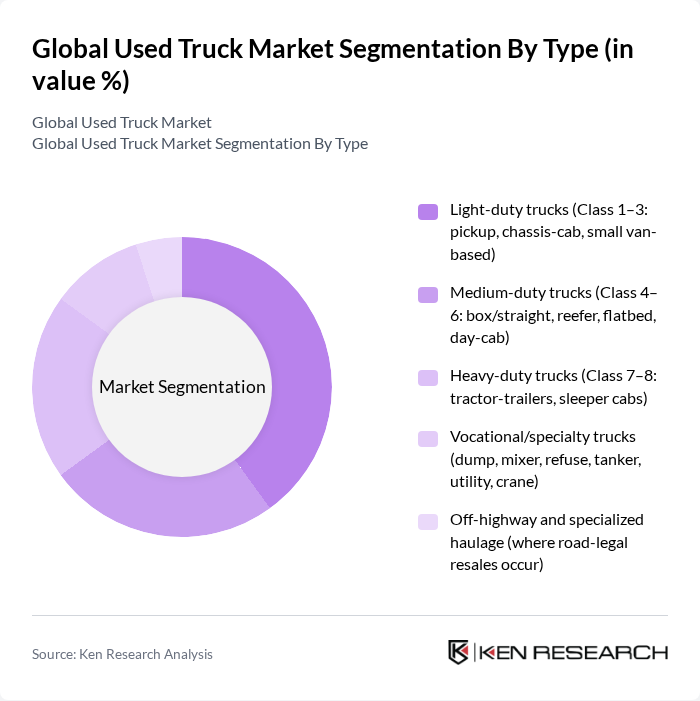
By Type:The used truck market is segmented into various types, including light-duty trucks, medium-duty trucks, heavy-duty trucks, vocational/specialty trucks, and off-highway and specialized haulage. Heavy-duty trucks account for a substantial share of used?truck revenues globally due to their higher unit values and sustained freight demand, while light?duty trucks lead volumes in urban logistics and last?mile applications; both categories are central to market liquidity across regions .
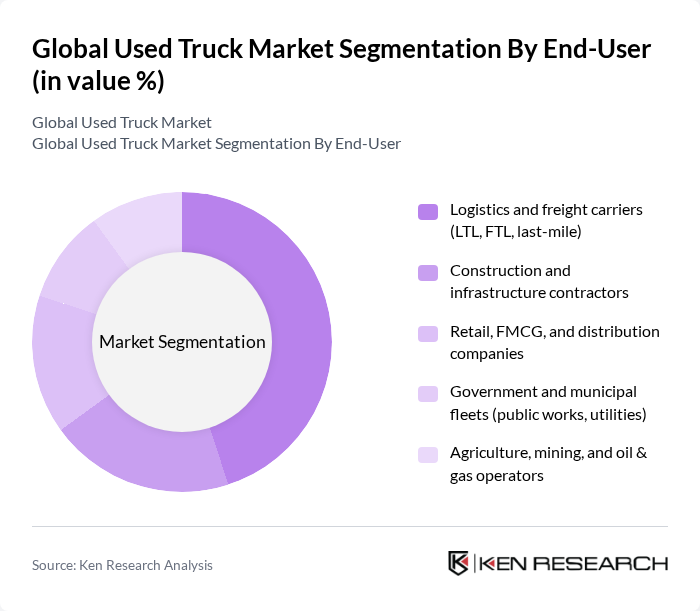
By End-User:The end-user segmentation includes logistics and freight carriers, construction and infrastructure contractors, retail and FMCG companies, government and municipal fleets, and agriculture, mining, and oil & gas operators. Logistics and freight carriers remain the most significant contributors to used?truck demand, underpinned by e?commerce growth, regional distribution build?outs, and fleet optimization cycles; construction and agriculture also support steady purchases of vocational and medium/heavy units .
Global Used Truck Market Competitive Landscape
The Global Used Truck Market is characterized by a dynamic mix of regional and international players. Leading participants such as Volvo Group (Volvo Used Trucks; Arrow Truck Sales), Daimler Truck AG (SelecTrucks; Mercedes?Benz Trucks Used), PACCAR Inc. (Kenworth Certified Pre?Owned; Peterbilt Red Oval), Navistar International Corporation (International Used Truck Centers), MAN Truck & Bus SE (MAN TopUsed), Scania AB (Scania Used Vehicles), Isuzu Motors Limited (Isuzu UTE/Isuzu Used Commercial Programs), Hino Motors, Ltd. (Hino CPO; Toyota Group), Tata Motors Limited (Tata Motors Assured Vehicles), Ford Motor Company (Ford Pro Commercial Vehicle Remarketing), Freightliner Trucks (Daimler Truck; SelecTrucks network), Kenworth Truck Company (PACCAR; CPO), Mack Trucks, Inc. (Mack Certified Used), International Trucks (Navistar; Used Truck Centers), Penske Used Trucks, Ryder Used Trucks, Enterprise Truck Sales, Ritchie Bros. (including IAA and IronPlanet), Manheim Auctions (Cox Automotive), AutoNation USA – Truck & Commercial (select markets), Trucks24/Truck24 (Europe digital marketplace), TruckScout24 (Europe), Mascus (Ritchie Bros. marketplace), Commercial Truck Trader (USA marketplace), OLX Autos (selected LATAM/Asia used commercial) contribute to innovation, geographic expansion, and service delivery in this space.
Global Used Truck Market Industry Analysis
Growth Drivers
- Increasing Demand for Cost-Effective Transportation Solutions:The global logistics industry is projected to reach $12 trillion in future, driving the demand for used trucks as businesses seek cost-effective transportation solutions. With the average cost of new trucks exceeding $100,000, many companies are turning to used trucks, which can be acquired for approximately $30,000 to $50,000. This trend is particularly evident in regions where operational costs are critical for maintaining competitive advantage.
- Rising Fuel Prices Driving the Need for Used Trucks:Fuel prices have surged, with the average diesel price reaching $4.00 per gallon in future, prompting fleet operators to seek more economical options. Used trucks, often more fuel-efficient than older models, are becoming increasingly attractive. The shift towards fuel-efficient used trucks is expected to enhance operational margins, as companies aim to mitigate rising transportation costs while maintaining service levels.
- Expansion of E-Commerce and Logistics Sectors:The e-commerce sector is anticipated to grow to $6.5 trillion in future, significantly impacting logistics and transportation needs. This growth is driving demand for used trucks, as businesses require flexible and scalable transportation solutions. The logistics sector's expansion is leading to increased utilization of used trucks, which offer a quicker return on investment compared to new vehicles, thereby supporting the overall market growth.
Market Challenges
- Stringent Emission Regulations:Governments worldwide are implementing stricter emission regulations, with many regions mandating compliance with Euro 6 standards in future. This poses a challenge for older used trucks, which may not meet these requirements. As a result, operators face potential fines and increased operational costs, leading to a decline in the attractiveness of certain used truck models that do not comply with these regulations.
- Fluctuating Resale Values:The resale value of used trucks can be highly volatile, influenced by market demand and economic conditions. In future, the average depreciation rate for used trucks is projected to be around 15% annually. This fluctuation can deter potential buyers, as uncertainty regarding future resale values complicates financial planning and investment decisions, impacting overall market stability.
Global Used Truck Market Future Outlook
The future of the used truck market appears promising, driven by technological advancements and evolving consumer preferences. As digital platforms for buying and selling used trucks gain traction, the market is expected to see increased transparency and efficiency. Additionally, the growing emphasis on sustainability will likely lead to a rise in demand for eco-friendly used trucks, including electric and hybrid models, further shaping the market landscape in the coming years.
Market Opportunities
- Growth in Online Used Truck Marketplaces:The rise of online platforms is revolutionizing the used truck market, with sales through digital channels projected to increase by 30% in future. This shift allows buyers to access a wider range of options and competitive pricing, enhancing market accessibility and efficiency, ultimately benefiting both buyers and sellers.
- Increasing Demand for Electric and Hybrid Used Trucks:As environmental concerns rise, the demand for electric and hybrid used trucks is expected to grow significantly, with sales projected to reach 200,000 units in future. This trend presents a lucrative opportunity for dealers and manufacturers to cater to eco-conscious consumers, aligning with global sustainability goals and enhancing market appeal.
Scope of the Report
| Segment | Sub-Segments |
|---|---|
| By Type | Light-duty trucks (Class 1–3: pickup, chassis-cab, small van-based) Medium-duty trucks (Class 4–6: box/straight, reefer, flatbed, day-cab) Heavy-duty trucks (Class 7–8: tractor-trailers, sleeper cabs) Vocational/specialty trucks (dump, mixer, refuse, tanker, utility, crane) Off-highway and specialized haulage (where road-legal resales occur) |
| By End-User | Logistics and freight carriers (LTL, FTL, last-mile) Construction and infrastructure contractors Retail, FMCG, and distribution companies Government and municipal fleets (public works, utilities) Agriculture, mining, and oil & gas operators |
| By Sales Channel | Direct fleet sales (fleet disposal/renewal) Online marketplaces and digital auction platforms Franchised OEM dealerships (manufacturer-approved used) Independent dealerships and physical auctions |
| By Condition | Certified pre-owned (multi-point inspected, warranty-backed) Non-certified used (as-is, dealer or private) |
| By Price Range | Below $20,000 $20,000 - $50,000 $50,000 - $100,000 Above $100,000 |
| By Fuel Type | Diesel Gasoline Battery-electric Hybrid and alternative fuels (CNG/LNG, hydrogen) |
| By Region | North America Europe Asia-Pacific Latin America Middle East & Africa |
Key Target Audience
Investors and Venture Capitalist Firms
Government and Regulatory Bodies (e.g., Department of Transportation, Environmental Protection Agency)
Manufacturers and Producers
Distributors and Retailers
Logistics and Transportation Companies
Fleet Management Companies
Insurance Companies
Financial Institutions
Players Mentioned in the Report:
Volvo Group (Volvo Used Trucks; Arrow Truck Sales)
Daimler Truck AG (SelecTrucks; MercedesBenz Trucks Used)
PACCAR Inc. (Kenworth Certified PreOwned; Peterbilt Red Oval)
Navistar International Corporation (International Used Truck Centers)
MAN Truck & Bus SE (MAN TopUsed)
Scania AB (Scania Used Vehicles)
Isuzu Motors Limited (Isuzu UTE/Isuzu Used Commercial Programs)
Hino Motors, Ltd. (Hino CPO; Toyota Group)
Tata Motors Limited (Tata Motors Assured Vehicles)
Ford Motor Company (Ford Pro Commercial Vehicle Remarketing)
Freightliner Trucks (Daimler Truck; SelecTrucks network)
Kenworth Truck Company (PACCAR; CPO)
Mack Trucks, Inc. (Mack Certified Used)
International Trucks (Navistar; Used Truck Centers)
Penske Used Trucks
Ryder Used Trucks
Enterprise Truck Sales
Ritchie Bros. (including IAA and IronPlanet)
Manheim Auctions (Cox Automotive)
AutoNation USA Truck & Commercial (select markets)
Trucks24/Truck24 (Europe digital marketplace)
TruckScout24 (Europe)
Mascus (Ritchie Bros. marketplace)
Commercial Truck Trader (USA marketplace)
OLX Autos (selected LATAM/Asia used commercial)
Table of Contents
Market Assessment Phase
1. Executive Summary and Approach
2. Global Used Truck Market Overview
2.1 Key Insights and Strategic Recommendations
2.2 Global Used Truck Market Overview
2.3 Definition and Scope
2.4 Evolution of Market Ecosystem
2.5 Timeline of Key Regulatory Milestones
2.6 Value Chain & Stakeholder Mapping
2.7 Business Cycle Analysis
2.8 Policy & Incentive Landscape
3. Global Used Truck Market Analysis
3.1 Growth Drivers
3.1.1 Increasing demand for cost-effective transportation solutions
3.1.2 Rising fuel prices driving the need for used trucks
3.1.3 Expansion of e-commerce and logistics sectors
3.1.4 Government incentives for fleet upgrades
3.2 Market Challenges
3.2.1 Stringent emission regulations
3.2.2 Fluctuating resale values
3.2.3 Limited financing options for buyers
3.2.4 Competition from new truck sales
3.3 Market Opportunities
3.3.1 Growth in online used truck marketplaces
3.3.2 Increasing demand for electric and hybrid used trucks
3.3.3 Expansion into emerging markets
3.3.4 Partnerships with logistics companies
3.4 Market Trends
3.4.1 Shift towards digital platforms for buying and selling
3.4.2 Increasing focus on sustainability and eco-friendly options
3.4.3 Rise in demand for certified pre-owned trucks
3.4.4 Enhanced technology integration in used trucks
3.5 Government Regulation
3.5.1 Emission standards for used trucks
3.5.2 Safety regulations for commercial vehicles
3.5.3 Tax incentives for purchasing used trucks
3.5.4 Import regulations affecting used truck sales
4. SWOT Analysis
5. Stakeholder Analysis
6. Porter's Five Forces Analysis
7. Global Used Truck Market Market Size, 2019-2024
7.1 By Value
7.2 By Volume
7.3 By Average Selling Price
8. Global Used Truck Market Segmentation
8.1 By Type
8.1.1 Light-duty trucks (Class 1–3: pickup, chassis-cab, small van-based)
8.1.2 Medium-duty trucks (Class 4–6: box/straight, reefer, flatbed, day-cab)
8.1.3 Heavy-duty trucks (Class 7–8: tractor-trailers, sleeper cabs)
8.1.4 Vocational/specialty trucks (dump, mixer, refuse, tanker, utility, crane)
8.1.5 Off-highway and specialized haulage (where road-legal resales occur)
8.2 By End-User
8.2.1 Logistics and freight carriers (LTL, FTL, last-mile)
8.2.2 Construction and infrastructure contractors
8.2.3 Retail, FMCG, and distribution companies
8.2.4 Government and municipal fleets (public works, utilities)
8.2.5 Agriculture, mining, and oil & gas operators
8.3 By Sales Channel
8.3.1 Direct fleet sales (fleet disposal/renewal)
8.3.2 Online marketplaces and digital auction platforms
8.3.3 Franchised OEM dealerships (manufacturer-approved used)
8.3.4 Independent dealerships and physical auctions
8.4 By Condition
8.4.1 Certified pre-owned (multi-point inspected, warranty-backed)
8.4.2 Non-certified used (as-is, dealer or private)
8.5 By Price Range
8.5.1 Below $20,000
8.5.2 $20,000 - $50,000
8.5.3 $50,000 - $100,000
8.5.4 Above $100,000
8.6 By Fuel Type
8.6.1 Diesel
8.6.2 Gasoline
8.6.3 Battery-electric
8.6.4 Hybrid and alternative fuels (CNG/LNG, hydrogen)
8.7 By Region
8.7.1 North America
8.7.2 Europe
8.7.3 Asia-Pacific
8.7.4 Latin America
8.7.5 Middle East & Africa
9. Global Used Truck Market Competitive Analysis
9.1 Market Share of Key Players
9.2 Cross Comparison of Key Players
9.2.1 Company Name (platform, dealer group, or OEM CPO program)
9.2.2 Group size (global, regional, or local footprint)
9.2.3 Used-vehicle sales volume (units/year)
9.2.4 Inventory size (active listings, average days in inventory)
9.2.5 Market coverage (countries/regions served, branch count)
9.2.6 Revenue from used trucks (USD, share of total)
9.2.7 Gross margin per used unit (%)
9.2.8 Inventory turnover (turns/year)
9.2.9 Average selling price (ASP) by class (MD/HD)
9.2.10 Financing penetration (% deals with financing/leasing)
9.2.11 Digital engagement (monthly traffic, lead-to-sale conversion)
9.2.12 Reconditioning cost per unit and time-to-ready
9.2.13 Return/claim rate and warranty attach rate (CPO)
9.2.14 Customer satisfaction/NPS and repeat purchase rate
9.2.15 Cross-border sales share and export compliance coverage
9.3 SWOT Analysis of Top Players
9.4 Pricing Analysis
9.5 Detailed Profile of Major Companies
9.5.1 Volvo Group (Volvo Used Trucks; Arrow Truck Sales)
9.5.2 Daimler Truck AG (SelecTrucks; Mercedes?Benz Trucks Used)
9.5.3 PACCAR Inc. (Kenworth Certified Pre?Owned; Peterbilt Red Oval)
9.5.4 Navistar International Corporation (International Used Truck Centers)
9.5.5 MAN Truck & Bus SE (MAN TopUsed)
9.5.6 Scania AB (Scania Used Vehicles)
9.5.7 Isuzu Motors Limited (Isuzu UTE/Isuzu Used Commercial Programs)
9.5.8 Hino Motors, Ltd. (Hino CPO; Toyota Group)
9.5.9 Tata Motors Limited (Tata Motors Assured Vehicles)
9.5.10 Ford Motor Company (Ford Pro Commercial Vehicle Remarketing)
9.5.11 Freightliner Trucks (Daimler Truck; SelecTrucks network)
9.5.12 Kenworth Truck Company (PACCAR; CPO)
9.5.13 Mack Trucks, Inc. (Mack Certified Used)
9.5.14 International Trucks (Navistar; Used Truck Centers)
9.5.15 Penske Used Trucks
9.5.16 Ryder Used Trucks
9.5.17 Enterprise Truck Sales
9.5.18 Ritchie Bros. (including IAA and IronPlanet)
9.5.19 Manheim Auctions (Cox Automotive)
9.5.20 AutoNation USA – Truck & Commercial (select markets)
9.5.21 Trucks24/Truck24 (Europe digital marketplace)
9.5.22 TruckScout24 (Europe)
9.5.23 Mascus (Ritchie Bros. marketplace)
9.5.24 Commercial Truck Trader (USA marketplace)
9.5.25 OLX Autos (selected LATAM/Asia used commercial)
10. Global Used Truck Market End-User Analysis
10.1 Procurement Behavior of Key Ministries
10.1.1 Government fleet procurement policies
10.1.2 Budget allocation for transportation
10.1.3 Preference for certified used trucks
10.1.4 Evaluation criteria for procurement
10.2 Corporate Spend on Infrastructure & Energy
10.2.1 Investment in logistics infrastructure
10.2.2 Budget for fleet upgrades
10.2.3 Spending on maintenance and repairs
10.3 Pain Point Analysis by End-User Category
10.3.1 Cost of ownership concerns
10.3.2 Availability of financing options
10.3.3 Reliability and maintenance issues
10.4 User Readiness for Adoption
10.4.1 Awareness of used truck benefits
10.4.2 Readiness to transition from new to used
10.4.3 Training needs for used truck operation
10.5 Post-Deployment ROI and Use Case Expansion
10.5.1 Evaluation of cost savings
10.5.2 Expansion of fleet capabilities
10.5.3 Long-term performance metrics
11. Global Used Truck Market Future Size, 2025-2030
11.1 By Value
11.2 By Volume
11.3 By Average Selling Price
Go-To-Market Strategy Phase
1. Whitespace Analysis + Business Model Canvas
1.1 Market gaps and opportunities
1.2 Business model components
2. Marketing and Positioning Recommendations
2.1 Branding strategies
2.2 Product USPs
3. Distribution Plan
3.1 Urban retail vs rural NGO tie-ups
4. Channel & Pricing Gaps
4.1 Underserved routes
4.2 Pricing bands
5. Unmet Demand & Latent Needs
5.1 Category gaps
5.2 Consumer segments
6. Customer Relationship
6.1 Loyalty programs
6.2 After-sales service
7. Value Proposition
7.1 Sustainability
7.2 Integrated supply chains
8. Key Activities
8.1 Regulatory compliance
8.2 Branding
8.3 Distribution setup
9. Entry Strategy Evaluation
9.1 Domestic Market Entry Strategy
9.1.1 Product mix
9.1.2 Pricing band
9.1.3 Packaging
9.2 Export Entry Strategy
9.2.1 Target countries
9.2.2 Compliance roadmap
10. Entry Mode Assessment
10.1 JV
10.2 Greenfield
10.3 M&A
10.4 Distributor Model
11. Capital and Timeline Estimation
11.1 Capital requirements
11.2 Timelines
12. Control vs Risk Trade-Off
12.1 Ownership vs Partnerships
13. Profitability Outlook
13.1 Breakeven analysis
13.2 Long-term sustainability
14. Potential Partner List
14.1 Distributors
14.2 JVs
14.3 Acquisition targets
15. Execution Roadmap
15.1 Phased Plan for Market Entry
15.1.1 Market Setup
15.1.2 Market Entry
15.1.3 Growth Acceleration
15.1.4 Scale & Stabilize
15.2 Key Activities and Milestones
15.2.1 Activity timelines
15.2.2 Milestone tracking
Research Methodology
Phase 1: Approach1
Desk Research
- Analysis of industry reports from automotive associations and market research firms
- Review of government publications on vehicle registrations and import/export statistics
- Examination of online marketplaces and auction platforms for used trucks
Primary Research
- Interviews with fleet managers and logistics companies regarding their used truck procurement strategies
- Surveys with dealerships and brokers specializing in used trucks to gather pricing and inventory data
- Field interviews with end-users such as construction and transportation companies to understand their needs
Validation & Triangulation
- Cross-validation of data from multiple sources including trade publications and expert insights
- Triangulation of market trends using historical sales data and current market dynamics
- Sanity checks through expert panel reviews to ensure data accuracy and relevance
Phase 2: Market Size Estimation1
Top-down Assessment
- Estimation of the total addressable market based on new truck sales and depreciation rates
- Segmentation of the market by truck type, age, and geographical region
- Incorporation of economic indicators such as GDP growth and infrastructure spending
Bottom-up Modeling
- Collection of sales data from major used truck dealerships and online platforms
- Estimation of average transaction values based on truck specifications and condition
- Volume estimates derived from historical sales trends and current inventory levels
Forecasting & Scenario Analysis
- Multi-factor regression analysis incorporating economic growth, fuel prices, and regulatory changes
- Scenario modeling based on potential shifts in consumer preferences and technological advancements
- Development of baseline, optimistic, and pessimistic forecasts through 2030
Phase 3: CATI Sample Composition1
| Scope Item/Segment | Sample Size | Target Respondent Profiles |
|---|---|---|
| Fleet Management Companies | 120 | Fleet Managers, Operations Directors |
| Used Truck Dealerships | 100 | Sales Managers, Inventory Specialists |
| Logistics and Transportation Firms | 110 | Logistics Coordinators, Procurement Managers |
| Construction Companies | 80 | Project Managers, Equipment Managers |
| Online Auction Platforms | 60 | Marketplace Managers, Customer Service Representatives |
Frequently Asked Questions
What is the current value of the global used truck market?
The global used truck market is valued at approximately USD 5055 billion, based on a five-year historical analysis and recent industry estimates. This valuation reflects actual transaction values in the secondary market, driven by demand for cost-effective transportation solutions.
What factors are driving the growth of the used truck market?
Which regions are leading in the used truck market?
What types of trucks are included in the used truck market?
Other Regional/Country Reports
Indonesia Used Truck Market
Malaysia Used Truck Market
APAC Used Truck Market
SEA Used Truck Market
Why Buy From Us?

What makes us stand out is that our consultants follow Robust, Refine and Result (RRR) methodology. Robust for clear definitions, approaches and sanity checking, Refine for differentiating respondents' facts and opinions, and Result for presenting data with story.

We have set a benchmark in the industry by offering our clients with syndicated and customized market research reports featuring coverage of entire market as well as meticulous research and analyst insights.

While we don't replace traditional research, we flip the method upside down. Our dual approach of Top Bottom & Bottom Top ensures quality deliverable by not just verifying company fundamentals but also looking at the sector and macroeconomic factors.

With one step in the future, our research team constantly tries to show you the bigger picture. We help with some of the tough questions you may encounter along the way: How is the industry positioned? Best marketing channel? KPI's of competitors? By aligning every element, we help maximize success.

Our report gives you instant access to the answers and sources that other companies might choose to hide. We elaborate each steps of research methodology we have used and showcase you the sample size to earn your trust.

If you need any support, we are here! We pride ourselves on universe strength, data quality, and quick, friendly, and professional service.