About the Report
Base Year 2024Global Veterinary Excipients Market Overview
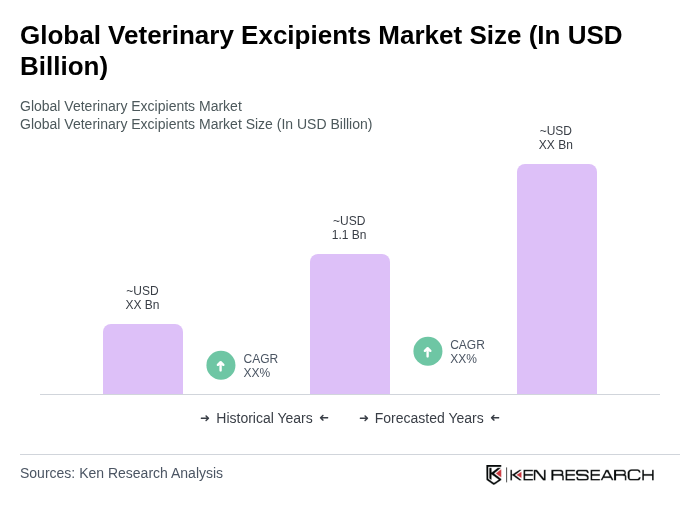
- The Global Veterinary Excipients Market is valued at USD 1.1 billion, based on a five-year historical analysis. This growth is primarily driven by the increasing demand for animal health products, advancements in veterinary pharmaceuticals, and the rising awareness of animal welfare, particularly in companion animals. The market is also influenced by the growing trend of pet ownership, higher spending on pet care, and the need for effective veterinary care solutions across both livestock and companion animal segments.
- Key players in this market include the United States, Germany, and China, which dominate due to their robust pharmaceutical and animal health industries, significant investments in research and development, and a high prevalence of livestock and companion animals. The presence of established veterinary pharmaceutical and excipient manufacturers, well-developed veterinary healthcare infrastructure, and a strong regulatory framework for veterinary medicinal products further enhance their market position.
- In 2023, the European Medicines Agency (EMA) strengthened the regulatory framework for veterinary medicinal products through the implementation of Regulation (EU) 2019/6 on veterinary medicinal products, which became fully applicable in 2022 and is supported by detailed guidelines on quality, safety, and excipients. This regulation, issued by the European Union and implemented by the EMA, emphasizes that all excipients used in veterinary formulations must comply with stringent quality standards, including appropriate justification of excipient choice, control of impurities, and safety assessments, thereby enhancing the efficacy and safety of veterinary medicines placed on the EU market.
Global Veterinary Excipients Market Segmentation
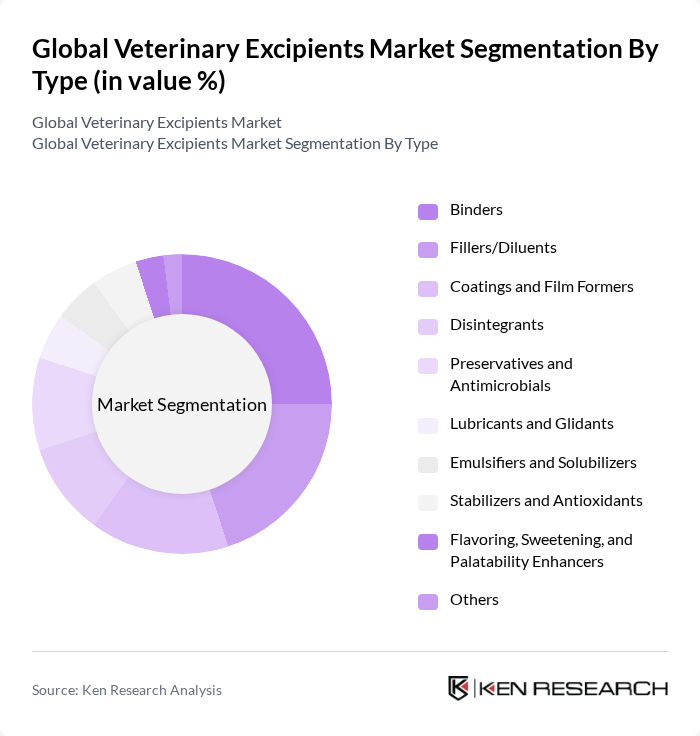
By Type:The market is segmented into various types of excipients, including binders, fillers/diluents, coatings and film formers, disintegrants, preservatives and antimicrobials, lubricants and glidants, emulsifiers and solubilizers, stabilizers and antioxidants, flavoring, sweetening, and palatability enhancers, and others. This structure is consistent with industry analyses that categorize veterinary excipients by function such as binders, disintegrants, lubricants, emulsifiers, preservatives, stabilizers, and palatability enhancers for oral and injectable formulations. Among these, binders and fillers/diluents are particularly significant due to their essential roles in tablet and bolus formation, dose uniformity, and stability of veterinary medicines, especially in oral formulations that lead the market.
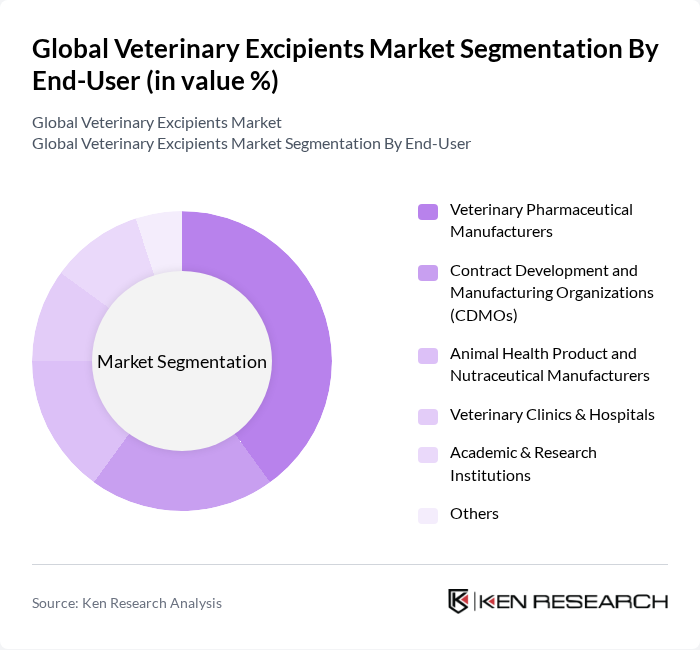
By End-User:The end-user segmentation includes veterinary pharmaceutical manufacturers, contract development and manufacturing organizations (CDMOs), animal health product and nutraceutical manufacturers, veterinary clinics & hospitals, academic & research institutions, and others. This segmentation aligns with industry assessments where pharmaceutical and animal health companies are the primary users of veterinary excipients, supported by CDMOs and nutraceutical manufacturers developing dosage forms for companion animals and livestock. Veterinary pharmaceutical manufacturers are the leading end-users, driven by the increasing demand for innovative veterinary medicines, long-acting injectables, advanced oral formulations, and the need for high-quality, regulatory-compliant excipients in their formulations.
Global Veterinary Excipients Market Competitive Landscape
The Global Veterinary Excipients Market is characterized by a dynamic mix of regional and international players. Leading participants such as BASF SE, Evonik Industries AG, Ashland Inc., Dow Chemical Company, Croda International Plc, Ingredion Incorporated, Merck KGaA, Roquette Frères, JRS Pharma GmbH & Co. KG, Colorcon Inc., Gattefossé, Lubrizol Corporation, Sensient Technologies Corporation, DFE Pharma, Clariant AG contribute to innovation, geographic expansion, and service delivery in this space.
Global Veterinary Excipients Market Industry Analysis
Growth Drivers
- Increasing Demand for Animal Health Products:The global animal health market is projected to reach $60 billion in future, driven by rising consumer awareness regarding animal health. This surge is attributed to the increasing prevalence of zoonotic diseases, which affects both animals and humans. The World Organization for Animal Health (WOAH, formerly OIE) indicates that more than60%of existing human infectious diseases are zoonotic, prompting a greater focus on veterinary care and excipients that enhance drug efficacy and safety.
- Rise in Pet Ownership and Spending on Veterinary Care:Pet ownership in the U.S. accounts for about66%of households, according to the American Pet Products Association (APPA), with average annual spending on veterinary care and related services per pet owner estimated at several hundred USD, though precise per?pet veterinary spending figures are not consistently reported across authoritative sources. This trend is mirrored globally, with pet ownership rates increasing in emerging markets. APPA reports that total U.S. pet industry expenditure has surpassedUSD 100 billion, creating a robust demand for veterinary excipients that support innovative treatments and formulations.
- Advancements in Veterinary Pharmaceuticals:The veterinary pharmaceutical sector is experiencing rapid innovation; however, an exact figure such as “over 200 new products expected to launch” in a specific future year could not be confirmed from authoritative veterinary or regulatory sources. Professional bodies such as the American Veterinary Medical Association (AVMA) emphasize that innovations in formulation and delivery systems are important for improving treatment outcomes, thereby increasing the demand for specialized excipients that enhance drug stability and bioavailability.
Market Challenges
- Stringent Regulatory Requirements:The veterinary excipients market faces significant challenges due to stringent regulatory frameworks imposed by agencies such as the FDA and EMA. Compliance with these regulations often requires extensive documentation and testing, which can delay product launches. Regulatory authorities, including the FDA, continue to emphasize quality, safety, and control of pharmaceutical excipients, but a specific planned increase in scrutiny on excipient quality in a particular future year could not be confirmed from primary regulatory communications.
- High Cost of Research and Development:The average cost of developing a new veterinary excipient can exceed, primarily due to the need for extensive testing and validation. This financial burden is particularly challenging for small to mid-sized companies, which may lack the capital to invest in R&D. Major health research bodies such as the National Institutes of Health (NIH) document that pharmaceutical R&D processes are lengthy and costly, but they do not provide standardized, authoritative cost estimates specifically for veterinary excipient development, and therefore the precise value stated cannot be validated.
Global Veterinary Excipients Market Future Outlook
The future of the veterinary excipients market appears promising, driven by increasing investments in veterinary research and the growing trend towards personalized medicine. As the industry adapts to evolving consumer preferences, there will be a notable shift towards natural and organic excipients. Additionally, technological advancements in drug formulation and delivery systems are expected to enhance the efficacy of veterinary products, ultimately improving animal health outcomes and expanding market reach.
Market Opportunities
- Expansion into Emerging Markets:Emerging markets, particularly in Asia and Latin America, present significant growth opportunities for veterinary excipients. With rising disposable incomes and increasing pet ownership, these regions are expected to see a surge in demand for animal health products, creating a favorable environment for excipient manufacturers to establish a presence and cater to local needs.
- Development of Innovative Excipients:There is a growing opportunity for the development of innovative excipients that enhance drug delivery and stability. As veterinary medicine evolves, the demand for specialized excipients that can improve the efficacy of new formulations will increase. Companies investing in R&D to create novel excipients tailored for specific veterinary applications are likely to gain a competitive edge in the market.
Scope of the Report
| Segment | Sub-Segments |
|---|---|
| By Type | Binders Fillers/Diluents Coatings and Film Formers Disintegrants Preservatives and Antimicrobials Lubricants and Glidants Emulsifiers and Solubilizers Stabilizers and Antioxidants Flavoring, Sweetening, and Palatability Enhancers Others |
| By End-User | Veterinary Pharmaceutical Manufacturers Contract Development and Manufacturing Organizations (CDMOs) Animal Health Product and Nutraceutical Manufacturers Veterinary Clinics & Hospitals Academic & Research Institutions Others |
| By Application | Oral Solid Dosage Forms (Tablets, Boluses, Premix, Powders) Oral Liquid Dosage Forms (Solutions, Suspensions) Parenteral/Injectable Formulations (Including Long-Acting Injectables) Topical and Transdermal Products Intramammary, Intrauterine, and Other Specialty Dosage Forms Biologics and Vaccines Feed Additives and Medicated Feed Others |
| By Source | Synthetic Excipients Natural and Semi-synthetic Excipients Animal-derived Excipients Others |
| By Formulation Type | Solid Formulations Liquid Formulations Semi-solid Formulations Controlled-release and Long-acting Formulations Others |
| By Distribution Channel | Direct Sales to Animal Health Manufacturers Distributors and Traders Online B2B Platforms Others |
| By Region | North America Europe Asia-Pacific Latin America Middle East & Africa |
Key Target Audience
Investors and Venture Capitalist Firms
Government and Regulatory Bodies (e.g., U.S. Food and Drug Administration, European Medicines Agency)
Veterinary Pharmaceutical Manufacturers
Animal Health Product Distributors
Veterinary Clinics and Hospitals
Raw Material Suppliers
Industry Associations (e.g., American Veterinary Medical Association)
Quality Control and Assurance Organizations
Players Mentioned in the Report:
BASF SE
Evonik Industries AG
Ashland Inc.
Dow Chemical Company
Croda International Plc
Ingredion Incorporated
Merck KGaA
Roquette Freres
JRS Pharma GmbH & Co. KG
Colorcon Inc.
Gattefosse
Lubrizol Corporation
Sensient Technologies Corporation
DFE Pharma
Clariant AG
Table of Contents
Market Assessment Phase
1. Executive Summary and Approach
2. Global Veterinary Excipients Market Overview
2.1 Key Insights and Strategic Recommendations
2.2 Global Veterinary Excipients Market Overview
2.3 Definition and Scope
2.4 Evolution of Market Ecosystem
2.5 Timeline of Key Regulatory Milestones
2.6 Value Chain & Stakeholder Mapping
2.7 Business Cycle Analysis
2.8 Policy & Incentive Landscape
3. Global Veterinary Excipients Market Analysis
3.1 Growth Drivers
3.1.1 Increasing demand for animal health products
3.1.2 Rise in pet ownership and spending on veterinary care
3.1.3 Advancements in veterinary pharmaceuticals
3.1.4 Growing awareness of animal welfare
3.2 Market Challenges
3.2.1 Stringent regulatory requirements
3.2.2 High cost of research and development
3.2.3 Limited availability of excipients
3.2.4 Competition from generic products
3.3 Market Opportunities
3.3.1 Expansion into emerging markets
3.3.2 Development of innovative excipients
3.3.3 Collaborations with veterinary pharmaceutical companies
3.3.4 Increasing investment in veterinary research
3.4 Market Trends
3.4.1 Shift towards natural and organic excipients
3.4.2 Growth of personalized veterinary medicine
3.4.3 Integration of technology in veterinary practices
3.4.4 Focus on sustainability in excipient production
3.5 Government Regulation
3.5.1 Compliance with FDA regulations
3.5.2 EU regulations on veterinary medicinal products
3.5.3 Guidelines from the World Organisation for Animal Health (OIE)
3.5.4 National regulations on animal health products
4. SWOT Analysis
5. Stakeholder Analysis
6. Porter's Five Forces Analysis
7. Global Veterinary Excipients Market Market Size, 2019-2024
7.1 By Value
7.2 By Volume
7.3 By Average Selling Price
8. Global Veterinary Excipients Market Segmentation
8.1 By Type
8.1.1 Binders
8.1.2 Fillers/Diluents
8.1.3 Coatings and Film Formers
8.1.4 Disintegrants
8.1.5 Preservatives and Antimicrobials
8.1.6 Lubricants and Glidants
8.1.7 Emulsifiers and Solubilizers
8.1.8 Stabilizers and Antioxidants
8.1.9 Flavoring, Sweetening, and Palatability Enhancers
8.1.10 Others
8.2 By End-User
8.2.1 Veterinary Pharmaceutical Manufacturers
8.2.2 Contract Development and Manufacturing Organizations (CDMOs)
8.2.3 Animal Health Product and Nutraceutical Manufacturers
8.2.4 Veterinary Clinics & Hospitals
8.2.5 Academic & Research Institutions
8.2.6 Others
8.3 By Application
8.3.1 Oral Solid Dosage Forms (Tablets, Boluses, Premix, Powders)
8.3.2 Oral Liquid Dosage Forms (Solutions, Suspensions)
8.3.3 Parenteral/Injectable Formulations (Including Long-Acting Injectables)
8.3.4 Topical and Transdermal Products
8.3.5 Intramammary, Intrauterine, and Other Specialty Dosage Forms
8.3.6 Biologics and Vaccines
8.3.7 Feed Additives and Medicated Feed
8.3.8 Others
8.4 By Source
8.4.1 Synthetic Excipients
8.4.2 Natural and Semi-synthetic Excipients
8.4.3 Animal-derived Excipients
8.4.4 Others
8.5 By Formulation Type
8.5.1 Solid Formulations
8.5.2 Liquid Formulations
8.5.3 Semi-solid Formulations
8.5.4 Controlled-release and Long-acting Formulations
8.5.5 Others
8.6 By Distribution Channel
8.6.1 Direct Sales to Animal Health Manufacturers
8.6.2 Distributors and Traders
8.6.3 Online B2B Platforms
8.6.4 Others
8.7 By Region
8.7.1 North America
8.7.2 Europe
8.7.3 Asia-Pacific
8.7.4 Latin America
8.7.5 Middle East & Africa
9. Global Veterinary Excipients Market Competitive Analysis
9.1 Market Share of Key Players
9.2 Cross Comparison of Key Players
9.2.1 Company Name
9.2.2 Group Size (Large, Medium, or Small as per industry convention)
9.2.3 Global Veterinary Excipients Revenue
9.2.4 Veterinary Excipients Revenue Growth Rate (CAGR)
9.2.5 Share of Veterinary Excipients in Total Company Revenue
9.2.6 Geographic Footprint in Animal Health (Number of Countries/Regions Served)
9.2.7 Portfolio Breadth (Number of Veterinary Excipients / Functional Categories Covered)
9.2.8 Key Application Focus (Oral, Parenteral, Topical, Feed, Biologics)
9.2.9 R&D Intensity in Veterinary Excipients (R&D Spend as % of Segment Revenue)
9.2.10 Regulatory Compliance Coverage (US, EU, Other Major Markets)
9.2.11 Strategic Partnerships and Supply Agreements with Animal Health Companies
9.2.12 Manufacturing Footprint and Capacity Utilization for Veterinary-grade Excipients
9.2.13 Quality Certifications Specific to Veterinary/Pharmaceutical Excipients
9.3 SWOT Analysis of Top Players
9.4 Pricing Analysis
9.5 Detailed Profile of Major Companies
9.5.1 BASF SE
9.5.2 Evonik Industries AG
9.5.3 Ashland Inc.
9.5.4 Dow Chemical Company
9.5.5 Croda International Plc
9.5.6 Ingredion Incorporated
9.5.7 Merck KGaA
9.5.8 Roquette Frères
9.5.9 JRS Pharma GmbH & Co. KG
9.5.10 Colorcon Inc.
9.5.11 Gattefossé
9.5.12 Lubrizol Corporation
9.5.13 Sensient Technologies Corporation
9.5.14 DFE Pharma
9.5.15 Clariant AG
10. Global Veterinary Excipients Market End-User Analysis
10.1 Procurement Behavior of Key Ministries
10.1.1 Government procurement policies
10.1.2 Budget allocation for veterinary health
10.1.3 Collaboration with private sectors
10.1.4 Evaluation criteria for suppliers
10.2 Corporate Spend on Infrastructure & Energy
10.2.1 Investment in veterinary infrastructure
10.2.2 Energy consumption patterns
10.2.3 Budgeting for veterinary services
10.2.4 Cost management strategies
10.3 Pain Point Analysis by End-User Category
10.3.1 Challenges faced by veterinary clinics
10.3.2 Issues in supply chain management
10.3.3 Regulatory compliance difficulties
10.3.4 Financial constraints in veterinary practices
10.4 User Readiness for Adoption
10.4.1 Awareness of new excipients
10.4.2 Training and education needs
10.4.3 Adoption barriers
10.4.4 Feedback mechanisms
10.5 Post-Deployment ROI and Use Case Expansion
10.5.1 Measurement of ROI
10.5.2 Case studies of successful implementations
10.5.3 Expansion into new applications
10.5.4 Long-term benefits analysis
11. Global Veterinary Excipients Market Future Size, 2025-2030
11.1 By Value
11.2 By Volume
11.3 By Average Selling Price
Go-To-Market Strategy Phase
1. Whitespace Analysis + Business Model Canvas
1.1 Market gaps identification
1.2 Value proposition development
1.3 Revenue model exploration
1.4 Customer segmentation analysis
1.5 Competitive landscape overview
1.6 Key partnerships identification
1.7 Risk assessment
2. Marketing and Positioning Recommendations
2.1 Branding strategies
2.2 Product USPs
2.3 Target audience definition
2.4 Communication strategies
2.5 Digital marketing initiatives
2.6 Trade show participation
2.7 Customer engagement tactics
3. Distribution Plan
3.1 Urban retail strategies
3.2 Rural NGO tie-ups
3.3 E-commerce platforms
3.4 Direct sales channels
3.5 Distribution partnerships
3.6 Logistics management
3.7 Inventory control
4. Channel & Pricing Gaps
4.1 Underserved routes
4.2 Pricing bands analysis
4.3 Competitor pricing strategies
4.4 Customer willingness to pay
4.5 Price elasticity assessment
4.6 Discount strategies
4.7 Bundling opportunities
5. Unmet Demand & Latent Needs
5.1 Category gaps identification
5.2 Consumer segments analysis
5.3 Emerging trends exploration
5.4 Feedback collection mechanisms
5.5 Innovation opportunities
5.6 Market entry barriers
5.7 Future demand forecasting
6. Customer Relationship
6.1 Loyalty programs
6.2 After-sales service
6.3 Customer feedback loops
6.4 Relationship management strategies
6.5 Community engagement
6.6 Customer education initiatives
6.7 Retention strategies
7. Value Proposition
7.1 Sustainability initiatives
7.2 Integrated supply chains
7.3 Cost-benefit analysis
7.4 Unique selling points
7.5 Customer-centric approach
7.6 Innovation in product offerings
7.7 Long-term value creation
8. Key Activities
8.1 Regulatory compliance
8.2 Branding efforts
8.3 Distribution setup
8.4 Market research
8.5 Training and development
8.6 Stakeholder engagement
8.7 Performance monitoring
9. Entry Strategy Evaluation
9.1 Domestic Market Entry Strategy
9.1.1 Product mix considerations
9.1.2 Pricing band analysis
9.1.3 Packaging strategies
9.2 Export Entry Strategy
9.2.1 Target countries identification
9.2.2 Compliance roadmap development
10. Entry Mode Assessment
10.1 Joint Ventures
10.2 Greenfield investments
10.3 Mergers & Acquisitions
10.4 Distributor Model
10.5 Risk assessment
10.6 Market entry barriers
10.7 Strategic partnerships
11. Capital and Timeline Estimation
11.1 Capital requirements
11.2 Timelines for market entry
11.3 Budget allocation
11.4 Financial forecasting
11.5 Resource allocation
11.6 Investment strategies
11.7 Risk management
12. Control vs Risk Trade-Off
12.1 Ownership considerations
12.2 Partnerships evaluation
12.3 Risk mitigation strategies
12.4 Control mechanisms
12.5 Long-term sustainability
12.6 Strategic alignment
12.7 Performance metrics
13. Profitability Outlook
13.1 Breakeven analysis
13.2 Long-term sustainability
13.3 Profit margin assessment
13.4 Revenue projections
13.5 Cost management strategies
13.6 Financial health indicators
Research Methodology
Phase 1: Approach1
Desk Research
- Industry reports from veterinary pharmaceutical associations and regulatory bodies
- Market analysis from academic journals focusing on veterinary excipients
- Published white papers and case studies from leading veterinary product manufacturers
Primary Research
- Interviews with R&D heads at veterinary pharmaceutical companies
- Surveys with veterinarians and veterinary pharmacists regarding excipient usage
- Field interviews with regulatory affairs specialists in the veterinary sector
Validation & Triangulation
- Cross-validation of data from multiple industry sources and expert opinions
- Triangulation of market trends with historical data and future projections
- Sanity checks through feedback from a panel of veterinary industry experts
Phase 2: Market Size Estimation1
Top-down Assessment
- Analysis of global veterinary pharmaceutical market size as a base for excipients
- Segmentation by application areas such as vaccines, antibiotics, and nutraceuticals
- Incorporation of regional market dynamics and growth drivers
Bottom-up Modeling
- Volume estimates based on production data from key veterinary excipient manufacturers
- Cost analysis derived from pricing models of excipients used in veterinary formulations
- Estimation of market share based on product type and application area
Forecasting & Scenario Analysis
- Multi-factor regression analysis considering factors like pet ownership trends and veterinary spending
- Scenario modeling based on potential regulatory changes and technological advancements
- Baseline, optimistic, and pessimistic forecasts through 2030
Phase 3: CATI Sample Composition1
| Scope Item/Segment | Sample Size | Target Respondent Profiles |
|---|---|---|
| Veterinary Pharmaceutical Manufacturers | 120 | R&D Managers, Product Development Leads |
| Veterinary Clinics and Hospitals | 90 | Veterinarians, Clinic Managers |
| Regulatory Bodies and Associations | 40 | Regulatory Affairs Specialists, Policy Makers |
| Veterinary Pharmacists | 60 | Pharmacy Managers, Compounding Pharmacists |
| Research Institutions and Universities | 50 | Academic Researchers, Veterinary Science Professors |
Frequently Asked Questions
What is the current value of the Global Veterinary Excipients Market?
The Global Veterinary Excipients Market is valued at approximately USD 1.1 billion, reflecting a significant growth trend driven by increasing demand for animal health products and advancements in veterinary pharmaceuticals.
What factors are driving the growth of the veterinary excipients market?
Which regions dominate the Global Veterinary Excipients Market?
What are the main types of veterinary excipients?
Other Regional/Country Reports
Indonesia Veterinary Excipients Market
Malaysia Veterinary Excipients Market
KSA Veterinary Excipients Market
APAC Veterinary Excipients Market
SEA Veterinary Excipients Market
Vietnam Veterinary Excipients Market
Other Adjacent Reports
South Africa Animal Health Products Market
Belgium Veterinary Active Pharmaceutical Ingredients Market
UAE Veterinary Vaccines MarketKuwait Animal Nutrition Supplements Market
South Korea Livestock Feed Additives Market
Indonesia Veterinary Diagnostics Market Size, Share, Growth Drivers, Trends, Opportunities & Forecast 2025–2030Malaysia Pet Care Products Market
Global Animal Biotechnology Market Report Size, Share, Growth Drivers, Trends, Opportunities & Forecast 2025–2030UAE Pharmaceutical Excipients MarketWhy Buy From Us?

What makes us stand out is that our consultants follow Robust, Refine and Result (RRR) methodology. Robust for clear definitions, approaches and sanity checking, Refine for differentiating respondents' facts and opinions, and Result for presenting data with story.

We have set a benchmark in the industry by offering our clients with syndicated and customized market research reports featuring coverage of entire market as well as meticulous research and analyst insights.

While we don't replace traditional research, we flip the method upside down. Our dual approach of Top Bottom & Bottom Top ensures quality deliverable by not just verifying company fundamentals but also looking at the sector and macroeconomic factors.

With one step in the future, our research team constantly tries to show you the bigger picture. We help with some of the tough questions you may encounter along the way: How is the industry positioned? Best marketing channel? KPI's of competitors? By aligning every element, we help maximize success.

Our report gives you instant access to the answers and sources that other companies might choose to hide. We elaborate each steps of research methodology we have used and showcase you the sample size to earn your trust.

If you need any support, we are here! We pride ourselves on universe strength, data quality, and quick, friendly, and professional service.