Region:Global
Author(s):Dev
Product Code:KRAD0414
Pages:97
Published On:August 2025
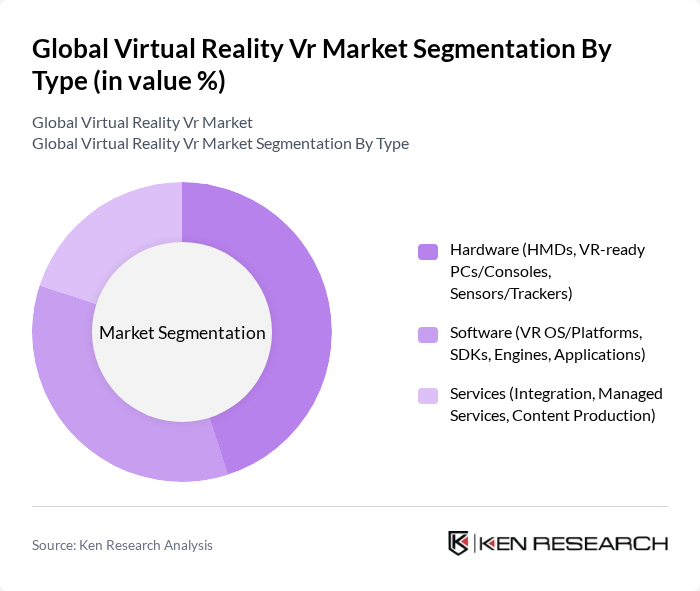
By Type:The market is segmented into three main types: Hardware, Software, and Services. Each of these segments plays a crucial role in the overall growth of the VR market. Hardware includes devices such as head-mounted displays (HMDs), VR-ready PCs, and sensors. Software encompasses VR operating systems, platforms, engines, SDKs, and applications, while services include systems integration, deployment, training, support, and content production for enterprise programs .
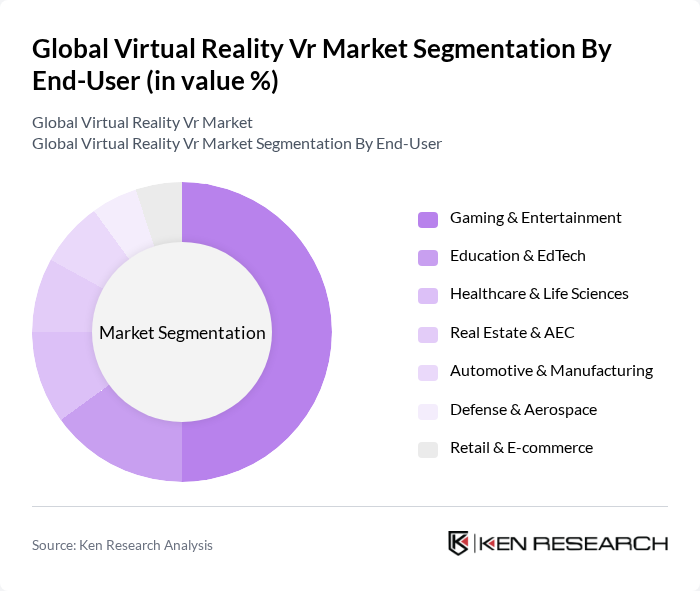
By End-User:The end-user segmentation includes various industries such as Gaming & Entertainment, Education & EdTech, Healthcare & Life Sciences, Real Estate & AEC, Automotive & Manufacturing, Defense & Aerospace, and Retail & E-commerce. Each sector utilizes VR technology to enhance user experience and operational efficiency. Gaming continues to dominate consumer spend, while enterprise use is expanding in training, simulation, design review, and remote collaboration across automotive, aerospace/defense, healthcare, and AEC .
The Global Virtual Reality Vr Market is characterized by a dynamic mix of regional and international players. Leading participants such as Meta Platforms, Inc. (Quest/Oculus), HTC Corporation (Vive), Sony Interactive Entertainment (PlayStation VR), Valve Corporation (Index), Samsung Electronics Co., Ltd., Microsoft Corporation (HoloLens, Mixed Reality), Unity Technologies, NVIDIA Corporation, Pimax Technology Co., Ltd., Varjo Technologies Oy, ByteDance Ltd. (PICO), Tencent Holdings Ltd. (XR initiatives), Qualcomm Technologies, Inc. (XR platforms), DPVR (Deepoon VR), Lynx SAS contribute to innovation, geographic expansion, and service delivery in this space .
The future of the VR market appears promising, driven by continuous technological advancements and increasing integration across various sectors. As companies invest in VR for training and remote collaboration, the demand for high-quality content will rise. Additionally, the expansion of VR in e-commerce and social platforms is expected to create new revenue streams. With ongoing innovations and a growing user base, the VR market is poised for significant growth, enhancing user experiences and broadening its applications in everyday life.
| Segment | Sub-Segments |
|---|---|
| By Type | Hardware (HMDs, VR-ready PCs/Consoles, Sensors/Trackers) Software (VR OS/Platforms, SDKs, Engines, Applications) Services (Integration, Managed Services, Content Production) |
| By End-User | Gaming & Entertainment Education & EdTech Healthcare & Life Sciences Real Estate & AEC (Architecture, Engineering, Construction) Automotive & Manufacturing Defense & Aerospace Retail & E-commerce |
| By Application | Training & Simulation Gaming & Location-based Entertainment Design, Prototyping & Visualization Virtual Collaboration & Remote Assistance Marketing & Advertising Experiences Therapeutic & Rehabilitation |
| By Distribution Channel | Online Retail & First-party Stores Offline Retail & Specialty Channels Enterprise/Direct Sales |
| By Region | North America Europe Asia-Pacific Latin America Middle East & Africa |
| By Price Range | Budget (Sub-$300) Mid-Range ($300–$700) Premium ($700+) |
| By Others | Immersion Level (Non-immersive, Semi-immersive, Fully Immersive) Form Factor (Standalone, Tethered, Smartphone-based) Enterprise Size (SMEs, Large Enterprises) |
| Scope Item/Segment | Sample Size | Target Respondent Profiles |
|---|---|---|
| Gaming Industry VR Adoption | 120 | Game Developers, Marketing Managers |
| Healthcare VR Applications | 100 | Healthcare Professionals, Medical Technology Innovators |
| Education Sector VR Integration | 80 | Educators, Curriculum Developers |
| Corporate Training VR Solutions | 70 | HR Managers, Training Coordinators |
| VR Content Creation and Development | 90 | Content Creators, Software Engineers |
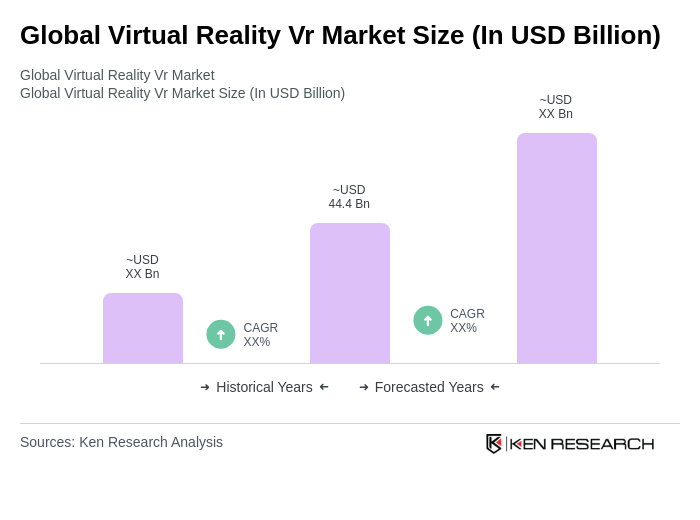
The Global Virtual Reality market is valued at approximately USD 44.4 billion, driven by advancements in hardware and software, a broader content ecosystem, and increased adoption across various sectors, including consumer and enterprise applications.

What makes us stand out is that our consultants follow Robust, Refine and Result (RRR) methodology. Robust for clear definitions, approaches and sanity checking, Refine for differentiating respondents' facts and opinions, and Result for presenting data with story.

We have set a benchmark in the industry by offering our clients with syndicated and customized market research reports featuring coverage of entire market as well as meticulous research and analyst insights.

While we don't replace traditional research, we flip the method upside down. Our dual approach of Top Bottom & Bottom Top ensures quality deliverable by not just verifying company fundamentals but also looking at the sector and macroeconomic factors.

With one step in the future, our research team constantly tries to show you the bigger picture. We help with some of the tough questions you may encounter along the way: How is the industry positioned? Best marketing channel? KPI's of competitors? By aligning every element, we help maximize success.

Our report gives you instant access to the answers and sources that other companies might choose to hide. We elaborate each steps of research methodology we have used and showcase you the sample size to earn your trust.

If you need any support, we are here! We pride ourselves on universe strength, data quality, and quick, friendly, and professional service.













